Check Point Certified Security Administrator (CCSA R80) Free Sample Questions

20 free sample questions554 in the full practice test Other versions: 156-215.82(381),156-215.81(210),156-215.81.20(231)

Try simulator

156-215.80 Sample Questions

  1. Question 1

    Which of the following is NOT an integral part of VPN communication within a network?

    Answer and explanation

    Correct answer: A

    VPN key is not an integral part of VPN communication within a Check Point R80 environment. The three essential components for VPN communication are VPN communities (which define groups of participating gateways), VPN trust entities (the security gateways and management server that participate in the VPN), and VPN domains (networks that can be accessed through each gateway). While encryption keys are used in the cryptographic process, the term "VPN key" is not a standard Check Point component. In R80 SmartConsole, administrators configure VPN communities to establish mesh or star topologies, define encryption domains through VPN trust entities, and specify accessible networks via VPN domains.
  2. Question 2

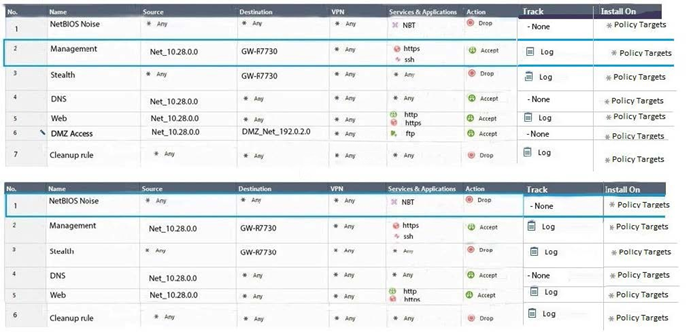
    Two administrators Dave and Jon both manage R80 Management as administrators for ABC Corp. Jon logged into the R80 Management and then shortly after Dave logged in to the same server. They are both in the Security Policies view. From the screenshots below, why does Dave not have the rule no.6 in his SmartConsole view even though Jon has it his in his SmartConsole view?

    Question 2 image
    Answer and explanation

    Correct answer: D

    Explanation:

    When an administrator logs in to the Security Management Server through SmartConsole, a new editing session starts. The changes that the administrator makes during the session are only available to that administrator. Other administrators see a lock icon on object and rules that are being edited. To make changes available to all administrators, and to unlock the objects and rules that are being edited, the administrator must publish the session.

    Reference: https://sc1.checkpoint.com/documents/R80.10/WebAdminGuides/EN/CP_R80.10_SecurityManagement_AdminGuide/html_frameset.htm?topic=documents/R80.10/WebAdminGuides/EN/CP_R80.10_SecurityManagement_AdminGuide/162331

  3. Question 3

    Vanessa is firewall administrator in her company; her company is using Check Point firewalls on central and remote locations, which are managed centrally by R80 Security Management Server. One central location has an installed R77.30 Gateway on Open server. Remote location is using Check Point UTM-1 570 series appliance with R71. Which encryption is used in Secure Internal Communication (SIC) between central management and firewall on each location?

    Answer and explanation

    Correct answer: A

    Explanation:

    Gateways above R71 use AES128 for SIC. If one of the gateways is R71 or below, the gateways use 3DES.

    Reference:

    http://dl3.checkpoint.com/paid/74/74d596decb6071a4ee642fbdaae7238f/CP_R80_SecurityManagement_AdminGuide.pdf?HashKey=1479584563_6f823c8ea1514609148aa4fec5425db2&xtn=.pdf

  4. Question 4

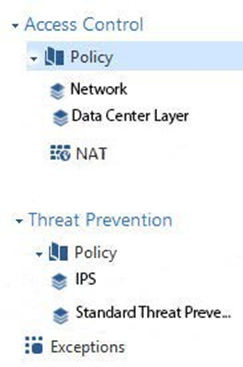
    Review the following screenshot and select the BEST answer.

    Question 4 image
    Answer and explanation

    Correct answer: C

    Based on the R80 SmartConsole screenshot showing policy layers, if a connection is dropped in the Network Layer, it will not be matched against subsequent layers like the Data Center Layer. In Check Point R80's layered policy architecture, policy layers are processed sequentially in order. When a connection is explicitly dropped (denied) by a rule in an earlier layer, the connection terminates and no further layer processing occurs. This is fundamental to R80's ordered layer processing where Accept actions allow continuation to the next layer, while Drop actions immediately terminate processing. The screenshot demonstrates the typical inline layer structure where Network Layer rules are evaluated before Data Center Layer rules.

  5. Question 5

    Which of the following is NOT a SecureXL traffic flow?

    Answer and explanation

    Correct answer: C

    High Priority Path is not a valid SecureXL traffic flow in Check Point R80. SecureXL uses three defined traffic flows: Fast Path (for connections that can be accelerated with minimal security processing), Accelerated Path (for connections requiring some security inspection but still benefiting from acceleration), and Slow Path (for connections requiring full security inspection that cannot be accelerated). The Fast Path provides the highest performance for established connections, while the Slow Path handles complex traffic requiring detailed inspection. Medium Path is also not a standard SecureXL flow - the correct flows are specifically Fast Path, Accelerated Path, and Slow Path as implemented in R80's SecureXL acceleration engine.

  6. Question 6

    Multiple answers

    Which of the following Automatically Generated Rules NAT rules have the lowest implementation priority?

    Answer and explanation

    Correct answers: B, C

    Address Range Hide NAT rules have the lowest implementation priority among Check Point automatic NAT rules. In R80 SmartConsole NAT policy, the automatic NAT rules are processed in a specific priority order: Machine Static NAT (highest priority), then Machine Hide NAT, followed by Network Hide NAT, and finally Address Range Hide NAT (lowest priority). This priority order ensures that more specific rules are matched before broader ones. Address Range Hide NAT applies to ranges of IP addresses and has the broadest scope, which is why it receives the lowest priority to avoid conflicts with more specific NAT configurations.

    Network Hide NAT rules have among the lowest implementation priorities in Check Point automatic NAT rule processing. In R80's NAT policy hierarchy, automatic rules are ordered by specificity: Machine Static NAT has the highest priority, followed by Machine Hide NAT, then Network Hide NAT, and finally Address Range Hide NAT at the lowest priority. Network Hide NAT applies to entire network objects and has broader scope than machine-specific rules but more specific scope than address range rules. This priority system in R80 ensures that specific host rules take precedence over network-wide rules, maintaining predictable NAT behavior and avoiding rule conflicts.

  7. Question 7

    VPN gateways authenticate using and _______

    Answer and explanation

    Correct answer: B

    VPN gateways authenticate using certificates and pre-shared secrets in Check Point R80 environments. These are the two primary authentication methods supported by Check Point VPN infrastructure. Certificate-based authentication provides stronger security through PKI (Public Key Infrastructure) and is preferred for site-to-site VPNs, while pre-shared secrets offer simpler configuration for smaller deployments. In R80 SmartConsole, administrators configure these authentication methods in the VPN communities and gateway objects. Passwords and tokens are used for user authentication in remote access VPNs, not for gateway-to-gateway authentication between Check Point security gateways.

  8. Question 8

    In R80 spoofing is defined as a method of:

    Answer and explanation

    Correct answer: D

    Explanation:

    IP spoofing replaces the untrusted source IP address with a fake, trusted one, to hijack connections to your network. Attackers use IP spoofing to send malware and bots to your protected network, to execute DoS attacks, or to gain unauthorized access.

    Reference:

    http://dl3.checkpoint.com/paid/74/74d596decb6071a4ee642fbdaae7238f/CP_R80_SecurityManagement_AdminGuide.pdf?HashKey=1479584563_6f823c8ea1514609148aa4fec5425db2&xtn=.pdf

  9. Question 10

    Which Check Point feature enables application scanning and the detection?

    Answer and explanation

    Correct answer: B

    Explanation:

    AppWiki Application Classification Library

    AppWiki enables application scanning and detection of more than 5,000 distinct applications and over 300,000 Web 2.0 widgets including instant messaging, social networking, video streaming, VoIP, games and more.

    Reference: https://www.checkpoint.com/products/application-control-software-blade/

Register free to unlock 10 more sample questions

Lifetime One

Own this practice test forever.

$79.99
$75.99
one-time
  • Full access to 1,376 questions
  • Study, Timed & Flashcard Modes
  • All past and future versions i
  • Detailed Explanations
  • Study Tracking & Past Attempts
  • Brainy AI Assistant
  • Lifetime updates

Two

Any 2 exams per month.

$20.00/exam
$39.99
/month
  • 2 active exam slots
  • Study, Timed & Flashcard Modes
  • All past and future versions i
  • Detailed Explanations
  • Study Tracking & Past Attempts
  • 1,000 Brainy AI Credits
  • Cancel anytime

Premium Twelve

Any 12 exams over 3 months.

$15.00/exam
$179.99
/3 months
  • 4 active exam slots
  • Study, Timed & Flashcard Modes
  • All past and future versions i
  • Detailed Explanations
  • Study Tracking & Past Attempts
  • 15,000 Brainy AI Credits
  • Dedicated support
  • Friend seat included — full access

Trusted by professionals at

NvidiaSupabaseGitHubOpenAITursoClerkClaude AIAmazon