

Oracle Database Administration II Free Sample Questions

Description

Covers creating and managing container and pluggable databases, RMAN backup and recovery strategies, installing and patching Grid Infrastructure and Oracle Database, and tuning performance.

20 free sample questions343 in the full practice test

Try simulator

1z0-083 Sample Questions

  1. Question 1

    Multiple answers

    Recovery and Flashback · Restore and Recovering Databases with RMAN

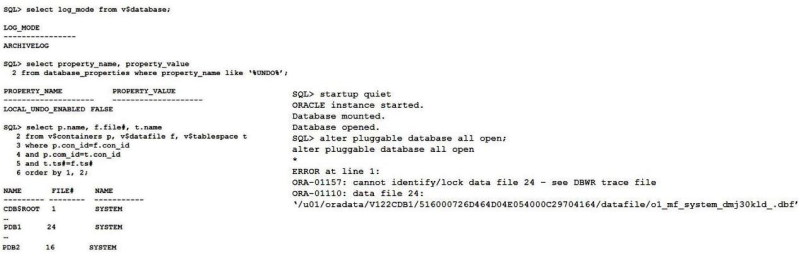
    Examine these queries and their output:

    After a system crash, an instance restart and an attempted opening of the PDBs result in:

    Which two are true? (Choose two.)
    Question 1 image
    Answer and explanation

    Correct answers: D, E

    File 24 is PDB1's SYSTEM data file. To restore and recover it, you shut down the CDB and start it in MOUNT mode. The CDB is therefore not open during this recovery.

    PDB1's SYSTEM data file is recovered while the whole CDB is only mounted. No PDB can be open in a mounted CDB, so PDB2 is closed during the recovery.
  2. Question 2

    Performing Recovery · Restore and Recovering Databases with RMAN

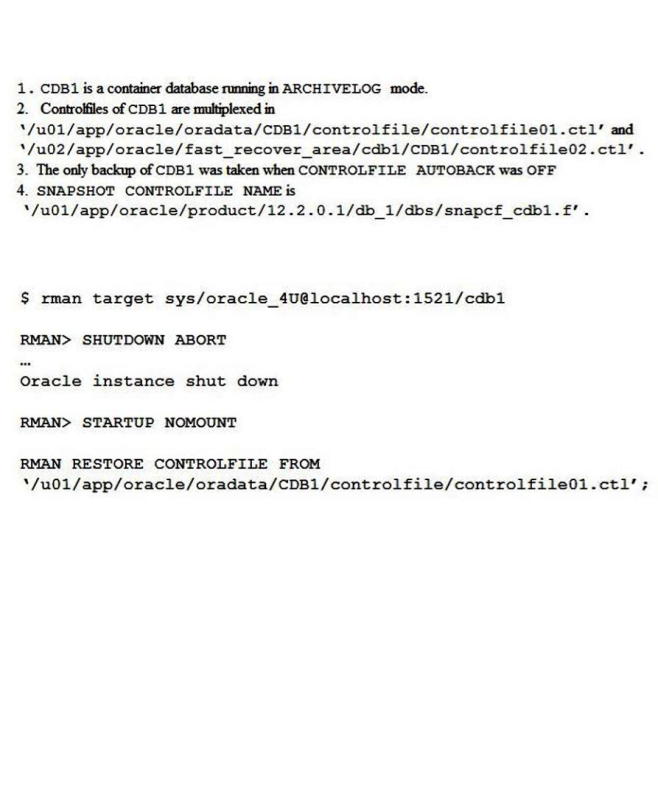
    Examine this configuration:

    While CDB1 is open, 7u02/app/oracle/fast_recover_area/cdb1/CDB1/controlfile02.ctl’ is accidentally deleted.

    To recover from this critical failure, you execute these commands:

    What will be the outcome?

    Question 2 image
    Answer and explanation

    Correct answer: C

    C

  3. Question 3

    Multiple answers

    Using General Overall Database Enhancements · Create, Delete and Configure Databases using DBCA

    Which three can be done using Oracle Database Configuration Assistant (DBCA) starting from Oracle Database 19c? (Choose three.)

    Answer and explanation

    Correct answers: B, E, G

    Oracle Database 19c added the DBCA relocatePDB command. It relocates a PDB from another CDB in silent mode.

    Oracle Database 19c added the DBCA createDuplicateDB command. It creates a duplicate (clone) of an existing database in silent mode.

    Oracle Database 19c added the createFromRemotePDB option to the DBCA createPluggableDatabase command. It clones a remote PDB in silent mode.

  4. Question 4

    Recovery and Flashback · Perform CDB and PDB flashback

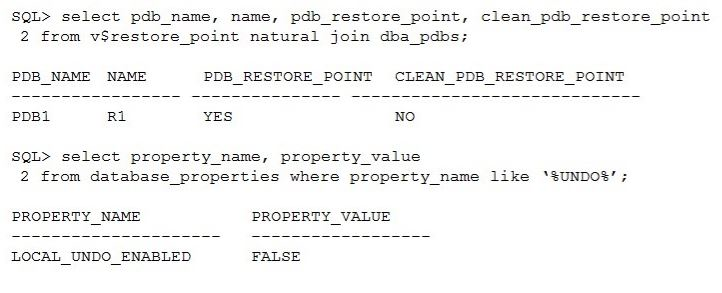
    Examine these queries and their output:

    An online RMAN backup of the CDB was taken an hour before Restore Point R1 was created.

    You want to recover PDB1 to Restore Point R1.

    How do you achieve this?

    Question 4 image
    Answer and explanation

    Correct answer: D

    PDB1 uses shared undo. R1 is not a clean restore point, so SQL*Plus cannot do the flashback. RMAN, connected to the root, does it with an auxiliary instance that restores undo from the backup.

  5. Question 5

    Monitoring and Tuning Database Performance · Monitoring Wait Events, Sessions, and Services

    A user complains about poor database performance.

    You want to verify if the user’s session has waited for certain types of I/O activity.

    Which view displays all waits waited on by a session at least once?

    Answer and explanation

    Correct answer: E

    V$SESSION_EVENT has a row for each wait event that a session has waited on, with its total waits and time waited. V$SESSION_WAIT shows only the current or last wait.

  6. Question 6

    Multiple answers

    RMAN Troubleshooting and Tuning · Diagnose RMAN performance issues

    While backing up to the Oracle Fast Recovery Area (FRA), you determined the backup is taking too long and suspect a performance bottleneck.

    Which three are true about diagnosing and tuning these problems? (Choose three.)

    Answer and explanation

    Correct answers: B, E, F

    BACKUP VALIDATE reads the files like a real backup but writes nothing. If it is much faster than the real backup, writing to the output device is the slow part.

    BACKUP VALIDATE does the same reads as a real backup but no writes. If both take about the same time, reading from disk is the slow part.

    With synchronous disk I/O, a nonzero DBWR_IO_SLAVES makes RMAN use disk I/O slaves. They simulate asynchronous I/O, which can speed up the backup.

  7. Question 7

    Multiple answers

    Using General Overall Database Enhancements · Use Miscellaneaous 19c New Features

    Which three are true in Oracle 19c and later releases? (Choose three.)

    Answer and explanation

    Correct answers: A, C, F

    In 19c, privilege analysis is part of Oracle Database Enterprise Edition. You no longer need a Database Vault license to find used and unused privileges.

    From 19c you can grant administrative privileges such as SYSOPER or SYSBACKUP to schema-only (passwordless) accounts.

    From 19c, unified auditing can audit only top-level statements, which a user issues directly. Indirect statements, for example inside PL/SQL, are then skipped.

  8. Question 8

    Multiple answers

    Backup Strategies and Terminology · Use a media manager

    Which two are true about RMAN backups when using a media manager to write backups to tape when there are only two tape drives? (Choose two.)

    Answer and explanation

    Correct answers: A, B

    The media manager or the tape device does tape compression. It does not depend on RMAN. Use either tape compression or RMAN compression, not both.

    Each tape drive needs its own channel. CONFIGURE DEVICE TYPE sbt PARALLELISM 2 gives two SBT channels, so RMAN writes to both drives at the same time.

  9. Question 9

    Multiple answers

    Patching Grid Infrastructure and Oracle Database · Patch Grid Infrastructure and Oracle Database

    Examine this command:

    $ rhpctl move database -sourcehome Oracle_home_path -desthome destination_oracle_home_path

    For which two purposes can you use this command? (Choose two.)

    Answer and explanation

    Correct answers: B, D

    With home paths instead of working copies, this is the local-mode patching command. It moves the database from its current home to a home that already has the patches.

    If a problem appears after a move, you roll back by running the same move again with the source and destination homes swapped.

  10. Question 10

    Multiple answers

    Duplicating a Database · Duplicate Databases

    Which four are true about a Recovery Manager (RMAN) duplication without a TARGET connection? (Choose four.)

    Answer and explanation

    Correct answers: A, B, E, H

    Without a target connection, RMAN cannot tell that the source was in NOARCHIVELOG mode. You must add NOREDO so that RMAN does not try to apply archived redo.

    Disk backups can be used when the destination host can read them, either at the same path as on the source or through the BACKUP LOCATION clause.

    NOREDO can also be used with backups taken in ARCHIVELOG mode when the backup is consistent and you do not want any archived redo applied.

    Backup-based duplication can use backups on tape. The auxiliary channels read them through the media manager, which the destination host must be able to reach.

Register free for 10 more questions

Or unlock all 343 1z0-083 questions with explanations, timed mode and flashcards.