Question 1
IntermediateA second set of traffic selectors is negotiated between two peers using IKEv2. Which IKEv2 packet will contain details of the exchange?
Answer and explanation
Correct answer: A

Covers GETVPN, DMVPN and FlexVPN site-to-site designs, AnyConnect IKEv2, SSL and clientless remote access VPNs, troubleshooting IPsec with ASDM and CLI, and VPN architecture design.
17 free sample questions240 in the full practice test Other version: 300-209(289)

A second set of traffic selectors is negotiated between two peers using IKEv2. Which IKEv2 packet will contain details of the exchange?
Correct answer: A
On a FlexVPN hub-and-spoke topology where spoke-to-spoke tunnels are not allowed, which command is needed for the hub to be able to terminate FlexVPN tunnels?
Correct answer: C
Which statement about GETVPN is true?
Correct answer: C
Refer to the exhibit. Which two tunnel types produce the show crypto ipsec sa output seen in the exhibit? (Choose two.)
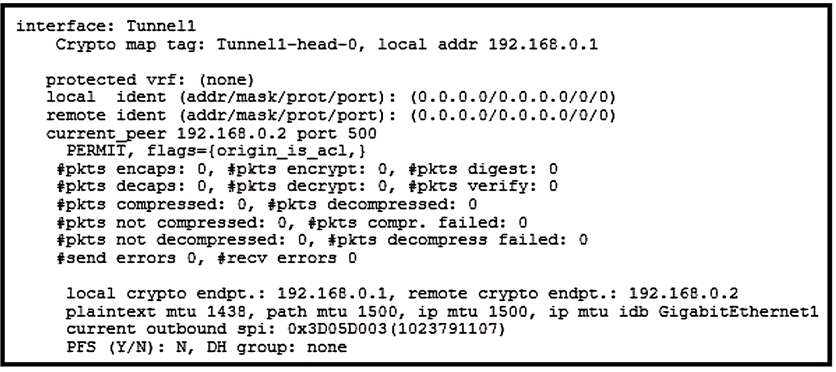
Correct answers: B, E
Which two changes should be made in order to migrate from DMVPN Phase 2 to Phase 3 when EIGRP is configured? (Choose two.)
Correct answers: C, D
In DMVPN Phase 2 with EIGRP, the hub runs no ip next-hop-self eigrp so that every spoke learns the other spokes' networks with the remote spoke as next hop. Phase 3 removes that need: Cisco's NHRP shortcut-switching guide says spokes can use summarized routes whose next hop is the hub's tunnel address and still build spoke-to-spoke tunnels, because NHRP installs shortcut routes after the hub sends an NHRP redirect. The migration therefore adds ip nhrp redirect on the hub tunnel, so the hub signals spokes when traffic enters and leaves the same tunnel, and returns EIGRP next-hop-self to its default on the hub so the hub can advertise itself as next hop, including summaries. Cisco's Phase 3 example hub has ip nhrp redirect and ip summary-address eigrp and no 'no ip next-hop-self eigrp'. Disabling next-hop-self is the Phase 2 setting, not a migration step. The spokes need ip nhrp shortcut to act on the redirects, so adding shortcuts on the hub, or redirects on the spokes in place of the hub, does not give the hub the redirect role Phase 3 depends on. Sources: Cisco, 'Shortcut Switching Enhancements for NHRP in DMVPN Networks' (IOS XE 16.9); Cisco, 'Configure Phase-3 Hierarchical DMVPN with Multi-Subnet Spokes'.
Refer to the exhibit. A customer cannot establish an IKEv2 site-to-site VPN tunnel between two Cisco ASA devices. Based on the syslog message, which action brings up the VPN tunnel? A.Reduce the maximum SA limit on the local Cisco ASA.B.Increase the maximum in-negotiation SA limit on the local Cisco ASA.C.Remove the maximum SA limit on the remote Cisco ASA.D.Correct the crypto access list on both Cisco ASA devices.

Correct answer:
Which two parameters help to map a VPN session to a tunnel group without using the tunnel-group list? (Choose two.)
Correct answers: A, D
Which method dynamically installs the network routes for remote tunnel endpoints? A.policy-based routingB.CEFC.reverse route injectionD.route filtering
Correct answer: C
Or unlock all 240 300-730 questions with explanations, timed mode and flashcards.