Implementing and Operating Cisco Enterprise Network Core Technologies (ENCOR) Free Sample Questions

Create a free account to browse all 20 sample questions. The full practice test includes 263 questions. Use the simulator for timed and flashcard mode.

Try Simulator

350-401 Sample Questions

  1. Question 1

    Q1

    You issue the following commands on a Cisco router:

    RouterA#debug condition interface serial 0/0
    RouterA#debug condition interface serial 0/1
    RouterA#debug condition username RouterB
    RouterA#debug ppp authentication

    Which of the following PPP authentication debugging messages will be displayed on RouterA? (Select the best answer.)

    Show answer & explanation

    Correct answer: D

    Debug conditions are combined with an OR logic. When multiple debug conditions are configured (interface serial 0/0, interface serial 0/1, and username RouterB), the debug output will display messages that match ANY of these conditions. The debug ppp authentication command will show messages that contain the RouterB username OR arrive on either Serial 0/0 OR Serial 0/1 interface. The other options are incorrect because they suggest only one specific condition would be met, ignoring the OR logic of multiple debug conditions.

  2. Question 2

    Q2

    Which of the following ping command options should be enabled if you want to determine the MTU size that a given connection supports? (Select the best answer.)

    Show answer & explanation

    Correct answer: A

    The IPv4 do-not-fragment bit (DF bit) is essential for MTU discovery because it prevents fragmentation of the ping packets. When the DF bit is set and a packet is too large for a link, an ICMP "fragmentation needed" message is returned, allowing you to determine the maximum transmission unit size. The other options are incorrect: increasing ping count, datagram size, or timeout values do not directly help determine MTU size - you need the DF bit to force MTU discovery through fragmentation prevention.

  3. Question 3

    Q3

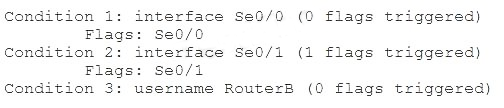
    You issue the debug ppp authentication command on RouterA, RouterA’s Serial 0/0 interface is connected to RouterB, RouterA’s Serial 0/1 interface is connected to RouterC, You issue the no shutdown command on all interfaces and note that every interface has entered the up state.

    Next, you issue the show debug condition command on RouterA and receive the following Output: [Image]. Which of the following statements is true? (Select the best answer.)

    Question 3 image
    Show answer & explanation

    Correct answer: B

    Based on the image showing debug output, the debug condition has been met on the Serial 0/1 interface. The debug output displays PPP authentication messages specifically from the Serial 0/1 connection to RouterC, indicating that this interface condition triggered the debug display. The other options are incorrect because the output specifically shows Serial 0/1 interface activity, not Serial 0/0, username-based conditions, or all/no conditions being met.

  4. Question 4

    Q4

    You issue the ping 192.168.1.1 size 1501 dfbit command on a Cisco device. You notice a message indicating that the DF bit has been set. However, the ping fails.

    You want to determine the largest datagram that the connection supports without fragmentation.

    Which of the following should you do next? (Select the best answer.)

    Show answer & explanation

    Correct answer: C

    When a ping with DF bit set fails because the datagram is too large (1501 bytes), you should issue the command with a lower size parameter value to find the maximum MTU. This process of gradually reducing the size until pings succeed determines the largest unfragmented packet size the path supports. The other options are incorrect: removing the dfbit parameter defeats MTU discovery purpose, removing size parameter uses default small size, and removing both parameters provides no MTU information.

  5. Question 5

    Q5

    RouterA’s Serial 0/0 interface is connected to RouterA, RouterA’s Serial 0/1 interface is connected to RouterA, You issue the debug ppp authentication on RouterA and then transition all connected interfaces to the up state.

    Next, you issue the show debug condition command on RouterA and receive the Output below.

    Using the least amount of administrative effort, which of the following should you issue to receive PPP authentication debug output from both RouterB and RouterC? (Select the best answer.)

    Question 5 image
    Show answer & explanation

    Correct answer: B

    You should issue the debug condition interface serial 0/1 command on RouterA to receive Point-to-Point Protocol (PPP) authentication debug output from both RouterB and RouterC with the least administrative effort. The debug condition interface command filters debug output to show only messages from the specified interface. Since both routers connect through different serial interfaces, adding the Serial 0/1 condition will enable debug output from both connections. The other options either disable debugging entirely or use incorrect syntax for interface conditions.

  6. Question 6

    Q6

    You issue the ping 192.168.1.1 size 1600 command on a Cisco device that is configured with the default system MTU. All pings succeed.
    Which of the following is most likely true? (Select the best answer.)

    Show answer & explanation

    Correct answer: B

    The pings were sent to the destination in a fragmented fashion. Since the default system MTU on Cisco devices is typically 1500 bytes and the ping size is 1600 bytes, the packets exceed the MTU and must be fragmented to succeed. Without the DF bit set, fragmentation is allowed and the pings succeed. The other options are incorrect: MTU of 1600 is not default, DF bit prevents fragmentation (would cause failure), and 1600 bytes exceeds default MTU values.

  7. Question 7

    Q7

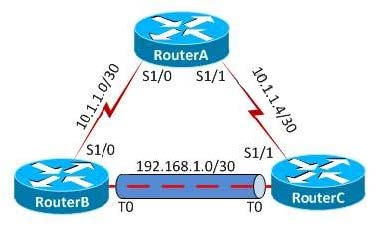
    You administer the network in the exhibit below.

    All routers are configured to the system MTU defaults.

    You issue the ping 192.168.1.2 size 1500 dfbit command from RouterB, but the ping fails.

    Which of the following is most likely the cause of the failure? (Select the best answer.)

    Question 7 image
    Show answer & explanation

    Correct answer: A

    Most likely, the Generic Routing Encapsulation (GRE) tunnel MTU is 1476 bytes. GRE tunneling adds 24 bytes of overhead to packets (20-byte IP header + 4-byte GRE header). With a standard Ethernet MTU of 1500 bytes, the effective tunnel MTU becomes 1476 bytes. Since the ping size is 1500 bytes with DF bit set, it exceeds the tunnel MTU and cannot be fragmented, causing the ping to fail. The other options are incorrect as they do not account for GRE tunneling overhead.

  8. Question 8

    Q8

    Which of the following statements is true regarding OSPF connections over a virtual link? (Select the best answer.)

    Show answer & explanation

    Correct answer: D

    Only routing updates are tunneled in OSPF virtual links. Virtual links are logical connections that carry OSPF routing information between areas when a non-backbone area cannot directly connect to Area 0. Unlike GRE tunnels, virtual links do not encapsulate all traffic - they only tunnel OSPF routing updates and LSA exchanges. The other options are incorrect: virtual links do not encapsulate regular traffic, do not add tunnel headers to data packets, and the transit area cannot be a stub area (stub areas cannot have virtual links).

  9. Question 9

    Q9

    Which of the following is not a GRE tunnel state on a Cisco device? (Select the best answer.)

    Show answer & explanation

    Correct answer: B

    Down/up is not a valid GRE tunnel state on Cisco devices. The valid GRE tunnel states are: Up/up (tunnel is operational), Up/down (tunnel interface is up but line protocol is down), Administratively down/down (tunnel is shutdown), and Reset/down (tunnel is being reset). The Down/up state does not exist because if the interface is down, the line protocol cannot be up. The other options are all legitimate tunnel states that can occur during tunnel operations.

  10. Question 10

    Q10

    Which of the following statements is true regarding OSPF connections over a GRE tunnel? (Select the best answer.)

    Show answer & explanation

    Correct answer: A

    Traffic is encapsulated and decapsulated by tunnel endpoints when using OSPF over GRE tunnels. GRE tunneling encapsulates the original packets (including OSPF traffic) with GRE and IP headers at the source endpoint, then decapsulates them at the destination endpoint. This allows OSPF to operate over networks that do not natively support multicast or direct connectivity. The other options are incorrect: tunnel headers do create overhead, transit areas can be stub areas in regular OSPF, and all traffic (not just routing updates) is tunneled in GRE.

Register free to unlock 10 more sample questions

Create a free account to continue with the rest of the 350-401 sample set.

Lifetime One

Own this practice test forever.

$79.99
$75.99
one-time
  • Full access to 263 questions
  • Study, Timed & Flashcard Modes
  • All past and future versions i
  • Detailed Explanations
  • Study Tracking & Past Attempts
  • Brainy AI Assistant
  • Lifetime updates

Two

Any 2 exams per month.

$20.00/exam
$39.99
/month
  • 2 active exam slots
  • Study, Timed & Flashcard Modes
  • All past and future versions i
  • Detailed Explanations
  • Study Tracking & Past Attempts
  • 1,000 Brainy AI Credits
  • Cancel anytime

Premium Twelve

Any 12 exams over 3 months.

$15.00/exam
$179.99
/3 months
  • 4 active exam slots
  • Study, Timed & Flashcard Modes
  • All past and future versions i
  • Detailed Explanations
  • Study Tracking & Past Attempts
  • 15,000 Brainy AI Credits
  • Dedicated support
  • Friend seat included — full access

Trusted by professionals at

NvidiaSupabaseGitHubOpenAITursoClerkClaude AIAmazon