Risk Reduction, Wellness and Health Literacy · Task 0101: Identify risk factors by administering assessment, pre-participation examination and other screening instruments, and reviewing individual and group history and surveillance data.
During pre-participation physical examinations (PPE) for an incoming secondary school cross-country team, an athletic trainer notes that a 15-year-old athlete completed their own history questionnaire indicating no prior cardiovascular symptoms. Which procedure is required to optimize the diagnostic yield and validity of this screening?
Answer and explanation
Correct answer: A
Adolescent self-reports are unreliable. History identifies 88% of PPE abnormalities but requires direct verbal review and parental confirmation for validity.
Q2Question 2
Advanced
Risk Reduction, Wellness and Health Literacy · Task 0101: Identify risk factors by administering assessment, pre-participation examination and other screening instruments, and reviewing individual and group history and surveillance data.
A 17-year-old high school basketball player presents for a comprehensive pre-participation physical examination prior to team tryouts. The athlete reports feeling healthy and denies any personal history of exertional syncope, chest discomfort, or unexpected dyspnea.
Upon physical examination, the athletic trainer observes a tall, slender habitus with an arm span markedly exceeding total body height. Craniofacial inspection reveals a high-arched palate and crowded dentition, while thoracic inspection reveals pectus excavatum. Examination of the hands demonstrates positive wrist (Walker-Murdoch) and thumb (Steinberg) signs indicative of arachnodactyly. Cardiac auscultation identifies a grade 2/6 midsystolic click followed by a late systolic murmur at the apex. Family history reveals that a paternal uncle died suddenly of an aortic dissection at age 28.
Which immediate clinical risk reduction action is required before sports participation can be considered?
Answer and explanation
Correct answer: A
The presentation strongly suggests Marfan syndrome with aortic risk. Clearance must be withheld pending definitive cardiology evaluation and echocardiogram.
Q3Question 3
Beginner
Risk Reduction, Wellness and Health Literacy · Task 0101: Identify risk factors by administering assessment, pre-participation examination and other screening instruments, and reviewing individual and group history and surveillance data.
When analyzing baseline functional movement screening data to identify risk factors for non-contact anterior cruciate ligament (ACL) injuries in collegiate female soccer athletes, which kinematic pattern during a jump-landing task indicates the greatest mechanical risk?
Answer and explanation
Correct answer: C
Dynamic knee valgus with contralateral pelvic drop increases knee abduction torque and ACL tensile strain during deceleration. Increased flexion is protective.
Q4Question 4
Intermediate
Risk Reduction, Wellness and Health Literacy · Task 0105: Facilitate individual and group safety by monitoring and responding to environmental conditions (e.g., weather, surfaces, and work setting).
During an outdoor afternoon lacrosse practice, the athletic trainer serving as the designated weather watcher identifies cloud-to-ground lightning with an automated detection system reporting a strike 4.2 nautical miles away. Which action must be executed immediately?
Answer and explanation
Correct answer: C
Activities must suspend when lightning is within 5 nautical miles. All personnel must move to safe structures. Dugouts and open canopies are unsafe.
flowchart TD
Detect[Lightning detected within 5 nmi] --> Suspend[Immediately suspend activity]
Suspend --> Shelter[Move to substantial enclosed structure]
Shelter --> Timer[Wait 30 min from LAST lightning or thunder]
Timer --> Safe{30 min clear?}
Safe -->|Yes| Resume[Resume activity]
Safe -->|No| Reset[Reset 30-min timer]
Reset --> Shelter
Q5Question 5
Intermediate
Risk Reduction, Wellness and Health Literacy · Task 0105: Facilitate individual and group safety by monitoring and responding to environmental conditions (e.g., weather, surfaces, and work setting).
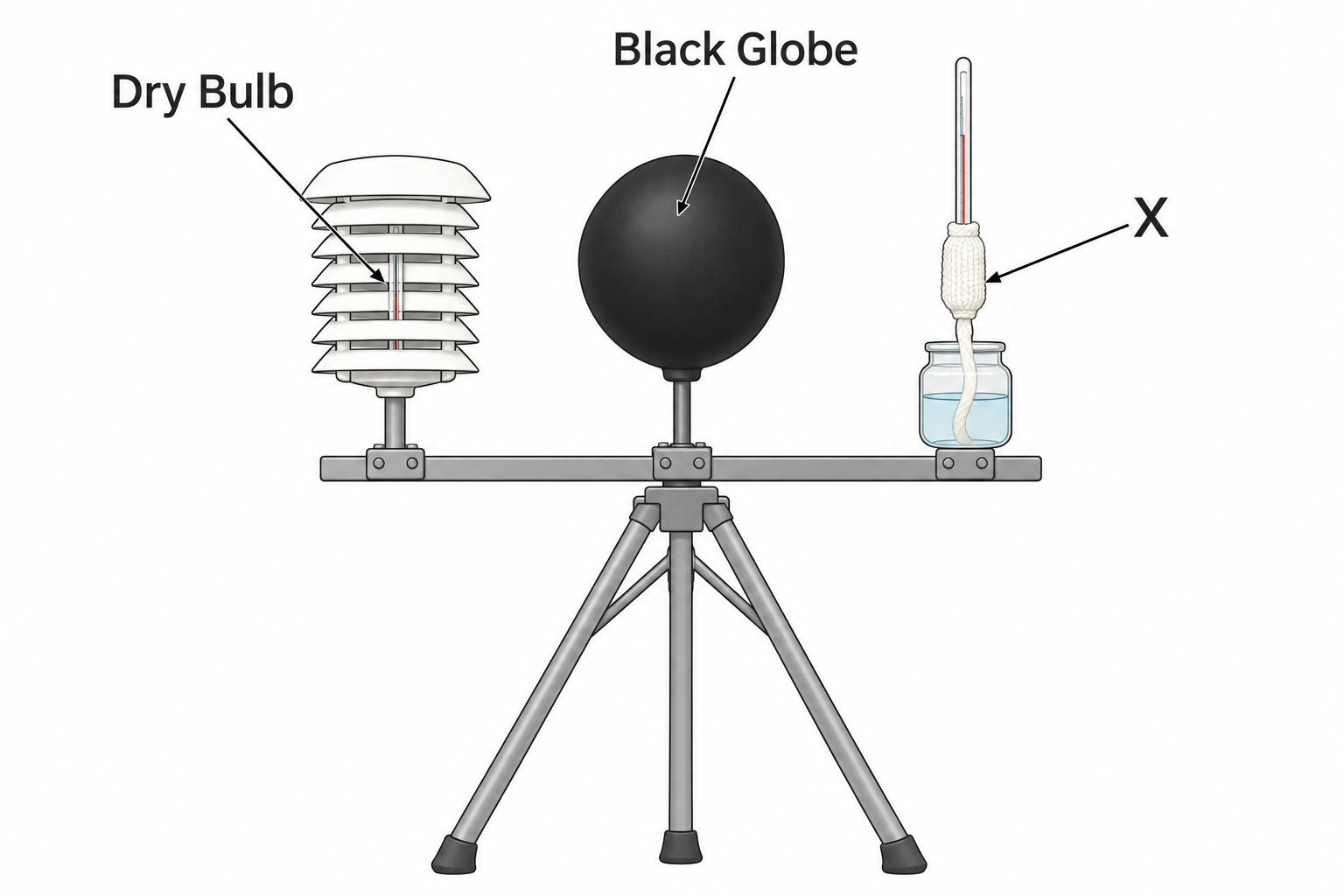
While preparing the athletic training facility for preseason camp, an athletic trainer sets up a Wet Bulb Globe Temperature (WBGT) device. What environmental factor is measured specifically by the sensor labelled X in the figure?
Answer and explanation
Correct answer: B
Sensor X is the naturally aspirated wet bulb thermometer; it measures evaporative cooling potential combining ambient air, humidity, and wind speed.
Q6Question 6
Beginner
Risk Reduction, Wellness and Health Literacy · Task 0105: Facilitate individual and group safety by monitoring and responding to environmental conditions (e.g., weather, surfaces, and work setting).
True or False: Under standard heat acclimatization guidelines, an educational walk-through conducted during the preseason acclimatization period may last up to 90 minutes provided athletes wear only helmets and conditioning drills are excluded.
Answer and explanation
Correct answer: A
Walk-throughs are strictly limited to a maximum of 1 hour, forbid all protective equipment, and exclude conditioning or weight work.
Register free for 6 more questions
Or unlock all 149 ATC questions with explanations, timed mode and flashcards.