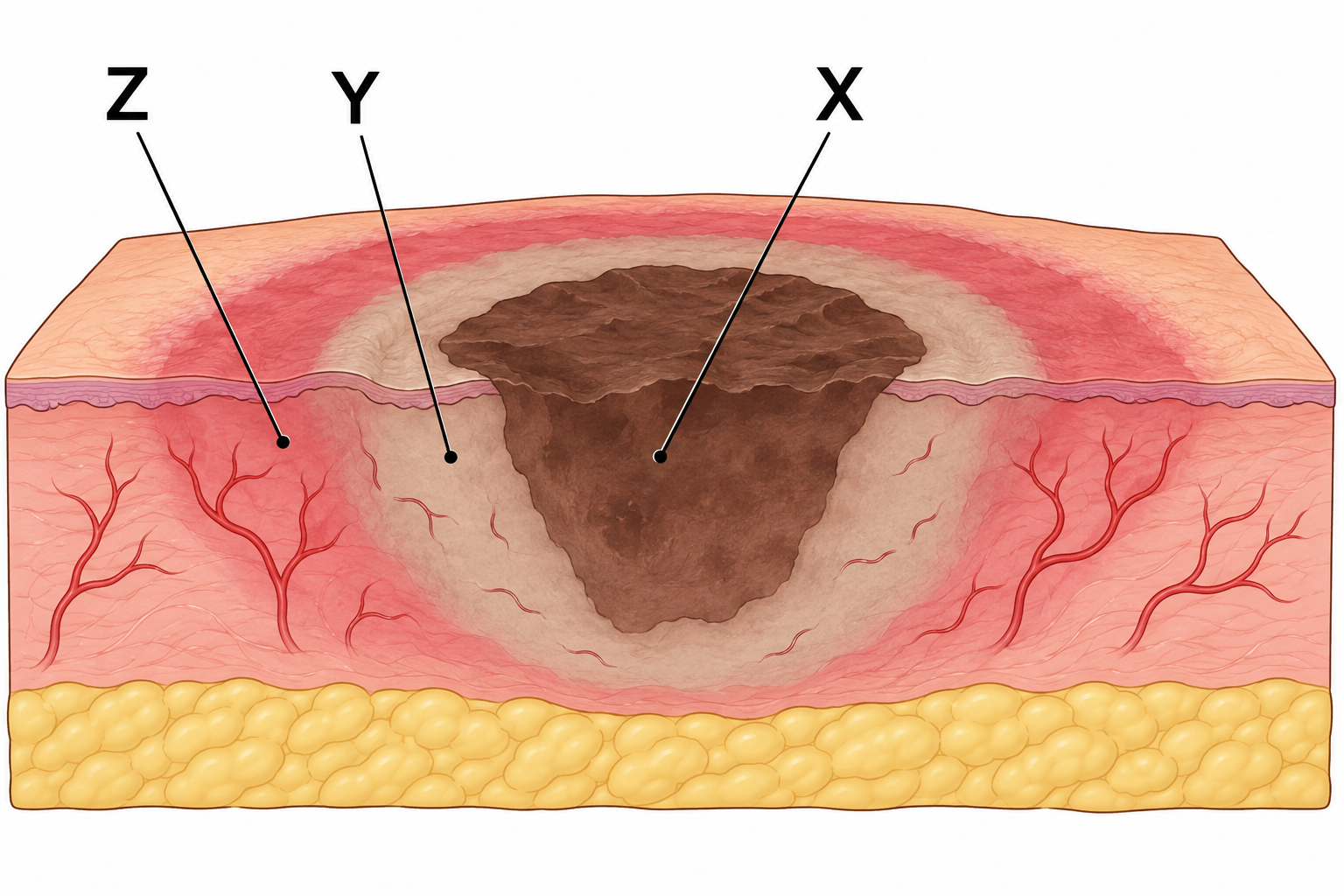
A 34-year-old patient sustained deep thermal contact burns to the anterior thigh. In the provided cross-sectional illustration of Jackson's zones of burn injury, which physiological phenomenon occurs within the intermediate region designated by label Y?
Answer and explanation
Correct answer: C
Zone Y is the zone of stasis; tissue has impaired perfusion that may survive with optimal resuscitation or infarct if under-resuscitated. Zone X is irreversible necrosis; Zone Z is viable hyperemia.
Q2Question 2
Intermediate
Pathophysiology · Burn shock
A 42-year-old firefighter with 35% total body surface area (TBSA) flame burns is admitted to the burn intensive care unit within 90 minutes of injury. Which hemodynamic profile classic for early unresuscitated burn shock should the nurse anticipate?
Answer and explanation
Correct answer: B
Burn shock combines hypovolemia from transcapillary fluid shift, myocardial depression lowering cardiac output, and compensatory vasoconstriction raising systemic vascular resistance.
Q3Question 3
Beginner
Pathophysiology · Burn shock
True or False: In patients with cutaneous thermal burns involving 20% or more total body surface area (TBSA), microvascular permeability increases systematically, resulting in generalized soft tissue and visceral organ edema even in unburned anatomical areas.
Answer and explanation
Correct answer: B
Burns involving 20% or more TBSA release massive systemic inflammatory mediators, driving widespread endothelial dysfunction and third-spacing in unburned tissues and distant organs.
Q4Question 4
Advanced
Clinical Practice: Initial Management (<72 hours) · ABA transfer criteria
A 48-year-old chemical manufacturing operator is transported to a community emergency department following an industrial pipeline rupture. The patient sustained splash injuries with an alkaline cleaning solvent across the face, anterior neck, bilateral hands, and anterior chest.
Physical assessment reveals white, indurated, insensate plaques across the dorsal hands and fingers, with erythematous blistering across the facial cheeks and perioral region, encompassing approximately 12% TBSA. Copious water decontamination was initiated on-site and continued in the trauma bay for 30 minutes. The emergency physician contemplates admitting the patient to the local intensive care unit for daily topical wound care.
Based on American Burn Association (ABA) transfer criteria, which recommendation and clinical rationale must the burn liaison nurse communicate?
flowchart TD
A[Industrial Chemical Burn Patient] --> B{Check ABA Criteria}
B -->|Chemical burn + Critical zones| C[Immediate Consultation & Transfer]
B -->|Minor non-critical burn| D[Local Outpatient Management]
Answer and explanation
Correct answer: B
ABA guidelines mandate immediate consultation and transfer for all chemical burns and burns involving high-risk functional zones (hands, face, genitalia, major joints), regardless of total burn size.
Q5Question 5
Beginner
Clinical Practice: Initial Management (<72 hours) · ABA transfer criteria
According to American Burn Association (ABA) transfer criteria, which electrical injury scenario requires immediate burn center consultation with consideration for emergent transfer?
Answer and explanation
Correct answer: D
The ABA designates all high-voltage electrical injuries (1,000 V or greater) and lightning injuries as criteria for immediate consultation with consideration for transfer. Low-voltage injuries (<1,000 V) warrant outpatient consultation.
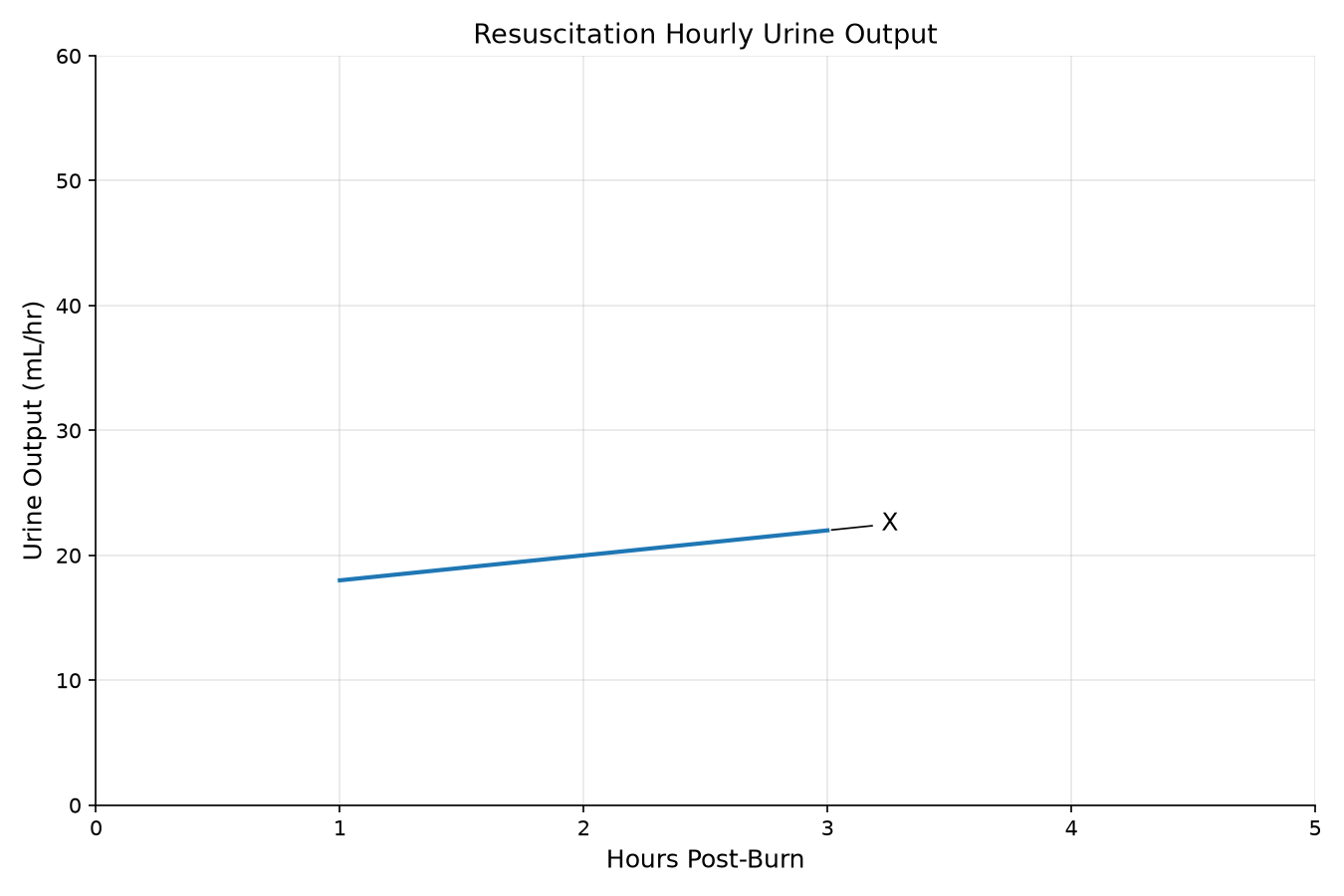
A 70-kg adult with 40% TBSA deep partial- and full-thickness burns is undergoing fluid resuscitation initiated at 2 mL/kg/%TBSA of Lactated Ringer's. Referring to the hourly urine output trend in the chart, which titration adjustment is indicated at hour 3?
Answer and explanation
Correct answer: C
Adult target urine output is 0.5 mL/kg/hr (35 mL/hr for 70 kg). Because output at point X is 22 mL/hr, resuscitation fluid must be titrated up by 10% to 20% hourly until target is met.
Register free for 6 more questions
Or unlock all 157 CBRN questions with explanations, timed mode and flashcards.