Assessment · Social determinants of health (economic, living situation, healthcare access, social supports, and food/housing insecurity)
A diabetes care and education specialist is incorporating social determinants of health screening into an outpatient clinic intake. When using the validated two-item Hunger Vital Sign screening tool to evaluate food insecurity, which timeframe must the questions address?
Answer and explanation
Correct answer: A
The Hunger Vital Sign is a validated two-question screener that assesses food insecurity over the preceding 12 months.
Q2Question 2
Intermediate
Assessment · Social determinants of health (economic, living situation, healthcare access, social supports, and food/housing insecurity)
During a self-management assessment, an individual experiencing temporary housing instability reports living out of a personal vehicle without access to a refrigerator. They inject insulin glargine once daily. Which strategy should the specialist recommend for safe insulin storage?
Answer and explanation
Correct answer: D
In-use insulin can be kept at controlled room temperatures up to 86°F for 28 days; an insulated pouch protects it from vehicle temperature spikes.
Q3Question 3
Advanced
Assessment · Social determinants of health (economic, living situation, healthcare access, social supports, and food/housing insecurity)
A 54-year-old individual with type 2 diabetes presents to the outpatient clinic for evaluation. The person reports inconsistent access to nutritious groceries toward the end of each monthly budget cycle. During these periods, carbohydrate intake drops markedly, but the individual continues taking glimepiride 4 mg daily as prescribed.
Over the past two months, the client experienced multiple late-afternoon episodes of lightheadedness, tremors, and diaphoresis, which resolve after consuming available refined carbohydrate snacks from a neighborhood food pantry. Laboratory tests demonstrate an A1C of 8.8%.
Which physiological factor explains why food insecurity in this individual increases the risk for acute hypoglycemia?
Sulfonylureas stimulate insulin release independently of glucose, inducing severe hypoglycemia when food intake is curtailed by insecurity.
Q4Question 4
Intermediate
Assessment · Mental health wellbeing (adjustment to diagnosis, coping ability, etc.)
A specialist is evaluating an adult with long-standing type 1 diabetes who expresses feelings of exhaustion, guilt, and emotional detachment regarding daily glucose tracking and carbohydrate counting. Which assessment tool specifically differentiates diabetes distress from major depressive disorder?
Answer and explanation
Correct answer: C
The PAID scale evaluates emotional distress specific to diabetes self-care, distinguishing diabetes distress from general depression.
Q5Question 5
IntermediateMultiple answers
Assessment · Mental health wellbeing (adjustment to diagnosis, coping ability, etc.)
According to clinical guidelines, routine screening for psychosocial challenges and diabetes distress should occur at specific touchpoints. Which TWO clinical situations indicate an immediate need for psychosocial re-screening? (Select TWO)
Answer and explanation
Correct answers: B, D
Persistent failure to meet treatment targets frequently signals underlying diabetes distress, depression, or coping barriers.
Assessment · Monitoring and data collection (glucose, ketones, weight, dietary intake, activity, etc.)
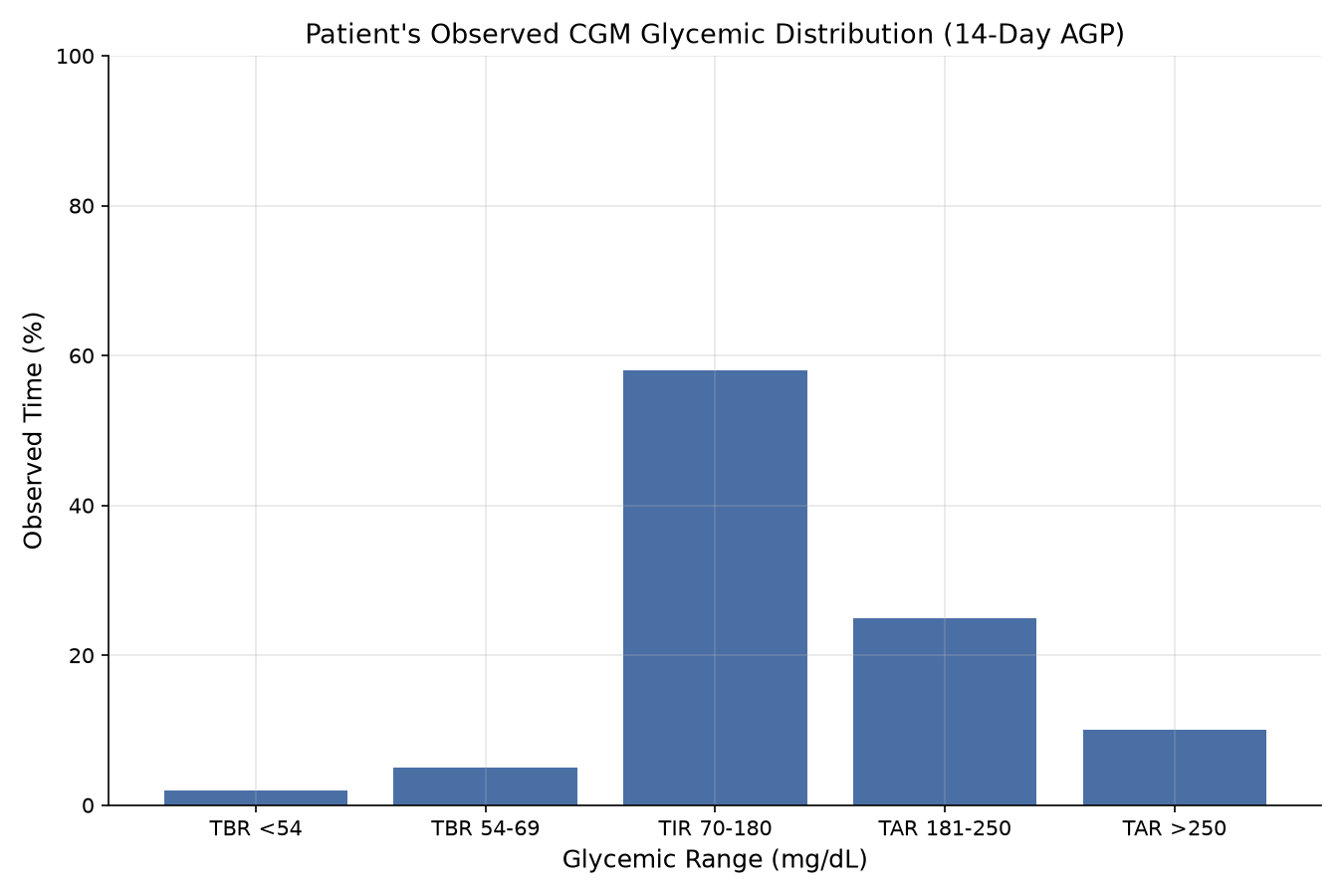
A specialist is analyzing a continuous glucose monitoring (CGM) Ambulatory Glucose Profile report for a 38-year-old nonpregnant adult with type 1 diabetes. In accordance with international consensus benchmarks, what is the target percentage for Time in Range (70–180 mg/dL)?
Answer and explanation
Correct answer: B
For nonpregnant adults with diabetes, the standard consensus target for Time in Range (70–180 mg/dL) is greater than 70%.
Register free for 6 more questions
Or unlock all 170 CDCES questions with explanations, timed mode and flashcards.