

CompTIA DataSys+ Free Sample Questions

Description

Covers database structure types and SQL scripting, deployment planning and testing, monitoring and maintenance, data security, governance and authentication, and backup and high availability.

20 free sample questions255 in the full practice test

Try simulator

DS0-001 Sample Questions

  1. Question 1

    IntermediateMultiple answers

    Over the weekend, a company’s transaction database was moved to an upgraded server. All validations performed after the migration indicated that the database was functioning as expected. However, on Monday morning, multiple users reported that the corporate reporting application was not working.Which of the following are the most likely causes? (Choose two.) A.The access permissions for the service account used by the reporting application were not changed.B.The new database server has its own reporting system, so the old one is not needed.C.The reporting jobs that could not process during the database migration have locked the application.D.The reporting application’s mapping to the database location was not updated.E.The database server is not permitted to fulfill requests from a reporting application.F.The reporting application cannot keep up with the new, faster response from the database.

    Answer and explanation

    Correct answers: A, D
  2. Question 2

    Intermediate

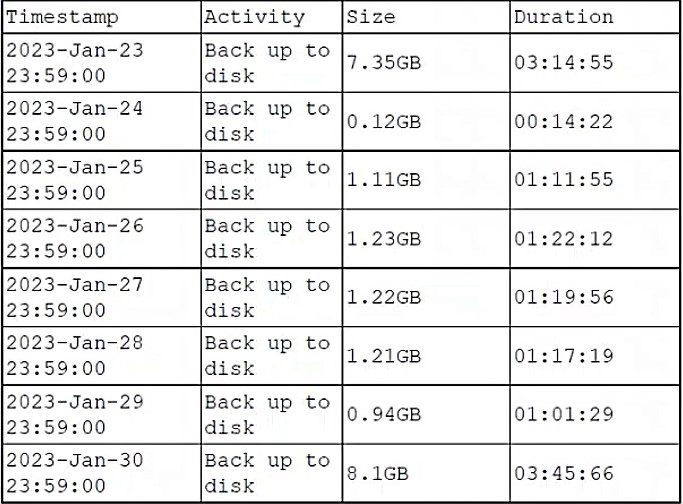
    A DBA is reviewing the following logs to determine the current data backup plan for a primary data server:Which of the following best describes this backup plan? A.Monthly full, daily differentialB.Daily differentialC.Daily fullD.Weekly full, daily incremental

    Question 2 image
    Answer and explanation

    Correct answer: D

  3. Question 3

    Intermediate

    A database administrator needs to ensure that a newly installed corporate business intelligence application can access the company’s transactional data. Which of the following tasks should the administrator perform first? A.Create a new service account exclusively for the business intelligence application.B.Build a separate data warehouse customized to the business intelligence application's specifications.C.Set up a nightly FTP data transfer from the database server to the business intelligence application server.D.Send the business intelligence administrator the approved TNS names file to configure the data mapping.E.Open a new port on the database server exclusively for the business intelligence application.

    Answer and explanation

    Correct answer: A

  4. Question 4

    Advanced

    Business Continuity · High Availability and Fault Tolerance

    A financial services company is deploying a new PostgreSQL database cluster for its high-frequency trading application. The primary requirements are zero data loss (RPO=0) upon primary node failure and automatic failover within 30 seconds (RTO<30s). The solution must also allow read-only queries to be distributed across secondary nodes. Which deployment architecture should the database architect implement?

    Answer and explanation

    Correct answer: C

    This architecture meets all requirements. Synchronous streaming replication ensures that a transaction is not considered committed until it has been written to both the primary and the synchronous standby, guaranteeing an RPO of zero. High-availability management tools like Patroni or Stolon use a distributed consensus store (like etcd or Consul) to manage the cluster state, handle leader election, and trigger automatic failover well within the 30-second RTO. They also facilitate routing read queries to the standby nodes.

  5. Question 5

    Intermediate

    Database Deployment · Data Migration Strategies

    A database administrator is tasked with migrating an on-premises 10TB data warehouse from a legacy system to a cloud platform. A key requirement is to minimize the initial migration downtime. The on-premises network has a stable but limited upload bandwidth of 1 Gbps. Which data transfer method should be used for the initial bulk data load?

    Answer and explanation

    Correct answer: B

    Transferring 10TB over a 1 Gbps connection would take approximately 24 hours, leading to significant downtime. Offline data transfer appliance services (like AWS Snowball or Azure Data Box) are designed for this exact scenario. The company can load the 10TB of data onto a physical appliance, ship it to the cloud provider, and have the data loaded directly into their cloud environment. This method is much faster for the initial bulk load than a network transfer over a limited connection, thus minimizing the initial migration downtime. Subsequent changes can be synchronized over the network.

  6. Question 6

    Intermediate

    Database Management and Maintenance · Query Optimization and Indexing

    A developer has created a report query that joins a Sales table (50 million rows) with a Customers table (2 million rows) and a Products table (10,000 rows). The query performance is unacceptably slow. The DBA analyzes the execution plan and discovers that the database is performing a full table scan on the Sales table. The WHERE clause filters on CustomerID and OrderDate. Which action would provide the MOST significant performance improvement?

    Answer and explanation

    Correct answer: D

    The presence of a full table scan on the largest table (Sales) indicates a missing or ineffective index for the query's WHERE clause. Since the filter applies to both CustomerID and OrderDate, a composite index on these two columns is the most effective solution. This allows the database engine to quickly locate the relevant rows without scanning the entire table, providing a dramatic performance boost. While separate indexes could be used, a single composite index is far more efficient for queries that filter on both columns simultaneously.

  7. Question 7

    Intermediate

    Data and Database Security · Access Control Mechanisms

    A security audit of a company's main transactional database reveals that developers have direct SELECT access to tables containing Personally Identifiable Information (PII) for debugging purposes. To comply with GDPR and reduce the risk of data exposure, the security team mandates that direct table access must be revoked. However, developers still need a way to query non-sensitive data from these tables. Which security mechanism should be implemented to meet these requirements?

    Answer and explanation

    Correct answer: B

    This solution adheres to the principle of least privilege. By creating views that select only the necessary, non-sensitive columns from the underlying tables, an abstraction layer is created. The developers' direct access to the base tables can be revoked, and they can be granted SELECT permissions only on these secure views. This allows them to perform their debugging tasks without ever having access to the PII, effectively mitigating the security risk and helping achieve GDPR compliance.

  8. Question 8

    Beginner

    Database Fundamentals · ACID Principles

    True or False: The primary purpose of the CONSISTENCY property in ACID is to ensure that a transaction, upon successful completion, will be permanently saved and survive any subsequent system failure.

    Answer and explanation

    Correct answer: B

    The statement is false. The property being described is DURABILITY, which guarantees that once a transaction is committed, it will remain so, even in the event of power loss, crashes, or errors. CONSISTENCY ensures that a transaction brings the database from one valid state to another, preserving all predefined rules, constraints, cascades, and triggers.

  9. Question 9

    Beginner

    Database Fundamentals · Scripting Methods

    A database administrator is setting up a new server and needs to automate a nightly task that involves exporting data, compressing it, and moving it to a network share. The server environment is Windows-based. Which scripting method would be MOST appropriate for automating this multi-step process with native tools?

    Answer and explanation

    Correct answer: C

    PowerShell is the native, object-oriented scripting language and automation framework for Windows. It is ideal for this task as it has built-in cmdlets for interacting with SQL Server (Invoke-Sqlcmd), file system operations (Compress-Archive), and network shares (Copy-Item). It allows the entire workflow to be managed within a single, powerful script without installing third-party tools.

  10. Question 10

    Intermediate

    Database Fundamentals · Database Structure Types

    A manufacturing company is designing a database to track its assembly line process. The system needs to capture data from IoT sensors at each stage of production. The data arrives at a very high velocity and has a simple structure (sensor_id, timestamp, value). The primary query pattern will be retrieving all data for a specific sensor over a given time range. High write throughput and horizontal scalability are critical. Which type of NoSQL database is the BEST fit for this workload?

    Answer and explanation

    Correct answer: C

    Column-oriented databases, like Apache Cassandra or HBase, are exceptionally well-suited for time-series data from IoT applications. They excel at high-velocity writes and are designed for massive horizontal scalability. The data model, which stores data by column rather than by row, is highly efficient for the specified query pattern of retrieving data for a specific sensor (partition key) over a time range (clustering key).

Register free for 10 more questions

Or unlock all 255 DS0-001 questions with explanations, timed mode and flashcards.