Scientific Orientation to Practice · 1.A.1. Biological bases of behavior (e.g., genetics, neurobiology, psychopharmacology, brain imaging)
A clinical neuropsychologist is consulting on a 42-year-old patient diagnosed with major depressive disorder and comorbid neuropathic pain who is initiated on duloxetine. What is the primary neurochemical mechanism of action through which this medication produces its therapeutic effects?
Answer and explanation
Correct answer: B
Duloxetine is an SNRI that selectively blocks presynaptic serotonin and norepinephrine reuptake transporters. It does not act primarily through postsynaptic receptor blockade, monoamine oxidase inhibition, or GABA-A modulation.
Q2Question 2
Intermediate
Scientific Orientation to Practice · 1.A.1. Biological bases of behavior (e.g., genetics, neurobiology, psychopharmacology, brain imaging)
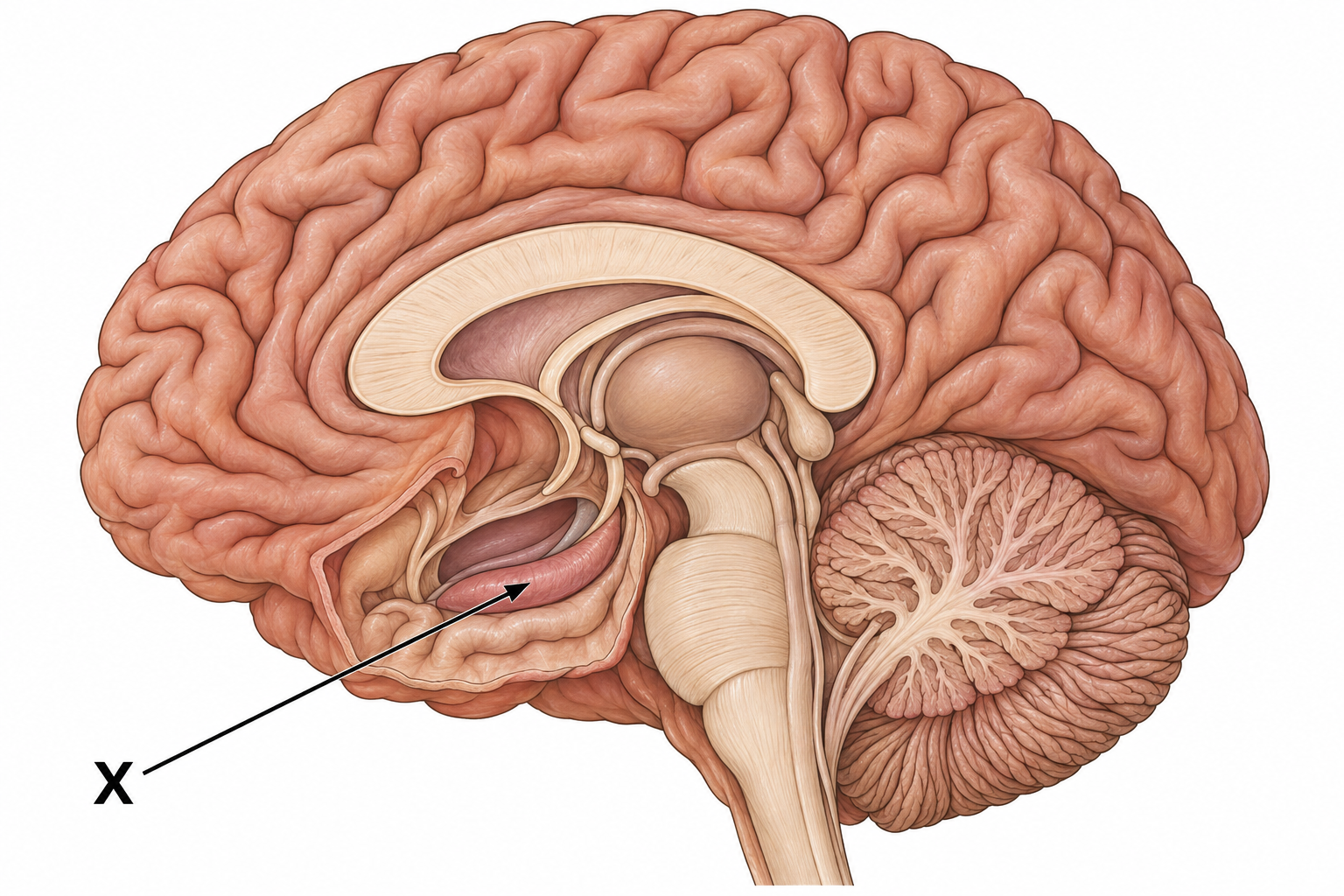
A neuropsychologist is reviewing neuroimaging for a 58-year-old patient who sustained an ischemic stroke. Structural MRI reveals localized infarction restricted to the structure labelled X in the figure. Which neurocognitive deficit is most characteristically produced by bilateral damage to this specific neuroanatomical structure?
Answer and explanation
Correct answer: D
Structure X is the hippocampus. Bilateral hippocampal damage produces severe anterograde declarative amnesia, impairing consolidation of new episodic memories, while procedural and motor skill memories remain intact.
Q3Question 3
Advanced
Scientific Orientation to Practice · 1.B.2. Data analysis methods (e.g., quantitative, qualitative, mixed) and statistical interpretation (e.g., power, effect size, causation vs. association, clinical vs. statistical significance)
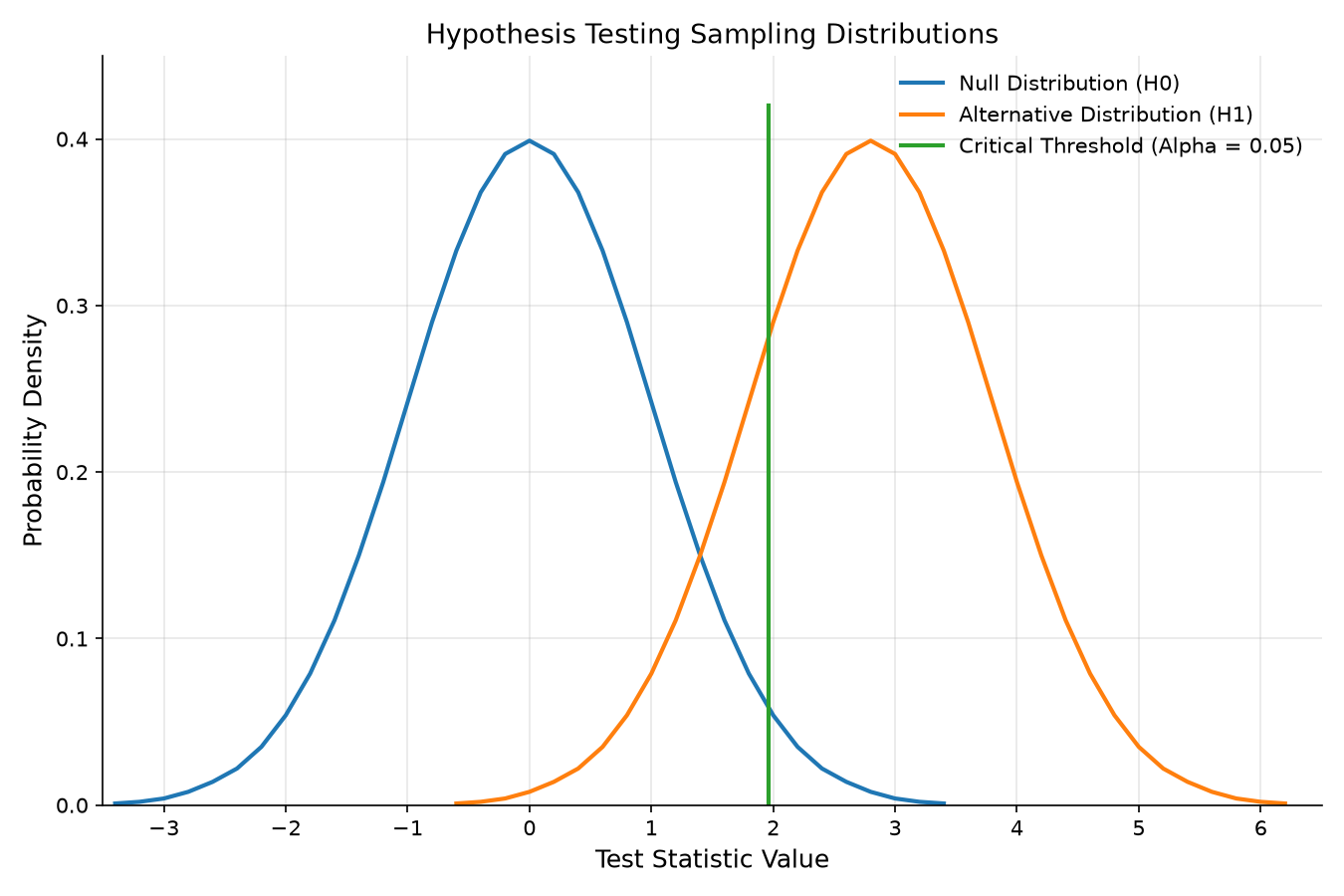
A clinical researcher designs an efficacy trial comparing an active psychotherapy protocol against treatment-as-usual. Prior to data collection, the researcher conducts a power analysis setting alpha at 0.05 (two-tailed) with a planned power of 0.80. The sampling distributions for the null (H0) and alternative (H1) hypotheses are illustrated in the figure. If the researcher increases the sample size from 40 to 120 participants per group while the true population effect size remains constant, what is the direct statistical consequence?
Answer and explanation
Correct answer: A
Increasing sample size reduces sampling variability and the standard error of the mean difference. This narrows the sampling distribution of the test statistic, directly increasing statistical power (1 - beta).
Q4Question 4
Beginner
Scientific Orientation to Practice · 1.B.2. Data analysis methods (e.g., quantitative, qualitative, mixed) and statistical interpretation (e.g., power, effect size, causation vs. association, clinical vs. statistical significance)
A psychologist analyzing outcome data from a large youth anxiety intervention computes both statistical significance and effect size metrics. In a sample of 2,000 adolescents, a post-treatment symptom reduction of 1.2 points on a 100-point rating scale yields p < .001 with an observed Cohen's d of 0.06. How should the psychologist interpret these statistical findings?
Answer and explanation
Correct answer: D
In large samples (N=2,000), even trivial score differences achieve statistical significance. An effect size of d = 0.06 is negligible, demonstrating that statistical significance does not imply meaningful clinical improvement.
Q5Question 5
Advanced
Assessment · 2.A.1. Psychometric principles (e.g., knowledge of item and test characteristics, test construction principles, standardization procedures, reliability, validity, sensitivity, specificity, test fairne
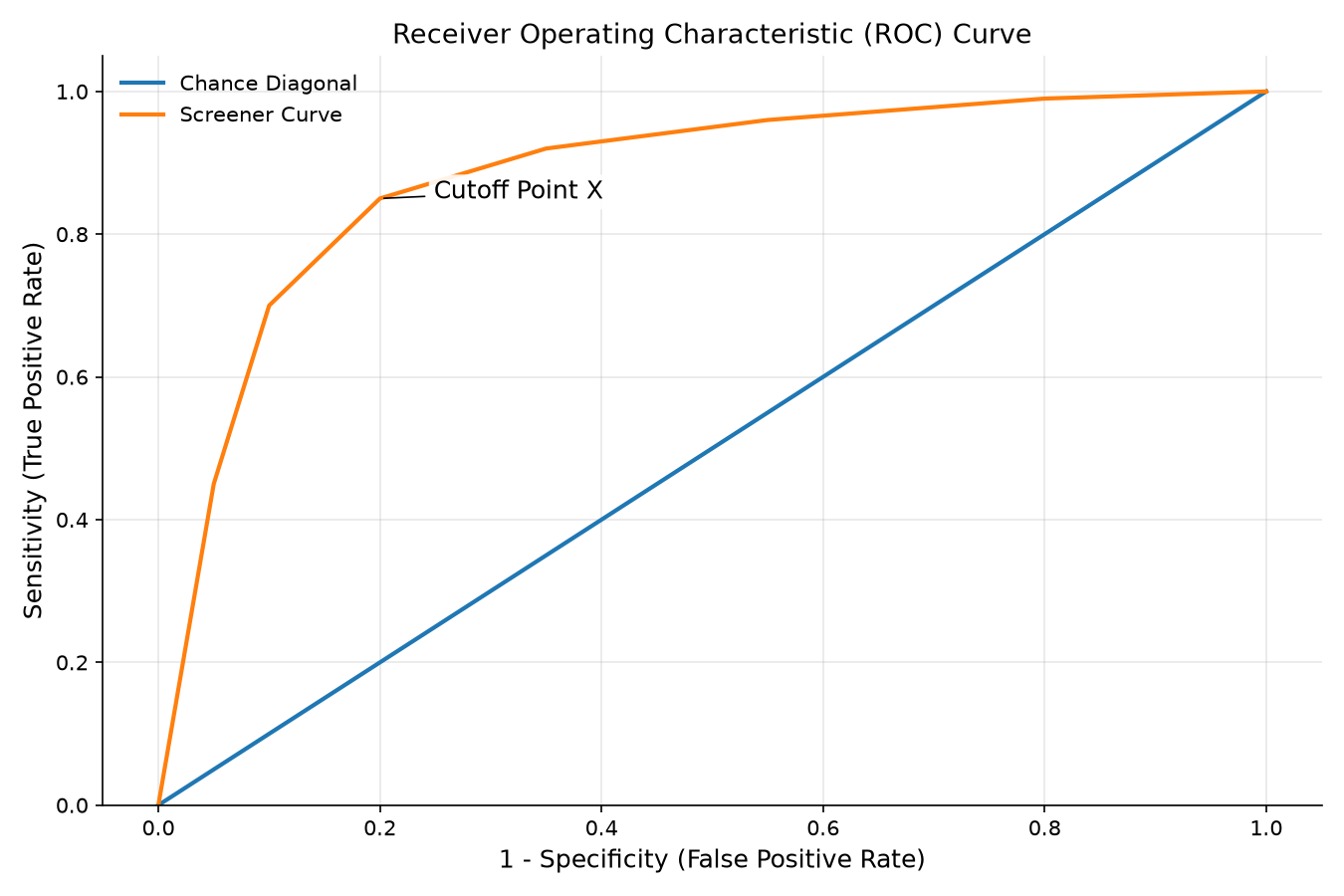
A psychologist is evaluating the diagnostic accuracy of a rapid neurocognitive screening instrument. Based on the Receiver Operating Characteristic (ROC) curve shown in the figure, Cutoff Point X corresponds to a False Positive Rate (1 - Specificity) of 0.20 and a True Positive Rate (Sensitivity) of 0.85. If the psychologist shifts the diagnostic decision threshold to a more stringent cutoff that lowers the False Positive Rate to 0.05, what is the inevitable psychometric consequence?
Answer and explanation
Correct answer: C
Shifting the diagnostic cutoff to lower the false positive rate (higher specificity) inevitably reduces sensitivity (true positive rate), causing more true cases to be missed and increasing false negatives.
Q6Question 6
Intermediate
Assessment · 2.A.1. Psychometric principles (e.g., knowledge of item and test characteristics, test construction principles, standardization procedures, reliability, validity, sensitivity, specificity, test fairne
A psychologist in an outpatient pediatric assessment center evaluates an 8-year-old child referred for suspected specific learning disorder. The psychologist administers an individually administered, standardized test of general cognitive ability and an academic achievement battery. The cognitive instrument has a published normative mean of 100 and a standard deviation of 15, with an established test-retest reliability coefficient of 0.96, resulting in a Standard Error of Measurement (SEM) of 3.0 points.
The child obtains an observed Full Scale standard score of 92. In the written evaluation report, the psychologist provides a 95% confidence interval for this score, reporting that the child's true cognitive ability is estimated to fall between standard scores of 86 and 98.
During feedback, the child's guardian asks why the evaluation provides a range of scores rather than stating a single, definitive number. In formulating an explanation based on classical test theory, what foundational measurement principle must the psychologist articulate?
Answer and explanation
Correct answer: D
Classical test theory establishes that an observed score reflects true ability plus random measurement error. The standard error of measurement (SEM) generates confidence intervals that bracket this true score.
Register free for 6 more questions
Or unlock all 156 EPPP questions with explanations, timed mode and flashcards.