The Practice of Systemic Therapy · Integrate multiple dimensions of diversity and social justice theories with systemic treatment approaches.
When conceptualizing distress in an undocumented immigrant family facing housing insecurity and deportation threats, which systemic intervention best aligns with a social justice framework?
Answer and explanation
Correct answer: C
Integrating social justice requires examining societal power imbalances and sociopolitical context, viewing systemic distress as an understandable reaction to oppression rather than pure individual or family dysfunction.
Q2Question 2
Advanced
The Practice of Systemic Therapy · Integrate multiple dimensions of diversity and social justice theories with systemic treatment approaches.
A community mental health clinic provides family therapy to a 15-year-old transgender youth and the youth's parents. The parents express distress over the adolescent's gender affirmation, citing strict religious teachings and fear of community ostracism. The adolescent reports depressive symptoms, feelings of invalidation, and severe minority stress stemming from peer bullying and familial rejection.
During the initial assessment, the therapist observes rigid family rules that penalize gender-nonconforming expression, while also acknowledging the parents' genuine fear and isolation from extended family support networks. The clinic administration encourages therapists to adhere strictly to neutral psychoeducation without addressing systemic marginalization or institutional prejudice.
The therapist must develop a culturally responsive systemic treatment plan that integrates diversity, minority stress theory, and social justice while preserving the therapeutic alliance across generational and ideological divides.
Which approach best integrates a social justice perspective into this family's systemic treatment plan while maintaining a multi-partial therapeutic stance?
Answer and explanation
Correct answer: D
Social justice systemic practice contextualizes distress within minority stress and social oppression while remaining multi-partial, fostering relational safety without dismissing parental struggles or colluding with invalidation.
Q3Question 3
Intermediate
The Practice of Systemic Therapy · Use a systemic perspective to understand the complexities inherent in therapeutic interactions (e.g., family homeostasis, self of the therapist).
During structural-strategic therapy with a conflicted couple, the therapist successfully assists the partners in direct, calm communication. Immediately following this shift, their ten-year-old child begins having severe emotional outbursts, prompting the couple to stop discussing their relationship and focus entirely on disciplining the child. The interactional loop is illustrated below. From a general systems perspective, this dynamic demonstrates which systemic mechanism?
flowchart LR
Therapist[Therapist Intervenes to Disrupt Conflict] --> Dyad[Couple Communicates Calmly]
Dyad --> ChildSymptom[Child Exhibits Behavioral Outburst]
ChildSymptom --> ParentsUnite[Parents Unite to Discipline Child]
ParentsUnite --> Homeostasis[System Returns to Baseline Balance]
Homeostasis --> Dyad
Answer and explanation
Correct answer: B
Negative feedback acts to preserve baseline family homeostasis; when marital conflict is disrupted, child symptoms unite parents around discipline, detouring dyadic tension and restoring the familiar systemic balance.
Q4Question 4
Beginner
The Practice of Systemic Therapy · Use a systemic perspective to understand the complexities inherent in therapeutic interactions (e.g., family homeostasis, self of the therapist).
A marriage and family therapist who recently finalized an acrimonious personal divorce finds themselves feeling intense irritation toward a male client who is contemplating separating from his wife. To manage the self of the therapist and uphold systemic competency, what should the clinician do FIRST?
Answer and explanation
Correct answer: B
Managing self-of-the-therapist requires clinicians to actively identify personal unresolved grief or bias through consultation and supervision, ensuring personal life experiences do not distort systemic neutrality or client care.
Q5Question 5
Intermediate
Assessing, Hypothesizing, and Diagnosing · Assess historic and current self-injurious behavior, suicidal ideation and intent, and/or homicidal ideation and intent.
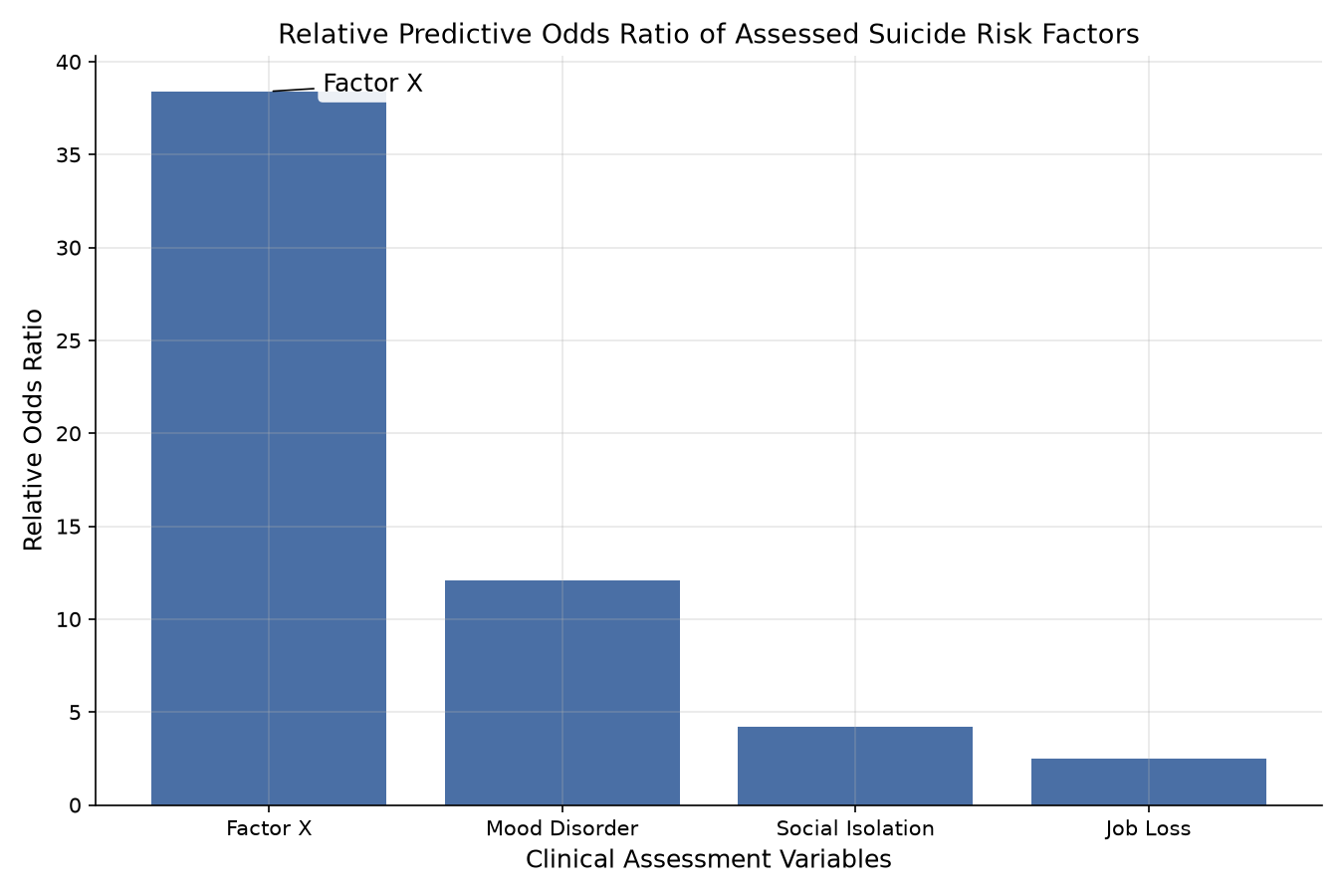
A therapist evaluates an adult client presenting with severe depressive symptoms using SAMHSA's SAFE-T framework. As depicted in the accompanying chart, Factor X demonstrates the highest predictive odds ratio for completed suicide among all clinical assessment variables. Which assessment variable corresponds to Factor X?
Answer and explanation
Correct answer: A
Prior suicide attempts are empirically documented as one of the single strongest clinical predictors of future suicidal behavior and completed suicide, carrying higher predictive weight than demographic or situational losses alone.
Q6Question 6
IntermediateMultiple answers
Assessing, Hypothesizing, and Diagnosing · Assess historic and current self-injurious behavior, suicidal ideation and intent, and/or homicidal ideation and intent.
When conducting a comprehensive suicide inquiry as part of SAMHSA's SAFE-T protocol with a client reporting recent death ideation, which TWO actions must the clinician prioritize? (Select TWO)
Answer and explanation
Correct answers: C, D
SAFE-T suicide inquiry requires evaluating plan specifics (timing, lethality, means access) and ideation details (frequency, intensity over past 48 hours, month, peak).
Detailed suicide inquiry examines both recent ideation patterns (past 48 hours and month) and worst-ever historical intensity to accurately stratify risk.
Register free for 6 more questions
Or unlock all 141 MFT questions with explanations, timed mode and flashcards.