

National Registry Paramedic Certification Examination Free Sample Questions

12 free sample questions151 in the full practice test

Try simulator

NREMT-PARAMEDIC Sample Questions

  1. Question 1

    Intermediate

    Airway, Respiration & Ventilation · Management

    A paramedic is preparing to intubate an adult female patient in respiratory failure. During direct laryngoscopy, only the epiglottis is visualized (Cormack-Lehane grade III). When advancing the endotracheal tube over a tracheal tube introducer (bougie), the paramedic aligns the feature labeled X in the figure with which anatomical landmark?
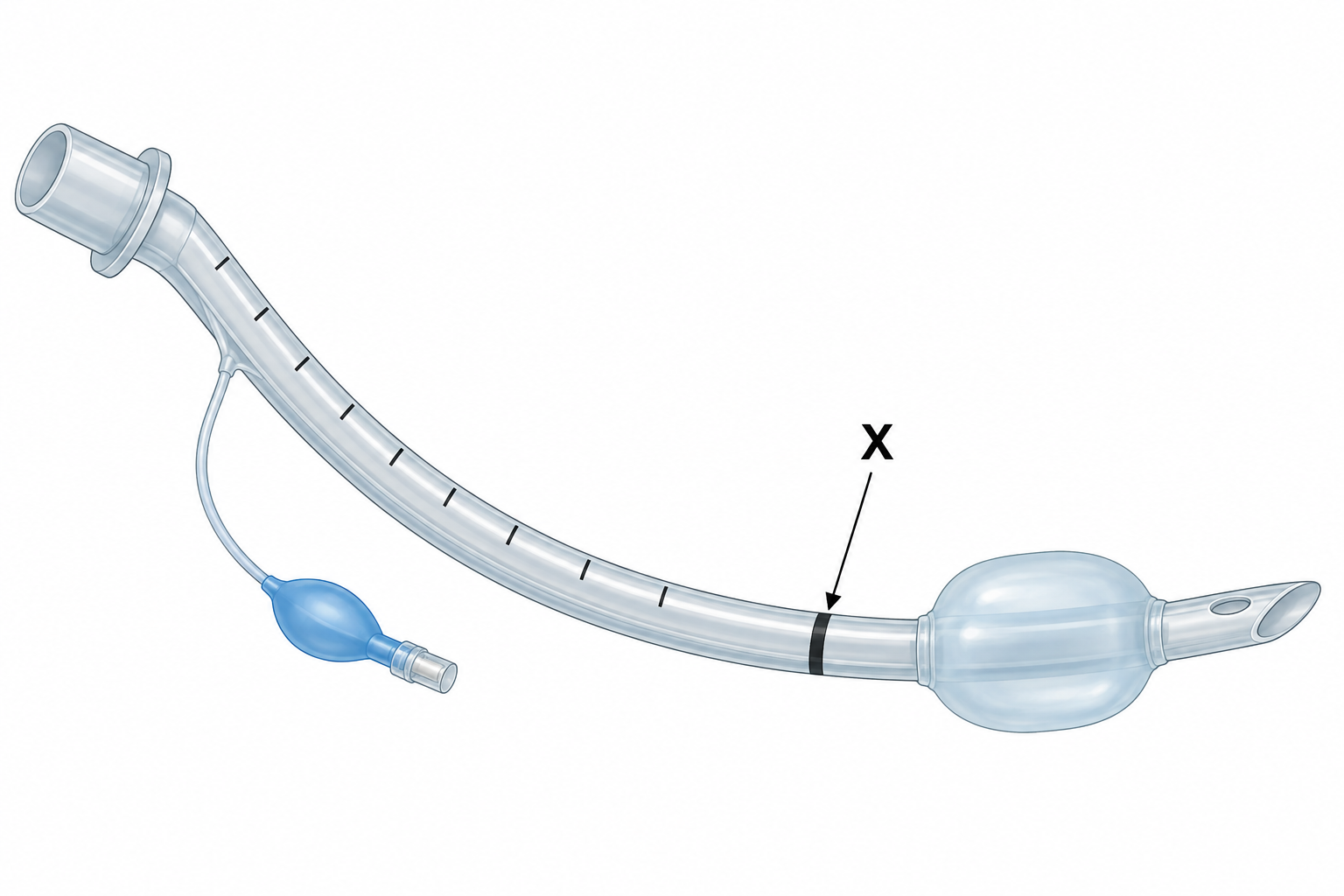
    Question 1 image
    Answer and explanation

    Correct answer: B

    The black circumferential guide mark (X) is designed to align with the vocal cords, ensuring the cuff rests below the larynx while preventing right mainstem bronchus intubation.

  2. Question 2

    Advanced

    Airway, Respiration & Ventilation · Management

    A 28-year-old male with severe traumatic brain injury following a motor vehicle collision is intubated. He displays a unilateral dilated and sluggish pupil with decerebrate posturing. Vital signs are blood pressure 178/94 mmHg, heart rate 56 bpm, and SpO2 98%. What is the appropriate ventilation strategy and target end-tidal carbon dioxide (EtCO2) level for this patient?

    Answer and explanation

    Correct answer: C

    For TBI with impending brain herniation, controlled hyperventilation is permitted only to an EtCO2 floor of 30 mmHg. Excessive hyperventilation causes cerebral vasoconstriction and secondary ischemia.

  3. Question 3

    Beginner

    Airway, Respiration & Ventilation · Management

    A 68-year-old male with acute cardiogenic pulmonary edema is receiving continuous positive airway pressure (CPAP) at 10 cmH2O. His work of breathing improves, but he suddenly pulls the mask off his face to speak to family. Why is preserving an uninterrupted mask seal critical during continuous positive airway pressure therapy?

    flowchart TD CPAP[Continuous Positive Pressure Applied] --> Alveoli[Alveoli Recruited & Fluid Displaced] Alveoli --> SealLost{Mask Seal Broken?} SealLost -->|Yes| Collapse[Immediate Loss of PEEP & Rapid Alveolar Collapse] SealLost -->|No| Oxygenation[Sustained Gas Exchange & Reduced Preload]
    Answer and explanation

    Correct answer: B

    CPAP maintains functional residual capacity by stenting open fluid-filled alveoli. Breaking the seal abruptly depressurizes the circuit, causing immediate alveolar collapse and worsening hypoxemia.

  4. Question 4

    Intermediate

    Cardiology & Resuscitation · Pathophysiology

    A 62-year-old male reports crushing substernal chest pressure radiating to his jaw, accompanied by diaphoresis and nausea. His 12-lead ECG reveals 2 mm ST-segment elevation in leads II, III, and aVF with reciprocal depressions in leads I and aVL. Blood pressure is 118/76 mmHg and heart rate is 64 bpm. Which pharmacological assessment finding represents an absolute contraindication to sublingual nitroglycerin administration?

    Answer and explanation

    Correct answer: B

    Tadalafil is a long-acting PDE-5 inhibitor; co-administration with nitroglycerin within 48 hours causes profound, life-threatening hypotension from synergistic vasodilation.

  5. Question 5

    Intermediate

    Cardiology & Resuscitation · Pathophysiology

    Following return of spontaneous circulation (ROSC) after prolonged cardiac arrest, a 58-year-old female remains comatose. Vital signs are blood pressure 82/46 mmHg (mean arterial pressure 58 mmHg), heart rate 92 bpm, SpO2 96% via endotracheal tube, and EtCO2 38 mmHg. What is the primary pathophysiological rationale for titrating vasopressors to maintain a mean arterial pressure (MAP) of at least 65 mmHg in the post-cardiac arrest phase?

    Answer and explanation

    Correct answer: A

    Following cardiac arrest, cerebral autoregulation is impaired or absent. Maintaining MAP >= 65 mmHg ensures vital coronary and cerebral perfusion, reducing secondary hypoxic brain injury.

  6. Question 6

    Advanced

    Cardiology & Resuscitation · Management

    Paramedics are treating a 54-year-old male in out-of-hospital ventricular fibrillation cardiac arrest. High-quality CPR is ongoing, two defibrillation shocks have been delivered, and 1 mg of epinephrine IV has been administered. The rhythm check shows persistent, coarse ventricular fibrillation. Which antiarrhythmic regimen is indicated next according to current resuscitation guidelines?

    Answer and explanation

    Correct answer: A

    For shock-refractory VF/pVT, the first-line antiarrhythmic is amiodarone 300 mg IV/IO bolus (or alternatively lidocaine 1.0–1.5 mg/kg IV/IO). The second amiodarone dose is 150 mg.

Register free for 6 more questions

Or unlock all 151 NREMT-PARAMEDIC questions with explanations, timed mode and flashcards.