

Fortinet NSE 7 - Secure Access 6.2 Free Sample Questions

Description

Covers Security Fabric and NAC architecture, LDAP and RADIUS authentication, 802.1X wired security on FortiSwitch, wireless security with FortiAP, and centralized management.

4 free sample questions30 in the full practice test

Try simulator

NSE7_SAC-6.2 Sample Questions

  1. Question 1

    Which step can be taken to ensure that only FortiAP devices receive IP addresses from a DHCP server on FortiGate?

    Answer and explanation

    Correct answer: C

    Configure a VCI (Vendor Class Identifier) string value of FortiAP in the DHCP server settings to ensure only FortiAP devices receive IP addresses. The VCI is a DHCP option that FortiAP devices automatically include in their DHCP requests, allowing the FortiGate DHCP server to identify and selectively assign IP addresses to legitimate FortiAP devices while denying DHCP requests from other devices. Interface addressing mode changes affect IP assignment methods, not device filtering. Reservation lists require knowing specific MAC addresses in advance. DHCP option 138 is for specific configuration parameters, not device identification.
  2. Question 2

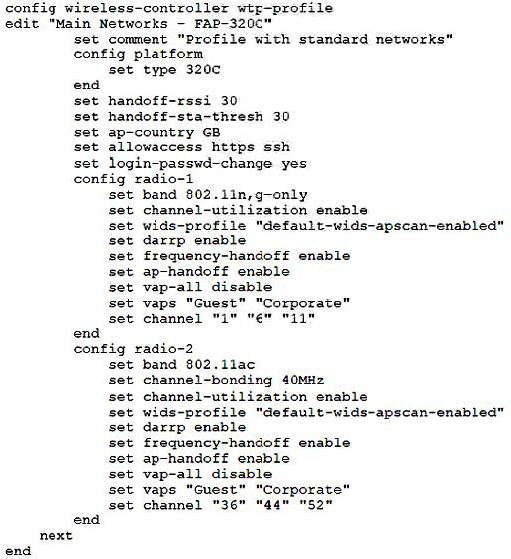
    Refer to the exhibit.

    In the WTP profile configuration shown in the exhibit, the AP profile is assigned to two FAP-320 APs that are installed in an open plan office.

    The first AP has 32 clients associated to the 5GHz radios and 22 clients associated to the 2.4GHz radio.

    The second AP has 12 clients associated to the 5GHz radios and 20 clients associated to the 2.4GHz radio.

    A dual band-capable client enters the office near the first AP and the first AP measures the new client at 33 dBm signal strength. The second AP measures the new client at 43 dBm signal strength.

    In the new client attempts to connect to the corporate wireless network, to which AP radio will the client be associated?

    Question 2 image
    Answer and explanation

    Correct answer: A

    Based on the WTP profile configuration shown in the image, with both APs having high client counts (32 on 5GHz, 22 on 2.4GHz for the first AP), the load balancing mechanism will direct new clients to the second AP 5GHz interface. The configuration shows channel bonding set to 40MHz and channel utilization enabled, which automatically distributes clients across available APs and radios based on current load. Since the first AP already has high utilization on both radios, new clients will be steered to the less loaded second AP, specifically the 5GHz interface which typically has better performance characteristics.

Register free for 2 more questions

Or unlock all 30 NSE7_SAC-6.2 questions with explanations, timed mode and flashcards.