A company has just rolled out new remote sites and now you need to deploy a single firewall policy to all of these sites to allow Internet access using FortiManager. For this particular firewall policy, the source address object is called LAN, but its value will change according to the site the policy is being installed.
Which statement about creating the object LAN is correct?
Answer and explanation
Correct answer: A
A
Question 2
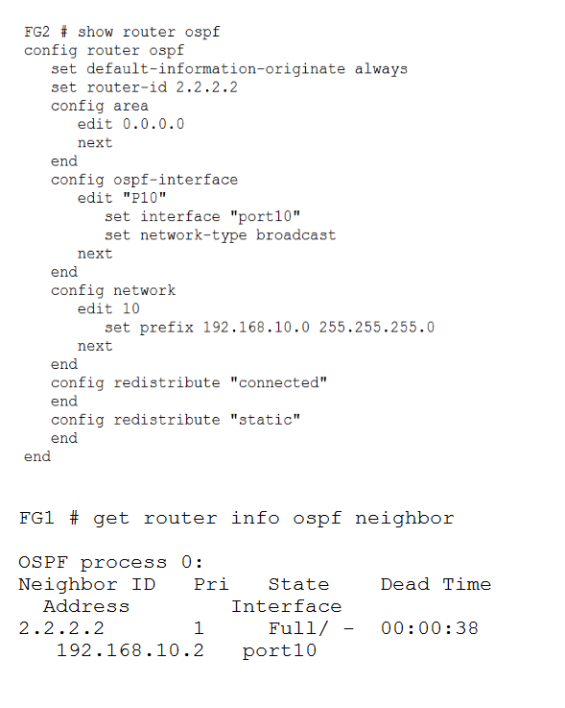
Refer to the exhibit.
A customer is using dynamic routing to exchange the default route between two FortiGate devices using OSPFv2. The output of the get router info ospf neighbor command shows that the neighbor is up, but the default route does not appear in the routing neighbor shown below.
According to the exhibit, what is causing the problem?
Answer and explanation
Correct answer: C
C
Question 3
Multiple answers
A company has just deployed a new FortiMail in gateway mode. The administrator is asked to strengthen e-mail protection by applying the policies shown below.
• E-mails can only be accepted if a valid e-mail account exists. • Only authenticated users can send e-mails out.
Which two actions will satisfy the requirements? (Choose two.)
Answer and explanation
Correct answers: A, D
A, D
Question 4
Multiple answers
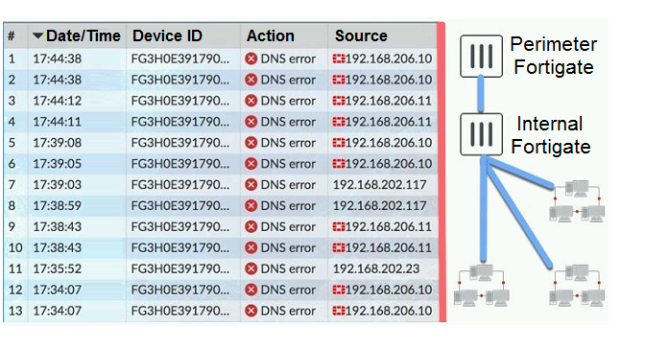
Refer to the exhibit.
You have deployed several perimeter FortiGate devices with internal segmentation FortiGate devices behind them. All FortiGate devices are logging to FortiAnalyzer. When you search the logs in FortiAnalyzer for denied traffic, you see numerous log messages, as shown in the exhibit, on your perimeter FortiGate device only.
Which two actions will reduce the number of these log messages? (Choose two.)
Answer and explanation
Correct answers: A, D
A, D
Question 5
Multiple answers
A customer wants to use a central RADIUS server for management authentication when connecting to the FortiGate GUI and to provide different levels of access for different types of employees.
Which three actions are required to provide the requested functionality? (Choose three.)
Answer and explanation
Correct answers: A, C, D
A, C, D
Question 6
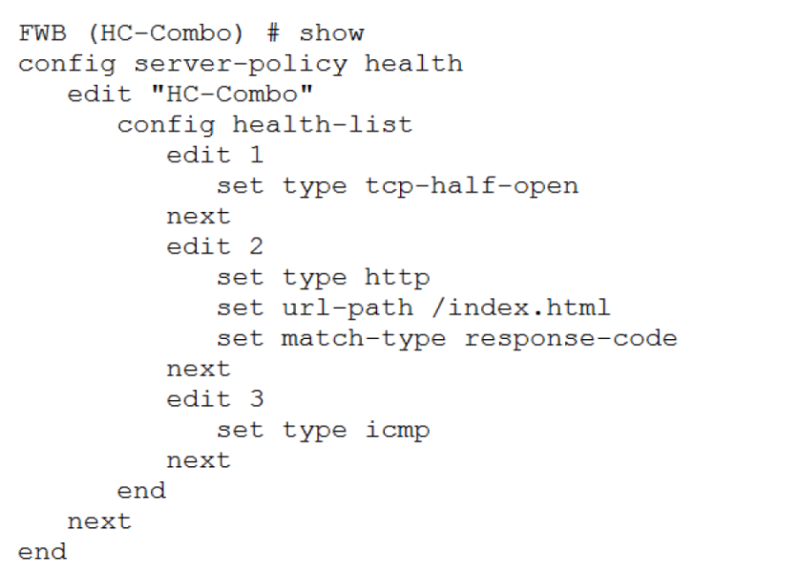
Refer to the exhibit.
You created a custom health-check for your FortiWeb deployment.
Given the output shown in the exhibit, which statement is true?