A radiographer mistakenly performs a PA and lateral chest examination on the wrong patient after failing to verify two standard hospital identifiers. Upon discovering the mistake, the radiographer observes that the patient experienced no physical injury or physiological distress. In accordance with Rule 22 of the ARRT Standards of Ethics, what is the radiographer's mandatory obligation?
Answer and explanation
Correct answer: C
ARRT Rule of Ethics 22 mandates immediate supervisor notification for any error in patient care or imaging, even if no injury occurs. Self-reporting is mandatory.
Q2Question 2
AdvancedMultiple answers
Patient Care · Ethical and Legal Aspects
Under the ARRT Standards of Ethics (Rules 10, 11, and 12), which TWO clinical scenarios represent actionable violations regarding delegation, supervision, and professional scope of practice? (Select TWO)
Answer and explanation
Correct answers: D, E
Rules 10-12 forbid enabling unlicensed personnel to practice or delegating tasks endangering safety outside competencies. Assisting nursing or using sponges is standard practice.
Rule 10 forbids performing tasks outside clinical competency or training without direct supervision. Endangering patient safety violates Rule 12 without requiring injury.
Q3Question 3
Intermediate
Patient Care · Pharmacology
A 68-year-old male with long-standing type 2 diabetes mellitus and peripheral artery disease presents for a scheduled intravenous contrast-enhanced radiographic study of the urinary system. During pre-examination medication reconciliation, the radiographer observes the patient takes daily metformin, lisinopril, and therapeutic doses of naproxen.
Which clinical decision aligns with established pharmacological safety guidelines for this patient?
Answer and explanation
Correct answer: C
An eGFR below 30 mL/min/1.73 m² denotes severe renal impairment, contraindicating elective intravascular iodinated contrast. Barium can never be given IV.
Q4Question 4
Beginner
Patient Care · Pharmacology
Approximately three minutes after an intravenous injection of non-ionic iodinated contrast media, a patient suddenly complains of widespread itching and develops localized urticaria and mild facial erythema. The patient's blood pressure is 124/78 mmHg, pulse is 76 bpm, and respiration is 16 breaths per minute with uncompromised breathing. How is this adverse event categorized, and what is the primary radiographer action?
Answer and explanation
Correct answer: C
Urticaria, pruritus, and erythema without airway compromise or hypotension represent a mild systemic reaction. Moderate reactions include bronchospasm or extensive vomiting.
Q5Question 5
Intermediate
Patient Care · Infection Control
A hospitalized inpatient with confirmed active cavitary pulmonary tuberculosis requires transport to the imaging suite for chest radiography. According to CDC Transmission-Based Precautions guidelines, what environmental control and personal protective equipment protocols are required?
Answer and explanation
Correct answer: A
TB requires Airborne Precautions, including an AIIR with negative pressure, 6-12 air exchanges/hour, and HEPA filtration or direct outside exhaust.
flowchart LR
Source[Active TB Patient] -->|Airborne Droplet Nuclei| Air[AIIR 6-12 ACH Negative Pressure]
Air --> Filter[HEPA Filter / Direct Exhaust]
Staff[Radiographer] -->|Wears| N95[Fit-Tested N95 Respirator]
Q6Question 6
Intermediate
Safety · Principles of Radiation Physics
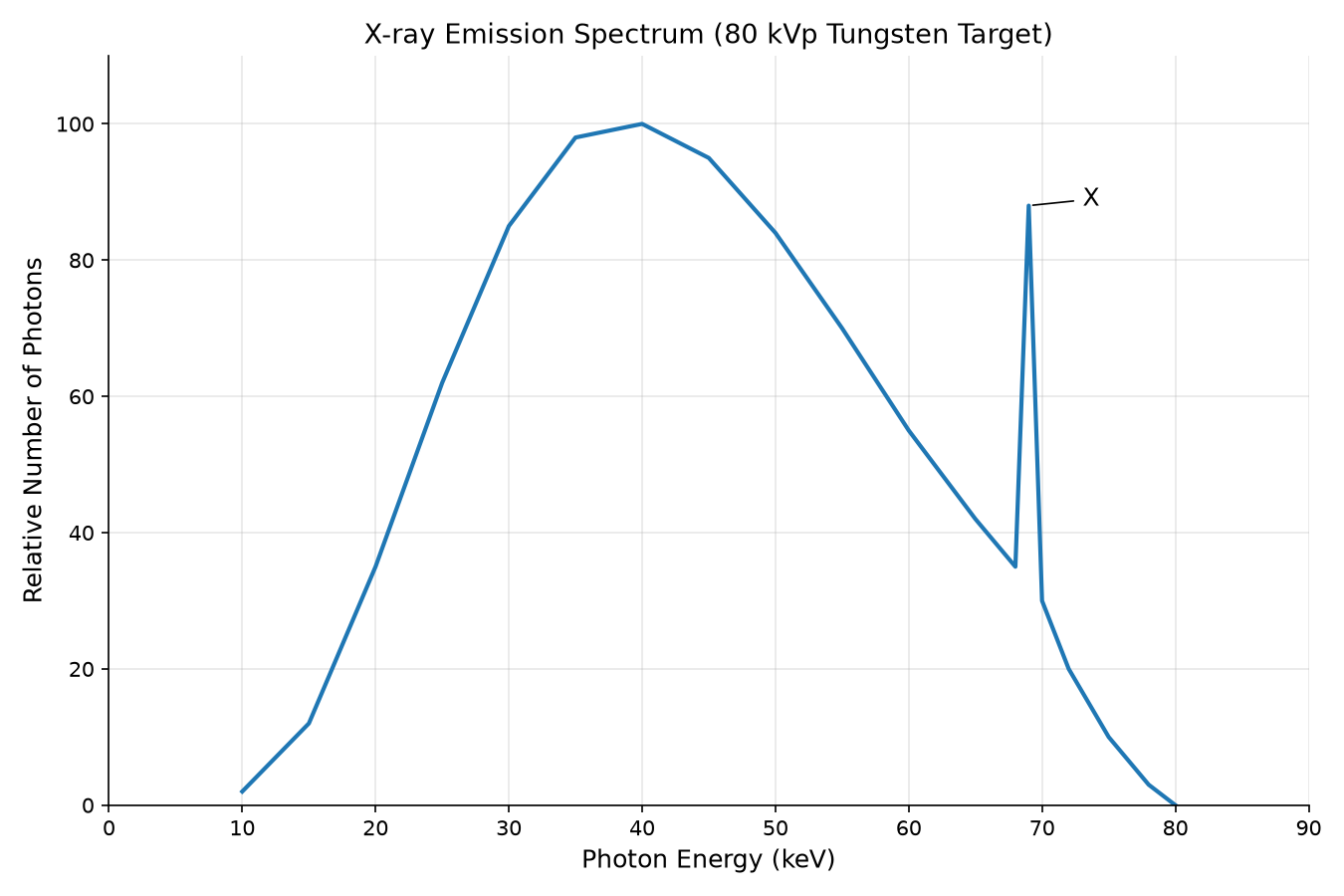
Based on the X-ray emission spectrum shown in the figure for a tungsten target operated at 80 kVp, which physical mechanism accounts for the broad continuous spectrum of photon energies below label X?
Answer and explanation
Correct answer: B
Bremsstrahlung produces 85-90% of the beam at 80 kVp as electrons decelerate near tungsten nuclei. Characteristic x-rays produce discrete peaks.
Register free for 6 more questions
Or unlock all 165 RADIOGRAPHY questions with explanations, timed mode and flashcards.