Question 1
Q1Multiple answersWhich three statements are true about tablespaces in a multitenant container database (CDB)? (Choose three.)
Show answer & explanation
Correct answers: B, D, E
B,D,E

Create a free account to browse all 20 sample questions. The full practice test includes 215 questions. Use the simulator for timed and flashcard mode.
Which three statements are true about tablespaces in a multitenant container database (CDB)? (Choose three.)
Correct answers: B, D, E
B,D,E
Which two statements are true about variable extent size support for large ASM files? (Choose two.)
Correct answers: A, D
A,D
Examine the current values for the following parameters in your database instance:
SGA_MAX_SIZE = 1024M
SGA_TARGET = 700M
DB_8K_CACHE_SIZE = 124M
LOGJ3UFFER = 200M
You issue the following command to increase the value of DB_8K_CACHE_SIZE: SQL> ALTER SYSTEM SET DB_8K_CACHE_SIZE=140M;
Which statement is true?
Correct answer: A
A
In order to exploit some new storage tiers that have been provisioned by a storage administrator, the partitions of a large heap table must be moved to other tablespaces in your Oracle 12c database?
Both local and global partitioned B-tree indexes are defined on the table.
A high volume of transactions access the table during the day and a medium volume of transactions access it at night and during weekends.
Minimal disruption to availability is required.
Which three statements are true about this requirement? (Choose three.)
Correct answers: A, B, C
A,B,C--Expiration:
A: You can create and rebuild indexes online. Therefore, you can update base tables at the same time you are building or rebuilding indexes on that table. You can perform DML operations while the index build is taking place, but DDL operations are not allowed. Parallel execution is not supported when creating or rebuilding an index online.
D: Moving (Rebuilding) Index-Organized Tables Because index-organized tables are primarily stored in a B-tree index, you can encounter fragmentation as a consequence of incremental updates. However, you can use the ALTER TABLE...MOVE statement to rebuild the index and reduce this fragmentation.
C: If a table can be compressed in the new tablespace, also it can be compressed in the same tablespace.
Incorrect answers:
B: Local and Global indexes can be automatically rebuild with UPDATE INDEXES when you move the table.--
References: http://www.oracle.com/technetwork/issue-archive/2014/14-may/o34dba-2193424.html
Which three statements are true about SQL plan directives? (Choose three.)
Correct answers: B, C, D
B,C,D
On your Oracle 12c database, you issue the following commands to create indexes:
SQL> CREATE INDEX oe.ord_customer_ix1 ON oe.orders (customerjd, sales_rep_id);
SQL> CREATE BITMAP INDEX oe.ord_customer_ix2 ON oe.orders (customerjd, sales_rep_id);
Which statement is correct?
Correct answer: C
C
You are the DBA supporting an Oracle 11g Release 2 database and wish to move a table containing several DATE, CHAR, VARCHAR2, and NUMBER data types, and the table’s indexes, to another tablespace.
The table does not have a primary key and is used by an OLTP application.
Which technique will move the table and indexes while maintaining the highest level of availability to the application?
Correct answer: A
A--Explanation:
You performed an incremental level 0 backup of a database:
RMAN> BACKUP INCREMENTAL LEVEL 0 DATABASE;
To enable block change tracking after the incremental level 0 backup, you issued this command:
SQL> ALTER DATABASE ENABLE BLOCK CHANGE TRACKING USING FILE 7mydir/rman_change_track.f;
To perform an incremental level 1 cumulative backup, you issued this command:
RMAN> BACKUP INCREMENTAL LEVEL 1 CUMULATIVE DATABASE;
Which three statements are true? (Choose three.)
Correct answers: B, C, E
B,C,E--Explanation:
A: In a cumulative level 1 backup, RMAN backs up all the blocks used since the most recent level 0 incremental backup.
E: Oracle Block Change Tracking Once enabled; this new 10g feature records the modified since last backup and stores the log of it in a block change tracking file using the CTW (Change Tracking Writer) process. During backups RMAN uses the log file to identify the specific blocks that must be backed up. This improves RMAN's performance as it does not have to scan whole datafiles to detect changed blocks. Logging of changed blocks is performed by the CTRW process which is also responsible for writing data to the block change tracking file.
Note: * An incremental level 0 backup backs up all blocks that have ever been in use in this database.
Which two partitioning methods are suitable for a parent table when using reference partitioning in Oracle Database 12c? (Choose two.)
Correct answers: B, C
B,C
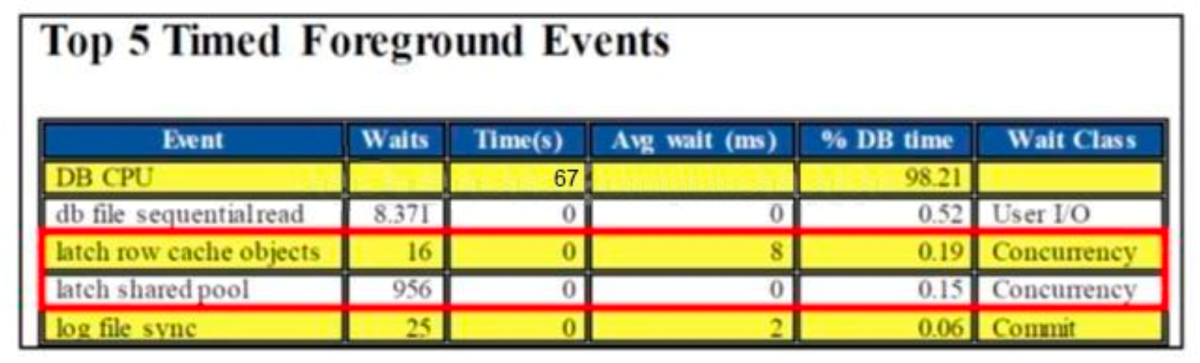
Examine the details of the Top 5 Timed Events in the following Automatic Workloads Repository (AWR) report:
What are three possible causes for the latch-related wait events? (Choose three.)
Correct answers: A, C, E
A,C,E
Register free to unlock 10 more sample questions
Create a free account to continue with the rest of the 1z0-060 sample set.
Own this practice test forever.
Any 2 exams per month.
Any 4 exams per month.
Any 12 exams over 3 months.







