Covers planning and securing Azure AI Foundry services, building and operationalizing generative AI solutions, creating custom agents, analyzing images and video, and knowledge mining.
17 free sample questions251 in the full practice test Other version: AI-100(50)
You need to build a chatbot that meets the following requirements:✑ Supports chit-chat, knowledge base, and multilingual models✑ Performs sentiment analysis on user messages✑ Selects the best language model automaticallyWhat should you integrate into the chatbot?
Answer and explanation
Correct answer: C
Question 2
Your company wants to reduce how long it takes for employees to log receipts in expense reports. All the receipts are in English.You need to extract top-level information from the receipts, such as the vendor and the transaction total. The solution must minimize development effort.Which Azure service should you use?
Answer and explanation
Correct answer: C
Question 3
Multiple answers
You are developing a new sales system that will process the video and text from a public-facing website.You plan to monitor the sales system to ensure that it provides equitable results regardless of the user's location or background.Which two responsible AI principles provide guidance to meet the monitoring requirements? Each correct answer presents part of the solution.NOTE: Each correct selection is worth one point.
Answer and explanation
Correct answers: B, C
Question 4
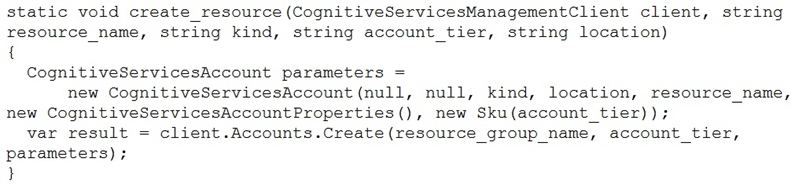
You have the following C# method for creating Azure Cognitive Services resources programmatically.You need to call the method to create a free Azure resource in the West US Azure region. The resource will be used to generate captions of images automatically.Which code should you use?
You are designing an autonomous customer support solution for a telecommunications company using Azure AI Agent Service. The system must autonomously handle complex user refunds by looking up customer data, calculating refund eligibility based on usage logs, and submitting refund requests to a legacy payment system via REST API. The agent must be able to reason through the steps without a hardcoded workflow. Which component should you implement to enable the agent to interact with the external payment system?
Answer and explanation
Correct answer: A
To enable an AI agent to interact with external systems, you must define tools (often using function calling or plugin definitions). Providing an OpenAPI specification allows the agent to understand the API structure, parameters, and return values, enabling it to construct the correct API calls dynamically based on its reasoning.
Question 7
You are implementing a multi-agent system using the AutoGen framework to generate software code. You need to configure a specific agent that executes the code generated by the 'Assistant' agent to validate it. This agent should run within a Docker container to prevent malicious code execution on the host system. Which type of agent configuration should you use?
Answer and explanation
Correct answer: A
In AutoGen, the UserProxyAgent is typically responsible for executing code. To ensure security and isolation, you configure the code_execution_config parameter to specify a Docker container image. This ensures that any code generated by the Assistant agent runs in an isolated environment.
Question 8
You are optimizing a Retrieval-Augmented Generation (RAG) solution in Azure AI Foundry. Users report that the model answers are accurate but often lack cohesion when summarizing long documents split into many small chunks. You need to improve the flow of the answers without losing the detail provided by the chunks. What should you adjust in your chunking strategy?
Answer and explanation
Correct answer: A
Increasing the overlap between chunks ensures that context is preserved across chunk boundaries. This helps the LLM generate more cohesive answers because adjacent chunks share bridging information, reducing disjointed transitions in the retrieved context.