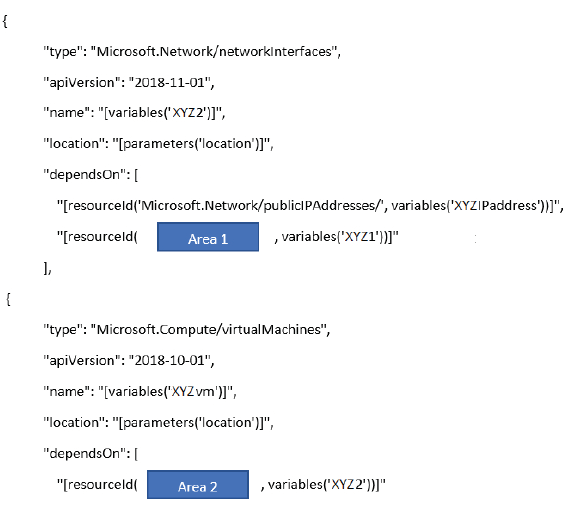
You have to deploy an Azure virtual machine using an Azure Resource Manager template. Below are snippets of the template. You have to complete the definition of the template:
Which of the following would go into Area 2?
Answer and explanation
Correct answer: C
Explanation: Here we have to mention the dependency on the virtual network interface When you implement an ARM template forthe deployment of the virtual machine, this dependency is evident.
Question 2
You have a set of virtual machines that are hosting mission-critical applications. You have to ensure the virtual machines experience as little downtime as possible. Which of the following can you use to maintain application availability when an Azure datacenter fails?
Answer and explanation
Correct answer: C
Explanation: You can use Availability zones to help protect against datacenter level failures. The Microsoft documentation mentions the following:Availability ZonesAn Availability Zone is a high-availability offering that protects your applications and data from datacenter failures. Availability Zones are unique physical locations within an Azure region. Each zone is made up ofone or more datacenters equipped with independent power, cooling, and networking. To ensure resiliency, there's a minimum ofthree separate zones in all enabled regions. The physical separation ofAvailability Zones within a region protects applications and data from datacenter failures. Zone-redundant services replicate your applications and data across Availability Zones to protect from single-points-of-failure. With Availability Zones, Azure offers industry best 99.99% VM uptime SLA. The full Azure SLA explains the guaranteed availability ofAzure as a whole. An Availability Zone in an Azure region is a combination of a fault domain and an update domain. For example, if you create three or more VMs across three zones in an Azure region, your VMs are effectively distributed across three fault domains and three update domains. The Azure platform recognizes this distribution across update domains to make sure that VMs in different zones are not scheduled to be updated at the same time. Since this is clearly given in the Microsoft documentation, all other options are incorrect -- Reference: https://docs.microsoft.com/en-us/azu re/ava ilab i I ity-zones/az-overview
Question 3
A company wants to sync their on-premise AD with Azure A
Answer and explanation
Correct answer: C
Explanation: This issue is also mentioned in the Microsoft documentation. Staging modeStaging mode can be used for several scenarios, including:• High availability.• Test and deploy new configuration changes.• Introduce a new server and decommission the old. During installation, you can select the server to be in staging mode. This action makes the server active for import and synchronization, but it does not run any exports. A server in staging mode is not running password sync or password writeback, even ifyou selected these features during installation. When you disable staging mode, the server starts exporting, enables password sync, and enables password writeback. Since this is clearly mentioned in the documentation, all other options are incorrect -- Reference: httDs://docs.microsoft.com/en-us/azure/active-directory/hybrid/how-to-connect-sync-staging-serverIt
Question 4
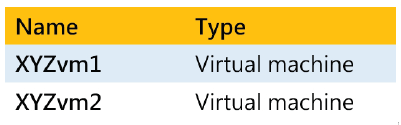
A company has setup the following Azure Virtual Machines in Azure:
There is a requirement to setup a load balancer in Azure and ensure the Virtual Machines are placed behind the load balancer. It needs to be ensured that session affinity is in place for requests flowing via the Load balancer. In which of the following section of the Load balancerwould you define this?
Answer and explanation
Correct answer: C
Explanation: You will define this in the load balancing rule as shown below:Add load balancing rule? X* Namedemo* IP Version® IPv4 O IPv6* Frontend IP address eI 51.140.87.135 (LoadBalancerFrontEnd)Protocol®TCP QUDP* PortI 80* Backend portFsoBackend pool eI demopool (1 virtual machine7Health probedemoprobe (TCP:80))Session persistence 6NoneNoneClient IPClient IP and protocolFloating lP (direct server retur
Question 5
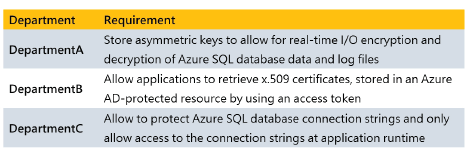
Your company needs to deploy resources for several departments. These resources will reside in Azure. Each department has a separate requirement when it comes to security.
Which of the following would you use to fulfil the requirement for DepartmentA?
Answer and explanation
Correct answer: C
Explanation: You can use the Azure Key vault service for the storage of encryption keys The Microsoft documentation mentions the following:About Azure Key VaultAzure Key Vault helps solve the following problems:• Secrets Management - Azure Key Vault can be used to Securely store and tightly control access to tokens, passwords, certificates, API keys, and other secrets• Key Management - Azure Key Vault can also be used as a Key Management solution. Azure Key Vault makes it easy to create and control the encryption keys used to encrypt your data.• Certificate Management - Azure Key Vault is also a service that lets you easily provision, manage, and deploy public and private Transport Layer Security/Secure Sockets Layer (TLS/SSL) certificates for use with Azure and your internal connected resources.• Store secrets backed by Hardware Security Modules - The secrets and keys can be protected either by software or FIPS 140-2 Level 2 validated HSMsSince this is clearly given in the Microsoft documentation, all other options are incorrect -- Reference: https://docs.microsoft.com/en-us/azure/key-vault/general/overview
Question 6
Case study
This is a case study. Case studies are not timed separately. You can use as much exam time as you would like to complete each case. However, there may be additional case studies and sections on this exam. You must manage your time to ensure that you are able to complete all questions included on this exam in the time provided.
To answer the questions included in a case study, you will need to reference information that is provided in the case study. Case studies might contain exhibits and other resources that provide more information about the scenario that is described in the case study. Each question is independent of the other questions in this case study.
At the end ofthis case study, a review screen will appear. This screen allows you to review your answers and to make changes before you move to the next section of the exam. After you begin a new section, you cannot return to this section.
To start the case study To display the first question in this case study, click the Next button. Use the buttons in the left pane to explore the content of the case study before you answerthe questions. Clicking these buttons displays information such as business requirements, existing environment, and problem statements. If the case study has an All Information tab, note that the information displayed is identical to the information displayed on the subsequent tabs. When you are ready to answer a question, click the Question button to return to the question.
Overview XYZ is an online training
ON-Premise Environment Currently XYZ has a set of applications running on their on-premise environment. The applications are hosted on Virtual machines hosted on a VMware environment managed by vCenter server 6.5. • The Virtual Machines are all part of an Active Directory forest named XYZ.com. • All of the virtual machines run Windows Server 2016. • The Mumbai office has a virtual_ machine named demo-virtual that has the vSphere console installed.
The company currently has the following offices with their associated IP address spaces: • The offices are connected by using a VPN connection. • Each office also has one Azure Expressroute circuit. This provides access to Azure services and Microsoft Online Services.
Azure Environment The following resources have been setup in Azure:
• XYZ-gateway1 has 2 backend pools named Pool A and Pool B • XYZ-gateway2 has 2 backend pools named Pool C and Pool.
Planned Changes • Virtual Machines from the Mumbai office need to be migrated to the East US Azure region using Site Recovery • An Azure Web app named XYZ-app needs to be deployed • Capacity planning needs to be carried out for the Virtual Machines that UICI be migrated from on premise to Azure • The Application gateway XYZ-gateway must balance incoming traffic as shown belowhttp://XYZ.com/videoP will be load balanced across Pool Ahttp://XYZ.com/images will be Load balanced across Pool B • The Application gateway XYZ-gateway2 must balance incoming traffic as shown below
Answer and explanation
Correct answer: B
B
Question 7
*Case study This is a case study. Case studies are not timed separately. You can use as much exam time as you would like to complete each case. However, there may be additional case studies and sections on this exam. You must manage your time to ensure that you are able to complete all questions included on this exam in the time provided.
To answer the questions included in a case study, you will need to reference information that is provided in the case study. Case studies might contain exhibits and other resources that provide more information about the scenario that is described in the case study. Each question is independent of the other questions in this case study.
At the end ofthis case study, a review screen will appear. This screen allows you to review your answers and to make changes before you move to the next section of the exam. After you begin a new section, you cannot return to this section.
To start the case studyTo display the first question in this case study, click the Next button. Use the buttons in the left pane to explore the content of the case study before you answerthe questions. Clicking these buttons displays information such as business requirements, existing environment, and problem statements. If the case study has an All Information tab, note that the information displayed is identical to the information displayed on the subsequent tabs. When you are ready to answer a question, click the Question button to return to the question.
Overview XYZ is an online training provider.
Current System
Training SiteThe system consists of 3 tiers: •Front end Web App •Middle tierAPI •Back end data storeThe backend is running on Microsoft SQL server 2016. All servers are running on Windows. The Front and Middle tiers are written in C# and hosted on Internet Information Services. The system currently has the following requirements: •The front and middle tier components currently make use of encryption keys to access the data store. •Backups are maintained in 2 separate locations that are 80 miles apart. •The backups need to be stored for up to 5 years. •Traffic to the servers needs to be controlled via source IP address and port no. •Access to the system should only be via the internal network ofXYZ.Current System - Processing systemXYZ also has an internal processing system. This is a C# Windows based service that gets invoked based on requests from the main training system. Each invocation ofthis service lasts for a maximum of2 minutes. Planned ChangesXYZ wants to migrate all systems to Azure. Key requirements •Infrastructure services must remain available if a region or a data center fails. •Failover must occurwithout any administrative intervention. •Wherever possible. Azure managed serves must be used to management overhead. •Whenever possible, costs must be minimized. •An SLA of 99.95% must be guaranteed on the Infrastructure for the front and middle tier systems. You need to comply with the below requirement: “Traffic to the servers needs to be controlled via source IP address and port no. You decide to implement custom route tables for the subnets hosting the Virtual Machines. Does this fulfil the requirement?
Answer and explanation
Correct answer: B
B
Question 8
A company is planning on deploying a web application onto Azure. The web application will be deployed onto the Azure Web App service. The company has the following requirements:
Provide support for efficient processing of SSL encryption and decryption to support high traffic loads on the web application.
Provide support to protect the web application against web vulnerabilities and attacks without modifying the backend code.
Be able to optimize web application responsiveness and reliability by routing HTTP requests and responses to the endpoint with the lowest network latency for the client.
Which of the following can be used forthe following requirement?
Provide support for efficient processing of SSL encryption and decryption to support high traffic loads on the web application.
Answer and explanation
Correct answer: A
Explanation: The Azure Application Gateway service has the ability to provide SSL offloading. This helps in the SSL encryption and decryption. The Microsoft documentation mentions the following:Overview ofTLS termination and end to end TLS with Application GatewayTransport Layer Security (TLS), previously known as Secure Sockets Layer (SSL), is the standard security technology for establishing an encrypted link between a web server and a browser. This link ensures that all data passed between the web server and browsers remain private and encrypted. Application gateway supports both TLS termination at the gateway as well as end to end TLS encryption. Since this is clearly mentioned in the Microsoft documentation, all other options are incorrect -- Reference: https://docs.microsoft.com/en-us/azure/application-gateway/ssl-overview
Question 9
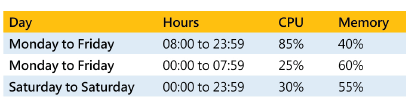
Your company has an Azure Web app hosted using the Standard App Service Plan. The application currently runs on three instances. The Autoscale condition set of the Web App has the following conditions: • The minimum number of instances is set to one • The maximum number of instances is set to fiveThe following rules are set: • Decrease the instance count by one when the CPU percentage is less than 30% • Decrease the instance count by one when the Memory percentage is less than 50% • Increase the instance count by one when the CPU percentage is greater than 80% • Increase the instance count by one when the Memory percentage is greater than 75%
The following table depicts the expected application utilization:
What is the maximum number of instances that would be running on Monday to Friday from 08:00 to 23:59?
Answer and explanation
Correct answer: D
Explanation: Here the scale out condition of “Increase the instance count by one when the CPU percentage is greater than 80% will be met. Hence the number of instances will keep on increasing till the maximum limit. The scale in condition of'Decrease the instance count by one when the Memory percentage is less than 50% will be ignored because you need to have both of the scale in conditions that need to be met. This logic of multiple scale in and scale out conditions is also given in the Microsoft documentation:Considerations for scaling when multiple rules are configured in a profileThere are cases where you may have to set multiple rules in a profile. The following autoscale rules are used by the autoscale engine when multiple rules are set. On scale-out, autoscale runs ifany rule is met. On scale-in, autoscale require all rules to be met. To illustrate, assume that you have the following four autoscale rules:lfCPU(30%,scale-in by1• If Memory ( 50%, scale-in by 1lfCPU)75%,scale-out by1• If Memory ) 75%, scale-out by 1Then the follow occurs:• If CPU is 76% and Memory is 50%, we scale out.• If CPU is 50% and Memory is 76%, we scale out. On the other hand, ifCPU is 25% and memory is 51% autoscale does not scale-in. In orderto scale-in, CPU must be 29% and Memory 49%.Since this is clear from the reasoning, all other options are incorrect -- Reference: https://docs.microsoft.com/en-us/azure/azure-monitor/platform/autoscale-best-practices
Question 10
Your company has an Azure subscription. They have an on-premises file server named XYZ-server that runs Windows Server 2019. This server is managed by using Windows Admin Center. You have to ensure that ifthe server fails, you can recover the server files from Azure. You decide to create a Recovery Services vault and then configure a backup by using Windows Server Backup. Would this meet the requirement?
Answer and explanation
Correct answer: A
Explanation: Yes, you can achieve this by using Windows Server Backup. All of the backup data will be stored in the Azure Recovery Services vault. -- Reference: httDs://docs.microsoft.com/en-us/azure/backup/backu p-azure-microsoft-azure-backu pIt