Covers cloud service and deployment models, virtualization and containerization, migration and infrastructure as code, observability and scaling, identity and data security, and CI/CD practices.
20 free sample questions226 in the full practice test Other version: CV0-002(228)
A software engineer needs to transfer data over the internet using programmatic access while also being able to query the data. Which of the following will best help the engineer to complete this task?
Answer and explanation
Correct answer: D
Q2Question 2
Intermediate
Which of the following is a field of computer science that enables computers to identify and understand objects and people in images and videos?
Answer and explanation
Correct answer: D
Q3Question 3
Intermediate
A company needs to deploy its own code directly in the cloud without provisioning additional infrastructure. Which of the following is the best cloud service model for the company to use?
Answer and explanation
Correct answer: A
Q4Question 4
Intermediate
A company just learned that the data in its object storage was accessed by an unauthorized party. Which of the following should the company have done to make the data unusable? A.The company should have switched from object storage to file storage.B.The company should have hashed the data.C.The company should have changed the file access permissions.D.The company should have encrypted the data at rest.
Answer and explanation
Correct answer: D
Q5Question 5
Intermediate
A customer relationship management application, which is hosted in a public cloud IaaS network, is vulnerable to a remote command execution vulnerability. Which of the following is the best solution for the security engineer to implement to prevent the application from being exploited by basic attacks?
Answer and explanation
Correct answer: D
Q6Question 6
Intermediate
Which of the following is a difference between a SAN and a NAS?
Answer and explanation
Correct answer: D
Q7Question 7
Intermediate
A cloud engineer is troubleshooting an application that consumes multiple third-party REST APIs. The application is randomly experiencing high latency. Which of the following would best help determine the source of the latency?
Answer and explanation
Correct answer: D
Q8Question 8
Intermediate
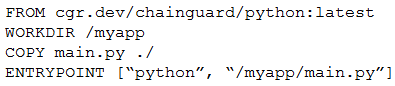
A cloud engineer is reviewing the following Dockerfile to deploy a Python web application:Which of the following changes should the engineer make to the file to improve container security? A.Add the instruction USER nonroot.B.Change the version from latest to 3.11.C.Remove the ENTRYPOINT instruction.D.Ensure myapp/main/py is owned by root.
Answer and explanation
Correct answer: A
Q9Question 9
Advanced
DevOps Fundamentals · Implement CI/CD
A financial services company is deploying a new containerized application to an Amazon EKS cluster. A recent security audit mandates that all container images must be scanned for vulnerabilities before being admitted to the cluster, and deployments with 'CRITICAL' severity vulnerabilities must be blocked. Which combination of tools and configurations BEST enforces this policy in an automated fashion?
Answer and explanation
Correct answer: B
This is the most comprehensive and automated solution. The CI/CD pipeline integration with Trivy provides 'shift-left' security by catching vulnerabilities early. The validating admission webhook with OPA acts as a final gatekeeper, enforcing the policy at the cluster level before any pod is created. This combination ensures that no container with critical vulnerabilities can run, regardless of how it was deployed, providing a robust defense-in-depth security posture.
Q10Question 10
Intermediate
Operations · Configure observability
A lead SRE is designing a monitoring strategy for a distributed application that spans multiple geographic regions and cloud providers. The primary goal is to gain deep insights into request flows and pinpoint performance bottlenecks across service boundaries. Which observability practice is MOST critical to achieving this goal?
Answer and explanation
Correct answer: C
Distributed tracing is specifically designed to track the entire lifecycle of a request as it travels through a distributed system. By instrumenting applications with a framework like OpenTelemetry, each request is assigned a unique trace ID, and each service call generates a span. This allows SREs to visualize the full request path, identify which service calls are contributing the most latency, and diagnose errors that occur deep within the call stack. While logging and metrics are crucial parts of observability, only distributed tracing provides the end-to-end visibility needed to effectively troubleshoot performance in a complex, multi-service environment.
Register free for 10 more questions
Or unlock all 226 CV0-004 questions with explanations, timed mode and flashcards.