SAT Free Sample Questions

SAT Test Practice Test
9/1057 questions · Unlock full access
Q1

(1) On my nineteenth birthday, I began my trip to Mali, West Africa. (2) Some 24 hours later I arrived in Bamako, the capital of Mali. (3) The sun had set and the night was starless. (4) One of the officials from the literacy program I was working was there to meet me. (5) After the melee in the baggage claim, we proceeded to his car. (6) Actually, it was a truck. (7) I was soon to learn that most people in Mali that had automobiles actually had trucks or SUVs. (8) Apparently, there notjust a convenience but a necessity when you live on the edge of the Sahara. (9) I threw my bags into the bed of the truck, and hopped in to the back of the cab. (10) Riding to my welcome dinner, I stared out the windows of the truck and took in the city. (11) It was truly a foreign land to me, and I knew that I was an alien there. (12) “What am I doing here?“I thought. (13) It is hard to believe but seven months later I returned to the same airport along the same road that I had traveled on that first night in Bamako, and my perspective on the things that I saw had completely changed. (14) The landscape that had once seemed so desolate and lifeless now was the homeland of people that I had come to love. (15) When I looked back at the capital, Bamako, fast receding on the horizon, I did not see a city foreboding and wild in its foreignness. (16) I saw the city which held so many dear friends. (17) I saw tea-drinking sessions going late into the night. (18) I saw the hospitality and open-heartedness of the people of Mali. (19) The second time, everything looked completely different, and I knew that it was I who had changed and not it. Sentence 13 (reproduced below) would best be revised to which of the following choices? It is hard to believe but seven months later I returned to the same airport along the same road that I had traveled on that first night in Bamako, and my perspective on the things that I saw had completely changed.

Q2

Passage 1 is adapted from Catharine Beecher, Essay on Slavery and Abolitionism. Originally published in 1837. Passage 2 is adapted from Angelina E. Grimke, Letters to Catharine Beecher. Originally published in 1838. Grimke encouraged Southern women to oppose slavery publicly. Passage 1 is Beecher’s response to Grimke’s views. Passage 2 is Grimke’s response to Beecher. Passage 1 Heaven has appointed to one sex the superior, and to the other the subordinate station, and this without any reference to the character or conduct of either. It is therefore as much for the dignity as it is for the interest offemales, in all respects to conform to the duties of this relation... But while woman holds a subordinate relation in society to the other sex, it is not because it was designed that her duties or her influence should be any the less important, or all pervading. But it was designed that the mode of gaining influence and of exercising power should be altogether different and peculiar... A man may act on society by the collision of intellect, in public debate; he may urge his measures by a sense of shame, by fear and by personal interest; he may coerce by the combination of public sentiment; he may drive by physical force, and he does not outstep the boundaries of his sphere. But all the power, and all the conquests that are lawful to woman, are those only which appeal to the kindly, generous, peaceful and benevolent principles. Woman is to win everything by peace and love; by making herself so much respected, esteemed and loved, that to yield to her opinions and to gratify her wishes, will be the free will offering of the heart. But this is to be all accomplished in the domestic and social circle. There let every woman become so cultivated and refined in intellect, that her taste and judgment will be respected; so benevolent in feeling and action; that her motives will be reverenced; - so unassuming and unambitious, that collision and competition will be banished; - so 'gentle and easy to be entreated,' as that every heart will repose in her presence; then, the fathers, the husbands, and the sons, will find an influence thrown around them, to which they will yield not only willingly but proudly... A woman may seek the aid ofco-operation and combination among her own sex, to assist her in her appropriate offices of piety, charity, maternal and domestic duty; but whatever, in any measure, throws a woman into the attitude of a combatant, either for herself or others - whatever binds her in a party conflict - whatever obliges her in any way to exert coercive influences, throws her out of her appropriate sphere. If these general principles are correct, they are entirely opposed to the plan of arraying females in any Abolition movement. Passage 2

Q3

Read the following passage and answer the question. But man is not destined to vanish. He can be killed, but he cannot be destroyed, because his soul is deathless and his spirit is irrepressible. Therefore, though the situation seems dark in the context of the confrontation between the superpowers, the silver lining is provided by amazing phenomenon that the very nations which have spent incalculable resources and energy for the production of deadly weapons are desperately trying to find out how they might never be used. They threaten each other, intimidate each other and go to the brink, but before the total hour arrives they withdraw from the brink. In the author's opinion:

Q4

This passage is adapted from Bryan Walsh, 'Whole Food Blues: Why Organic Agriculture May Not Be So Sustainable.' ©2012 by Time Incorporated. When it comes to energy, everyone loves efficiency. Cutting energy waste is one of those goals that both sides of the political divide can agree on, even if they sometimes diverge on how best to get there. Energy efficiency allows us to get more out of our given resources, which is good for the economy and (mostly) good for the environment as well. In an increasingly hot and crowded world, the only sustainable way to live is to get more out of less. Every environmentalist would agree. But change the conversation to food, and suddenly efficiency doesn’t look so good. Conventional industrial agriculture has become incredibly efficient on a simple land to food basis. Thanks to fertilizers, mechanization and irrigation, each American farmer feeds over 155 people worldwide. Conventional farming gets more and more crop per square foot ofcultivated land - over 170 bushels of corn per acre in Iowa, for example - which can mean less territory needs to be converted from wilderness to farmland. And since a third of the planet is already used for agriculture -destroying forests and other wild habitats along the way - anything that could help us produce more food on less land would seem to be good for the environment. Of course, that’s not how most environmentalists regard their arugula [a leafy green]. They have embraced organic food as better for the planet - and healthier and tastier, too - than the stuff produced by agricultural corporations. Environmentalists disdain the enormous amounts ofenergy needed and waste created by conventional farming, while organic practices-forgoing artificial fertilizers and chemical pesticides - are considered far more sustainable. Sales of organic food rose 7.7% in 2010, up to $26.7 billion - and people are making those purchases for their consciences as much as their taste buds. Yet a new meta-analysis in Nature does the math and comes to a hard conclusion: organic farming yields 25% fewer crops on average than conventional agriculture. More land is therefore needed to produce fewer crops - and that means organic farming may not be as good for the planet as we think. In the Nature analysis, scientists from McGill University in Montreal and the University of Minnesota performed an analysis of66 studies comparing conventional and organic methods across 34 different crop species, from fruits to grains to legumes. They found that organic farming delivered a lower yield for every crop type, though the disparity varied widely. For rain watered legume crops like beans or perennial crops like fruit trees, organic trailed conventional agriculture by just 5%. Yet for major cereal crops like corn or wheat, as well as most vegetables - all of which provide the bulk of the world’s calories - conventional agriculture outperformed organics by more than 25%. The main difference is nitrogen, the chemical key to plant growth. Conventional agriculture makes use of 171 million metric tons ofsynthetic fertilizer each year, and all that nitrogen enables much faster plant growth than the slower release of nitrogen from the compost or cover crops used in organic farming. When we talk about a Green Revolution, we really mean a nitrogen revolution -along with a lot of water. But not all the nitrogen used in conventional fertilizer ends up in crops - much of it ends up running offthe soil and into the oceans, creating vast polluted dead zones. We’re already putting more nitrogen into the soil than the planet can stand overthe long term. And conventional agriculture also depends heavily on chemical pesticides, which can have unintended side effects. What that means is that while conventional agriculture is more efficient - sometimes much more efficient - than organic farming, there are trade-offs with each. So an ideal global agriculture system, in the views of the study’s authors, may borrow the best from both systems, as Jonathan Foley of the University of Minnesota explained: 'The bottom line? Today’s organic farming practices are probably best deployed in fruit and vegetable farms, where growing nutrition (notjust bulk calories) is the primary goal. But for delivering sheer calories, especially in our staple crops ofwheat, rice, maize, soybeans and so on, conventional farms have the advantage right now. Looking forward, I think we will need to deploy different kinds of practices (especially new, mixed approaches that take the best of organic and conventional farming systems) where they are best suited - geographically, economically, socially, etc

Q5

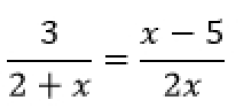
According to the expression. One possible value of x could be...

Question image
Q6

If q ? 0 and q = q - 4, what's the value of q?

Q7

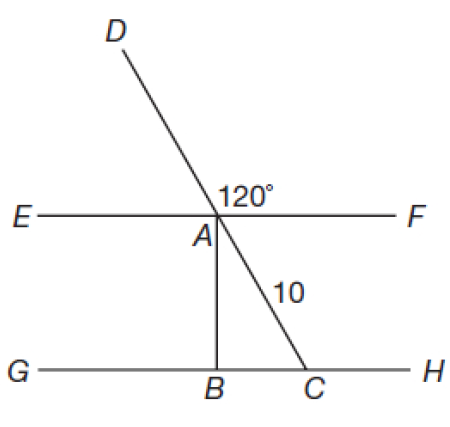
In the diagram above, lines EF and GH are parallel, and line AB is perpendicular to lines EF and GH. What is the length of line AB?

Question image
Q8

The radius of the outer circle shown above is 1.2 times greater than the radius of the inner circle. What is the area of the shaded region?

Q9

Jack has b blueberries. He uses 30 percent of the blueberries to make muffins, each ofwhich requires m blueberries. He uses the rest of the blueberries to make pies, each pie ofwhich requires p blueberries. Which of the following describes the number of blueberry pies Jack can make?