

AWS Academy Cloud Foundations Exam Blueprint Changes 2026
AWS quietly reworked the AWS Academy Cloud Foundations exam blueprint in early 2026, and if you’re enrolled in the course—or studying on your own for the AWS Certified Cloud Practitioner (CLF-C02)—the fresh objectives will shift what you practise and how long you need. The old syllabus stopped at “define the AWS Cloud” and “name the core services.” The 2026 version adds cloud architecture design principles, consolidated billing mechanics, and a real introduction to generative AI tools—topics that most candidates who sat the exam in 2025 never had to touch. This isn’t a cosmetic refresh; it’s the quiet moment when a foundational exam stops being a vocabulary test and starts asking you to think like a junior cloud practitioner. I’ll separate what’s confirmed from what’s still rumour, show you exactly which domains got heavier, and give you a practical study rebalance so you don’t burn weeks drilling material that no longer carries the same weight.
What the 2026 Blueprint Actually Changed
The biggest signal came when the CLF-C02 exam guide absorbed new task statements and reweighted several domains. Because the Academy curriculum maps directly to that certification, the course blueprint had to follow. The earlier v2.0 course outline from 2020 packed roughly twenty hours of instruction into cloud concepts, EC2, S3, VPC, IAM basics, and a light pass through pricing. Architecture patterns, billing tool comparisons, and generative AI were absent altogether. That outline still surfaces in some university handbooks, and candidates who follow it now are studying for an exam that no longer exists.
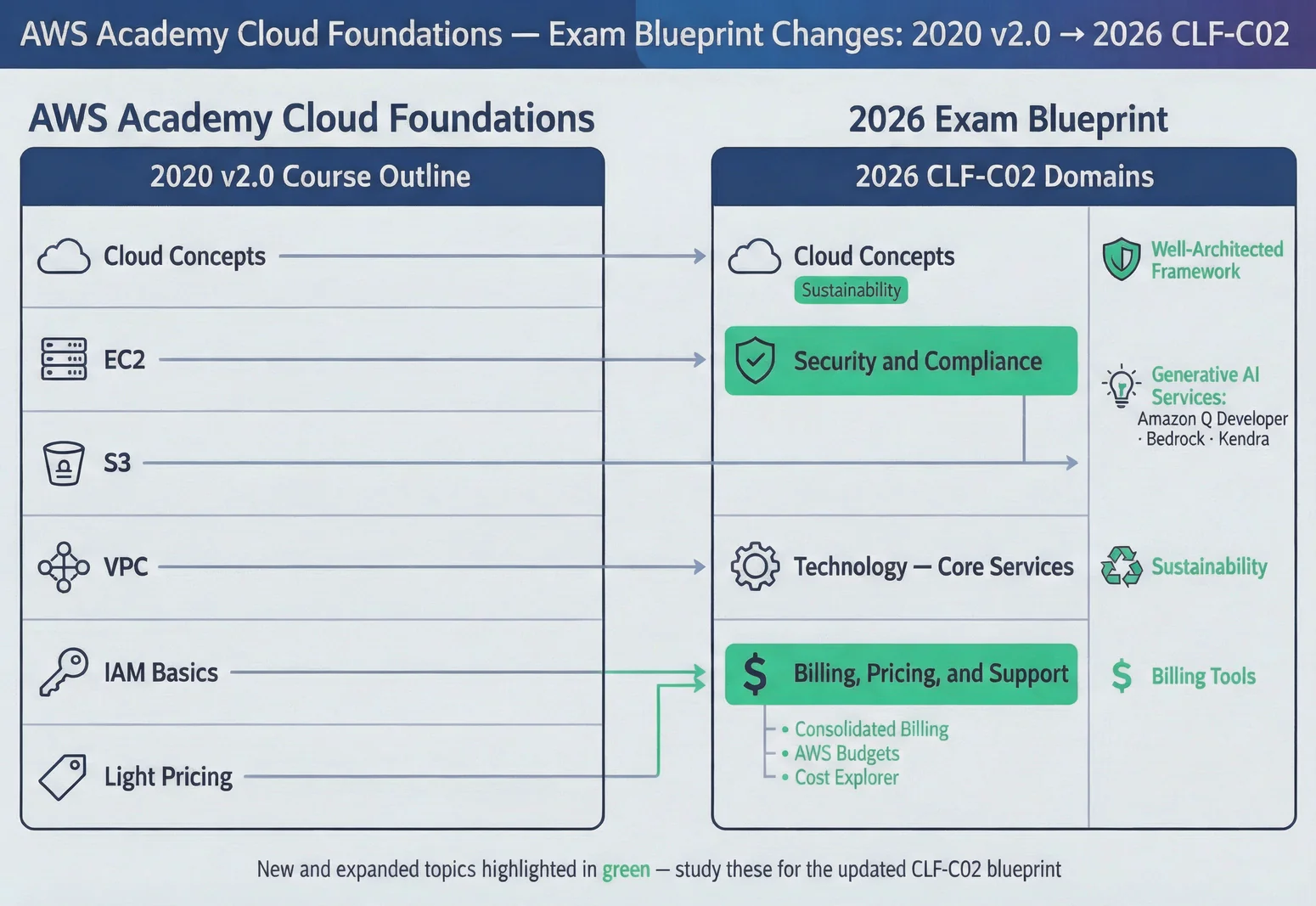
When you open the current CLF-C02 exam guide, the shift is immediate. The task statements now expect you to:
- Map real workloads to the six pillars of the AWS Well-Architected Framework.
- Differentiate Consolidated Billing, AWS Budgets, and Cost Explorer in a scenario—not just by definition.
- Identify the primary use case for generative AI services such as Amazon Q Developer, Amazon Bedrock, and Amazon Kendra.
- Factor sustainability into infrastructure decisions, including how AWS regions differ in their carbon profiles.
Those aren’t bonus bullet points. They sit inside the official content outline under Domain 1 (Cloud Concepts) and Domain 4 (Billing, Pricing, and Support), and several of the reworked task statements now weave billing and architecture together. The Academy course added corresponding modules around the same time the exam guide revisions went live, which AWS began tracking publicly in late 2025 through a newly introduced revisions section that gives candidates at least one month of notice before an update hits the test. That level of transparency is new, and it’s worth keeping an eye on it quarterly.
Chloe, a second-year IT student in Manchester, started her AWS Academy module in January 2026. Her first three weeks were comfortable: define a region, pick an instance type, list the pillars. By March the instructor posted a revised syllabus that had an entire workshop on reading Consolidated Billing reports and a new graded lab on matching architecture decisions to Well-Architected pillars. Chloe had already locked in her part-time hours around the old pace, and those extra modules forced her to reclaim evenings for generative AI videos and Cost Explorer walkthroughs. She passed the final exam, but only after accepting that waiting for the classroom to catch up wasn’t going to work.
Why Architecture, Billing, and Generative AI Are Now Front and Centre
AWS didn’t add these topics on intuition. The foundational certifications have been drifting toward operational awareness for two years, and the 2026 CLF-C02 update formalised that shift. For the Academy blueprint, the effect is practical: questions that used to ask “What is Amazon S3?” now ask “Which storage class would keep your monthly costs under £10 while meeting retrieval latency requirements?” The architecture layer and the billing layer land on the same scenario card.
Candidates who’ve only memorised definitions will feel the pressure. I watched Priya, a cloud support engineer who’d been hands-on with IAM and S3 for two years, stumble on exactly this during a timed practice session. She could describe an SCP, but she couldn’t explain why Cost Explorer’s granular usage reports were a better fit than a simple Budget alert for a hypothetical three-account organisation. Her instinct was solid practical knowledge, but the exam wanted her to speak in Well-Architected language and tool-specific decision logic. Six focused hours later she’d rewired her mental map, and she passed—but she told me later that the “billing meets architecture” questions were the hardest part of the whole test.
For anyone studying the updated blueprint, I’d argue the highest-impact study tactic this year is building a tiny sandbox and watching the money. Deploy a t3.micro instance, attach an Internet Gateway, push a small amount of data, and check Cost Explorer the next morning. Then toggle the instance to a Reserved purchase and compare the projected delta. That single exercise replaces an hour of flashcards and makes the connection between architecture choices and spend tangible. If you’re short on time, at minimum spin up a free-tier workload and set a zero-spend Budget alert—the interface familiarity alone will carry you through several exam items.
When the New Content Reaches Your Classroom
AWS Academy doesn’t publish a single roll-out date for instructor materials, so adoption varies by institution. The CLF-C02 exam guide revision landed in early 2026, and many universities updated their Academy syllabi by February. Others won’t switch until the autumn term, which means a student starting the course in September 2026 could still encounter a handout that references the v2.0 outline from five years ago.
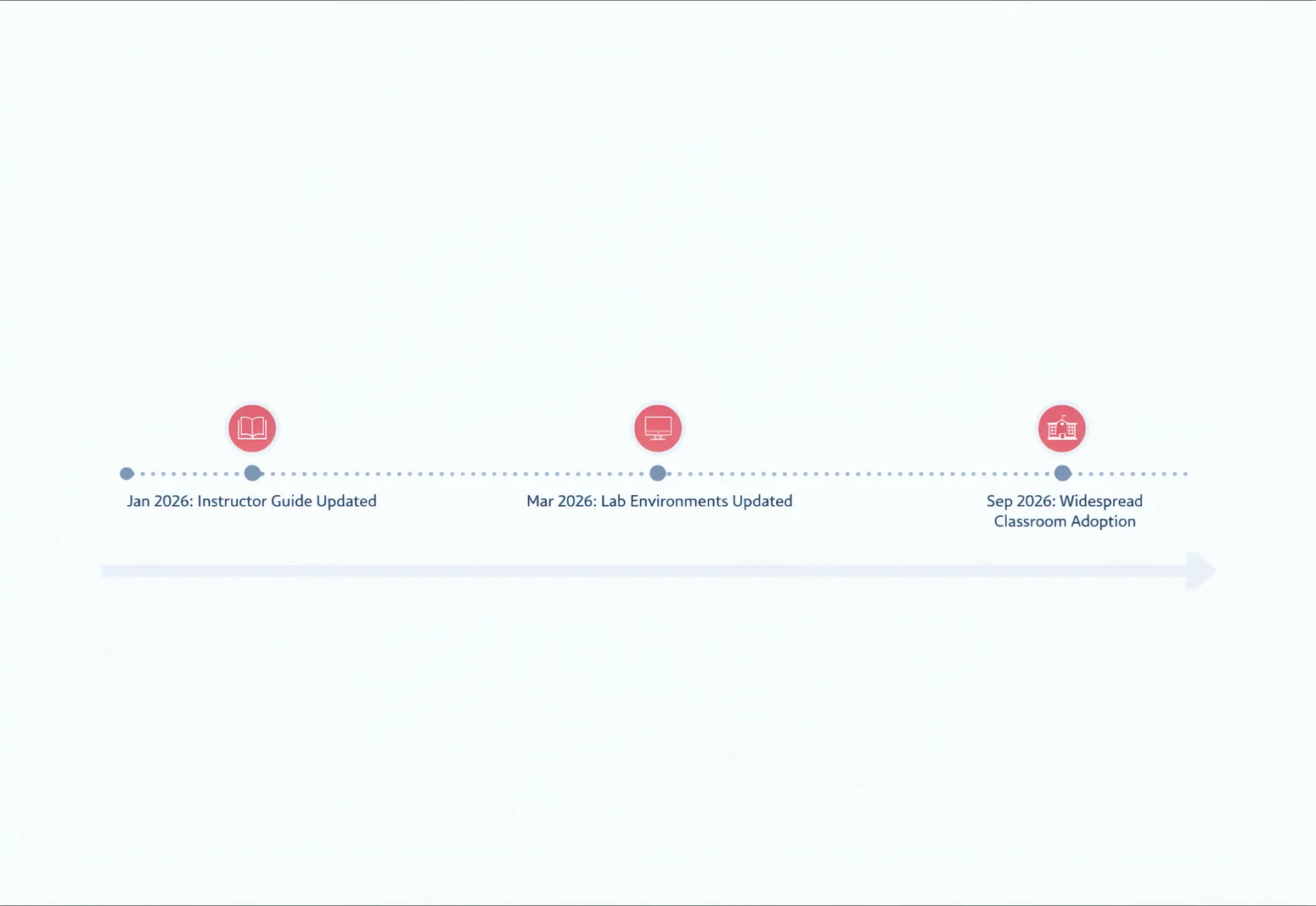
An instructor at a UK higher-education institution told me the updated Instructor Guide arrived in late January 2026, but the matching lab environments didn’t appear until mid-March. For nearly two months the lectures covered new theory—architecture design patterns, generative AI tooling, sustainability metrics—while the hands-on exercises still reflected the old blueprint. That gap isn’t unusual, and it’s worth checking directly with your tutor: ask whether the current lab exercises include Cost Explorer tasks, Well-Architected scenario prompts, or any mention of Amazon Q. If the answer is “not yet,” the free tier on AWS Skill Builder can fill the hole with short, self-paced Builder Labs that map to the new task statements.
The practical check I give every student is simple: scan your module’s week-by-week topic list. If you don’t see “Well-Architected Framework,” “consolidated billing,” or “generative AI” by name, assume the curriculum is lagging and supplement aggressively. The exam will test the 2026 objectives regardless of whether your classroom caught up.
Adjusting Your Study Plan for the Updated Blueprint
If you already started prepping under the old blueprint, don’t scrap your materials. The cloud concepts and core services you’ve covered remain relevant—but their relative weight has dipped, and you now need to reinvest around 10-15 hours into the new emphasis areas. The table below maps the domain shifts against the official content outline so you can see exactly where the pressure moved.
| Domain | Old course focus (v2.0) | New emphasis (2026 exam guide) |
|---|---|---|
| Cloud Concepts | Cloud economics, benefits, deployment models | Well-Architected pillars, sustainability, design trade-offs |
| Security and Compliance | IAM basics, Shared Responsibility Model | Identity Centre, SCPs, compliance reporting, governance scenarios |
| Technology | Core service definitions (EC2, S3, VPC) | Architecture patterns, high-availability design, global infrastructure choices |
| Billing, Pricing, and Support | Pricing fundamentals, basic support tiers | Consolidated Billing, Budgets vs Cost Explorer, Savings Plans, tool-level decision making |
| Generative AI & ML | Not present | Amazon Q developer, Bedrock, Kendra, general AI/ML service awareness |
Marcus, a career switcher who booked his CLF-C02 for June 2026, felt the impact directly. He’d been drilling flashcards built from a question bank last updated in late 2024. When he transitioned to an AWS Cloud Practitioner practice test that mirrored the 2026 blueprint, he faced multiple items asking him to pick between Cost Explorer and AWS Budgets for a specific reporting need, and one scenario that required identifying Amazon Bedrock as the service for building a custom generative AI application. He’d spent zero time on either. With three weeks left, he carved out four evenings for billing tool walkthroughs and the free AWS Skill Builder “Generative AI for Executives” course, and he passed—but he told me he nearly pushed the exam back.
Here’s how I’d reweight a four-to-six-week study plan right now:
- Architecture and design (4-5 hours): Memorise the six Well-Architected pillars—operational excellence, security, reliability, performance efficiency, cost optimisation, sustainability—and have at least one concrete AWS service or practice per pillar. The exam loves to ask “Which pillar does this action address?” and the answer is rarely guessable without context. Practise mapping the pillars to scenarios until it feels reflexive.
- Billing literacy (4 hours): Build a hypothetical three-tier web app in the AWS Pricing Calculator. Learn the exact difference between a Cost Explorer usage report and an AWS Budget threshold alert. Know what Consolidated Billing does for linked accounts and why it isn’t the same as AWS Organisations. Expect exam items that show a dashboard screenshot-like description and ask which tool you’re looking at.
- Generative AI (2-3 hours): You need breadth, not depth. Recognise Amazon Q as an enterprise assistant, Bedrock as a platform for building and scaling GenAI applications, and Kendra for intelligent enterprise search. The exam won’t ask configuration details, but it will ask which service matches a customer need. The free “Generative AI for Executives” digital course on AWS Skill Builder covers enough ground at the practitioner level.
- Sustainability (1 hour): Read the sustainability description inside the CLF-C02 exam guide. Expect one or two items that link the AWS Sustainability Pillar to environmental design choices or ask why a region’s energy mix matters. Don’t over-rotate on this; it’s a short, fact-based topic.
- Lab time (as needed): If updated classroom labs aren’t available, use AWS Skill Builder’s Builder Labs and microcredentials. Several of these are free and align with the 2026 task statements. A couple of hours pushing small workloads will do more for your billing and architecture confidence than reading any document.
Separating Confirmed Changes from Exam-Room Hearsay
Whenever an exam blueprint shifts, a gap opens between what’s published and what early test-takers report. I’ll draw the line with what’s verifiable from official AWS sources versus what’s still community signal.
Confirmed (straight from the CLF-C02 exam guide and AWS documentation):
- Domain 2 (Security and Compliance) and Domain 4 (Billing, Pricing, and Support) have expanded task statements that explicitly name AWS Cost Explorer, Savings Plans, AWS Identity Centre, and service control policies.
- Generative AI services appear under a broad “identify AWS services” umbrella that now includes Amazon Q Developer, Amazon Bedrock, and Amazon Kendra.
- Sustainability is a named subcategory under Cloud Concepts, with direct references to the AWS Sustainability Pillar and region-level carbon considerations.
- AWS added a revisions section to exam guides, committing to publish changes at least one month before they appear on the exam, which increases transparency for every CLF-C02 blueprint update going forward.
Still in the rumour category (learner reports, Reddit threads, and community feedback):
- Several candidates have reported that the exam now mixes billing and architecture in a single scenario more frequently than the older version, which kept domains siloed. That aligns with the guide’s intent, but there’s no published weighting change that confirms a deliberate blending.
- A handful of students mentioned seeing items about AWS Organizations and service control policies (SCPs) that felt slightly beyond the stated scope. AWS includes five unscored questions in every exam, and it’s possible these are trial items for a future revision. You should know what an SCP does at the outline level, but don’t spend a day mastering Organizations unless the official service table lists it as in-scope.
- A few forum posts claim the pass mark increased; that’s false. The scaled score remains 700 out of 1000, and AWS hasn’t announced any change to the passing threshold.
Treat the confirmed items as required reading. The speculative ones deserve a light pass—fifteen minutes of familiarisation, not a late-night panic session.
Questions Candidates Are Asking About the 2026 Update
Is the CLF-C02 harder now than it was in 2025?
It depends on your learning style. If you’ve spent time inside the AWS console, poked at billing tools, and read a few Well-Architected case studies, the new objectives probably feel like a natural progression. If you learned the old blueprint purely through rote memorisation, the scenario-based items that tie billing to architecture will feel more demanding. The pass bar hasn’t moved, but the path to reach it now requires a wider set of mental models.
Do I need to retake the exam if I passed CLF-C02 earlier this year?
No. The three-year certification validity isn’t affected by blueprint changes. If you passed in 2025 or early 2026, your credential stands. The updates matter only for new candidates and anyone choosing to recertify down the road.
When will the Academy course materials fully align with the new blueprint?
AWS doesn’t enforce a global cutover date, but the updated Instructor Guide and lab materials reached most institutions by mid-2026. Some schools will adopt the new materials for the autumn term. If your current syllabus still mirrors the old v2.0 outline, ask your instructor whether the updated Instructor Guide is available through the Academy portal. (The guide itself isn’t public, but member institutions have access.) In the meantime, the AWS Skill Builder free tier gives you current Builder Labs that cover every gap.
Can I trust free community study resources to cover the generative AI and billing additions?
Some community creators are moving fast, but many still lag. Paid practice tests that explicitly cite the 2026 CLF-C02 exam guide tend to be more current, and they surface domain-level weak spots under the new weighting better than most free question sets. If your budget is tight, at least cross-check any free deck against the “In-scope AWS services” table in the official guide—chances are you’ll spot services that the deck doesn’t address.
What’s the single best starting point?
Read the current CLF-C02 exam guide in full. Pay particular attention to the table of in-scope services and the task statements inside Domain 1 and Domain 4. Highlight every service and concept that’s new to you. That ten-minute audit produces a personalised study list no off-the-shelf course will give you.
How soon should I book the exam after starting prep on the updated blueprint?
For most learners who can commit four to six weeks of consistent effort, that window still works. Add an extra week if you’re starting billing and generative AI from scratch. Book the exam once you’re scoring above 80% on timed practice tests that use the new domain weights and include the newer service scenarios. If your scores swing wildly between domains, hold off and even out the weak areas first.
AWS Exams to Tackle After Cloud Practitioner
- AWS Certified Cloud Practitioner Practice Test
- AWS Certified Security - Specialty Practice Test
- Professional Cloud Developer Practice Test
browse the relevant exam page and purchase a practice test

Discussion
Question Comments
0 comments·0 participantsSign in to leave a comment and access more free questions.