

Most GMAT score gains do not come from doing more questions. They come from reviewing fewer questions better.
A GMAT practice exam is valuable because it exposes what broke under real test conditions: your pacing, your decision rules, your accuracy when tired, and the specific traps that keep repeating. The workflow below turns every practice exam into a targeted improvement plan, so your next score moves for a clear reason.
What “good review” looks like (and why most people do it wrong)
A common pattern is: take a full-length test, check the score, read explanations, feel you “get it,” then move on. The problem is that reading explanations is not the same as being able to reproduce the thinking under time pressure.
A high-impact review does three things:
- Recreates the decision you made on test day (not the ideal solution you wish you did).
- Finds a root cause you can fix with a repeatable rule.
- Builds a drill that forces retrieval and speed, not passive recognition.
If you do those three consistently, you can get meaningful gains even when your weekly question volume stays the same.
Step 0: Set up your review system before you take the exam
You want review to be fast enough that you actually do it, and structured enough that patterns surface.
Create an error log (spreadsheet, notebook, or tool) with these columns:
- Question ID (or screenshot reference)
- Section (Quant, Verbal, Data Insights)
- Topic label (for example: rates, CR assumption, DS inequalities, multi-source reasoning)
- Your answer, correct answer
- Time spent
- Confidence (High, Medium, Low)
- Root cause (use the table below)
- Fix (a rule you will apply next time)
- Drill plan (what you will do to prevent recurrence)
Also set one “next-exam goal” that is process-based, not score-based, such as “no more than 3 over-time questions per section” or “no more than 2 blind guesses.” That keeps the practice exam honest.
Step 1: Take the practice exam like it counts
A review workflow only works if the exam data is real. Try to match test conditions as closely as you can:
- Use a realistic timer and section flow that matches the current GMAT format (check the latest structure and policies on mba.com).
- Eliminate interruptions (phone off, single tab if testing online).
- Practice your “flagging rule” (when you will move on, when you will guess).
- Record quick notes after each section (2 minutes max): what felt slow, what felt confusing, where you panicked.
If you use an exam simulator and question bank, make sure it supports timed modes and review. A platform like Planet Cert practice tests can help here because you can run realistic practice exams, then immediately work through explanations and targeted sets without installing extra software.
Step 2: Do a 10-minute “triage” before deep review
Right after the exam (or within a few hours), do a fast classification pass. Do not reread every solution yet.
For each missed question and each correct-but-shaky question, tag it:
- Concept gap: you did not know the math/grammar/logic.
- Process gap: you knew the content but your approach was inefficient or incorrect.
- Careless: misread, arithmetic slip, wrong option clicked.
- Timing/decision: you stayed too long, guessed too late, or abandoned a solvable path.
This step prevents the biggest review trap: spending 45 minutes “learning” a hard concept when the real issue was a decision error (for example, you should have guessed at 2:00 instead of grinding until 4:10).
Step 3: Re-solve “cold” before you look at any explanation
This is the score-boosting move most people skip.
Pick a question you got wrong. Cover the explanation. Then re-solve it under a mini-timer:
- Quant and Data Insights: 2 minutes
- Verbal: 1.5 to 2 minutes
Your goal is not perfection. Your goal is to see whether you can now produce a clean path.
Why this works: it forces retrieval practice, which is strongly associated with durable learning compared to rereading. If you want the research backbone, see the classic work on test-enhanced learning by Roediger and Karpicke (2006) in Psychological Science.
If you still cannot solve it, then read the explanation, but read it with a purpose: “What is the minimal rule that would make this solvable next time?”
Step 4: Do a “root cause” write-up you can actually reuse
For each reviewed question, write two short lines in your error log:
- Because: what specifically caused the miss.
- Next time: the rule you will apply.
Examples:
- Because: I treated it like a compute problem, but it was a compare problem. Next time: look for a quick inequality or estimate before algebra.
- Because: I answered a Strengthen question like it was an Assumption question. Next time: ask “which option most increases the argument’s likelihood,” not “what must be true.”
- Because: I did not set a bailout point. Next time: if no plan by 45 seconds, guess and move.
This turns review into playbook building.
Root causes and fixes (use this table as your checklist)
| Root cause tag | What it usually looks like in your work | The fix you should drill | How to verify it’s fixed |
|---|---|---|---|
| Concept gap | You cannot explain the rule or definition | Learn one core idea, then do 10 to 15 focused questions | Accuracy improves without time blowups |
| Process gap | You got lost, used long algebra, or missed a shortcut | Write a 3-step method, then redo with a timer | Time drops while accuracy holds |
| Careless | Misread constraint, sign error, wrong column | Add a micro-check (units, sign, reread question stem) | Careless errors trend down across exams |
| Timing/decision | Over-time questions, late guessing, panic streaks | Set bailout points and practice strategic guessing | Fewer over-time questions and steadier pacing |
| Trap pattern | Same wrong answer style repeats | Create a “trap list” with examples | Trap frequency declines over 2 to 3 exams |
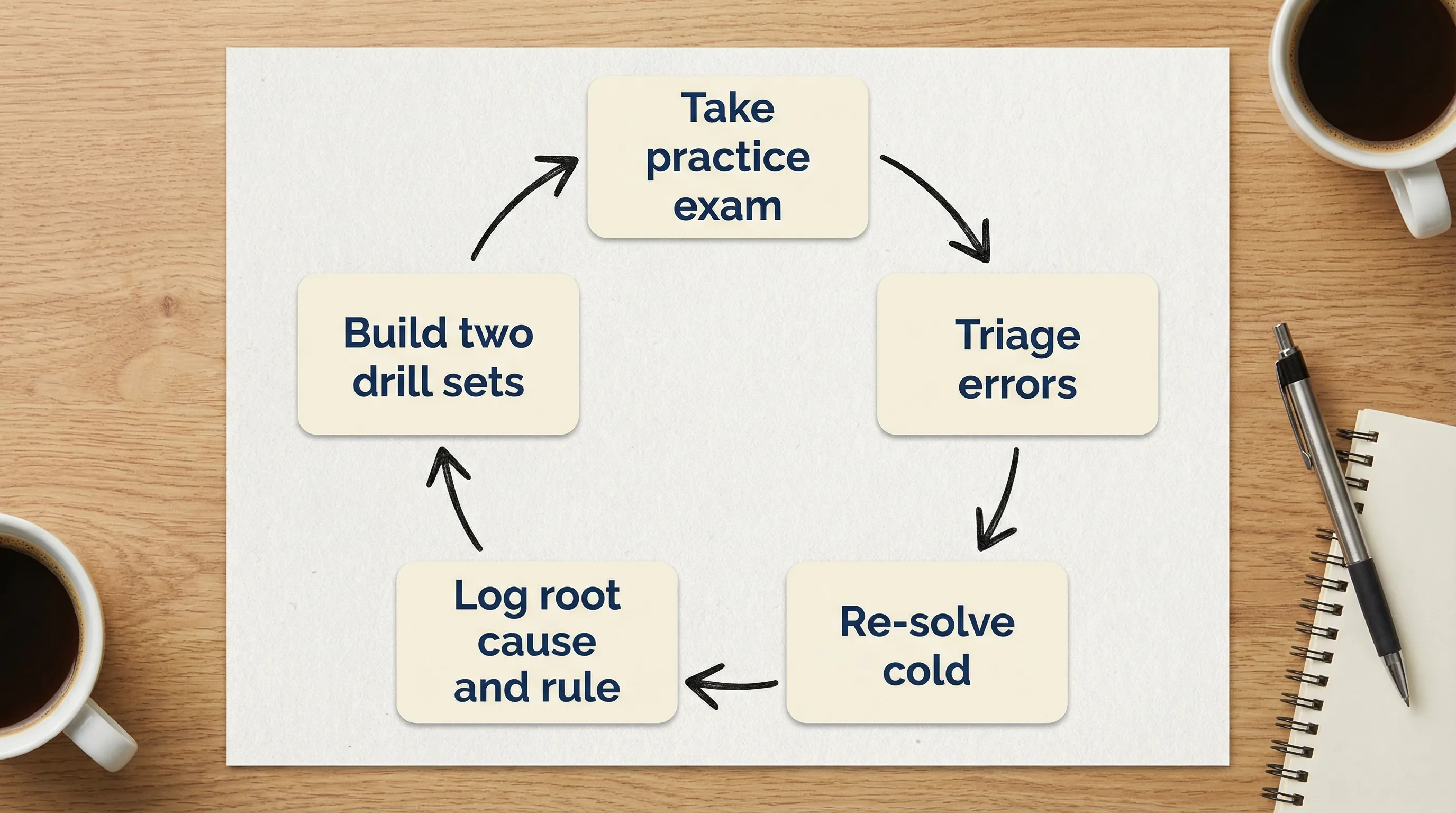
Step 5: Convert review into drills (the “two-set rule”)
A review that does not change your future practice is entertainment.
For every meaningful mistake, create two follow-up sets:
- Set A (precision set): 6 to 10 questions of the same type, untimed or lightly timed, focused on method.
- Set B (transfer set): 6 to 10 mixed questions (same section) under stricter timing, focused on recognition and decision-making.
This is how you stop “knowing it in review” but missing it on the next GMAT practice exam.
If you are using Planet Cert exam questions or another question engine, build these sets directly from your error tags. The best workflow is the one that makes it easy to retest the exact weakness you just diagnosed.
Step 6: Add a 72-hour retest loop (so fixes stick)
Here is a simple cadence that improves retention without bloating your schedule:
- Same day: triage + cold re-solve + root cause notes.
- Within 48 hours: complete Set A (precision).
- Within 72 hours: complete Set B (transfer) under time.
Then, one week later, reattempt 5 previously missed questions (without seeing solutions). If you miss again, the issue is not exposure. It is method or decision-making.
Step 7: Review timing like a skill, not a symptom
Most score plateaus have a timing component, even when they look like “content problems.” You want to review timing the same way you review accuracy.
After each exam, compute:
- Over-time count: how many questions went beyond your target time.
- Longest time sink: your top 3 slowest questions (and whether they were worth it).
- Guess quality: were your guesses random, or were they narrowed to 2 choices.
Then create a rule such as:
- “If I cannot articulate a plan by 45 seconds in Quant, I switch strategies or guess.”
- “If a Data Insights prompt is dense, I search for a question I can answer without reading everything.”
Timing improves when your decisions become consistent.
Step 8: Section-specific review cues (GMAT Focus reality)
This is still a workflow article, but it helps to know what to look for while you log root causes.
Quant
In your error log, flag whether the miss came from:
- Translation (wording into math)
- Structure recognition (rates, ratios, inequalities, exponents)
- Over-computing (algebra when estimation would do)
A high ROI Quant drill is “same concept, different skin.” For example, do 8 rate questions in a row, but force yourself to write the setup in 20 seconds.
Verbal
For Critical Reasoning and Reading Comprehension, include a “why wrong” note for each eliminated option. Many verbal misses are not about finding the right answer, they are about failing to reliably reject four wrong ones.
If you are stuck between two options, log what the two options had in common (scope, strength of wording, causality, outside info). That becomes your trap list.
Data Insights
Data Insights punishes passive reading. In review, write down:
- What was the fastest path to the question (which tab, which chart, which statement)
- What you should ignore next time
If you want a real-world habit that helps here, practice quickly extracting “what matters” from business descriptions. Even skimming how a company explains its operations, like this apparel development and manufacturing partner, can reinforce the skill of separating signal (process, constraints, inputs and outputs) from marketing noise, which is exactly what DI prompts try to test.
Step 9: Use score reports to choose the next practice exam date
Do not schedule full-length exams by calendar alone. Schedule them by readiness signals:
- Your last two transfer sets stayed within time targets.
- Your top 3 root cause categories are shrinking.
- You can explain your last 20 misses in one sentence each (no vague “I just messed up”).
If those are true, take another full GMAT practice exam. If not, you will get more value from drills and one timed section test.
Step 10: A practical “exam review checklist” you can reuse every time
After every practice exam, your review is complete only when:
- Every miss has a root cause tag and a “next time” rule.
- You re-solved at least the top 10 most valuable questions cold (wrong or shaky).
- You built one precision set and one transfer set for each high-frequency weakness.
- You updated one timing rule and one trap rule.
That is it. If you do this consistently, your score increases become predictable rather than hopeful.
Bringing it all together with a tool-assisted workflow
You can run this entire system with a notebook and any question source. It is even easier when your platform supports timed simulation, explanations, and fast retesting.
If you are building your study stack now, consider using Planet Cert practice exams as your question engine: take a realistic simulator exam, review with explanations, then spin up targeted sets from the exact weaknesses your error log reveals. The point is not the brand. The point is the loop.
Because the GMAT rewards repeatable thinking under time pressure, the best workflow is the one you can execute after every exam, even on a busy week. Do that, and your next practice score becomes a byproduct of a better process, not a surprise.

Discussion
Question Comments
0 comments·0 participantsSign in to leave a comment and access more free questions.