

How Exam Dumps Work—Risks and Realities for IT Certs
What makes exam preparation so challenging for IT professionals and tech students in countries like Canada, India, and the United States? The search for reliable study materials often leads people to exam dumps, sparking debate about their true value and risks. Understanding exam dumps are collections of real exam questions and answers is crucial, but the misconceptions and ethical dilemmas surrounding their use can impact not just your certification but your entire career. This article clarifies the basics and exposes what every candidate needs to know before relying on questionable resources.
Key Takeaways
| Point | Details |
|---|---|
| Understanding Exam Dumps | Exam dumps are collections of past exam questions and answers, but they may not reflect current certification tests due to constant updates by vendors. |
| Risks of Using Dumps | Using exam dumps can lead to disqualification, certification revocation, and damage to professional reputation, as they violate ethical agreements. |
| Effective Study Practices | Dumps should be used as supplementary materials alongside legitimate study resources, not as primary tools for exam preparation. |
| Impact on Career | Relying on exam dumps can lead to gaps in knowledge that become apparent in job performance, ultimately hindering career advancement. |
Exam Dumps Defined—Basics and Misconceptions
When you start preparing for certifications like AWS Solutions Architect, Cisco CCNA, or CompTIA Security+, you’ll inevitably encounter the term “exam dumps” online. But what exactly are they, and why do so many IT professionals talk about them with a mix of curiosity and caution?
Exam dumps are collections of real exam questions and answers that have been compiled and shared online, typically by previous test takers. They’re often crowd-sourced from candidates who’ve recently taken certification exams and documented what they remember seeing. The format varies—some exist as PDF files, others as interactive platforms or mobile apps. The appeal is straightforward: they offer what appears to be a shortcut to passing your exam without months of structured study.
However, understanding what exam dumps actually are and how they work reveals a landscape filled with critical misconceptions that trip up countless IT professionals. Here’s what separates fact from fiction:
The Reality Behind the Misconceptions
Most people assume exam dumps contain identical questions you’ll face on test day. That’s not accurate. Certification vendors rotate questions constantly, update exam content annually, and use different variations for different test dates. A dump from six months ago may look similar to current exam questions but won’t match exactly. You might memorize 200 questions only to encounter entirely different ones when you sit for your actual exam.
Another widespread misconception is that using dumps is risk-free. It isn’t. Here’s the actual risk profile:
- Disqualification risk: Certification authorities track patterns of test takers who perform suspiciously well on specific topics but fail on others. Sudden perfect scores followed by mediocre performance on similar content raises red flags.
- Account bans: Vendors like Cisco, AWS, and Pearson Vue explicitly ban candidates caught using unauthorized study materials. Once banned, you may lose access to retake exams for extended periods.
- NDA violations: Every certification exam includes a Non-Disclosure Agreement you sign before testing. Using or sharing exam dumps violates this agreement, creating legal exposure beyond just losing your certification.
- Credential invalidation: Some employers conduct background checks that verify certification legitimacy. Discovered violations can damage your professional reputation.
Many IT professionals convince themselves that exam dumps are acceptable because “everyone uses them.” That’s rationalizing, not reasoning. The question isn’t whether others do it—it’s whether you’re willing to accept the consequences if caught.
Exam dumps might get you a passing score, but they won’t give you the skills your employer expects from someone holding your certification.
What Dumps Actually Represent
Exam dumps serve a specific purpose if used correctly: they’re supplementary study materials, not primary learning tools. A legitimate approach treats dumps as one data point among many. You use them to identify weak areas, test your understanding of concepts you’ve already learned, and familiarize yourself with question formats.
The problem arises when candidates skip legitimate study resources and jump straight to memorizing dump answers. That approach creates a false sense of readiness. You might pass your exam, but you’ll lack the foundational knowledge needed to actually perform your job. For IT professionals—whether you’re managing AWS infrastructure, securing networks, or administering systems—that knowledge gap becomes dangerously apparent within months of getting hired.
If you’re considering exam dumps, ask yourself: Are you using them as a final review tool after thorough preparation, or as a replacement for actual studying? The first approach might provide marginal value. The second approach is essentially cheating with extra steps.
Pro tip: Use verified practice tests from reputable platforms that track question updates and align with current exam objectives instead of relying on crowd-sourced dumps with unknown accuracy.
Key differences between legitimate certification prep and exam dump reliance:
| Study Approach | Knowledge Retention | Career Impact | Ethical Standing |
|---|---|---|---|
| Official Study Materials | Deep, long-term | Strong job performance | Fully compliant |
| Exam Dump Memorization | Shallow, short-lived | Skill gaps, risk of firing | Violates agreements |
| Verified Practice Tests | Balanced, practical | Enhanced readiness | Permitted by vendors |
Popular Types of Exam Dumps for 2026 Certs
Exam dumps come in several distinct formats, each with different characteristics, accessibility levels, and reliability concerns. If you’re exploring what’s available in the dump ecosystem for 2026 certifications, understanding these categories helps you recognize what you’re looking at and assess the risks involved.
The most common format is PDF dumps, which are static documents containing questions and answers compiled into downloadable files. These typically come from crowd-sourced collections where test takers have documented exam questions from memory. PDF dumps are easy to share, require no special software, and work offline—which is why they remain popular despite being outdated quickly. However, they’re also the least reliable format. A PDF dump from early 2025 may contain questions that vendors have already rotated out, leaving you studying material that won’t appear on your actual exam.
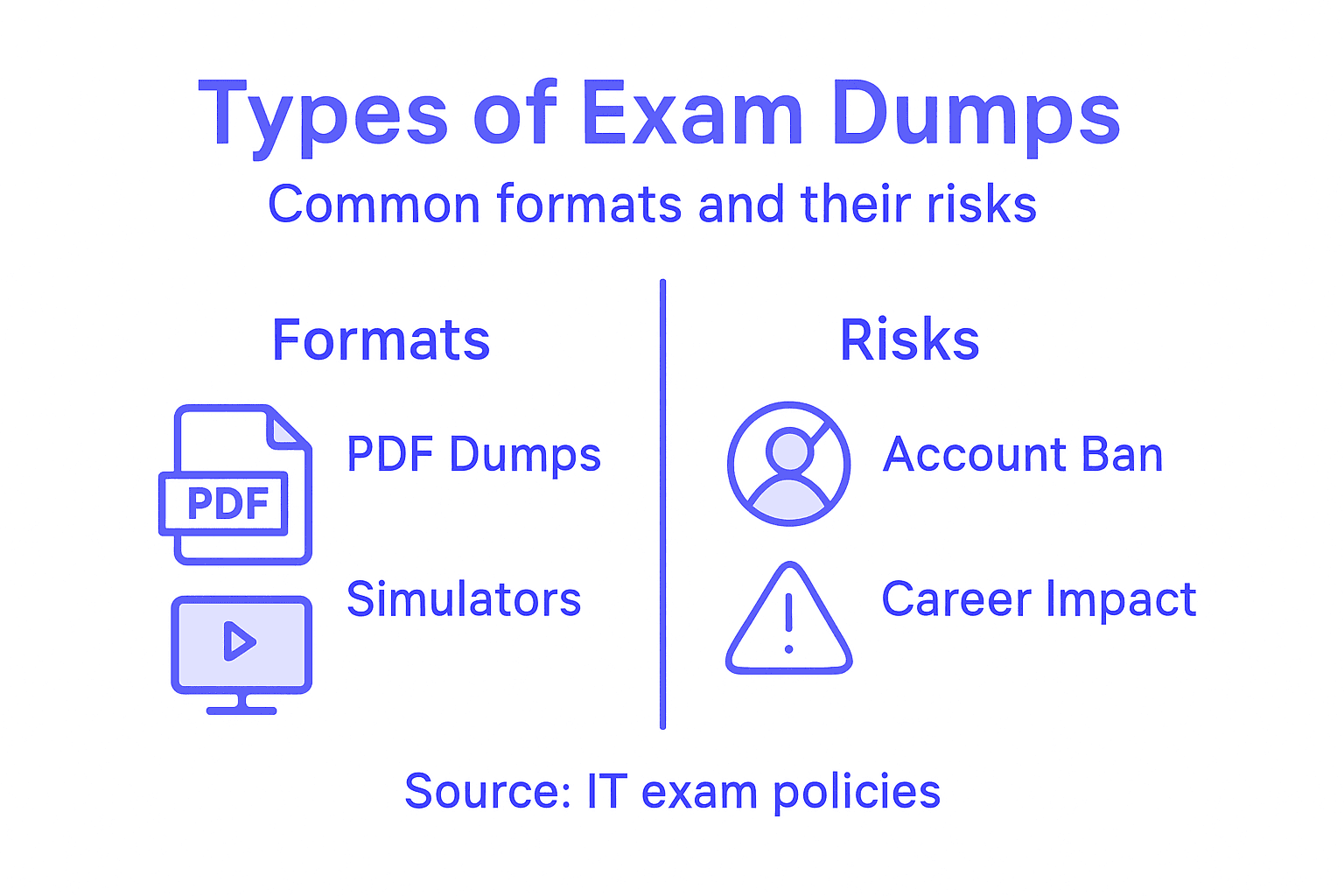
Another prevalent type is practice question banks, which are often hosted on websites or platforms designed to simulate exam conditions. These typically allow you to take multiple-choice questions in a timed environment, sometimes with instant feedback on answers. The most trusted providers maintain current verified questions reflecting real exams for certifications like CCNA, AZ-900, Security+, and Salesforce credentials. The key distinction here is that legitimate question banks update their content regularly to reflect actual exam changes, while illegitimate dumps stagnate. You can sometimes tell the difference by checking when content was last updated and whether the platform explains how they keep questions current.
Online test simulators represent the most sophisticated dump format. These platforms mimic the actual exam interface, including timing mechanisms, question randomization, and performance analytics. They often feature detailed explanations for answers and identify knowledge gaps by topic area. Simulators targeting AWS certifications, Cisco exams, or CompTIA credentials sometimes include interactive labs or scenario-based questions. The problem: many simulator platforms claim legitimacy while actually using unverified or outdated dump content underneath their polished interfaces.
Here’s a comparison of common exam dump formats and their unique characteristics:
| Format Type | Accessibility | Update Frequency | Typical Reliability |
|---|---|---|---|
| PDF Dumps | Downloadable/Offline | Rarely updated | Often outdated, least reliable |
| Practice Question Banks | Web-based access | Regular (if reputable) | Usually more current, reliable if verified |
| Online Test Simulators | Interactive platforms | Varies by provider | Mixed—depends on content source and updates |
Certification Targets in 2026
Exam dumps exist for virtually every major certification, but certain ones are more heavily targeted by dump providers. This matters because high-demand dumps often contain more recent content (since more people take these exams and contribute question data), but also face stricter monitoring by vendors.
The most commonly dumped certifications include:
- AWS certifications: Solutions Architect Associate, Developer Associate, and Cloud Practitioner dominate dump communities because they’re in high demand and constantly evolving
- Microsoft Azure certifications: AZ-900, AZ-104, and AZ-500 see heavy dump traffic due to widespread adoption in enterprise environments
- Cisco CCNA: The foundational networking certification generates extensive dump collections because it’s a prerequisite for advanced Cisco tracks
- CompTIA Security+: High volume of dumps exists for this certification, partly because it’s required for government contractor positions
- Google Cloud certifications: Emerging dump presence for Associate Cloud Engineer and Professional Data Engineer roles
Just because dumps exist for your target certification doesn’t mean they’re accurate, current, or safe to use.
Quality Variance and Update Cycles
One critical distinction separates “better” dumps from worse ones: update frequency. Some dump websites claim quarterly updates, others claim monthly refreshes, and the truly deceptive ones never update at all while claiming current content.
Here’s what determines actual quality:
- Question accuracy: Verified dumps contain questions that actually appeared on recent exams, while unverified dumps may include fabricated questions or ones from outdated exam versions
- Answer reliability: Legitimate sources verify answers are correct; illegitimate sources sometimes contain wrong answers that candidates memorize and fail on test day
- Format alignment: Current dumps reflect the actual exam format (number of questions, time limits, question types); outdated dumps may have different structures
- Explanation depth: Quality dumps include reasoning for correct answers; poor-quality dumps offer only answer keys
Microsoft, AWS, and Cisco actively monitor and update their exams multiple times per year. A dump that’s three months old for these certifications may already miss 20-30 percent of current exam content. This is why the “last updated” date matters so much.
Pro tip: Compare dump questions against official exam objectives from the certification vendor’s website; if significant topics from the official outline are missing from the dump, it’s outdated regardless of what the provider claims.
How Exam Dumps Are Distributed and Used
Exam dumps don’t exist in some hidden corner of the internet accessible only to insiders. They’re actively distributed across multiple channels, and understanding how they move through the ecosystem helps you recognize what you might encounter during your certification preparation.

The distribution network operates with surprising openness. Exam dumps are shared through direct file downloads, forum communities, and unauthorized third-party websites that specialize in hosting them. You’ll find PDFs posted on file-sharing platforms, flashcard collections on study sites, and question banks embedded in websites that claim to offer practice materials. Some dumps come packaged as email attachments shared between study group members. Others appear as pastebin entries or forum posts where test takers share what they remember from recent exams. The sheer variety of distribution channels makes dumps easy to find if you’re actively searching for them.
The sourcing is remarkably straightforward. Exam dumps are crowd-sourced from test takers who recall questions after exams, meaning every dump originates from someone’s memory of what they saw during their certification test. This creates a persistent game of catch-and-release: a candidate takes an AWS Solutions Architect exam on Monday, documents questions they remember on Tuesday, uploads them to a forum on Wednesday, and by Thursday those questions are circulating across multiple websites. The crowdsourcing model explains why popular certifications like CCNA, AZ-104, and Security+ have extensive dump libraries while niche certifications have minimal coverage.
How Candidates Actually Use Dumps
The stated purpose versus actual usage of exam dumps often diverge dramatically. In theory, dumps serve as supplementary practice material. In practice, many candidates use them as their primary study method.
Common usage patterns break down into distinct approaches:
- Rote memorization: Candidates download a dump, memorize every question and answer, then sit for the exam expecting to encounter identical questions
- Pattern identification: Test takers review dumps to understand question formats, identify frequently tested topics, and recognize common answer structures
- Last-minute cramming: Someone buys access to a dump collection one week before their exam and races through hundreds of questions hoping for overlap
- Confidence building: A candidate uses dumps alongside structured study materials to verify their knowledge against what they assume reflects real exam content
- Test-taking strategy: Experienced professionals use dumps to familiarize themselves with how a particular vendor structures questions, timing, and difficulty levels
The critical distinction separates legitimate supplementary use from problematic exploitation. Using a dump to understand question formats after you’ve completed official study materials is defensible. Using a dump as your entire study strategy is not.
The dump you’re studying today may not match the exam you’re taking next month, but certification vendors are tracking who memorizes dumps and who actually understands the material.
The Distribution Infrastructure
Understanding where dumps come from and how they spread helps explain why they remain so prevalent despite being explicitly prohibited.
The dump ecosystem includes several key players:
- Original posters: Test takers who document and first share exam questions, usually in forums or on Discord servers
- Aggregator websites: Sites that compile dumps from multiple sources into organized libraries organized by certification and exam name
- Resellers: Individuals and organizations that package dumps and sell them for profit, sometimes bundling them with fake practice tests or study guides
- Social media channels: Telegram groups, Reddit communities, and Facebook groups where dumps circulate among study communities
- Questionable platforms: Websites claiming to offer legitimate study materials while actually distributing unverified dumps with no quality control
The economics are straightforward. Someone provides dumps for free to build an audience, another person repackages them and sells access for fifteen dollars, a third person creates a polished platform interface around the same content and charges monthly subscriptions. The content never improves—it just gets resold with increasingly sophisticated presentation.
Vendors actively fight this distribution. Cisco, Microsoft, and AWS employ teams monitoring for leaked exam content, sending takedown notices to websites, and tracking suspicious exam performance patterns. Yet the fight remains asymmetrical. Vendors release updates quarterly. Dump communities operate continuously. It’s a cat-and-mouse game with no permanent resolution.
Pro tip: If a study platform offers “updated dumps” at suspiciously low prices or guarantees you’ll pass by memorizing their questions, it’s a reseller of crowd-sourced content, not a legitimate study resource with verified materials.
Legal and Ethical Risks for Candidates
Using exam dumps isn’t a gray area. It’s explicitly prohibited by certification vendors, covered in the legal agreements you sign, and increasingly monitored through sophisticated detection systems. The risks extend far beyond failing a single exam—they can derail your entire IT career.
When you register for any major certification exam, you sign a Non-Disclosure Agreement and agree to testing policies that explicitly prohibit using unauthorized study materials during the exam. This isn’t vague language. The agreements specifically state that exam dumps, leaked questions, and crowd-sourced materials violate their terms. You’re not signing something ambiguous that you might interpret loosely. You’re agreeing to specific, enforceable rules.
The legal consequences are substantial. Using exam dumps violates exam integrity rules and legal agreements, risking certification revocation, bans from future testing, and legal action for intellectual property infringement. Vendors like Microsoft, Cisco, and CompTIA don’t treat this casually. They’ve invested millions developing and protecting their exam content. When they discover someone used dumps, they respond with precision.
Here’s what actually happens when vendors catch cheating:
- Certification revocation: Your credential gets stripped. That AWS Solutions Architect certification you claimed on LinkedIn? It no longer exists in the vendor’s system. Employers conducting verification checks won’t find it.
- Testing bans: You become ineligible to retake the exam for extended periods. A first violation might ban you for one year. Repeat violations extend the restriction.
- Account disqualification: Your Pearson Vue account or testing center records flag you permanently, making it difficult to register for other exams across vendors.
- Legal liability: Vendors reserve the right to pursue civil action against individuals and organizations profiting from leaked exam content. This rarely happens to individual test takers, but it’s theoretically possible.
Detection Methods and Forensic Analysis
You might assume vendors can’t detect dump usage if you’re careful. That assumption is dangerously wrong. Leading vendors like Microsoft, Cisco, and CompTIA employ forensic algorithms to detect cheating, meaning they’re analyzing patterns you can’t see.
Modern detection works on multiple levels:
- Performance pattern analysis: If you score perfectly on dump-covered topics but poorly on anything not in the dump, algorithms flag that anomaly
- Question timing data: Candidates who memorized answers respond suspiciously fast to specific questions, creating statistical outliers
- Cross-test correlation: Vendors compare your performance across multiple exam attempts or related certifications for inconsistencies
- IP and location tracking: Unusual geographic or device patterns during testing trigger investigation
- Post-exam behavior: Candidates who suddenly can’t answer basic follow-up questions about topics they “passed” raise red flags
Vendors share data across testing platforms. A suspicious pattern on one AWS exam gets reported to the AWS certification database. That information persists and influences future testing decisions.
Career and Employment Consequences
The immediate testing consequences pale compared to employment damage. Employers may rescind job offers or terminate employment upon discovering fraudulent certification, and this discovery happens more frequently than you might think.
Here’s the employment reality:
- Background verification: Many employers conduct certification verification checks during onboarding. If your credential doesn’t exist in the vendor’s system, you have a problem that’s difficult to explain away.
- Job termination: Getting hired with a revoked certification is grounds for immediate dismissal in most organizations. Tech companies treat this as cause for termination without severance.
- Blacklisting: You’re not formally blacklisted, but your departure on these terms spreads through professional networks faster than you’d expect.
- Security clearance impact: For government or contractor roles, certification fraud becomes a serious issue that can affect future clearance eligibility.
- Professional reputation: In tight-knit tech communities, word travels. A contaminated professional reputation can haunt you across multiple job searches.
The dump might get you a passing score, but it can cost you your job, your credentials, and years of career momentum.
Long-Term Career Damage
Beyond immediate consequences, using dumps creates lasting professional damage. You’ve accepted a credential that represents knowledge you don’t possess. Within months of getting hired, that knowledge gap becomes apparent. You struggle with tasks that your certification suggests should be routine. You can’t troubleshoot problems related to topics you supposedly mastered.
This plays out differently depending on your role. A Cisco CCNA holder who can’t configure basic network scenarios becomes a liability. An AWS Solutions Architect who doesn’t understand infrastructure design creates costly mistakes. A CompTIA Security+ professional unfamiliar with security frameworks compromises your employer’s security posture.
Your colleagues notice. Your manager notices. Your credibility evaporates. Even if you’re never formally accused of fraud, you’re functionally unable to perform the role your credentials claimed to qualify you for.
Pro tip: If you’ve already used dumps, don’t compound the mistake by keeping the credential. Study legitimately, retake the exam through proper channels, and build genuine expertise that actually matches your certifications.
Impact on Certification Value and Career Prospects
When enough people use exam dumps to pass certifications they don’t truly understand, something shifts in how employers perceive those credentials. The market starts discounting the value of certifications because they no longer reliably signal genuine competence. This isn’t theoretical—it’s already happening across IT certifications in 2025 and 2026.
Widespread use of exam dumps undermines the genuine effort and skills certifications are meant to represent, diminishing their perceived value in the job market. Employers conduct interviews where candidates with AWS Solutions Architect certifications can’t explain basic architectural decisions. They discover Cisco CCNA holders unfamiliar with fundamental routing concepts. They hire CompTIA Security+ professionals who struggle with the frameworks they supposedly mastered. These experiences accumulate across hiring teams and departments, creating skepticism about credential authenticity.
This skepticism translates directly into hiring behavior. Companies start viewing certifications with more caution. Some require additional technical assessments before hiring certified candidates. Others discount certifications entirely, preferring demonstrated experience over credentials. The more widespread the dumps become, the more employers justify ignoring certifications because they’ve stopped being reliable quality signals. You’ve suddenly got a credential that looks good on paper but doesn’t actually help you get hired.
Industry-Wide Credential Devaluation
The damage extends beyond individual job prospects. When certifications lose credibility, entire career paths become less valuable. A CompTIA Security+ used to be a recognized entry point into cybersecurity roles. Now, with widespread dump usage, employers question what that certification actually proves. Some shift their hiring focus toward other credentials they perceive as more secure. Others implement stricter verification processes that add friction to the hiring process for everyone.
Employer trust decreases as credential authenticity is questioned, harming the industry’s integrity and creating broader consequences. Here’s how this manifests:
- Certification premium erosion: The salary bump historically associated with certifications shrinks as employers perceive less value
- Increased verification requirements: Companies implement third-party verification, creating additional hurdles for legitimate candidates
- Credential stacking: Organizations start requiring multiple certifications or supplementary credentials to compensate for lost trust in individual certifications
- Experience preference shift: Hiring committees start prioritizing demonstrable experience over certifications, disadvantaging candidates trying to break into new areas
- Testing fee increases: As vendors combat fraud, testing costs rise, making legitimate certification more expensive for everyone
The people hurt most aren’t the dump users getting short-term passes. They’re the legitimate candidates who studied properly, earned their credentials honestly, and suddenly find those credentials worth less in the job market.
Personal Career Stagnation
For individuals who use dumps, the career impact follows a predictable trajectory. Initially, the certification opens doors. You get hired based on credentials you don’t actually possess. Then reality sets in.
Certifications gained through dumps fail to accurately represent true skills, leading to professional embarrassment and decreased job opportunities. You struggle with work tasks that your credentials suggested you’d handle easily. Your peers notice the gap between your claimed expertise and actual performance. Your manager starts questioning why your resume doesn’t match your capabilities. Your career trajectory that looked promising on paper stalls in reality.
This creates several scenarios:
- Quiet termination: You get let go during probation or a performance review cycle, with vague explanations about “not being a fit”
- Lateral movement trap: You get moved to roles that don’t require the expertise you claimed, effectively sidelined
- Reference problem: When you leave, you can’t use this employer as a reference because your departure was due to credential fraud
- Resume liability: Listing this job becomes problematic because explaining the gap or the short tenure raises questions you can’t honestly answer
- Reputation damage: In smaller tech communities, people talk. Your name becomes associated with fraudulent credentials
A shortcut to one certification can cost you years of career advancement and decades of professional reputation damage.
Long-Term Market Consequences
The cumulative effect of widespread dump usage weakens the entire certification ecosystem. Organizations that relied on certifications to identify qualified professionals lose that signal. They respond by distrusting certifications more broadly, even though most certified professionals earned their credentials legitimately.
This creates a tragic outcome: honest professionals get punished for an industry problem they didn’t create. Someone who spent 200 hours studying for an AWS certification legitimately finds employers skeptical of that credential because so many others took shortcuts. The certification that should help their career becomes a liability because employers question its authenticity.
Vendors respond by making exams harder, more expensive, and more frequently updated. They implement stricter proctoring and advanced cheating detection. These measures increase costs and barriers to legitimate candidates, further distorting the market. The supposed shortcut ends up making certification harder for everyone.
Pro tip: If you’re early in your IT career, earn certifications the right way. Your long-term earning potential and career stability depend on credentials that actually represent genuine expertise, not shortcuts that create short-term liability.
Secure Your Certification Journey with Trusted Preparation at PlanetCert
Navigating the complex risks and realities of exam dumps requires a smarter and ethical approach to certification success. From AWS Solutions Architect Associate to Cisco CCNA and CompTIA Security+, genuine preparation that builds real skills protects you from disqualification, bans, and long-term career damage. Avoid shallow memorization traps and instead focus on verified practice tests and comprehensive study guides aligned with 2025 and 2026 exam objectives.
PlanetCert.com offers you a powerful solution with regularly updated real exam questions, interactive exam simulators, and in-depth study resources tailored for top industry certifications. Our platform is designed to boost your confidence and knowledge, ensuring you not only pass your certification on the first attempt but also gain the expertise employers trust.
Take control of your career with a preparation method that respects exam integrity and delivers lasting value for your IT, cybersecurity, or cloud role.
Ready to overcome the pitfalls of exam dumps and achieve real certification success? Start your journey today at PlanetCert.com. Explore our trusted resources for Cisco CCNA, CompTIA Security+, and AWS certifications and secure your professional future now.
Frequently Asked Questions
What are exam dumps, and how are they created?
Exam dumps are collections of real exam questions and answers compiled by test takers who record their memories of the certification exams they have taken. They are often shared online, usually in formats like PDFs or interactive platforms.
Are exam dumps a reliable study tool for certification exams?
Exam dumps are generally not reliable because certification vendors continuously update exam questions, making older dumps often outdated. While they may provide some familiarity with question types, they should not be used as the primary study resource.
What are the risks associated with using exam dumps?
Using exam dumps can lead to serious consequences, including certification revocation, account bans, legal issues, and damage to your professional reputation. Candidates caught using dumps may also experience long-term career setbacks due to a lack of essential skills.
How can I effectively study for a certification exam without relying on exam dumps?
Instead of relying on exam dumps, focus on using legitimate study materials such as official guides, online courses, and verified practice tests that reflect current exam objectives. These resources provide in-depth knowledge and understanding necessary for success in your actual exams.
Recommended

Discussion
Question Comments
0 comments·0 participantsSign in to leave a comment and access more free questions.