

HPE Certification Path: Mapping Out Tracks, Costs, and Career Impact
Hewlett Packard Enterprise is executing the most consequential certification overhaul it has undertaken in years. Throughout the 2026 fiscal year—and visible already in the latest Certification Paths quick-reference guide, dated 16 June 2026—HPE is dismantling flat, product-centric credentials and replacing them with a modular framework that mirrors real job roles: edge-to-cloud architect, compute solutions specialist, storage solutions engineer. For IT professionals who design, deploy, or manage HPE infrastructure, the transition is a double-edged signal. On one side, the new structure promises tighter alignment with the skills employers actually pay for. On the other, candidates now face genuine decision complexity: which tracks are already stable, which are being retired, and which match the infrastructure patterns set by their own employers.
This report examines the certification portfolio as it stands mid-2026, the restructuring already in progress, and the career-market evidence that can help you pick a path with confidence. It draws on the official Certification Paths documentation, the full HPE certifications catalog, and two complementary IT skills-market reports published in mid-2026. The analysis is written for working IT professionals who need a practical decision framework, not a marketing brochure.
The 2026 Restructuring: From Product Exams to Role-Based Credentials
The current certification landscape is the product of a deliberate shift that began gaining visible momentum in late 2025. An October 2025 HPE video, HPE Certifications: Evolving for Tomorrow’s Tech Landscape, outlines a plan to integrate certifications with the HPE Tech Pro continuous learning programme. The goal, as described, is to replace episodic, exam-only certification with a model where credential holders maintain currency through regular micro-credentials and updated assessments. In practice, that means HPE certifications are becoming ongoing professional subscriptions, not one-time achievements.
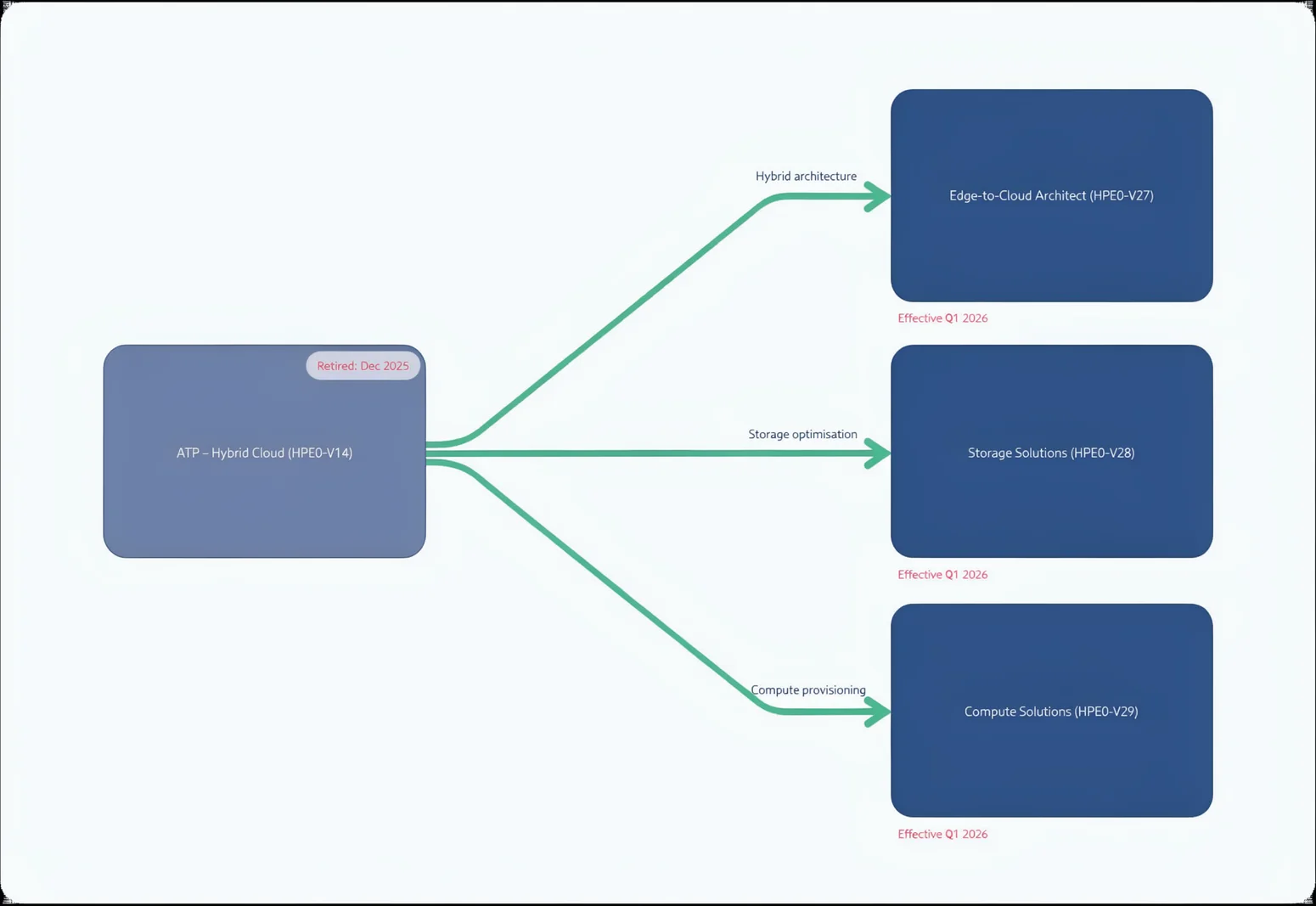
The most immediate consequence of this shift is the retirement of the HPE ATP – Hybrid Cloud certification. The official datasheet states that this credential becomes inactive on 1 July 2026. It is being replaced by three separate expert-level tracks: HPE ATP – Edge-to-Cloud Architect, HPE ATP – Storage Solutions, and HPE ATP – Compute Solutions. For candidates who previously used ATP – Hybrid Cloud as a general entry point, the message is clear: you must now choose a specialisation from the beginning. There is no catch-all foundation credential that spans compute, storage, and cloud architecture simultaneously.
The broader portfolio, as documented in the Certification Paths reference, now organises credentials into distinct ladders within several technology domains, including compute solutions, storage solutions, hybrid cloud/edge-to-cloud, Aruba networking (which alone contains over a dozen sub-tracks), artificial intelligence, data centre facilities, and OneView management. The pattern across all of them is the same: move from product recall to scenario evaluation, and from one-and-done testing to continuous demonstration of competence.
Track-by-Track Architecture
Edge-to-Cloud Architect
The Edge-to-Cloud Architect track represents the strategic core of the new framework. It targets engineers and architects who design solutions spanning on-premises data centres, colocation facilities, and public cloud environments—all under the HPE GreenLake consumption model. Early exam codes associated with this track, such as the HPE0-V27 series, test workload placement logic, hybrid management tooling, and the financial modelling of as-a-service delivery. In many ways, the Edge-to-Cloud Architect is the intellectual successor to the retired ATP – Hybrid Cloud, but with a heavier emphasis on architecture decisions rather than general product knowledge.
Candidates who held the retired ATP – Hybrid Cloud should watch the release notes on the HPE Certification and Learning portal for any transition pathway. At the time of writing, HPE has not published a formal bridge exam, so the safest route is to prepare for the new ATP-level credential directly. The scenario-heavy nature of these questions rewards hands-on experience with Synergy composable infrastructure and GreenLake deployments more than rote memorisation of spec sheets.
Compute and Storage Solutions
Unlike the hybrid cloud area, the Compute Solutions and Storage Solutions tracks are relatively stable. The Compute path covers server architecture across ProLiant, Synergy, and Apollo platforms, and it now extends into composable infrastructure through exams such as HPE0-S58. That exam, targeting Composable Infrastructure Solutions, evaluates your ability to design and manage Synergy-based environments where physical and software-defined resources are treated as a single pool. Similarly, the Compute Solutions practice test provides a diagnostic for candidates who need to confirm their readiness before spending on official training.
The Storage Solutions track focuses on Alletra, Primera, and Nimble arrays, plus data protection integration. Self-study resources are more mature here than in the newer cloud tracks. HPE Press already publishes official study guides for several exams, including the Advanced HPE Compute and HPE Storage Solutions guide for HPE1-H05. For candidates working across data centre disciplines, a Data Center Solutions practice test can efficiently surface gaps across both storage and compute fundamentals in a single session.
Aruba Networking
The Aruba Networking certification family is the largest and most granular segment of the HPE portfolio. The Certification Paths document lists separate tracks for switching, data centre architecture, security, campus access, and the CX 10000 switching platform. Each track follows the familiar associate–professional–expert hierarchy, with a mix of written and practical assessments at the higher levels. Expert-tier practical exams, such as the Campus Access Switching Expert exam, require lab access and significant hands-on practice, which is a genuine differentiator in a crowded networking certification market.
For a network engineer, the decision tree is not “should I get an HPE certification?” but “which Aruba specialisation matches the hardware and topology I manage day to day?” Someone responsible for campus networks built on Aruba CX switches will find the Network Switching Expert (HPE7-A09) relevant, while a data centre architect with a denser switching fabric would target the Network Data Center Professional exam. The Aruba security certification path also sits at the intersection of networking and the rapidly growing demand for infrastructure security skills, which we examine next.
Career Demand and Market Signals
No vendor credential guarantees a salary increase in isolation, but the 2026 labour market data suggests that infrastructure specialisation commands a premium. Robert Half’s Demand for Skilled Talent report, published in July 2026, captures the colliding pressures that make these skills valuable:
“Technology leaders face colliding priorities as they try to strengthen security, implement AI and modernize systems simultaneously, often with limited capacity. That pressure is keeping demand high for talent in areas such as cybersecurity and data engineering.” — Robert Half, Demand for Skilled Talent, July 2026
Complementing this, Foote Partners’ 2Q 2026 IT Skills Demand and Pay Trends Report analysed over 660 certifications and found that hands-on, vendor-specific technical certifications continue to produce pay premiums, especially for roles that require physical or hybrid infrastructure competencies. While cloud certifications dominate the list of fastest-growing credentials in terms of volume, the skills attached to on-premises and edge infrastructure remain tightly supplied. An HPE-certified professional with demonstrated composable infrastructure or Aruba security expertise is less common—and therefore more valuable—than a generic cloud generalist.
The practical conclusion for an IT professional: the HPE certification path can yield scarcity value, but only when the selected track maps cleanly to a real, recognisable job scope. Broad, legacy credentials like the retired ATP – Hybrid Cloud no longer signal the depth employers look for. Specialisation in an area with clear hiring demand—edge-to-cloud architecture or Aruba data centre switching, for example—converts certification effort into a stronger negotiating position.
A Decision Framework for Selecting a Track
Rather than enumerate every available credential, the following framework matches common roles to appropriate starting points and progression targets.
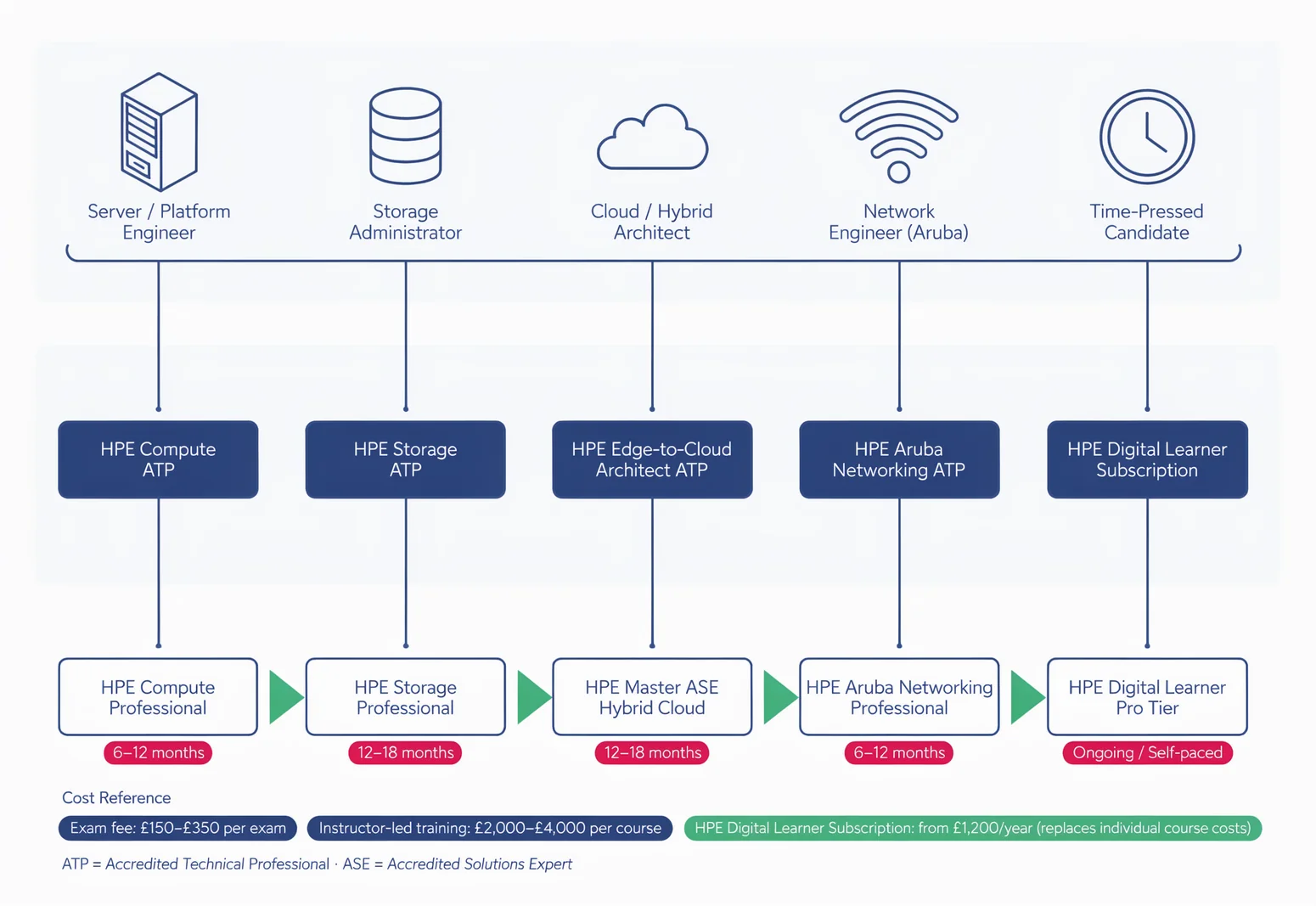
- Server and platform engineer: Begin with the HPE ATP – Compute Solutions or an equivalent foundation, then progress toward the Advanced HPE Server Solutions exam if your role involves multi-generational ProLiant deployments. Expect exam content that crosses hardware model selection, firmware baselines, and workload sizing under real constraints.
- Storage administrator: The HPE ATP – Storage Solutions track maps directly to array management tasks. Supplement study with practice sets that blend storage and compute scenarios, because many real-world exams frame data protection questions inside broader solution contexts.
- Cloud or hybrid infrastructure architect: The Edge-to-Cloud Architect path is the most aligned pick. Confirm the current exam version before committing—this track is still being shaped. The certification combines technical architecture with financial modelling for as-a-service consumption, a combination that remains comparatively rare in the candidate pool.
- Network engineer in an Aruba environment: Select the Aruba track that matches your daily environment. The expert-level practicals demand lab work; budget for that time. Aruba practice tests and vendor-specific labs can shorten the preparation cycle.
- Candidate under time pressure: If your employer requires an HPE credential quickly, the older Hybrid IT Solutions (HPE0-V14) still covers foundational compute and cloud concepts. Consider it a bridging credential only, and plan to migrate to one of the newer role-based tracks within 18–24 months as HPE’s continuous learning model accelerates the obsolescence of legacy certifications.
Exam costs vary by geography and delivery mode. Standard written exams typically fall between £150 and £250, while practical exams at the expert tier can reach £350. Official instructor-led training through HPE Education Services adds substantial cost—often £2,000 to £4,000—but HPE Digital Learner subscriptions provide a more affordable, on-demand alternative. Self-study using HPE Press guides and third-party practice tests can bring the total investment to a few hundred pounds, a figure that is viable for many self-funded candidates.
Preparation That Matches the New Exam Style
HPE’s own technical certifications page describes the credentials as designed to “verify your expertise in our industry-leading technologies.” The exam blueprints are tight, and the recent restructuring pushes questions toward scenario evaluation: given a customer’s workload profile, budget, and growth trajectory, which HPE solution fits? That shift rewards a specific preparation approach.
Start with the official exam datasheet and release notes on the HPE Certification and Learning portal. These documents provide the exam objective weightings and any last-minute updates that distinguish a current candidate from one who studied outdated materials. Next, invest time in hands-on practice. If production hardware is unavailable, HPE’s Virtual Labs or partner portal demonstration environments allow you to work through configuration scenarios without risk. Finally, use timed practice tests that include detailed answer explanations. The explanation is often more valuable than the score: it reveals the HPE decision logic behind choosing one ProLiant model over another, or one storage tier over a seemingly comparable alternative. Candidates who rely solely on memorised part numbers tend to second-guess themselves when the exam presents a cost-versus-performance trade-off. The goal is to practise the decision, not just recall the facts.
Limitations and Forward Outlook
This report reflects HPE’s certification portfolio as documented in mid-June 2026. Several major track revisions are still underway, and the final shape of the Edge-to-Cloud Architect curriculum may diverge from current early exam objectives. The salary and demand data cited here draw on cross-industry surveys rather than an HPE-specific compensation study; treat them as directional evidence, not individual earnings forecasts. The Robert Half and Foote Partners reports focus primarily on the US market, so candidates based elsewhere should supplement these findings with local job-board and salary data.
Another variable is the continuous learning integration. As HPE connects certifications to the Tech Pro platform, expect shorter renewal cycles and more granular micro-credentials. For employers, this shift is a positive signal—certified staff are demonstrably current. For individuals funding their own preparation, it changes the financial model from a one-time project to a recurring investment. The window of opportunity, however, is open now. Early adopters of the new Edge-to-Cloud and Storage tracks will differentiate themselves in a market where these credentials are still uncommon. Pair that early-mover advantage with deliberate, scenario-based practice, and a vendor certification becomes a genuine career accelerator.
HPE Practice Tests and Study Resources
browse the relevant exam page and purchase a practice test

Discussion
Question Comments
0 comments·0 participantsSign in to leave a comment and access more free questions.