

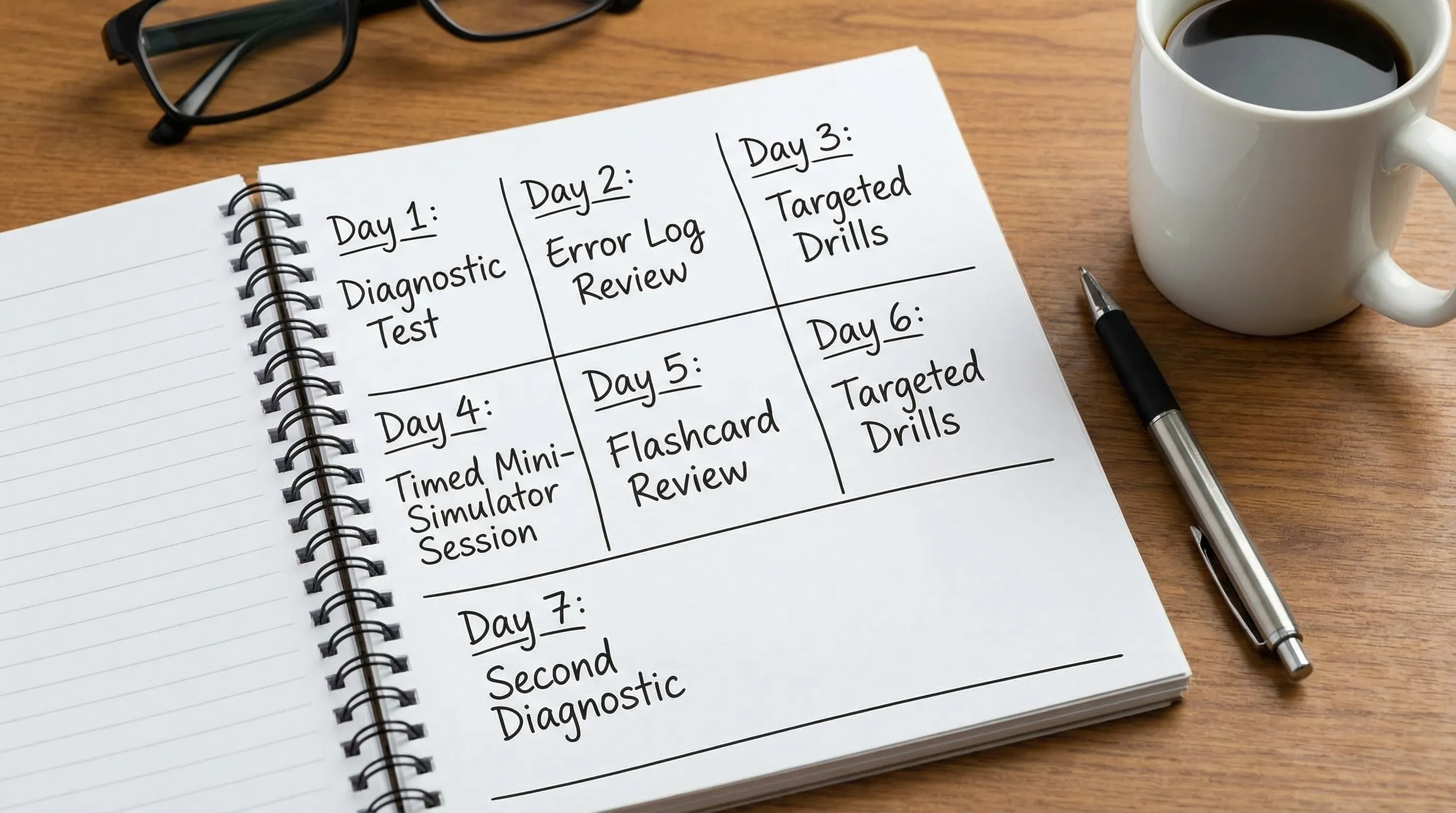
Most certification plans fail in the first week, not because the material is too hard, but because the start is too random. An online practice test is the fastest way to replace guesswork with data, as long as you use it as a warm-up to diagnose, set priorities, and build habits you can sustain.
This guide lays out a high-leverage first-week routine you can use for almost any IT certification, from networking and cloud to security and vendor-specific exams.
The goal of week one (and what it is not)
Week one is about building a reliable baseline and a system.
It is not about “finishing half the content,” grinding thousands of questions, or trying to reach a passing score immediately.
A good first week should help you:
- Understand the exam’s structure and your current score range
- Identify the topics that drive most of your missed questions
- Build a review workflow that turns mistakes into durable knowledge
- Get comfortable with timed, realistic testing conditions
Those outcomes matter because practice testing itself improves learning. Cognitive science consistently finds a “testing effect,” where retrieval practice (being forced to recall) improves long-term retention more than re-reading notes. A classic overview is Roediger and Karpicke’s work on retrieval practice (Association for Psychological Science) and broader learning-technique reviews like Dunlosky et al. (2013) (American Psychological Association).
Day 0 (setup): pick the right practice environment
Before you take your first online practice test, set up your environment so your results reflect your knowledge, not distractions.
Match your practice conditions to the real exam
If you can, mirror the conditions you will face on exam day:
- Use a laptop or desktop (not a phone) for full-length timed attempts
- Practice in a quiet place, with notifications off
- Use a single note sheet for “parking lot” notes (things you want to review later), not for live cheating
Choose question sets that explain answers
In week one, explanations matter as much as the score. You are building your error-correction engine.
If you are using Planet Cert practice tests, prioritize sets that include explanations and use the web-based exam simulator so you can practice the pacing and pressure of real attempts.
Day 1: take a diagnostic online practice test (the right way)
Your first test is not a final exam. It is a diagnostic.
How long should the diagnostic be?
- If your exam is short (60 to 90 minutes), take one full timed attempt.
- If your exam is long (2 to 3+ hours), start with a timed “mini-diagnostic” of 25 to 40 questions so you do not burn out on day one.
Rules for the diagnostic
Keep these rules strict, or your baseline will be inflated:
- No notes, no searching, no “quick check” on a second screen
- Flag tough questions and move on
- Finish under a timer
What to track (beyond the score)
Open a simple document and capture four fields for every missed or guessed question:
| Field | What to write | Why it matters |
|---|---|---|
| Topic/domain | The exam objective area | Helps you prioritize high-impact study |
| Error type | Knowledge gap, misread, time pressure, trap option | Prevents repeating the same mistake pattern |
| Why the right answer is right | One or two sentences in your own words | Forces understanding, not recognition |
| Fix | One resource to review and one micro-drill you will do | Converts review into action |
This becomes your “error log,” the single most useful artifact you can create in week one.
Day 2: analyze your diagnostic and pick your “score movers”
Day two is about turning your error log into a plan.
Use the 3-bucket method
Sort missed questions into three buckets:
- Bucket A: Frequent fundamentals (core concepts that keep showing up)
- Bucket B: High-confusion items (concepts you partially know but mix up)
- Bucket C: Low-frequency edge cases (rare topics you can postpone)
In week one, focus on Buckets A and B. That is where the fastest point gains usually live.
Create a simple weekly target
Set a realistic target for week one, such as:
- Improve accuracy by 10 to 15 percentage points on Bucket A topics
- Reduce “misread” mistakes by rewriting your approach to stems and keywords
- Cut your average time per question by 10 to 20 percent on familiar topics
These targets are process-based and measurable, which keeps you out of the motivation trap.
Day 3: build a tight study loop (learn, drill, retest)
Day three is where most people either create momentum or drift.
The loop that works
Your loop should be short enough to repeat daily:
Learn one objective (30 to 60 minutes)
Drill with questions (20 to 40 minutes)
Review every miss (20 to 40 minutes)
Even if you only have 60 to 90 minutes per day, you can still run the loop on a smaller scale.
If you are using Planet Cert exam questions, this is the moment to switch from “random everything” to targeted practice sets aligned to your weakest objectives, while keeping explanations on.
Make spaced repetition automatic
Spaced repetition works because forgetting is part of learning, and reviewing right before you forget strengthens memory. One widely cited review is Cepeda et al. on spaced practice effects (Psychological Science).
Practical way to implement it in week one:
- Turn your top 15 to 25 recurring misses into flashcards
- Review them briefly on days 4, 6, and 7
Keep flashcards simple: definition, key distinction, command behavior, port, limit, or “this vs that.”
Day 4: do a timed “mini-sim” to train pacing
Many candidates know the material but fail on pacing, fatigue, and second-guessing.
On day four, do a timed mini-sim (25 to 40 questions) with these constraints:
- Set a per-question pace target (example: 75 to 90 seconds)
- Flag and move on when stuck
- Do not review answers until the end
Then review with your error log.
A simple pacing checkpoint
Use this table as a quick self-assessment after the mini-sim:
| Signal | What it usually means | What to do next |
|---|---|---|
| You ran out of time | Over-investing in hard questions | Enforce a hard “flag-and-move” rule |
| Accuracy dropped late | Fatigue or attention drift | Add a planned 60 to 90 second reset break |
| Many misreads | Skimming stems too fast | Read the last line first, then the stem |
| Too many 50/50 guesses | Weak concept boundaries | Create comparison flashcards (“A vs B”) |
If you want realistic conditions without installing software, use a browser-based simulator like the one included with Planet Cert practice exams.
Day 5: fix your top 2 mistake patterns (not your top 20 topics)
By day five, you will usually see repeating patterns that have nothing to do with content volume. Fixing these can raise your score quickly.
Common high-impact mistake patterns:
- Misreading qualifiers: “most likely,” “best,” “first,” “NOT,” “except”
- Falling for plausible distractors: answers that are true in general, but wrong for the question’s constraints
- Switching answers without new evidence: changing correct answers due to anxiety
Choose your top two patterns and create a rule for each.
Example rules:
- Misread rule: circle or rewrite the qualifier before looking at options
- Distractor rule: restate the requirement in your own words before selecting
Then run a short targeted set of questions to practice the rule. This is skill training, not content review.
Day 6: take a second diagnostic (shorter, sharper)
Now you retest, but you do it strategically.
What the day 6 test should look like
- Shorter than day 1 (unless your day 1 was already short)
- Heavily weighted toward Bucket A and Bucket B topics
- Timed
The purpose is to see whether your fixes are working.
If your score improved but you still feel “shaky,” that is normal. Confidence should come from repeatable process, not one good attempt.
Day 7: consolidate, then plan week two
Day seven is where you lock in the gains and decide what changes in week two.
Do a consolidation review
- Re-read the week’s error log
- Rework 10 to 15 previously missed questions without looking at the explanations
- Review your flashcards
Decide your week two focus
Use your data to pick one of these directions:
- If timing is the problem, schedule more mini-sims
- If fundamentals are the problem, schedule more targeted drills with explanations
- If you are close to passing, move toward one full-length exam simulation per week
If you need fresh sets and regularly updated material as you scale up, Planet Cert test questions can help you keep your practice aligned with current exam expectations.
A few first-week mistakes to avoid
Most “bad weeks” come from a handful of predictable traps:
- Doing only random questions, never building an error log
- Reviewing explanations passively instead of rewriting the reasoning
- Taking too many full-length tests too early, then burning out
- Ignoring timing until the final week
Treat week one as your warm-up block. The goal is not to prove you are ready, it is to create a repeatable system that makes you ready.
Putting it all together: your first-week checklist
If you want a simple pass-fail checklist for week one, you are on track if you can say yes to these:
- I took a timed diagnostic online practice test under clean conditions
- I created an error log and used it daily
- I did at least one timed mini-sim to train pacing
- I converted my most common misses into flashcards or short notes
- I retested to confirm improvement, not just “studied more”
Once that foundation is in place, increasing volume in week two actually works, because you are practicing with feedback, not spinning your wheels.

Discussion
Question Comments
0 comments·0 participantsSign in to leave a comment and access more free questions.