

Choosing a PMP test prep course in 2026 is less about finding “the best” program and more about finding the best match for how you learn, how much time you have, and how you’ll measure readiness. The market is crowded with bootcamps, self-paced video libraries, and “guaranteed pass” offers, but the PMP exam rewards applied judgment, not memorization.
This checklist helps you evaluate any PMP course (and the practice ecosystem around it) so you can pick a setup you will actually finish, retain, and perform with.
Start with the non-negotiables (PMP exam reality check)
Before you compare providers, anchor on what the PMP exam requires.
- The PMP is governed by PMI. Course claims should map to PMI’s official structure and expectations.
- The exam is scenario-driven and blends predictive, agile, and hybrid approaches.
- You need 35 contact hours of project management education to be eligible.
For the most current exam details, always confirm against PMI’s official pages and documents, such as the PMP certification overview and the current Exam Content Outline.
PMP test prep course checklist (2026): how to choose the right fit
Use the sections below as a scoring rubric. If a course fails multiple “must-have” items, keep shopping.
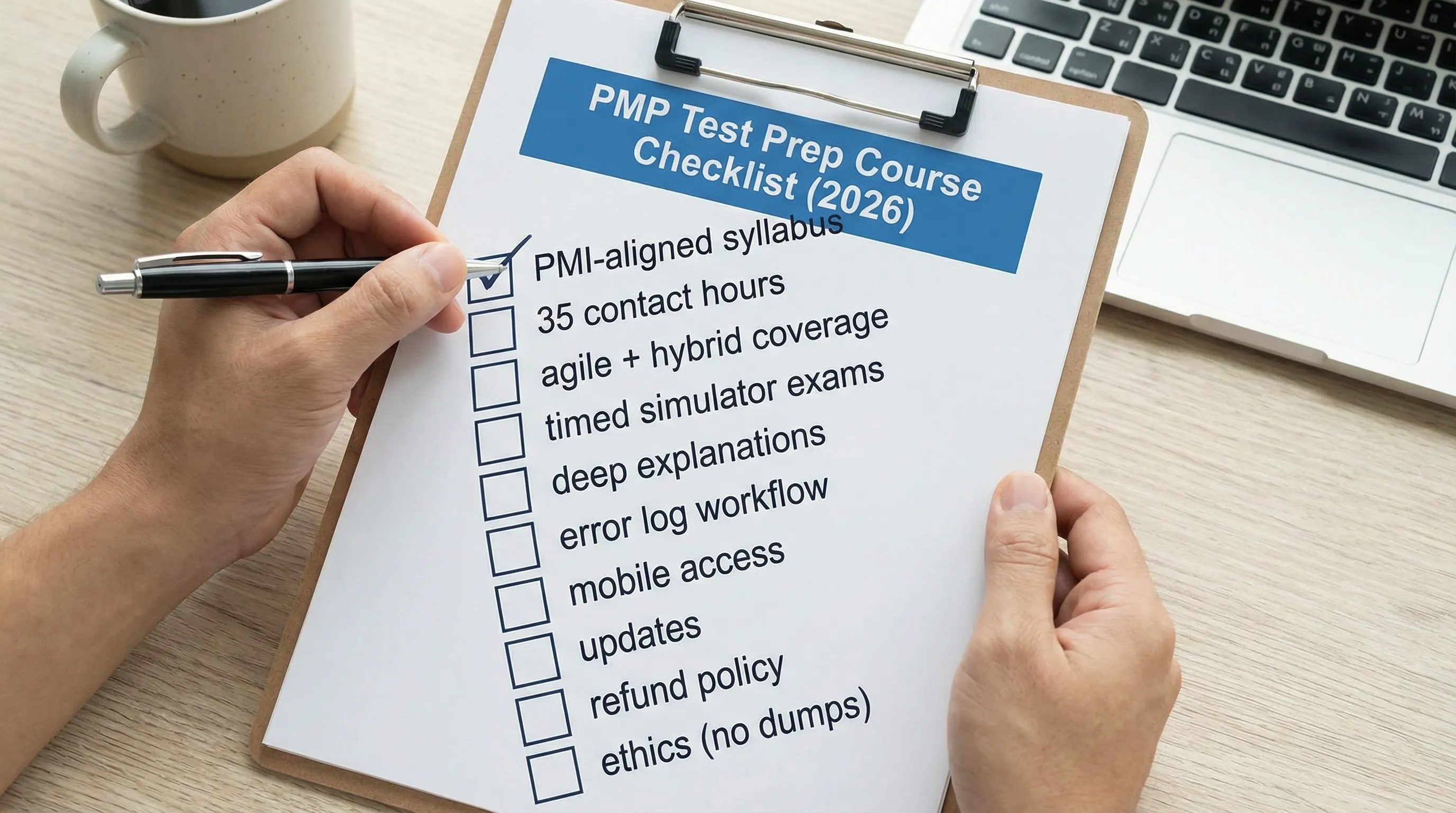
1) PMI alignment (not just “PMP-compatible” marketing)
A good course should clearly show how it aligns to PMI’s exam structure.
What to look for
- A syllabus that explicitly maps to PMI’s domains and tasks from the Exam Content Outline.
- Clear coverage of predictive, agile, and hybrid delivery.
- Practice questions that feel like project scenarios (tradeoffs, constraints, stakeholders), not trivia.
Red flags
- “We cover everything you need” with no outline or mapping.
- Heavy emphasis on memorizing definitions without decision-making practice.
2) The course fits your schedule and your attention span
The best PMP prep is the one you will complete.
Choose your format intentionally
- Live bootcamp: fast, structured, good if you want momentum and deadlines.
- Self-paced: flexible, good if your schedule is unpredictable.
- Cohort + accountability: best if you tend to start strong and fade without peers.
Quick rule: If you cannot realistically study at least 4 to 6 hours per week for the next several weeks, avoid an “intense” bootcamp that assumes you will.
3) You get real practice, not just content
Most candidates fail because they “learned the material” but did not build exam performance: pacing, interpretation, and choosing the best answer under ambiguity.
Must-have practice elements
- Timed practice in an exam-like simulator.
- Mixed-topic sets (not only chapter quizzes).
- A review method that forces you to explain why the right answer is right.
If your course includes weak quizzes, plan to pair it with a dedicated question engine like Planet Cert PMP practice tests that lets you train under realistic conditions.
4) Explanations are strong enough to teach judgment
Great PMP questions do more than say “Correct answer: B.” They teach the decision rule.
What “good explanations” include
- Why the correct choice best fits PMI’s mindset.
- Why the other options are tempting but wrong.
- A quick concept link (stakeholders, risk response, servant leadership, change control, etc.).
If you are comparing two providers, open their sample questions and judge explanation quality first. Explanations are where most prep products quietly fail.
5) The course has a built-in review loop (error log + retest)
A course is only as good as its remediation process.
Look for a workflow like
- Diagnostic assessment early.
- Targeted drills based on misses.
- Retest after 48 to 72 hours to confirm learning.
If the course does not provide a structured review loop, you can create one using a question bank and an error log. Many candidates do this with Planet Cert PMP exam questions by tagging misses, capturing the reason (knowledge gap vs misread vs timing), then retesting in mixed sets.
6) Contact hours are legitimate and documented (35-hour requirement)
If you need the 35 contact hours, confirm:
- The course explicitly states it provides 35 contact hours (or more).
- You receive proof of completion (certificate or equivalent documentation).
If you already have the hours, you can select a course purely for performance, then invest more heavily in practice exams.
7) Updates are frequent and transparent
In 2026, “updated regularly” should mean something concrete.
What to ask
- When was the content last updated?
- How often are questions reviewed?
- Do they publish change notes or revision history?
Why it matters: PMP prep ages quickly when it does not reflect how PMI frames scenarios and terminology.
8) Ethics: no dumps, no “leaked questions” claims
Avoid any provider that markets “real PMP questions” in a way that implies leaked exam content. That is a risk to your certification and your career.
Instead, look for realistic, original practice questions, expert review, and explanations that teach principles. (You can still use products labeled as “realistic exam questions” when they are clearly practice items created for training, not stolen content.)
9) Support and accountability (especially if you are busy)
Support is a feature, not a nice-to-have.
High-value support options
- Office hours or instructor Q&A.
- A community where people discuss rationale (not just answers).
- A clear escalation path when you are stuck.
If you know you procrastinate, choose accountability over “more content.”
10) Refund policy and risk management
A money-back guarantee can reduce risk, but read the conditions.
- Is the guarantee tied to completing assignments, practice scores, or a specific timeline?
- Is the process clear or buried behind support tickets?
PlanetCert notes a money-back guarantee in its offering, but you should always review the current policy details on the site before purchase.
Compare providers with one simple table
Use this table to keep your evaluation objective.
| Checklist area | What “good” looks like | Common red flags |
|---|---|---|
| PMI alignment | ECO-mapped syllabus, scenario-first teaching | Vague outline, definition memorization |
| Format fit | Schedule matches your real week | Aggressive timeline with no buffer |
| Practice volume | Multiple timed simulations, mixed sets | Only chapter quizzes |
| Explanations | Teaches decision logic and eliminates distractors | “B is correct” with no rationale |
| Review system | Error log, retest cadence, progress tracking | No remediation plan |
| 35 contact hours | Clear eligibility statement + proof | Ambiguous or undocumented hours |
| Updates | Recent update dates, ongoing question review | “Updated” with no evidence |
| Ethics | Original practice items, no dump language | “Leaked/actual exam” claims |
| Support | Q&A, community, instructor access | No help beyond FAQs |
| Policies | Clear access length and refund terms | Restrictive, unclear conditions |
A practical way to validate your choice (before you commit)
You do not need weeks to figure out whether a course fits. Run this quick validation:
Do a 60-minute “trial sprint”
- Watch one lesson on a high-impact domain (stakeholders, risk, or agile team leadership).
- Do 20 to 30 practice questions immediately after.
- Review every miss and every guess.
Pass/fail signal: If the explanations do not improve your reasoning in real time, the course is not teaching what the exam rewards.
Take a short timed set to test simulator quality
Even a 30-question timed block reveals:
- Whether the interface supports realistic pacing.
- Whether questions feel scenario-based.
- Whether your review workflow is workable.
You can do this with your provider’s tool, or layer in a dedicated question bank like Planet Cert PMP test questions if your course is content-strong but practice-weak.
The best “stack” for most PMP candidates in 2026
Most successful candidates use a combination:
- A course for structured learning and the 35 contact hours (if needed).
- A simulator + practice exams for performance training.
- A review loop (error log, retest, mixed sets).
If you are building that stack, Planet Cert PMP practice exams can serve as the practice layer: realistic simulator sessions, explanations, and repetition across a large question pool.
Frequently Asked Questions
What should a PMP test prep course include in 2026? A PMI-aligned syllabus mapped to the Exam Content Outline, coverage of predictive and agile/hybrid approaches, realistic scenario questions, timed simulator exams, and a structured review process.
Is a PMP bootcamp better than a self-paced course? Bootcamps work well if you need structure and deadlines. Self-paced courses are better if your schedule changes often. The best choice is the one you will finish and pair with enough timed practice.
How many practice exams should I take for PMP? Enough to make your performance stable, not just your knowledge. Many candidates benefit from multiple full-length timed simulations plus mixed-topic sets, with deep review between attempts.
Are “real PMP questions” safe to use? Avoid anything that implies leaked or stolen exam content (dumps). Use reputable practice questions written for training, with strong explanations and ethical sourcing.
Can I use practice tests without buying a full prep course? Yes, especially if you already have the 35 contact hours. Practice tests are often the most direct way to build exam readiness, as long as you review misses and retest.
Build confidence with realistic practice (without overpaying for content)
If you have a course picked (or you are still deciding) and want to pressure-test your readiness with exam-like practice, use Planet Cert practice tests to run timed simulations, drill weak areas, and review detailed explanations.
When you can consistently perform under time pressure and explain the “why” behind your answers, you are no longer just studying, you are training for the PMP exam.

Discussion
Question Comments
0 comments·0 participantsSign in to leave a comment and access more free questions.