
Most score gains on the SAT come from two levers you can actually control: timing (how you pace) and pattern recognition (how well you understand the sections and scoring). A great SAT practice test does not just “check your score”, it shows you where time leaks, which question types cost you points, and how the adaptive format changes your strategy.
Below is a practical breakdown of the digital SAT timing, sections, and scoring, plus how to use practice tests to improve faster.
Digital SAT at a glance (what your SAT practice test should mirror)
The SAT is now a digital, adaptive exam (two modules per section). That means your performance in Module 1 influences the difficulty of Module 2 within that section. For official overview and specs, see the College Board SAT page.
Here is the structure most SAT practice tests aim to replicate:
| Section | Modules | Time | Questions | What it tests |
|---|---|---|---|---|
| Reading and Writing | 2 | 64 minutes | 54 | Short passages, grammar, rhetorical skills, vocabulary-in-context |
| Math | 2 | 70 minutes | 44 | Algebra, advanced math, problem solving/data analysis, geometry/trig |
| Total | 4 | 134 minutes (2h 14m) | 98 | Two-section score, 400 to 1600 |
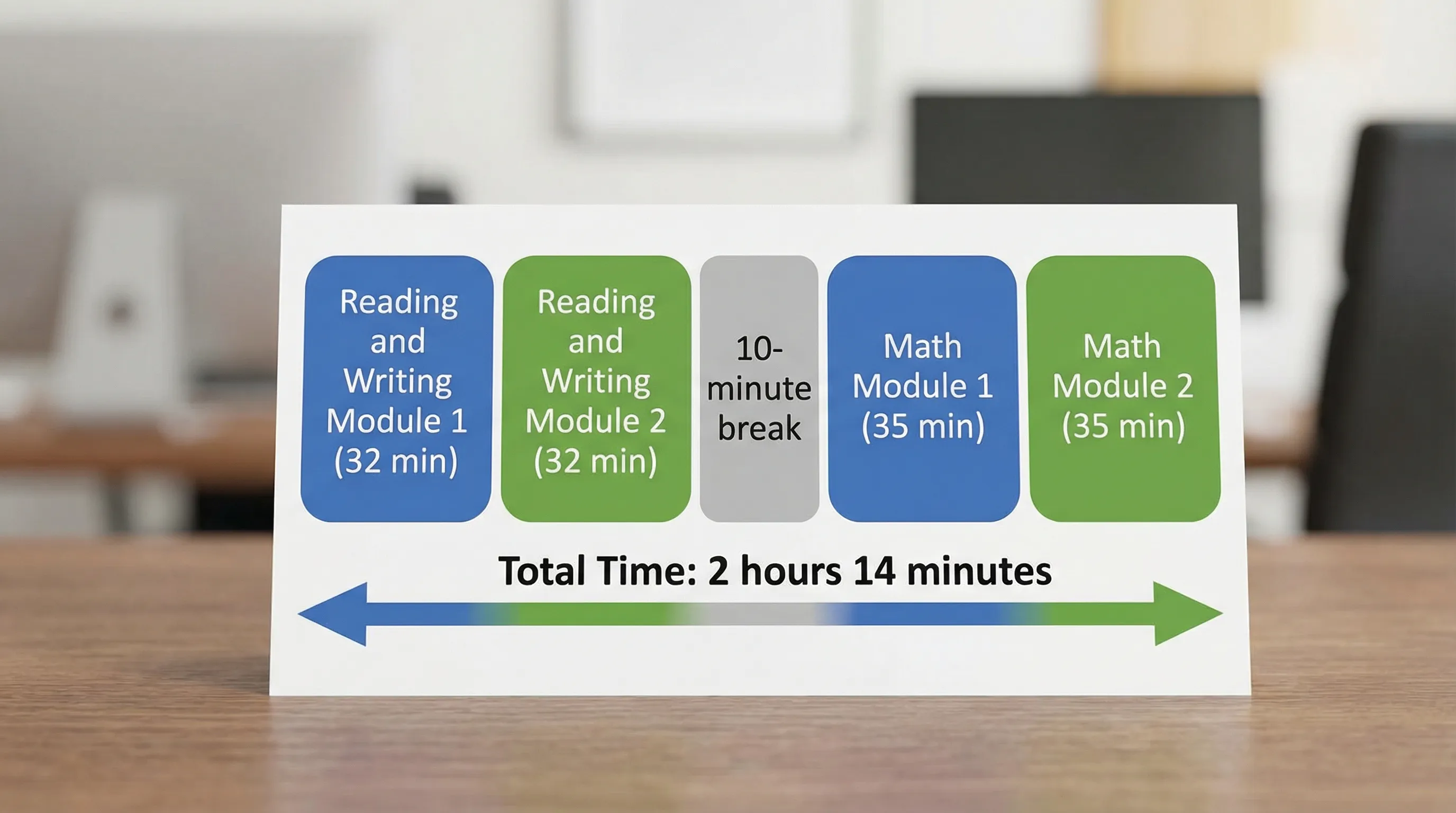
There is also a 10-minute break between the Reading and Writing section and the Math section.
Module timing (and what it means for pacing)
| Part | Time | Questions | Average time per question |
|---|---|---|---|
| Reading and Writing Module 1 | 32 minutes | 27 | ~71 seconds |
| Reading and Writing Module 2 | 32 minutes | 27 | ~71 seconds |
| Math Module 1 | 35 minutes | 22 | ~95 seconds |
| Math Module 2 | 35 minutes | 22 | ~95 seconds |
Those averages are not targets you must hit on every item. They are a baseline to help you decide when to skip and return.
Section 1: Reading and Writing (64 minutes)
Reading and Writing on the digital SAT is not long passages anymore. Instead, you get many short passages, each paired with one question. This changes timing in a good way because you are not “stuck” in a dense passage for 10 questions, but it also punishes slow starts because you see a lot of prompts.
What you will see most often
Question types vary, but most fall into categories like:
- Information and Ideas (main idea, inference, evidence, data in a chart)
- Craft and Structure (word choice in context, purpose, function)
- Expression of Ideas (transitions, organization, clarity)
- Standard English Conventions (grammar, punctuation, sentence structure)
The College Board’s “What’s on the SAT” pages outline these skills in detail: Reading and Writing overview.
Timing strategy that works in real SAT practice tests
Because you have ~71 seconds per question on average, you need a repeatable decision rule:
- Answer immediately if you can confidently solve within ~45 to 60 seconds.
- Mark and move if you are still parsing the passage after ~30 seconds or you are between two answer choices with no clear reason.
- Return later with fresh eyes. Many students improve accuracy by re-reading only after they have secured the easier points.
A useful benchmark in a timed SAT practice test:
- Aim to be around question 14 by the halfway time mark (about 16 minutes into the module).
- Try to finish your first pass with 3 to 5 minutes left for marked questions.
High-leverage skills to drill (fast improvement)
If you are limited on study time, these tend to provide good ROI:
- Transitions (however, therefore, moreover, for example): easy to practice, predictable patterns.
- Punctuation and boundaries (commas vs semicolons vs periods): consistent rules.
- Rhetorical synthesis (notes to a sentence): learn to pick the choice that matches the goal and stays specific.
In review, do not just mark “grammar mistake.” Write the rule in one line (example: “two independent clauses, need semicolon or period”). That is how practice tests turn into lasting score gains.
Section 2: Math (70 minutes)
Math is also split into two modules. A key difference from the old SAT is that the digital SAT includes an on-screen graphing calculator (Desmos) and allows calculators throughout the Math section.
College Board’s breakdown is here: Math overview.
Content areas you should expect
You will see a mix of:
- Algebra (linear equations, systems, inequalities)
- Advanced Math (quadratics, functions, exponentials)
- Problem Solving and Data Analysis (ratios, rates, probability, interpreting data)
- Geometry and Trigonometry (circles, area/volume, right-triangle trig)
Timing strategy: first pass, then the time sinks
With ~95 seconds per question on average, Math pacing usually improves when you split your approach:
- First pass (fast points): do the questions you can solve quickly, including many algebra manipulations and straightforward function questions.
- Second pass (heavier items): word problems with multiple steps, trickier function interpretation, geometry setups.
A practical rule inside any SAT practice test:
- If you do not have a clear setup after ~45 seconds, mark it and move.
- Avoid spending 3+ minutes early. One long stall can cost you two easier questions later.
Use the calculator deliberately (not automatically)
The built-in graphing calculator can be a huge advantage, but only if you know when it saves time.
Use it when:
- You can graph and identify an intersection quickly.
- You are checking a factor/zero or comparing function behaviors.
- You want to verify an answer choice by substitution.
Avoid it when:
- A quick algebra step is faster than opening a graph.
- You will lose time typing complex expressions.
The goal is not “calculator everywhere,” it is “calculator where it reduces cognitive load and time.”
How SAT scoring works (what your SAT practice test score is telling you)
The SAT score range is:
- Total score: 400 to 1600
- Section scores: Reading and Writing (200 to 800), Math (200 to 800)
College Board explains score components here: Understanding SAT scores.
The most important scoring truth
There is no penalty for wrong answers. You should never leave a question blank.
Why “raw score to scaled score” is not fixed
Students often ask: “If I miss 10 questions, what score is that?” On the SAT, the conversion is not a single universal chart because forms are equated. Equating adjusts for small differences in difficulty across test forms, so that a score means roughly the same level of performance across dates.
What this means for practice:
- Treat your SAT practice test score as an estimate.
- Treat your mistake patterns and timing breakdown as the real value.
Adaptive modules and what they mean for scoring
Because the digital SAT is adaptive within each section, Module 2 may be easier or harder based on Module 1 performance. Practically, that means:
- A strong Module 1 can unlock a more difficult Module 2, which can support a higher score ceiling.
- Early careless errors can have an outsized impact because they can affect the second module difficulty.
So your best scoring “hack” is not a trick question type. It is clean execution on the first module.
What to look for in a high-quality SAT practice test
When you take an SAT practice test, you want it to match the real decision pressure of test day.
A good practice experience should include:
- Correct timing per module (32/32/35/35)
- A realistic mix of question types and difficulties
- Explanations that teach the why, not just the letter
- A way to review missed questions and track weak areas
For official practice, the College Board points students to the Bluebook app: Official SAT practice tests in Bluebook.
How to review an SAT practice test (the part that actually raises scores)
Taking practice tests is useful, but review is where most improvement happens. Use a simple error log that captures the cause of each miss.
The 4-bucket mistake system
For every wrong or guessed question, label it:
- Content gap: you did not know the rule or method.
- Process error: you knew the content but used the wrong steps.
- Careless error: you misread, miscopied, or made an arithmetic slip.
- Timing error: you rushed, or you ran out of time and guessed.
This turns “I got 12 wrong” into an actual plan.
A realistic weekly practice rhythm
Most students do well with a schedule that balances full tests and targeted drills:
| Day type | What you do | Time | Outcome |
|---|---|---|---|
| Full test day | 1 full SAT practice test under timed conditions | 2h 30m to 3h (including review start) | Endurance, pacing data |
| Review day | Deep review of every miss and every guess | 60 to 120m | Converts mistakes into skills |
| Drill day | Target 1 to 2 weak areas (for example transitions, linear systems) | 30 to 60m | Fast score gains |
If you only have time for one thing, prioritize review plus targeted drills over taking endless full-length tests.
Timing tips you can apply on your next SAT practice test
Use “checkpoints” instead of constant clock-watching
Constantly checking time increases stress. Instead, check at planned moments:
- Reading and Writing: once around question 10, again around question 20
- Math: once around question 8, again around question 16
If you are behind at a checkpoint, shift into “secure points” mode: do easier questions first, mark the time sinks, then return.
Always guess strategically if time is running out
Since there is no guessing penalty, a good end-of-module strategy is:
- Eliminate obviously wrong choices quickly.
- Guess consistently if you cannot finish (some students pick a default letter after elimination to reduce decision time).
Frequently Asked Questions
How long is the digital SAT? The digital SAT is 2 hours and 14 minutes of testing time (134 minutes), plus a 10-minute break between sections.
How many questions are on the SAT? The digital SAT has 98 questions total: 54 in Reading and Writing and 44 in Math.
Is the digital SAT adaptive? Yes. Each section has two modules, and Module 2 difficulty can adjust based on your performance in Module 1.
Is there a guessing penalty on the SAT? No. There is no penalty for incorrect answers, so you should not leave questions blank.
How often should I take an SAT practice test? Many students benefit from one full timed practice test every 1 to 2 weeks, with focused review and drills between tests.
Practice smarter with PlanetCert
If you want a structured way to train timing, build confidence, and learn from your mistakes, use realistic practice tests and detailed explanations. Explore PlanetCert practice tests to find practice exams and exam questions across a wide range of exams, and if you do not see what you need, you can request an exam and PlanetCert can add it within 7 days. That way your next SAT practice test session is not just more work, it is measurable progress.

Discussion
Question Comments
0 comments·0 participantsSign in to leave a comment and access more free questions.