

Why Choose AWS Certified Solutions Architect - Associate Now
The AWS Certified Solutions Architect - Associate is AWS’s associate-level architecture credential for people who need to design secure, resilient, high-performing, and cost-optimized solutions on AWS.[1] AWS positions the SAA-C03 exam as a practical validation of architecture decisions, not just service memorization, and says certified individuals report increased confidence and credibility with technical colleagues and customers.[1]
Last verified: March 10, 2026
Key Takeaways
| Point | Details |
|---|---|
| Exam entity | AWS lists SAA-C03 as an Associate-level certification exam for architecture work on AWS.[1] |
| Format | The exam is 130 minutes, contains 65 questions, and uses multiple-choice or multiple-response formats.[1][2] |
| Role fit | This credential is strongest for people designing workloads, choosing services, and explaining architecture tradeoffs in real environments. |
| Best starting path | If you already have AWS or strong on-prem IT experience, SAA-C03 can be a reasonable entry point; if you have no IT work experience, AWS says Cloud Practitioner is a better first certification.[1] |
Defining AWS Certified Solutions Architect Credentials
The AWS Certified Solutions Architect - Associate is one of the most recognized cloud certification credentials available today. This certification validates your ability to design secure, resilient, high-performing, and cost-optimized solutions on Amazon Web Services.

The credential targets IT professionals with intermediate cloud experience who want to prove their architectural expertise. You don’t need to be a genius—just someone who understands AWS services and can apply them to real-world problems.
What the Certification Actually Tests
The SAA-C03 exam (the current version) evaluates your knowledge across four core domains:
- Design Secure Architectures - Building systems that protect data and meet compliance requirements
- Design Resilient Architectures - Creating solutions that recover from failures and scale automatically
- Design High-Performing Architectures - Optimizing systems for speed and efficiency across regions
- Design Cost-Optimized Architectures - Reducing expenses while maintaining performance standards
These aren’t theoretical concepts. You’re learning how to build real infrastructure that companies depend on.
Exam Format and Requirements
Here’s what you’re facing on test day:
- Duration: 130 minutes (2 hours 10 minutes)
- Question Count: 65 questions total
- Question Types: Multiple choice and multiple response formats
- Passing Score: 720 out of 1000 (typically)
The mix of question types means you can’t just memorize answers. You need to understand how services interact and solve multi-step scenarios.
Prerequisites and Experience Level
AWS says the recommended experience before taking this exam is at least 1 year of hands-on experience designing cloud solutions that use AWS services.[1] That recommendation is useful because the exam assumes you can compare architecture options, not just name products.
You should have experience with:
- Deploying applications on AWS
- Configuring networking, storage, and compute services
- Understanding security best practices
- Managing cloud costs
If you do not yet have IT work experience, AWS says you would benefit from first earning AWS Certified Cloud Practitioner before attempting the associate-level solutions architect exam.[1]
If you’ve worked in on-premises IT and want to transition to cloud, this certification bridges that gap perfectly.
The Well-Architected Framework Connection
The entire exam is grounded in AWS’s design principles for secure, resilient architectures. You’re not just learning AWS—you’re learning how to think architecturally about cloud systems.
This framework teaches you to evaluate decisions across multiple dimensions: security, reliability, performance, cost optimization, and operational excellence.
This certification is most valuable when it sits on top of real architecture practice, documented design choices, and a working understanding of AWS tradeoffs.
The credential matters because it demonstrates a specific skill set companies actively hire for. Solutions architects command premium salaries and have diverse career options across industries.
Pro tip: Start with AWS hands-on labs and real-world projects before studying for the exam—the experience requirement exists because you genuinely need to understand how services behave under pressure.
Current Exam Versions and Key Requirements
The The SAA-C03 is the current version of the AWS Certified Solutions Architect - Associate exam. If you are preparing for this certification, start with the SAA-C03 exam page, use the SAA-C03 sample questions to pressure-test your decision-making, and keep our AWS practice test comparison nearby when you choose practice material. AWS lists the exam at 130 minutes, 65 questions, and $150 USD.[1]
This version replaced earlier iterations and reflects AWS services and architecture patterns you are more likely to see in active production environments.
The Four Weighted Domains
Your exam score depends on how well you master these four areas:
- Design Secure Architectures (30%) - The largest portion, emphasizing compliance and data protection
- Design Resilient Architectures - Building fault-tolerant systems that survive failures
- Design High-Performing Architectures - Optimizing latency, throughput, and scalability
- Design Cost-Optimized Architectures - Reducing expenses without sacrificing reliability
The 30% weighting on security tells you something important: AWS prioritizes architecture decisions that protect workloads from day one.
Test Logistics and Format
Here’s what you need to know for exam day:
- 65 questions to answer in 130 minutes (roughly 2 minutes per question)
- Multiple choice and multiple response formats mixed throughout
- Scaled score of 720 out of 1000 required to pass
- $150 USD exam fee
Multiple response questions are trickier than multiple choice. You might select 2, 3, or 4 correct answers—no partial credit. This format tests deeper understanding.
Where You’ll Take the Exam
You have flexibility on testing location:
- Pearson VUE testing centers - Physical locations in most countries
- Online proctored exams - Take it from home with remote supervision
The exam is delivered in multiple languages, though American English is the primary version.
Minimum Experience Requirements
AWS officially requires at least one year of hands-on experience designing cloud solutions. This isn’t arbitrary—the exam questions assume you’ve dealt with real architectural challenges.
You should understand:
- Deploying multi-tier applications on AWS
- Configuring security controls and IAM policies
- Optimizing costs across multiple services
- Troubleshooting networking and connectivity issues
Real experience beats study guides every time. The exam rewards people who’ve actually built things.
Your hands-on background is your strongest asset. If you’re light on experience, consider working on AWS projects before test day rather than cramming study materials.
Pro tip: Verify your exam eligibility at least 3 weeks before your test date, and use official AWS practice exams to identify weak domains—then focus your final prep weeks there. To compare prep platforms before you book the exam, use our AWS practice test comparison.
Career Benefits and Role Mobility
The AWS Certified Solutions Architect - Associate is valuable because it gives employers and clients a cleaner signal about the kind of work you can handle: evaluating requirements, selecting AWS services, and defending architecture tradeoffs in language the business can understand.
What the Credential Signals
AWS itself says certified individuals report increased confidence and credibility after earning the certification.[1] That is a better way to think about the credential than headline salary claims: it helps you show role readiness for solutions architecture, cloud engineering, and architecture-adjacent delivery work.
If you want the broader map of how this fits inside the AWS ladder, review our guide to AWS certifications before deciding whether Associate is your first stop or your next one.
What Still Matters Beyond Certification
The certification is not a substitute for project experience. Hiring teams still care about the kinds of workloads you have designed, the tradeoffs you can explain, and whether you can connect security, resilience, performance, and cost in one architecture story.
- Hands-on work: labs, migrations, diagrams, and architecture reviews make the credential easier to trust.
- Service judgment: you need to explain why one AWS pattern is a better fit than another.
- Communication: solutions architects are often judged by how clearly they can justify decisions to technical and non-technical stakeholders.
The existing Skillsoft salary reporting is useful as directional context for market interest, but it should not be treated as a guaranteed salary outcome for every candidate.
Career Mobility and Opportunity
This credential can help move you from general infrastructure or systems work into roles that are more architecture-focused. It also gives you a cleaner bridge from on-premises experience into cloud design work because the exam is built around scenario decisions rather than isolated trivia.
What to Earn Next After SAA-C03
AWS points candidates toward next-step paths such as Solutions Architect - Professional, Security - Specialty, and Data Engineer - Associate depending on the work they want to do next.[1] If your role is moving toward pipelines and analytics platforms, our AWS Data Engineer certification guide is the most relevant follow-on read.
Real-World Applications in Cloud Architecture
The AWS Certified Solutions Architect certification isn’t theoretical. You’re learning to solve actual problems that companies face every day when building cloud infrastructure at scale.
The difference between passing an exam and being a real architect is understanding how these concepts apply when millions of dollars are at stake.
Common Scenarios You’ll Design
Real-world scenarios cover multi-region web applications, batch processing pipelines, hybrid network connectivity, and serverless dashboards. These aren’t contrived test questions—they mirror actual business requirements.
Typical problems you’ll solve:
- Multi-region failover - Keeping applications running when entire AWS regions fail
- Cost optimization - Reducing expenses by 40-60% through smarter architecture choices
- Disaster recovery - Designing backup strategies that meet business RPO/RTO requirements
- Hybrid connectivity - Securely connecting on-premises data centers to AWS
Each scenario forces you to balance competing demands: security, performance, cost, and operational simplicity.
See how real-world AWS architecture scenarios differ by business value:
| Scenario Type | Main Business Goal | Typical Challenge | AWS Strategy |
|---|---|---|---|
| Multi-region failover | Ensure uptime during outages | Regional failures | Cross-region replication |
| Cost optimization | Reduce IT expenses | Unused resources | Rightsizing, Reserved Instances |
| Disaster recovery | Meet RPO/RTO needs | Fast, reliable restores | Automated backups, multi-site |
| Hybrid connectivity | Connect on-premises to cloud | Secure, low-latency links | Direct Connect, VPN |
Migration Strategies in Practice
Migration work dominates solutions architect jobs. You’re moving legacy applications from data centers to cloud, deciding which strategy fits each workload.
The approaches differ dramatically:
- Lift and shift - Move servers as-is, minimum changes
- Replatform - Update databases or runtimes, keep architecture similar
- Refactor - Redesign for cloud-native patterns like serverless
- Repurchase - Switch to SaaS alternatives
Your architecture decision determines project timeline, risk, and cost. Wrong choice and you waste millions.
Building for Enterprise Requirements
AWS architectural patterns address building secure, scalable, production-ready architectures aligned with the Well-Architected Framework. Enterprise customers don’t just need something that works—they need compliance audits, disaster recovery, security controls, and cost visibility.
You’re designing for:
- Regulatory compliance (HIPAA, PCI-DSS, SOC 2)
- Multi-team access without security compromises
- Automated cost tracking and budget alerts
- Predictable performance under traffic spikes
Real-world architecture means designing for failure. Your system must function when individual components break, regions go down, and traffic triples overnight.
The certification teaches you frameworks. Real work teaches you that frameworks exist because architects repeatedly made mistakes without them.
Pro tip: Build three production projects before your interview—one migration, one cost optimization, one disaster recovery scenario—so you can speak from experience, not theory.
Comparing AWS Solutions Architect to Alternatives
You have three major cloud architect certifications to choose from: AWS, Microsoft Azure, and Google Cloud. Each has strengths, but the market dynamics heavily favor one option.
The question isn’t which is “best” in theory—it’s which opens the most doors for your career right now.
The Market Reality
AWS dominates market share, certification popularity, and global adoption compared to Azure and GCP. This isn’t marketing hype. AWS controls roughly 32% of the global cloud market, more than Azure and GCP combined.
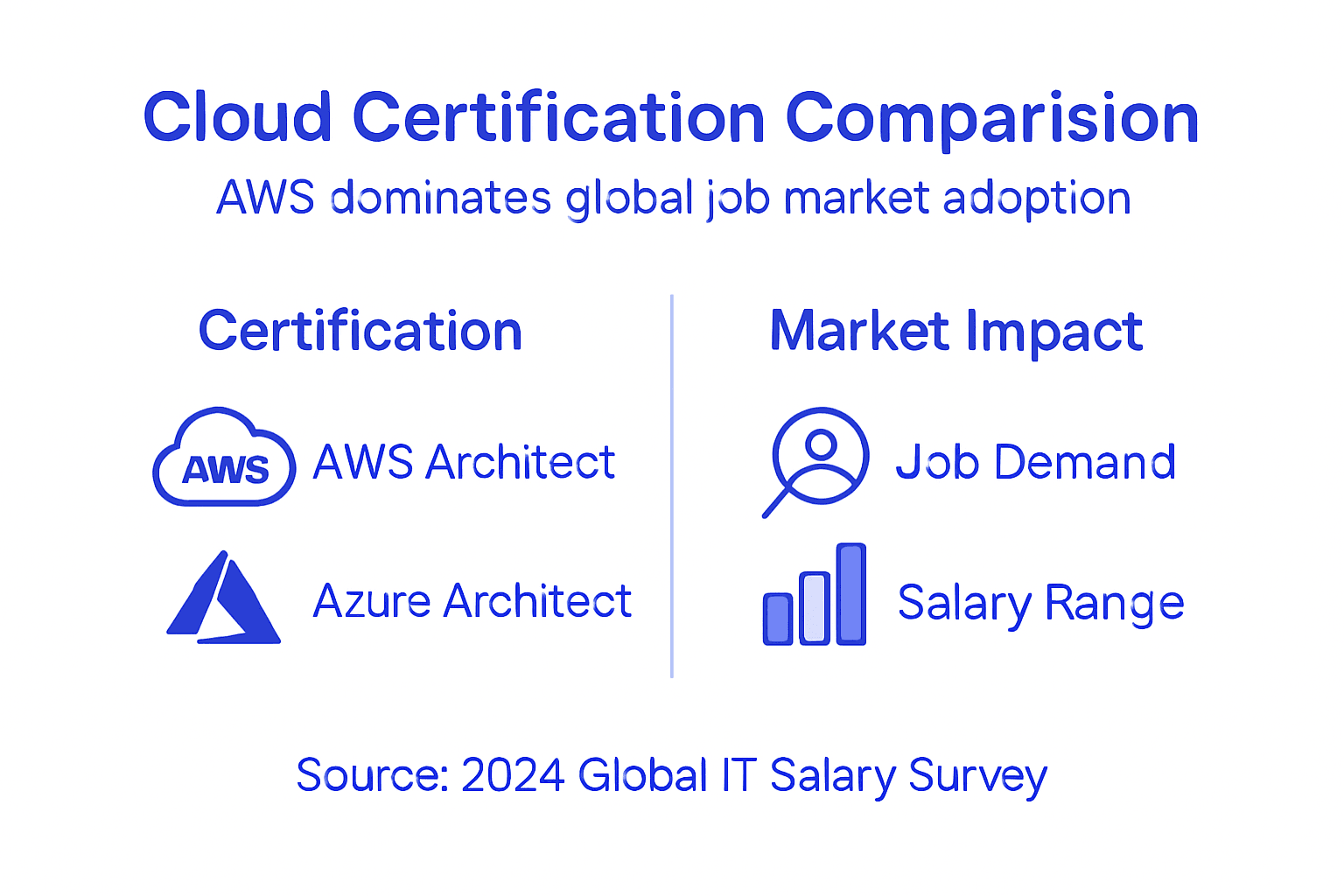
That translates to job availability. More companies use AWS. More job postings require AWS skills. More opportunities exist for AWS architects.
Azure: The Enterprise Default
Microsoft Azure integrates deeply with organizations that already run Windows, Office 365, and SQL Server. If you’re targeting financial institutions, large manufacturers, or government agencies, Azure matters.
Azure strengths:
- Hybrid advantage - Seamless connections to on-premises Microsoft infrastructure
- Enterprise relationships - Microsoft’s sales force has decades of customer connections
- Cost if you’re already licensed - Existing Microsoft investments reduce cloud expenses
But Azure lags in job postings, startup adoption, and innovation velocity.
Google Cloud: The Data Play
Google Cloud Platform excels at data analytics, machine learning, and AI workloads. If you’re building data pipelines or AI applications, GCP’s BigQuery and Vertex AI are genuinely superior.
GCP strengths:
- Data analytics tools - BigQuery is industry-leading for SQL analysis
- AI/ML capabilities - TensorFlow and Vertex AI integration native to the platform
- Competitive pricing - Often cheaper than AWS for specific workloads
GCP’s weakness: limited job market outside tech companies and data-focused roles.
Here’s how AWS, Azure, and Google Cloud architect certifications compare for career impact:
| Certification | Job Market Share | Typical Salary | Industry Strength |
|---|---|---|---|
| AWS Solutions Architect | Largest, global demand | Highest overall | Versatile, many sectors |
| Azure Solutions Architect | Strong in enterprises | Slightly lower | Enterprise, finance, government |
| Google Cloud Architect | Niche, growing | Competitive for data jobs | Data/AI, tech startups |
Why AWS Wins for Career Growth
AWS certifications include comprehensive role-based paths with strong ecosystem support, creating clear career progression. You start with Associate, move to Professional, then specialize in domains like database design or security.
AWS career advantages:
- Job availability - 3-5x more positions than Azure or GCP
- Salary premium - AWS architects earn 10-15% more than equivalent roles
- Skill transferability - AWS skills apply to 40% of all cloud workloads globally
- Consulting demand - Migration work pays premium rates
If you have time for one certification, AWS opens more doors. If you want maximum market coverage, learn AWS first, then Azure or GCP later.
Your choice depends on your target market. Enterprise finance? Azure. Startups and scale-ups? AWS. Data companies? GCP. Most people should start with AWS.
Pro tip: Learn AWS first, then add Azure or GCP as secondary credentials—multi-cloud architects command salaries 20-30% higher than single-platform specialists.
Build Your AWS Solutions Architect Study Workflow with PlanetCert
If you are actively preparing for SAA-C03, keep the workflow simple: confirm the exam scope on the exam page, work through SAA-C03 sample questions, and compare practice sources with our AWS practice test comparison so you know which materials are helping and which are just noisy.
If you are earlier in the path, start with Cloud Practitioner. If you are already planning your next move after Associate, use our AWS certification role guide and the AWS Data Engineer guide to choose the right direction.
Sources
- AWS Certified Solutions Architect - Associate
- AWS Certified Solutions Architect - Associate Exam Guide (SAA-C03)
- AWS Well-Architected Framework
- AWS Certification Paths
Frequently Asked Questions
What are the key benefits of obtaining the AWS Certified Solutions Architect credential?
The main benefit is clearer role signaling. The certification helps show that you can evaluate AWS services, design around security and resilience requirements, and explain architecture tradeoffs in a way employers and clients can trust.
What topics does the AWS Certified Solutions Architect exam cover?
SAA-C03 is built around four domains: designing secure, resilient, high-performing, and cost-optimized architectures. The exam expects you to make architecture decisions across these domains rather than memorize isolated service facts.
How much hands-on experience is required before taking the AWS Certified Solutions Architect exam?
AWS recommends about one year of hands-on experience designing cloud solutions that use AWS services. If you do not have IT work experience yet, AWS says Cloud Practitioner is a better starting point before this associate-level exam.
How does the AWS Certified Solutions Architect certification compare to other cloud certifications?
It is best viewed as an AWS-specific architecture credential, not a universal replacement for Azure or Google Cloud certifications. It is strongest when your target role, current stack, or client environment is already AWS-heavy.
Recommended

Discussion
Question Comments
0 comments·0 participantsSign in to leave a comment and access more free questions.