

Associate Safety Professional® (ASP®) Free Sample Questions

12 free sample questions141 in the full practice test

Try simulator

ASP Sample Questions

  1. Question 1

    Intermediate

    Mathematical Calculations · Calculate noise hazards (e.g., Time-Weighted Average [TWA], dual machinery, noise reduction rates)

    An industrial hygienist conducts full-shift personal noise dosimetry on an operator stationed at a CNC routing center. Over the 8-hour workday, the dosimeter records continuous noise exposure of 90 dBA for the first 4 hours and 80 dBA for the remaining 4 hours. Under OSHA's 1910.95 occupational noise standard using a 5-dB exchange rate (where reference durations are 8 hours at 90 dBA and 32 hours at 80 dBA), what is the worker's noise dose percentage and corresponding compliance requirement?
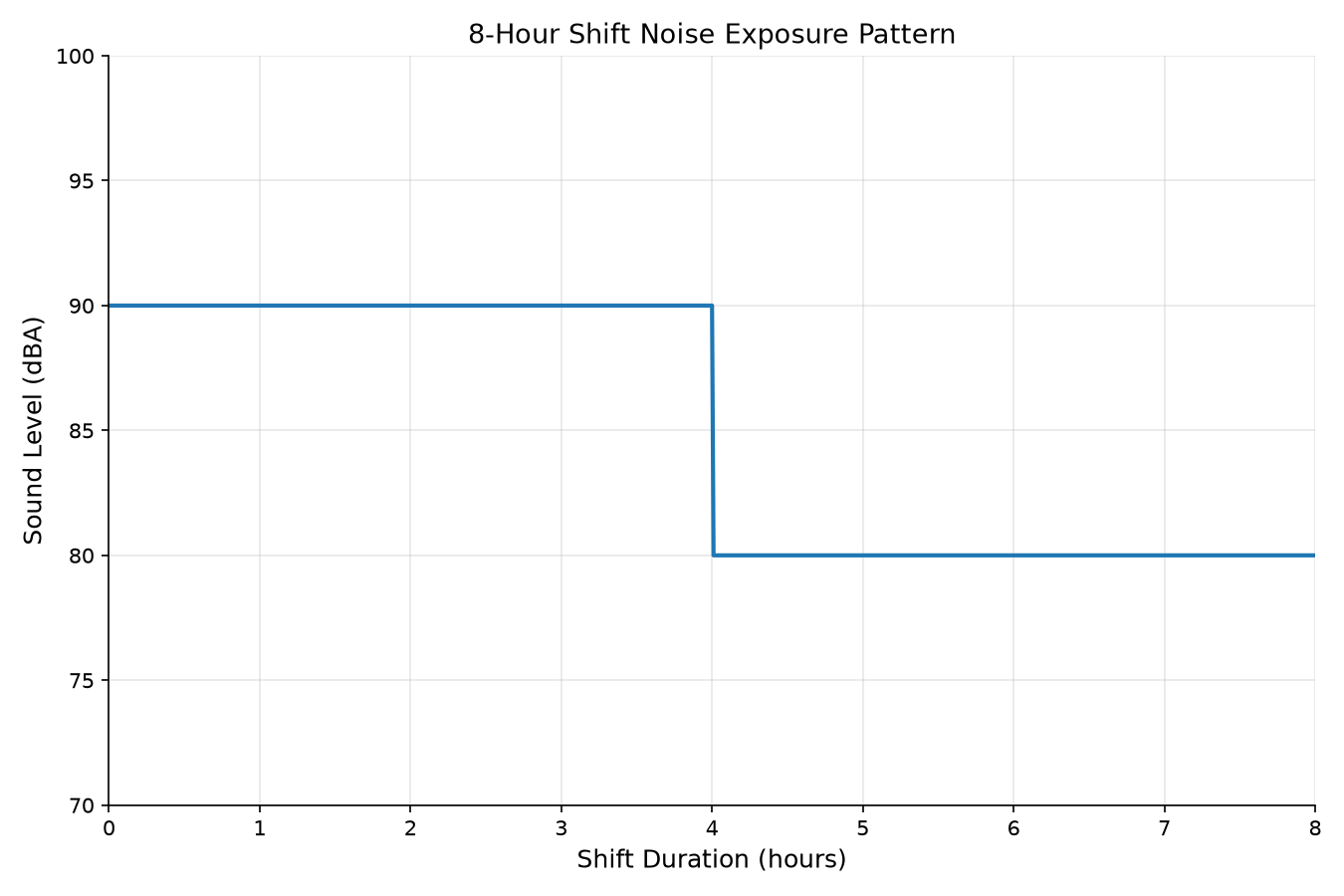
    Question 1 image
    Answer and explanation

    Correct answer: B

    Dose equals 100 * (4/8 + 4/32) = 62.5%. Under OSHA, any dose at or above 50% (85 dBA TWA) triggers mandatory enrollment in a hearing conservation program.

  2. Question 2

    Beginner

    Mathematical Calculations · Calculate noise hazards (e.g., Time-Weighted Average [TWA], dual machinery, noise reduction rates)

    A manufacturing facility acoustic survey measures an ambient continuous sound level of 94 dBA in a stamping press bay. Workers are issued formable foam earplugs bearing a manufacturer Noise Reduction Rating (NRR) of 29 dB. Using OSHA's standard field derating calculation to estimate workplace attenuation, what is the estimated protected noise exposure level for these workers?

    Answer and explanation

    Correct answer: A

    Using OSHA's derating formula, attenuation is (29 - 7) / 2 = 11 dB. Subtracting 11 dB from 94 dBA gives 83 dBA, which reduces exposure below the 85 dBA action level.

  3. Question 3

    Advanced

    Mathematical Calculations · Calculate noise hazards (e.g., Time-Weighted Average [TWA], dual machinery, noise reduction rates)

    A plant engineer operates an industrial air compressor that generates a sound pressure level of 87 dBA at an evaluation point 10 feet away. Due to increased pneumatic demand, an identical second compressor is installed adjacent to the first unit and operated simultaneously. What is the resulting combined sound pressure level at that same evaluation point?

    Answer and explanation

    Correct answer: B

    Combining two identical decibel sources increases the total sound pressure level by exactly 3 dB (87 + 3 = 90 dBA). Logarithmic sound levels cannot be added linearly.

  4. Question 4

    Intermediate

    Safety Programs and Concepts · Apply the hierarchy of hazard controls

    An aerospace maintenance hangar uses trichloroethylene (TCE), a chlorinated solvent, in manual parts-degreasing tanks. Air monitoring shows airborne concentrations approaching regulatory exposure thresholds. The safety committee evaluates multiple corrective proposals. According to the hierarchy of controls, which action represents the highest level of hazard control?

    graph TD A[Elimination: Physically remove hazard] --> B[Substitution: Replace hazard] B --> C[Engineering Controls: Isolate people from hazard] C --> D[Administrative Controls: Change work practices] D --> E[PPE: Protect worker with personal gear]
    Answer and explanation

    Correct answer: C

    Replacing hazardous TCE with a non-toxic aqueous wash substitutes the chemical with a safer alternative, which outranks engineering hoods, administrative rotations, and PPE.

  5. Question 5

    Beginner

    Safety Programs and Concepts · Apply the hierarchy of hazard controls

    True or False: Under the NIOSH Total Worker Health® (TWH) hierarchy of controls, the "Redesign" strategy is prioritized above the "Educate" and "Encourage" strategies to protect and advance worker well-being.

    Answer and explanation

    Correct answer: B

    True. In the NIOSH Total Worker Health framework, redesigning the work environment sits in the middle tier, outranking individual-focused educate and encourage strategies.

  6. Question 6

    IntermediateMultiple answers

    Safety Programs and Concepts · Implement hazardous energy control programs (e.g., electrical, hydraulic, thermal, kinetic, mechanical, magnetic)

    While auditing a manufacturing plant's hazardous energy control program, a safety specialist inspects energy-isolation hardware across several stamping presses. Which TWO of the following items qualify as energy-isolating devices under OSHA 29 CFR 1910.147? (Select TWO)

    flowchart TD Start[Energy Source Isolation] --> Check{Device Type?} Check -->|Manual Disconnect Switch| Isolating[Energy-Isolating Device: Lockable] Check -->|Mechanical Line Valve| Isolating Check -->|Push Button / E-Stop| Control[Control Circuit Device: Non-Isolating] Check -->|Selector / Interlock| Control
    Answer and explanation

    Correct answers: C, E

    Manually operated disconnect switches physically break power circuits, qualifying as energy-isolating devices under 1910.147.

    Mechanical line valves physically isolate fluid or gas lines and can be locked, meeting energy-isolating device criteria.

Register free for 6 more questions

Or unlock all 141 ASP questions with explanations, timed mode and flashcards.