Advanced Application of Safety Principles · Describe the principles of minimizing hazards using Prevention-Through-Design
An engineering design team is laying out utility piping across a high-traffic pedestrian walkway in a newly planned aerospace component manufacturing facility. According to Prevention-through-Design (PtD) best practices, what minimum vertical overhead clearance must be maintained above the walking surface to eliminate head strike hazards?
Answer and explanation
Correct answer: D
PtD guidelines require at least 6'-6" (78 in) clearance above walking grade to eliminate head strike hazards. While 7' is common for architectural doors, 6'-6" is the standard minimum PtD threshold for overhead obstructions.
Q2Question 2
Beginner
Advanced Application of Safety Principles · Describe the principles of minimizing hazards using Prevention-Through-Design
Under the National Institute for Occupational Safety and Health (NIOSH) Prevention through Design (PtD) national initiative, strategic implementation across the lifecycle of facilities, materials, and equipment is structured around which four overarching functional areas?
Answer and explanation
Correct answer: D
NIOSH organizes its national PtD initiative into Practice, Policy, Research, and Education. The traditional 4 Es of safety and the hierarchy of controls are distinct safety management frameworks.
Q3Question 3
Intermediate
Advanced Application of Safety Principles · Evaluate common workplace hazards
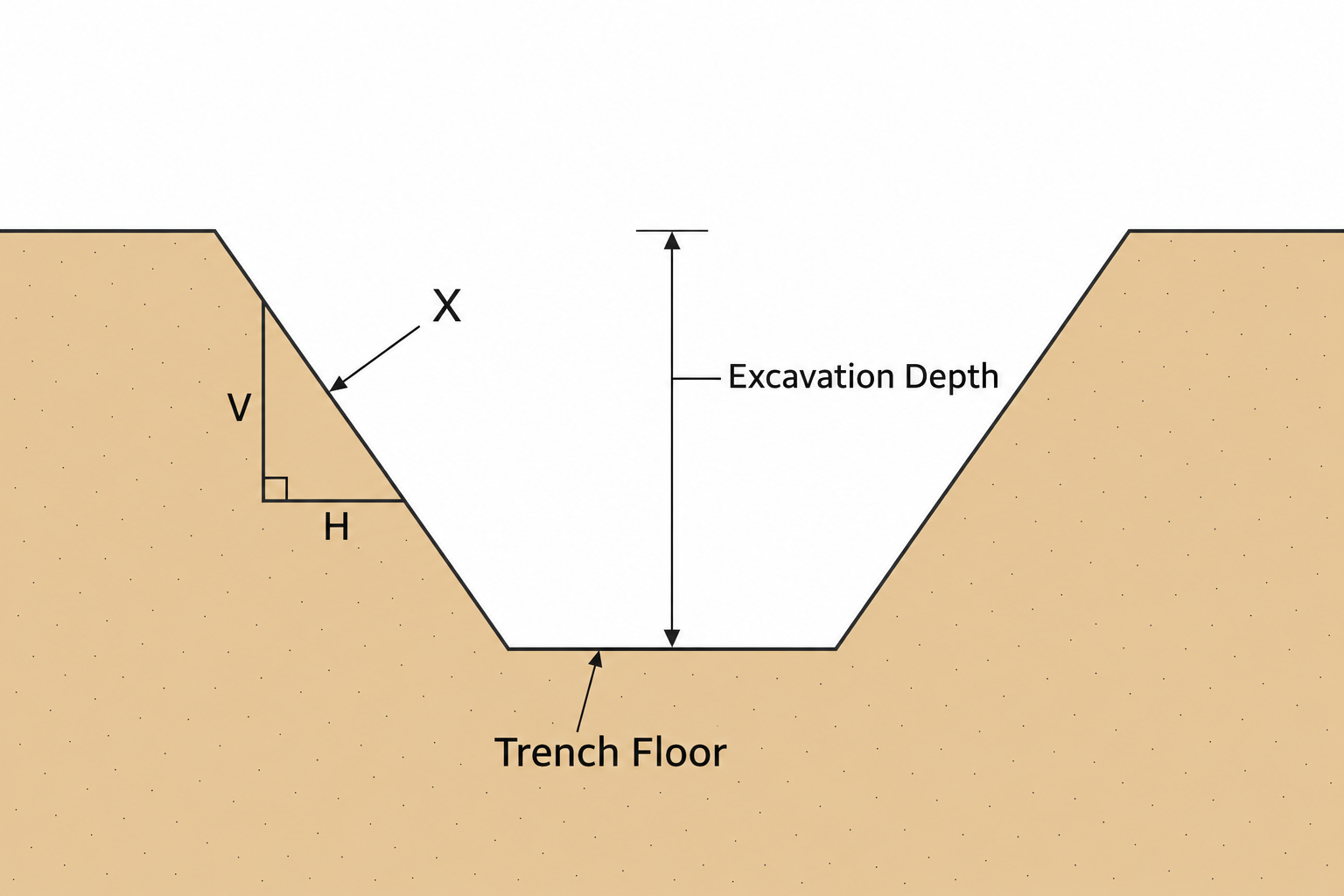
An excavation contractor is trenching in cohesive clay soil with an unconfined compressive strength of 1.8 tons per square foot (tsf). The soil is unfissured, has not been previously disturbed, and is not subject to vehicular vibrations. In the provided trench cross-section figure, which maximum allowable slope ratio (horizontal to vertical, H:V) designated by label X is permissible under OSHA excavation standards for simple sloping?
Answer and explanation
Correct answer: A
Cohesive soil >=1.5 tsf without fissures or vibration is Type A, permitting a maximum simple slope of 3/4:1 (53°). Type B requires 1:1, while Type C requires 1.5:1. 1/2:1 is only allowed in short-term excavations up to 12 feet.
Q4Question 4
Advanced
Advanced Application of Safety Principles · Evaluate common workplace hazards
Apex Petrochemical operates a bulk liquid terminal. During scheduled turnaround, maintenance technicians must enter a 20,000-gallon vertical storage vessel that previously contained a volatile organic solvent. The vessel was completely drained, isolated using line blinds, and cleaned.
Atmospheric testing indicates no toxic vapors, combustible gas levels at 0% LEL, and oxygen at 20.9%. However, the vessel contains a conical bottom discharge chute and internal mechanical agitator blades driven by an electric motor that is locked and tagged out. Continuous forced-air ventilation is operating.
The safety manager is reviewing whether this entry qualifies for alternate entry procedures under 29 CFR 1910.146(c)(5) to eliminate the requirement for a full entry permit, attendant, and rescue team. Which factor legally prohibits Apex Petrochemical from utilizing alternate entry procedures for entering this vessel?
Answer and explanation
Correct answer: A
Alternate entry is permitted only when continuous ventilation alone ensures safe entry AND no actual or potential physical, mechanical, or engulfment hazards exist. Mechanical and entrapment hazards require standard PRCS permit entry.
Q5Question 5
IntermediateMultiple answers
Advanced Application of Safety Principles · Evaluate common workplace hazards
A civil contractor is excavating a utility trench that measures 6 feet deep and 80 feet long through cohesive loam soil. Which TWO safety requirements are mandatory for this excavation under federal safety standards? (Select TWO)
Answer and explanation
Correct answers: A, B
Excavations 5 feet or deeper require protective systems against cave-ins unless made entirely in stable rock.
Excavated materials and equipment must be kept at least 2 feet from the excavation edge to prevent materials from rolling into the trench.
Q6Question 6
Beginner
Advanced Application of Safety Principles · Evaluate materials handling methods and controls
According to federal safety standards for overhead and gantry cranes in general industry, what is the minimum required frequency for conducting a thorough inspection of running ropes, and what documentation must be maintained?
Answer and explanation
Correct answer: D
Running ropes must be thoroughly inspected at least monthly, with a written certification record displaying inspection date, inspector signature, and rope identifier. Daily visual checks do not satisfy this monthly certification mandate.
Register free for 6 more questions
Or unlock all 152 CSP questions with explanations, timed mode and flashcards.