General Principles of Flight Transport Nursing Practice · Physiologic stressors
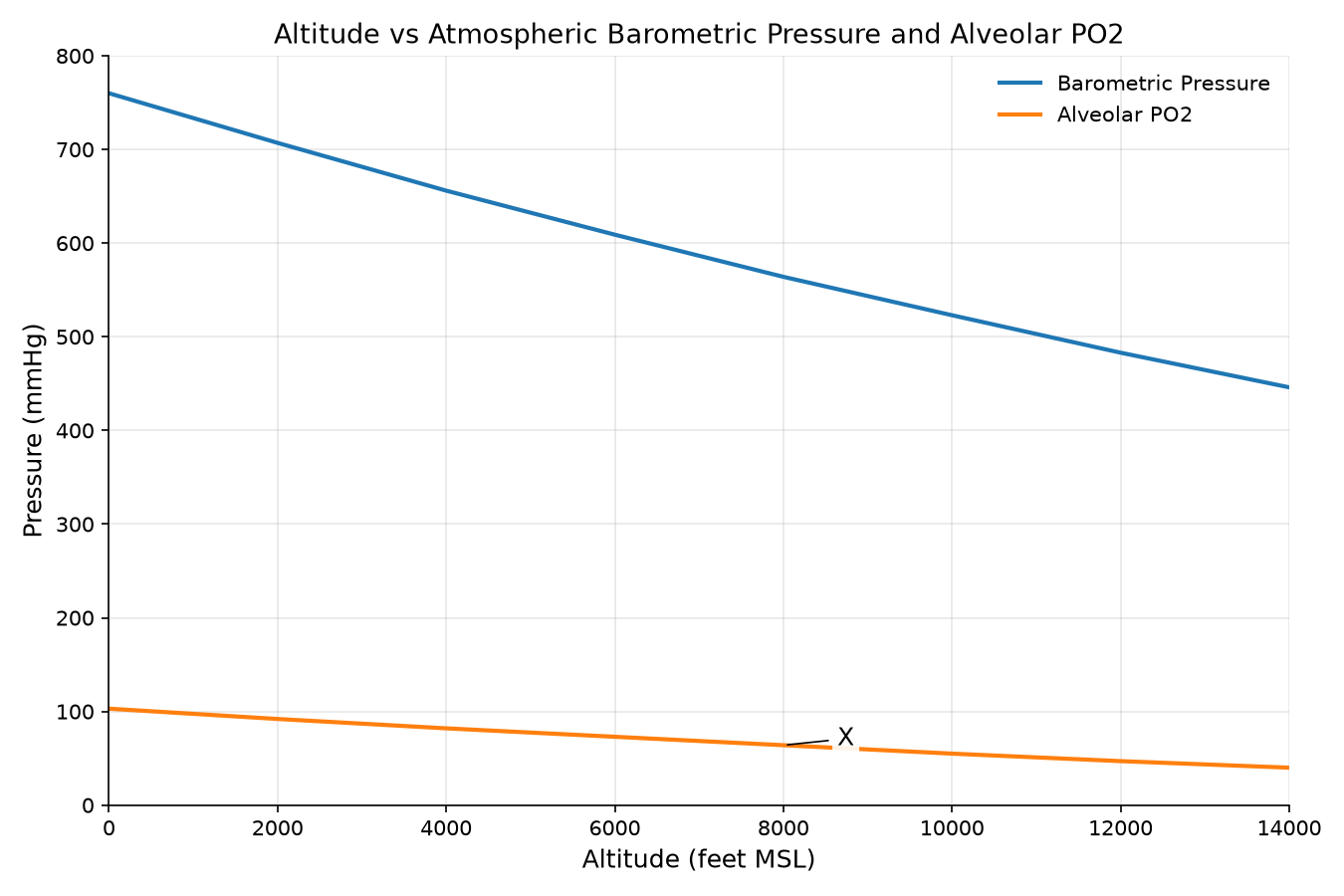
A flight nurse is transporting a spontaneously breathing patient with mild hypoxemia in an unpressurized helicopter. As the rotorcraft climbs from sea level to a cruising altitude of 8,000 feet mean sea level (MSL), the patient's oxygen saturation drops from 95% to 88% on ambient air despite an unchanged respiratory rate and depth. Based on the relationship shown in the figure, which physical gas law directly accounts for this altitude-induced arterial desaturation?
Answer and explanation
Correct answer: A
Dalton's law dictates that total pressure is the sum of partial pressures. As barometric pressure decreases with altitude, ambient PO2 drops proportionally, lowering alveolar PO2 and driving hypoxic hypoxia.
Q2Question 2
Beginner
General Principles of Flight Transport Nursing Practice · Physiologic stressors
Prior to transferring an intubated adult patient into a fixed-wing critical care transport aircraft with a planned cabin altitude of 6,000 feet, what physiologic gas law explains why the flight nurse must replace the air in the endotracheal tube cuff with sterile saline or perform regular cuff pressure monitoring during ascent?
Answer and explanation
Correct answer: A
Boyle's law states that volume varies inversely with pressure at constant temperature. Ascent decreases ambient pressure, expanding trapped cuff air and risking tracheal mucosal necrosis if unmonitored.
Q3Question 3
Advanced
General Principles of Flight Transport Nursing Practice · Physiologic stressors
A critical care flight nurse is staffing an international fixed-wing repatriation transport at a cruising altitude of 34,000 feet MSL (cabin altitude 6,000 feet MSL). The patient is being transported 18 hours after completing a recreational deep-sea scuba dive. Suddenly, the aircraft experiences an explosive cabin depressurization, causing cabin altitude to rapidly equilibrate with the outside flight level.
Both the flight crew and patient experience immediate fogging in the cabin, rapid chest expansion, and sudden severe musculoskeletal and periarticular joint pain in their shoulders and knees. The patient becomes acutely dyspneic and exhibits mottling across the torso. The pilot immediately initiates emergency descent maneuvers and orders the crew to don 100% emergency oxygen masks.
Which gas law explains the immediate precipitation of inert gas bubbles driving this clinical emergency, and what is the primary pathophysiologic process?
flowchart TD
A[Rapid Cabin Decompression] --> B[Sudden Drop in Ambient Pressure]
B --> C[Nitrogen Gas Solubility Decreases in Blood and Lipids]
C --> D[Inert Gas Forms Bubbles in Tissues and Venous Blood]
D --> E[Ischemia, Periarticular Joint Pain, Cutis Marmorata, and Bends]
Answer and explanation
Correct answer: B
Henry's law states that gas dissolved in liquid is proportional to partial pressure. Sudden decompression causes dissolved nitrogen to precipitate out of blood and adipose into gas bubbles, causing DCS.
Q4Question 4
Intermediate
General Principles of Flight Transport Nursing Practice · Landing Zone Operations
During a night rotorcraft emergency scene response to a multi-vehicle highway collision, the flight team establishes two-way radio communications with the incident commander on the ground. Which operational procedure is required by CAMTS and FAA standards before the helicopter makes final approach and touchdown at an off-airport landing zone?
Answer and explanation
Correct answer: C
CAMTS and FAA standards mandate high and low reconnaissance before landing at an unapproved scene LZ to verify wind direction, approach/departure corridors, terrain slope, wires, and obstacles.
Q5Question 5
Beginner
General Principles of Flight Transport Nursing Practice · EMTALA
True or False: Under federal EMTALA regulations, a tertiary specialized receiving hospital with available specialized pediatric intensive care capability and capacity is legally obligated to accept the interfacility transfer of an unstable pediatric trauma patient from a referring rural emergency department that lacks critical care capabilities.
Answer and explanation
Correct answer: B
Under EMTALA's nondiscrimination provision, a Medicare-participating hospital with specialized capabilities and capacity cannot refuse an appropriate transfer of an unstable individual from a facility lacking capability.
Q6Question 6
IntermediateMultiple answers
General Principles of Flight Transport Nursing Practice · Landing Zone Operations
During an emergency scene landing zone operation, which TWO safety practices are mandatory for ground responders and transport crew members operating around an active rotorcraft? (Select TWO)
Answer and explanation
Correct answers: B, C
CAMTS and FAA guidelines instruct personnel to stay strictly clear of the tail rotor and aircraft battery compartments to prevent fatal strikes, thermal runaway, and electrical fires.
Approaching within the pilot's forward field of view after explicit eye contact and signal prevents accidental entry into the hazardous tail rotor and low main rotor arc areas.
Register free for 6 more questions
Or unlock all 165 CFRN questions with explanations, timed mode and flashcards.