Test Tools and Automation Assume you are a Test Manager involved in system testing of a CRM application for a Pay-TV company. Currently the application is able to support a proper number of users assuring the required responsiveness. Since the business is expected to grow, you have been asked to evaluate the ability of the application to grow to support more users while maintaining the same responsiveness. Which of the following tools would you expect to be the most useful at performing this evaluation?
Q2
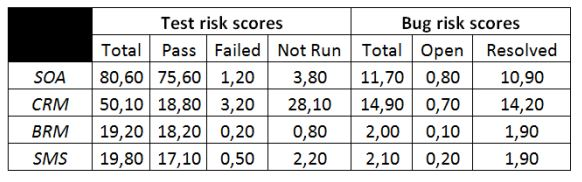
Test Management You are managing the system testing for a SOA based system. The integrated system consists of several subsystems: - a SOA middleware - a CRM (Customer Relationship Management) system - a BRM (Billing and Revenue Management) system - a SMS (Subscriber Management System) system and you performed a risk analysis based on these subsystems. At the end of the scheduled period for test execution you produce a first classical report based on the traditional metrics of testing. Test pass/fail status and bug status (open/resolved) That table provides you a distorted picture of the quality risk, because there is no indication of the risk level of the failed tests, the tests not run, or the open bugs. Thus, you produce the following table to solve this distortion issue: In the table above, where you have introduced the concept of risk weighting, the highest risk test or bug report has a score of 1, while the lowest risk test or bug report has a score of 0.04. Which of the following subsystems, based on the risk scores of the table, is most risky?
Q3
Test Management Which of the following statements best describes an appropriate approach for managing exploratory testing?
Q4
Reviews Consider the following list of statements about audits and management reviews: I. Audits are usually more effective than management reviews at finding defects II. Audits and management reviews have the same main goals, the only difference is related to the roles and level of formality III. Atypical outcome of an audit includes observations and recommendations, corrective actions and a pass/fail assessment IV. An audit is not the appropriate mechanism to use at the code review in order to detect defects prior to dynamic testing Which of the following statements is true?
Q5
Test Management Assume you are currently working on a project developing a system where functional requirements are very well specified. Unfortunately non-functional requirements do almost not exist. You are the Test Manager. You have to choose a technique for test selection that allows testing of non-functional characteristics, especially reliability. Which of the following techniques for test selection do you expect being most useful in this scenario?
Q6
Test Management Which of the following statements describing how identified product quality risks should be mitigated and managed, is true?