
A10 CPSA-4 Sample Questions: What the Architecture Exam Tests
Finding reliable A10 CPSA-4 sample questions is harder than it should be. Most candidates discover this after they've already committed time and money to a study plan, only to realize the practice material they've gathered doesn't match what the live exam actually asks. The gap between generic practice and exam reality is where certifications are won or lost.
This whitepaper examines how the A10 Certified Professional System Administration 4 exam structures its questions, what cognitive skills each item type targets, and how candidates can use that knowledge to study more efficiently. Rather than listing questions to memorize, we treat sample items as a methodology — a window into the exam's architecture that reveals where to focus limited preparation time.
The Exam Blueprint and What It Reveals
The A10 CPSA-4 exam, officially designated A10-System-Administration, validates skills in deploying, configuring, and managing A10 Networks application delivery controllers and Thunder Series appliances. The test consists of approximately 30 multiple-choice and scenario-based questions delivered in a 60-minute window, with a passing threshold of 70% or higher according to PrepRate's exam documentation.
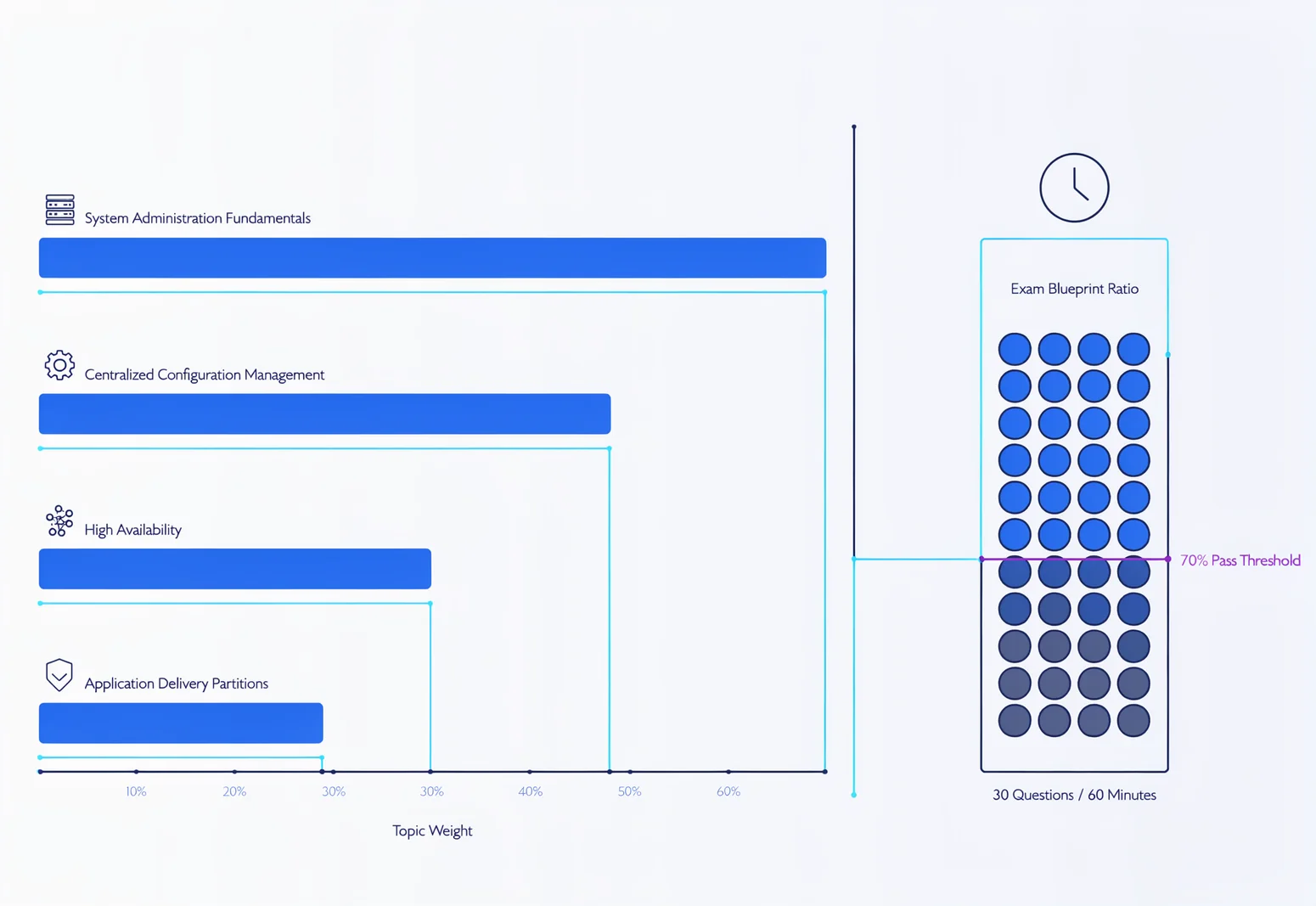
That 30-question format is telling. With roughly two minutes per question, the exam prioritizes rapid decision-making over deep calculation. Candidates who expect lengthy lab simulations or complex troubleshooting scenarios will find the format closer to a structured knowledge check with scenario framing. The time pressure is real, but it tests recognition and prioritization rather than step-by-step configuration from memory.
The official topic domains break down into several core areas:
- System Administration Fundamentals: CLI and GUI navigation, account management, role-based access control, and session handling
- Centralized Configuration Management: aVCS clustering, vMaster and vBlade topology, election processes, and chassis synchronization
- High Availability: Active-Standby failover, N+M deployments, and active device selection
- Application Delivery Partitions: Layer 3 Virtualization Partitions (L3V), shared and private partitions, public and private object scope
Each domain carries different weight in the question pool, though A10 Networks does not publish exact percentages. The distribution favors operational scenarios over pure theory — questions tend to place you in a specific administrative context and ask for the correct action or configuration outcome.
How Sample Questions Map to Cognitive Levels
Not all A10 CPSA-4 sample questions test the same mental skill. Understanding the taxonomy helps you recognize what a question is really asking and avoid the common trap of studying facts when the exam wants application.
Recall and Recognition Items
The simplest tier tests whether you know terminology and default behaviors. These appear as straightforward multiple-choice questions with one clearly correct answer and three distractors. A representative pattern from CertsTime's sample set asks how aVCS changes performed on the vMaster propagate to vBlades — the answer hinges on knowing the synchronization mechanism, not on analyzing a complex topology.
These items reward flashcard-style study and repeated exposure to core concepts. They're also the easiest to over-prepare for. Candidates who spend disproportionate time here may feel confident in practice yet struggle on exam day when the ratio of recognition to application questions shifts.
Application and Configuration Items
The middle tier presents partial configurations or operational scenarios and asks for the correct completion or next step. Study4Pass's practice materials include examples where SNMP trap commands are shown and candidates must identify what specific events trigger notifications. The configuration snippet:
snmp enable traps slb-change server snmp enable traps slb-change server-port snmp enable traps slb-change vip snmp enable traps slb-change vip-port
requires understanding that these commands enable traps for creation or removal of virtual and real servers and ports — not merely recognizing the syntax, but interpreting the functional scope of the configuration block.
This tier separates candidates who have labbed the commands from those who have only read about them. The exam doesn't always require hands-on experience, but it does reward the mental model that hands-on practice builds.
Analysis and Troubleshooting Items
The most demanding questions present symptoms or failure conditions and require root-cause identification. Pass4Success's sample materials include scenarios where private partitions are created on a VRRP-A-enabled device, and candidates must determine which statements about the resulting behavior are true. These questions test whether you understand interaction effects between features — how partitioning changes failover behavior, how object visibility shifts between shared and private contexts, and how VRRP-A state propagates across administrative boundaries.
These items carry the highest failure rate because they resist simple memorization. The correct answer often contradicts intuitive assumptions about feature independence. Candidates who haven't worked through partition behavior in a lab or high-quality simulator frequently default to guessing.
Distractor Patterns and Common Traps
The A10 CPSA-4 exam's question writers employ consistent distractor strategies that appear across verified sample materials. Recognizing these patterns improves both speed and accuracy under time pressure.
The Plausible Configuration Trap
Distractors often present syntactically valid configurations that produce wrong outcomes. In SNMP trap questions, an option might enable traps for "any SLB changes" — broader than the actual command scope — or restrict them to "only SLB changes related to virtual-server," which is narrower. Both sound administratively reasonable. Neither matches the documented behavior.
The defense against this pattern is precise knowledge of default scopes and explicit limitations. When you encounter a configuration question, ask yourself: "Does this option add, remove, or alter the documented behavior?" rather than "Does this seem like a sensible administrative choice?"
The Feature Interaction Assumption
Questions involving multiple technologies — partitions plus VRRP-A, aVCS plus high availability — often include distractors that would be correct if the features operated independently. The exam tests whether you know where features intersect and modify each other's behavior.
This pattern rewards study that deliberately combines topics rather than treating domains as isolated silos. When reviewing partitions, explicitly ask how partition type affects VRRP-A. When studying aVCS, trace how cluster state influences failover decisions.
The Absolute Language Warning
Distractors containing absolute terms — "always," "never," "only" — merit extra scrutiny. These appear in correct answers when the underlying technology genuinely has no exceptions, but more often they overstate a general rule. The sample materials from multiple providers show that correct answers with absolute language tend to describe hard technical limits (protocol specifications, command syntax) rather than operational behaviors.
Building a Study System from Sample Question Analysis
Effective preparation for the A10 CPSA-4 exam uses sample questions diagnostically rather than as a memorization target. The following approach leverages the question taxonomy and distractor patterns identified above.
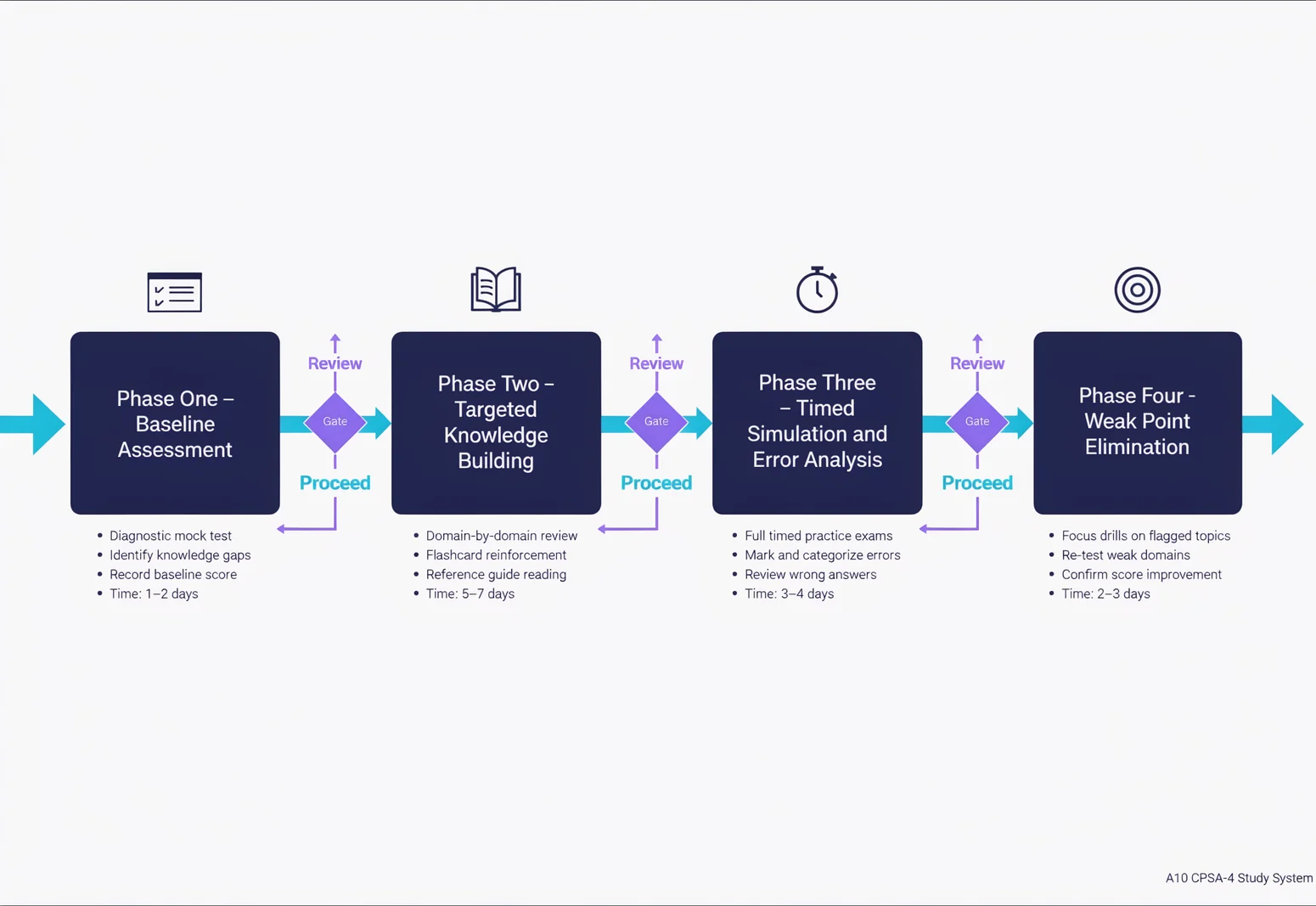
Phase One: Baseline Assessment
Begin with a small set of verified sample questions — 15 to 20 items from multiple providers — taken under light time pressure. The goal is not passing score but pattern recognition. Track which cognitive levels give you trouble: are you missing recognition items (study gap), application items (lab gap), or analysis items (integration gap)?
This baseline prevents the common error of studying what you already know. Many candidates find they score well on recall items and assume readiness, only to discover on exam day that the live test's application-to-analysis ratio is higher than their practice material suggested.
Phase Two: Targeted Knowledge Building
For each weak domain identified in baseline assessment, build structured knowledge before returning to practice questions. Use official A10 Networks training documentation for foundational accuracy, supplemented by community-verified practice materials for question exposure.
The A10 System Administration course covers the exam's technical content directly. For candidates without access to official training, the exam objectives published by A10 Networks provide a reliable study outline. Cross-reference any third-party practice material against these objectives — if a topic area appears heavily in practice questions but lightly or not at all in official objectives, treat those questions with appropriate skepticism.
Phase Three: Timed Simulation and Error Analysis
Return to full practice sets only after targeted study. Run complete 30-question simulations under strict 60-minute conditions. The PlanetCert simulator environment matches this format precisely, including the pressure dynamics that separate prepared candidates from merely knowledgeable ones.
After each simulation, analyze errors by cognitive level and distractor type. Are you still missing analysis questions? Do specific distractor patterns trip you repeatedly? This error analysis drives the final refinement phase.
Phase Four: Weak Point Elimination
Use the final study period before scheduling to address only identified weaknesses. Avoid comprehensive review — it dilutes focus and creates false confidence through familiarity effects. The goal is converting your lowest-scoring question types and domains to passing-level performance, not achieving uniform mastery.
The Role of Practice Test Quality in Exam Success
Not all A10 CPSA-4 sample questions are equivalent. The certification prep market includes materials that range from carefully verified to actively misleading. Understanding quality indicators protects both your study time and exam investment.
Verified materials align with current exam objectives and provide explanatory depth. CertsTime's sample questions include rationale for correct answers, which supports learning transfer beyond the specific item. Study4Pass and Pass4Success materials show similar alignment in their published samples, though explanation depth varies.
Warning signs of lower-quality materials include: questions that test obsolete product versions, answer explanations that merely restate the correct choice without mechanism, and items that appear to be recycled from unrelated certification exams. The A10 Networks product line evolves regularly; material dated before 2025 should be verified against current objectives before use.
The 2026 certification market trends reported by TrueAbility emphasize that providers are increasingly updating content to match exam evolution. This creates both opportunity and risk — more current material exists, but so does more outdated material repackaged with fresh dates. Cross-referencing against official A10 Networks documentation remains the most reliable validation step.
Exam-Day Strategy from Question Pattern Analysis
The structural knowledge developed through sample question analysis translates directly to exam-day tactics.
Time Allocation
With 30 questions and 60 minutes, average time per question is two minutes. However, recognition items may require 45 seconds while analysis items need three minutes. The effective strategy is rapid progress through early questions, banking time for later complex items. Resist the urge to verify recognition answers repeatedly — this is where time leaks occur.
Answer Elimination
For questions with uncertain answers, apply distractor pattern knowledge. Eliminate options with unsupported absolute language first. Then eliminate configurations that extend beyond documented command scope. Between remaining options, select the one that most precisely matches official documentation rather than the one that seems most administratively sensible.
Scenario Deconstruction
For scenario-based items, identify the specific technologies involved before reading answer options. Many candidates read options first and unconsciously let plausible-sounding configurations influence their scenario interpretation. Explicit technology identification — "this involves partitions and VRRP-A" — maintains analytical distance.
Limitations and Evidence Boundaries
This analysis has several constraints candidates should understand.
First, A10 Networks does not publish complete live exam items, so all sample materials are reconstructed or remembered. The providers cited — CertsTime, Study4Pass, Pass4Success, PrepRate — publish samples that appear consistent with exam structure, but no third-party material is guaranteed to match live test content.
Second, exam objectives evolve. The analysis here reflects 2026 documentation. Candidates should verify current objectives on the A10 CPSA-4 exam page before finalizing study plans.
Third, cognitive level classification involves interpretation. One candidate's application item is another's recognition item, depending on prior experience. The taxonomy here serves as a study framework, not a rigid prediction of exam content distribution.
What Candidates Should Verify Before Scheduling
Before committing to an exam date, confirm four elements:
- Objective currency: Check the A10 Networks website for exam outline updates within the past 12 months
- Practice material alignment: Verify that your primary study source covers all published domains with appropriate weighting
- Simulation readiness: Complete at least two full timed practice sessions scoring above 80% to build margin against exam-day pressure effects
- Feature version match: Confirm that practice materials reference the Thunder Series appliance software versions you'll be tested on
The 70% passing threshold provides modest margin, but exam-day stress typically degrades performance 5-10% from practice levels. Building to 80%+ in simulation creates realistic passing confidence.
From Sample Questions to Certification
The A10 CPSA-4 exam tests whether you can operate A10 Networks infrastructure under realistic administrative constraints. Sample questions reveal this intent more clearly than any exam outline — they show not just what the test covers, but how it thinks about competent administration.
Treat every practice item as a hypothesis about exam priorities. When multiple providers' samples converge on specific topics — aVCS synchronization behavior, partition scope rules, SNMP trap granularity — that convergence signals genuine exam emphasis. When samples diverge, that divergence often indicates either evolving exam content or provider speculation.
The candidates who pass efficiently are those who use sample questions to build a mental model of the exam's decision logic, then verify that model against official documentation. Rote memorization of practice answers fails because the live exam varies item specifics while maintaining consistent cognitive demands. Understanding the architecture behind the questions — the why of correct answers, not merely the what — is what separates certification success from repeated retakes.
References
- Free A10 Networks Certified Professional — CertsTime has provided you with a sample question set to elevate your knowledge about the A10 Networks A10 Certified Professional System Administration 4 exam. With these updated
- study4pass View — A10-CERTIFIED-PROFESSIONAL-SYSTEM-ADMINISTRATION-4 A10-Networks A10-CERTIFIED-PROFESSIONAL-SYSTEM-ADMINISTRATION-4 - Practice Questions | Study4Pass ... #
- Free A10 Networks A10 — # A10 Networks A10-System-Administration Exam Questions ... Exam Name: A10 Certified Professional System Administration 4 ... Expected A10-System-Administration Exam Topics, as
Continue Your A10 Certification Preparation


Discussion
Question Comments
0 comments·0 participantsSign in to leave a comment and access more free questions.