

AI Certifications That Advance Tech Careers in 2026
Most american employers now see AI certifications as powerful career signals. With over 60 percent of tech job listings in the United States requiring proof of AI expertise, IT professionals and global career switchers recognize how quickly these certifications open new doors. As competition heats up in every major tech market, this guide highlights what top AI certifications truly validate today and how they shape your growth in advanced technology roles.
Key Takeaways
| Point | Details |
|---|---|
| Importance of AI Certifications | AI certifications validate professional competency in various AI domains, showing potential employers that candidates have advanced technical skills. |
| Hottest Certification Paths | 2026 certification programs are focused on cloud platforms and cutting-edge AI technologies, emphasizing hands-on project experience. |
| Exam Structure and Requirements | AI certification exams blend theoretical assessments with practical demonstrations, requiring foundational knowledge and programming skills. |
| Financial Considerations | Weigh certification costs against potential salary increases, as the AI job market rewards verified technical expertise significantly. |
What AI Certifications Validate Today
AI certifications are critical validation instruments that confirm professional competency in rapidly evolving artificial intelligence technologies. Modern certifications do far more than verify basic knowledge - they serve as comprehensive proof of technical expertise across complex AI domains. Emerging AI skill validation methods now cover intricate areas like machine learning architectures, deep learning algorithms, and natural language processing implementations.

These professional credentials validate professionals’ capabilities in designing, building, and deploying sophisticated AI systems. They demonstrate an individual’s proficiency with cutting-edge frameworks, tools, and ethical deployment strategies. AI certification holders signal to potential employers their ability to navigate sophisticated technological challenges, understand complex algorithmic structures, and implement responsible AI solutions across various industry contexts.
In 2026, AI certifications validate several core competency areas, including:
- Generative AI system design
- Machine learning model development
- Natural language processing techniques
- Ethical AI deployment strategies
- Autonomous system management
- Compliance and quality standards for AI technologies
Pro tip: Select AI certifications that align with your specific career trajectory and demonstrate practical skills through hands-on project portfolios alongside your credentials.
Hottest AI Certification Paths for 2026
The AI certification landscape in 2026 is dominated by rigorous programs that validate advanced technological expertise. Leading certification paths now emphasize comprehensive skill development in emerging AI domains, with a strong focus on cloud platforms, generative AI, and sophisticated machine learning technologies.
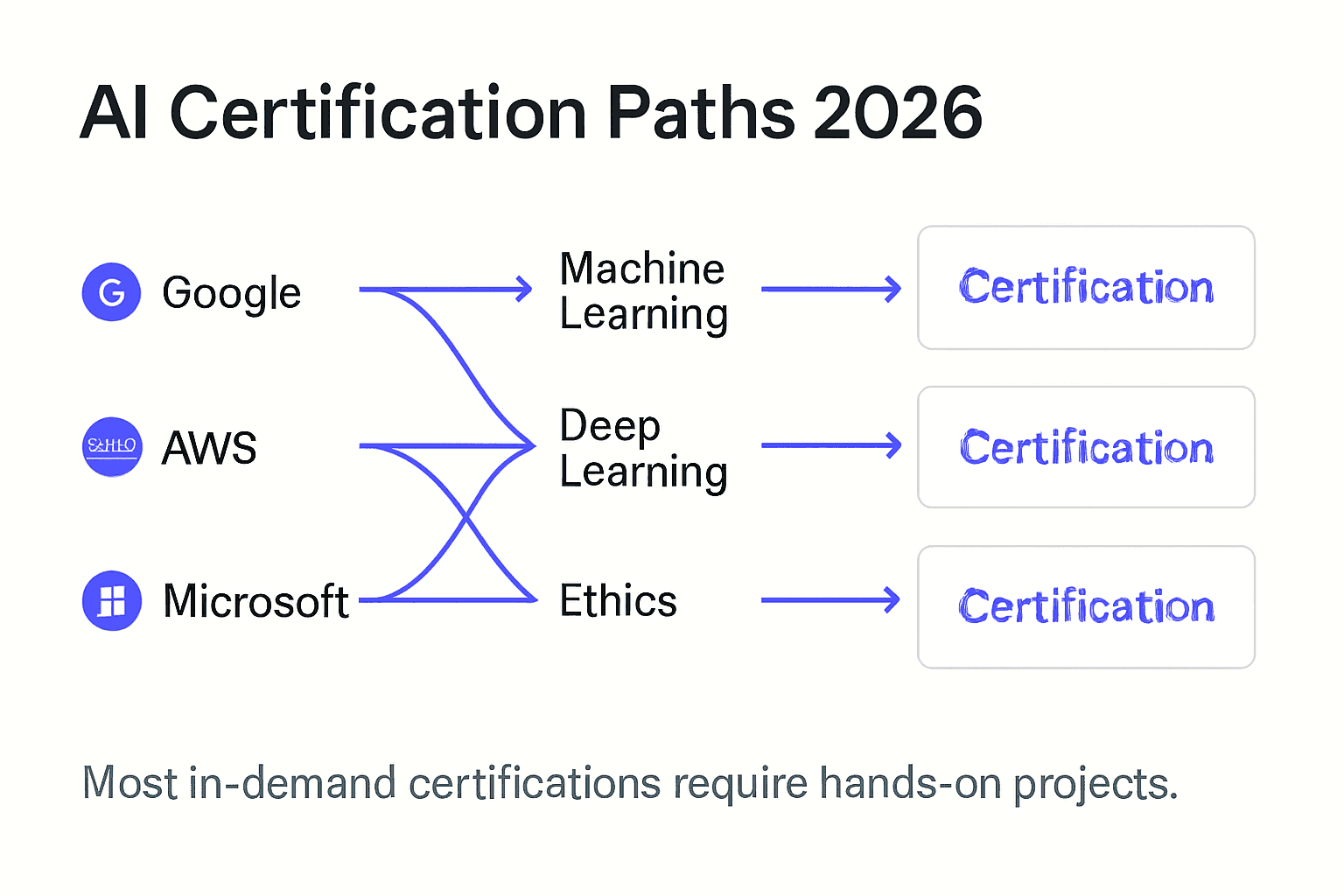
Cloud providers like Google, Amazon Web Services (AWS), and Microsoft Azure are pioneering certification tracks that validate complex AI engineering skills. These programs assess professionals’ abilities to design scalable machine learning architectures, develop advanced generative AI systems, and implement responsible AI solutions across enterprise environments. Specific high-demand certification paths include the Google Professional Machine Learning Engineer, AWS Certified Machine Learning Specialty, and Microsoft Azure AI Engineer certifications.
Key AI certification paths gaining significant traction in 2026 include:
- Cloud Platform AI Engineering Certifications
- Generative AI Specialist Credentials
- Machine Learning Operations (MLOps) Certifications
- Ethical AI and Responsible AI Implementation Programs
- Advanced Natural Language Processing Credentials
- Autonomous Systems Design Certifications
Pro tip: Prioritize certifications that offer hands-on project experience and align with your specific career goals in AI technology deployment.
Here is a comparison of popular AI certification providers and how each enhances professional growth:
| Provider | Skill Focus | Industry Impact | Unique Advantage |
|---|---|---|---|
| Google Cloud | Machine learning, MLOps | Cloud AI integration | Global enterprise adoption |
| AWS | ML engineering, NLP | Scalable AI solutions | Advanced cloud deployments |
| Microsoft Azure | AI engineering, automation | Responsible AI practices | Strong enterprise partnerships |
Core Requirements and Exam Processes
AI certification exams in 2026 represent rigorous professional evaluations designed to validate complex technological skills. Certification exam processes typically combine comprehensive theoretical assessments with practical skill demonstrations, requiring candidates to showcase their technical proficiency across multiple AI domains.
Most AI certification exams follow a structured assessment framework that includes multiple evaluation components. Candidates can expect a combination of multiple-choice questions, hands-on laboratory exercises, and project-based assessments that test real-world problem-solving capabilities. The exam duration usually ranges from 2-4 hours, with costs varying between $150 and $500 depending on the certification’s complexity and the issuing organization.
Core requirements for AI certification candidates generally include:
- Foundational knowledge in machine learning concepts
- Programming skills (typically Python or R)
- Understanding of cloud computing platforms
- Basic statistical and mathematical comprehension
- Experience with data manipulation and analysis
- Familiarity with AI tools and frameworks
Pro tip: Create a structured study plan that allocates specific time for theoretical learning and practical skill development to maximize your certification preparation effectiveness.
Costs, Risks, and Return on Investment
AI certification investments in 2026 represent complex financial and professional decisions that require careful strategic planning. Certification return on investment varies dramatically, with potential salary increases ranging from 20% to 25% for professionals who successfully navigate these specialized credential pathways.
Certification costs demonstrate significant variability, spanning from affordable subscription models around $49 monthly to elite university programs exceeding several thousand dollars. The financial risks include substantial time and monetary investments without guaranteed job placement. However, the rapidly expanding AI job market continues to create unprecedented opportunities for certified professionals, with employers increasingly valuing verified technical expertise over traditional academic credentials.
Key financial considerations for AI certification investments include:
- Initial certification examination fees
- Study material and preparation course expenses
- Potential lost income during intensive study periods
- Ongoing recertification and skill maintenance costs
- Potential salary increment and career advancement opportunities
Pro tip: Calculate your potential return on investment by comparing certification costs against projected salary increases and comparing multiple certification options before making a final decision.
Comparing AI Certifications and Alternatives
Professionals exploring AI skill development face multiple pathways for acquiring technological expertise. Comparing educational alternatives reveals nuanced trade-offs between traditional academic degrees, professional certifications, self-study programs, and intensive bootcamp experiences, each offering distinct advantages for career advancement.
Traditional university degrees provide comprehensive theoretical foundations, while professional AI certifications offer targeted, practical skill validation that many employers find increasingly compelling. Certification programs typically require less time and financial investment compared to full degree programs, making them attractive for working professionals seeking rapid skill enhancement. Self-directed learning and online bootcamps represent more flexible alternatives, though they may lack the structured curriculum and formal recognition of established certification tracks.
Key comparison points for AI learning pathways include:
- Technical depth and curriculum comprehensiveness
- Time commitment required
- Financial investment
- Employer recognition
- Practical skill demonstration
- Networking and professional credibility
- Flexibility of learning schedule
Pro tip: Evaluate your current career stage, learning preferences, and professional goals to select the most appropriate AI skill development pathway that balances practical learning with recognized credentials.
Compare your AI learning pathway options and their career advantages:
| Pathway | Time to Complete | Recognition Level | Career Advancement Potential |
|---|---|---|---|
| University Degree | 2-4 years | Highest | Strong foundation, slower ROI |
| Professional Certification | 2-6 months | High | Rapid skill validation |
| Self-guided Learning | Variable | Moderate | Flexible, requires discipline |
| Bootcamp | 8-16 weeks | Good | Fast career change possible |
Accelerate Your AI Career with Verified Certification Prep
The challenge of mastering complex AI domains like generative AI design, machine learning operations, and ethical AI deployment is real and demanding. Professionals aiming to validate these skills face high-stakes exams that require deep knowledge and hands-on experience. If you want to confidently pass your AI or related tech certification on the first try, overcoming barriers such as exam complexity and time constraints is essential.
At PlanetCert.com, we understand these pain points and offer a powerful solution with our extensive library of real exam questions, detailed study guides, and online exam simulators. Our proven methodology focuses on helping you build practical skills while boosting your confidence with verified practice tests tailored to certifications from major cloud providers and AI pathways.
Take control of your career advancement now by preparing with trusted resources that mirror the rigorous evaluation processes described in the article.
Ready to conquer challenging AI certifications like Google’s Professional Machine Learning Engineer or AWS’s Certified Machine Learning Specialty? Visit PlanetCert.com today and start your journey with expert study materials designed specifically for tech professionals targeting rapid skill validation and career growth. Don’t wait — your certification success begins with the right preparation.
Frequently Asked Questions
What are the core competency areas validated by AI certifications in 2026?
AI certifications in 2026 validate several core competency areas, including generative AI system design, machine learning model development, natural language processing techniques, ethical AI deployment strategies, autonomous system management, and compliance with quality standards for AI technologies.
How do professional AI certifications impact career advancement?
Professional AI certifications can significantly impact career advancement by validating technical expertise, which can lead to increased job opportunities, potential salary increases ranging from 20% to 25%, and a stronger position in the competitive AI job market.
What are the common requirements for AI certification candidates in 2026?
Common requirements for AI certification candidates typically include foundational knowledge in machine learning concepts, programming skills (often in Python or R), understanding of cloud computing platforms, basic statistics and math comprehension, experience with data manipulation and analysis, and familiarity with AI tools and frameworks.
How do AI certifications compare to traditional university degrees?
AI certifications generally provide targeted and practical skill validation that many employers find appealing. They require less time and financial investment than traditional university degrees, making them suitable for working professionals seeking rapid skill enhancement while offering good employer recognition and potential for career advancement.
Recommended

Discussion
Question Comments
0 comments·0 participantsSign in to leave a comment and access more free questions.