


Role of CompTIA Security+ in 2026 IT Careers
Over one million professionals worldwide now hold the CompTIA Security+ certification, making it a cornerstone for anyone entering cybersecurity roles in both American and international organizations. With cyber threats growing in complexity, employers demand verified skills that go beyond surface-level knowledge. This guide explains what makes CompTIA Security+ a critical credential, the expertise it measures, and how it empowers cybersecurity professionals to access advanced opportunities in a rapidly evolving industry.
Key Takeaways
| Point | Details |
|---|---|
| Foundational Certification | CompTIA Security+ is a vendor-neutral certification validating essential cybersecurity skills for IT professionals. |
| Core Exam Domains | The certification examines candidates across six key areas relevant to modern cybersecurity challenges. |
| Career Advancement | Security+ certification opens various career opportunities in cybersecurity, often leading to advancement into specialized roles. |
| Continuous Learning | Professionals must view certification as a dynamic process, emphasizing ongoing education and skills development in cybersecurity. |
Defining CompTIA Security+ Certification
The CompTIA Security+ certification represents a foundational credential that validates essential cybersecurity skills for professionals entering the IT security domain. This vendor-neutral certification provides practitioners with critical knowledge needed to protect networks, detect emerging threats, and implement robust security solutions across complex technological environments. Entry-level security skills are comprehensively evaluated through a rigorous examination process.
Designed to meet industry standards, the Security+ certification covers multiple critical domains including threat management, cryptography, risk mitigation, and security infrastructure. Professionals who earn this certification demonstrate competency in implementing secure network architectures, understanding cybersecurity principles, and responding effectively to potential security incidents. The credential serves as a valuable benchmark for employers seeking qualified cybersecurity professionals who can navigate increasingly complex technological landscapes.
The certification exam (currently SY0-701) tests candidates on advanced technical competencies essential for modern cybersecurity roles. Key areas of focus include secure system design, threat detection methodologies, incident response protocols, and understanding governance frameworks. By validating both theoretical knowledge and practical skills, CompTIA Security+ ensures that certified professionals possess the fundamental capabilities required to protect organizational digital assets and respond to emerging cyber threats.
Pro Tip: Prepare for the Security+ exam by combining official study materials with hands-on practical experience in network security configurations and threat assessment scenarios.
Core Domains and Exam Structure 2026
The CompTIA Security+ certification exam for 2026 is meticulously designed to assess comprehensive cybersecurity competencies through structured exam domains. Candidates will be evaluated across six critical knowledge areas that represent the most current and relevant security challenges facing modern organizations. These domains are carefully crafted to ensure professionals demonstrate practical skills and theoretical understanding of complex security environments.
The six primary exam domains provide a holistic assessment of cybersecurity capabilities. These include General Security Concepts, which tests foundational security principles; Threats, Vulnerabilities & Mitigations, focusing on identifying and addressing potential security risks; Security Architecture, examining design and implementation strategies; Security Operations, evaluating practical incident response and monitoring techniques; Security Program Management & Oversight, assessing organizational security governance; and Cryptography & PKI Concepts, testing advanced encryption and key management skills.
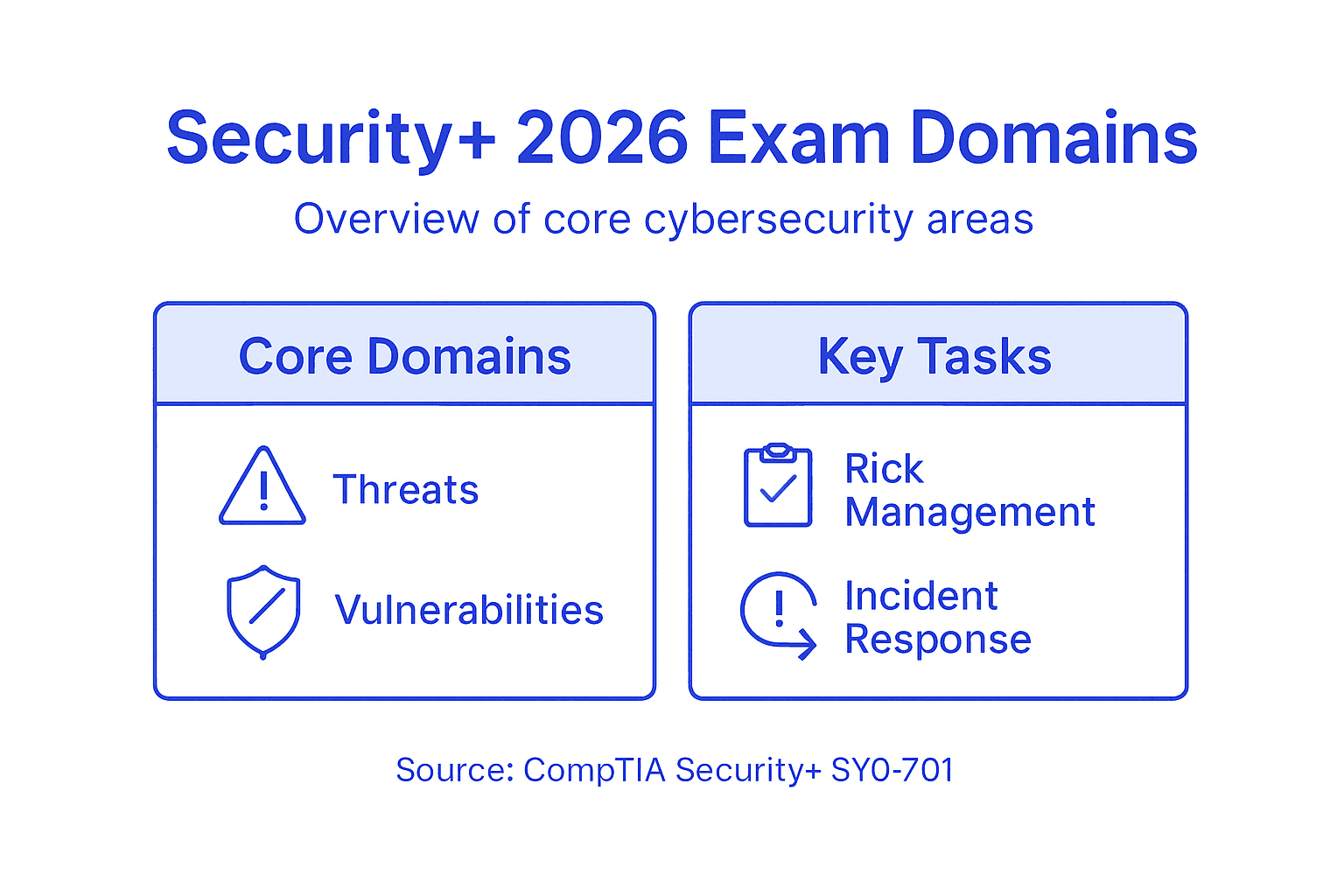
Each domain is strategically weighted to reflect the real-world importance of specific security skills. The exam incorporates scenario-based questions that simulate actual cybersecurity challenges, requiring candidates to demonstrate critical thinking, problem-solving, and technical expertise. By using practical, context-driven assessments, CompTIA ensures that certified professionals are prepared to handle complex security situations across diverse technological environments.
Here’s a summary of the six CompTIA Security+ exam domains and their core focus for 2026:
| Exam Domain | Primary Focus Area | Typical Real-World Task |
|---|---|---|
| General Security Concepts | Foundational security principles | Define basic security terminology |
| Threats, Vulnerabilities & Mitigations | Identifying and reducing risks | Assess and address security gaps |
| Security Architecture | Designing secure systems | Build protected network infrastructures |
| Security Operations | Incident response and monitoring | Monitor alerts, respond to attacks |
| Security Program Management & Oversight | Governance and risk management | Set policies and track compliance |
| Cryptography & PKI Concepts | Encryption and key management | Implement certificate-based security |
Pro Tip: Create a structured study plan that allocates specific time for each exam domain, with extra focus on areas where your practical experience might be limited.
Variants and Vendor-Neutral Approach
CompTIA Security+ stands out in the certification landscape through its vendor-neutral certification approach, offering professionals a comprehensive framework for cybersecurity skills that transcends specific technological ecosystems. Unlike vendor-specific certifications that limit professionals to particular hardware or software environments, this approach provides practitioners with adaptable, universally applicable security knowledge that remains relevant across diverse technological infrastructures.
The vendor-neutral methodology ensures that certified professionals develop foundational skills applicable to multiple technology platforms and organizational contexts. This strategic approach enables cybersecurity professionals to understand core security principles that remain consistent regardless of specific technological implementations. By focusing on fundamental security concepts, risk management strategies, and universal best practices, CompTIA Security+ prepares professionals to navigate complex, heterogeneous technology environments with confidence and expertise.
ANSI accreditation further validates the certification’s international recognition and rigorous standards. The vendor-neutral design allows professionals to demonstrate their skills across different technological ecosystems, making them more marketable and adaptable in an increasingly complex global cybersecurity landscape. Organizations value these professionals because they can apply security principles consistently, regardless of the specific technological infrastructure, making them versatile and strategically valuable assets to any cybersecurity team.
Pro Tip: When studying for a vendor-neutral certification, focus on understanding underlying security principles rather than memorizing platform-specific configurations.
Career Opportunities and Industry Demand
The CompTIA Security+ certification opens substantial career pathways across multiple sectors in the cybersecurity landscape, positioning professionals for roles that are critical to organizational digital defense strategies. Cybersecurity job markets continue to demonstrate exponential growth, with employers seeking candidates who possess verified, comprehensive security skills that translate directly into practical workplace capabilities.
Typical career opportunities for Security+ certified professionals span diverse organizational contexts, including roles such as Security Analyst, Network Security Administrator, Cybersecurity Specialist, and Information Security Technician. These positions exist across industries ranging from government agencies and financial institutions to healthcare organizations and technology companies. The certification provides a robust foundation that enables professionals to understand complex security infrastructures, implement protective measures, and respond effectively to emerging technological threats.
The certification’s broad applicability makes it particularly valuable for professionals seeking entry-level to intermediate cybersecurity positions. Organizations consistently prioritize candidates with validated security credentials, recognizing that CompTIA Security+ represents a standardized measure of fundamental cybersecurity competencies. Professionals can expect potential career progression into more advanced roles such as Security Engineer, Incident Response Specialist, and Cybersecurity Consultant, with potential salary ranges varying significantly based on geographical location, organizational complexity, and individual expertise.
Pro Tip: Complement your Security+ certification by developing practical skills through hands-on lab experience, personal cybersecurity projects, and continuous learning in emerging technological domains.
Responsibilities and Impact on Cybersecurity Teams
Cybersecurity teams with CompTIA Security+ certified professionals bring enhanced capabilities to organizational digital defense strategies. Certification sample questions demonstrate the practical skills these professionals introduce to complex security environments. These team members provide critical insights into threat detection, risk mitigation, and comprehensive security infrastructure management, bridging theoretical knowledge with actionable implementation strategies.
The responsibilities of Security+ certified professionals within cybersecurity teams encompass multiple strategic domains. They are typically responsible for conducting comprehensive security assessments, implementing robust network protection protocols, monitoring potential vulnerabilities, and developing incident response strategies. Their expertise allows organizations to proactively identify potential security risks, design preventative measures, and create resilient technological ecosystems that can withstand increasingly sophisticated cyber threats.
Beyond technical implementation, Security+ certified professionals significantly contribute to organizational security culture. They serve as critical translators between technical complexities and strategic business objectives, helping leadership understand cybersecurity risks in context of broader operational goals. Their vendor-neutral training enables them to provide flexible, adaptable solutions that transcend specific technological limitations, making them invaluable assets in creating holistic, dynamic security frameworks that evolve with emerging technological challenges.
Compare the impact of Security+ certification on cybersecurity teams across organizational needs:
| Area of Impact | Contribution of Security+ Certified Professionals | Value to Organization |
|---|---|---|
| Risk Identification | Proactively recognize vulnerabilities | Fewer breaches and data losses |
| Communication | Bridge technical and business priorities | Improved security awareness for all |
| Adaptability | Apply universal security principles | Consistent protection across platforms |
| Incident Response | Lead coordinated response actions | Faster recovery from security incidents |
Pro Tip: Continuously expand your cybersecurity team’s capabilities by encouraging ongoing professional development and cross-training across different security domains.
Common Pitfalls and Misconceptions
Cybersecurity professionals pursuing CompTIA Security+ certification must navigate several critical misconceptions that can potentially derail their professional development. Cybersecurity strategy challenges reveal that many professionals misunderstand fundamental aspects of security implementation, often overestimating technical solutions while undervaluing human factors and communication strategies.
One prevalent misconception involves viewing security as a purely technical discipline, neglecting the critical role of human behavior and organizational culture. Security+ certified professionals must recognize that effective cybersecurity extends beyond technological implementations. Common errors include assuming technological solutions alone can prevent security breaches, overlooking the importance of comprehensive user training, and failing to develop adaptive, holistic security approaches that account for human interactions with technological systems.
Another significant pitfall relates to certification preparation and professional development. Many candidates mistakenly believe that passing the Security+ exam is a one-time achievement, rather than understanding it as part of an ongoing learning journey. Professionals who view the certification as a static credential rather than a dynamic framework for continuous learning risk becoming obsolete in a rapidly evolving technological landscape. Successful Security+ professionals maintain a growth mindset, continuously updating their skills, understanding emerging threats, and adapting to new technological challenges.
Pro Tip: Approach cybersecurity learning as a continuous journey, dedicating time each month to explore emerging technologies and threat landscapes beyond your current skill set.
Accelerate Your CompTIA Security+ Journey with PlanetCert.com
Preparing for the CompTIA Security+ (SY0-701) exam is crucial for those aiming to secure cutting-edge IT careers in 2026. This certification demands deep understanding of cybersecurity concepts such as Threats, Vulnerabilities & Mitigations, Security Operations, and Cryptography & PKI Concepts. If your goal is to master these domains and avoid common pitfalls like superficial exam prep or overlooking vendor-neutral principles, you need a resource that matches the exam’s rigor and real-world applicability. PlanetCert.com provides verified real exam questions, practice tests, and detailed study guides designed to sharpen your skills and boost your confidence.

Don’t leave your career advancement to chance. Begin your focused preparation today with PlanetCert.com’s proven CompTIA Security+ practice tests. Our online exam simulators replicate real testing environments so you can develop critical thinking and problem-solving skills needed for cybersecurity roles. With up-to-date materials and a money-back guarantee, PlanetCert.com is your trusted partner to navigate the complexities of vendor-neutral security certification. Visit PlanetCert now and take the decisive step toward excelling in your 2026 Security+ exam and advancing your cybersecurity career.
Frequently Asked Questions
What is CompTIA Security+ and why is it important in 2026 IT careers?
CompTIA Security+ is a foundational certification in cybersecurity that validates essential skills needed to protect networks and respond to security incidents. It’s important in 2026 IT careers because it prepares professionals for entry-level and intermediate roles in an increasingly demanding cybersecurity landscape.
What are the main domains covered in the CompTIA Security+ exam for 2026?
The CompTIA Security+ exam for 2026 covers six main domains: General Security Concepts, Threats, Vulnerabilities & Mitigations, Security Architecture, Security Operations, Security Program Management & Oversight, and Cryptography & PKI Concepts. Each domain assesses critical skills relevant to modern cybersecurity challenges.
How does CompTIA Security+ differ from vendor-specific certifications?
CompTIA Security+ is vendor-neutral, which means it provides a comprehensive framework for cybersecurity skills applicable across various technology platforms. Unlike vendor-specific certifications, it equips professionals with universal security knowledge that remains relevant regardless of technological changes.
What career opportunities can I pursue with a CompTIA Security+ certification?
With a CompTIA Security+ certification, you can pursue various roles such as Security Analyst, Network Security Administrator, Cybersecurity Specialist, or Information Security Technician. This certification enhances your career prospects across different industries, as employers highly value professionals with verified security skills.
Discussion
Community Discussion
Sign in to leave a comment and access more free questions.