

If you’re prepping for CSCP, you’ll hear two strong opinions: “Just buy the APICS CSCP learning system and follow it” versus “Skip the books and grind practice tests.” In reality, those approaches train different skills. One builds understanding, the other builds performance under exam conditions.
This guide breaks down what each method does well, where it commonly fails, and how to combine them into a plan that actually improves your odds of passing.
What the APICS CSCP learning system is designed to do
The APICS CSCP learning system (now under ASCM, but many candidates still call it “APICS CSCP”) is typically built to:
- Teach the full body of knowledge in a structured sequence
- Standardize terminology and frameworks across end-to-end supply chain
- Provide knowledge checks that confirm you can recall and recognize concepts
Its biggest strength is coverage and coherence. If you have gaps across planning, sourcing, operations, logistics, and integration topics, a structured learning system helps you build a stable “map” of the domain.
Where candidates sometimes struggle is assuming “I finished the content” equals “I’m exam-ready.” It often doesn’t.
What practice tests are designed to do
Practice tests (when they’re high quality and reviewed properly) are built to:
- Train retrieval and application, not just recognition
- Expose weak areas quickly, so you can study with precision
- Build timing, stamina, and decision-making under pressure
In other words, practice tests help you convert knowledge into repeatable exam performance.
If you want a question engine with realistic simulation, explanations, and mobile-friendly study, a resource like Planet Cert practice tests is meant for that “performance” layer, not as a replacement for learning the concepts.
The learning science piece: why “practice” usually beats “re-reading”
A lot of candidates default to reading and highlighting because it feels productive. But decades of cognitive science show that retrieval practice (trying to answer, then checking, then correcting) produces stronger long-term learning than passive review.
A well-known paper in PNAS found that testing can significantly improve long-term retention compared to additional studying, even when learners feel less confident during practice (Roediger & Karpicke, 2006).
That doesn’t mean “only practice tests.” It means you should treat questions as a learning tool, not just a final check.
APICS CSCP learning system vs practice tests (head-to-head)
Here’s the practical difference in outcomes.
| Approach | What it’s best at | Where it tends to fall short | Best time to use it |
|---|---|---|---|
| APICS CSCP learning system | Building foundational understanding, consistent terminology, full-scope coverage | Can create “false readiness” if you don’t practice exam-style application and timing | Early to mid prep, or whenever you discover conceptual gaps |
| Practice tests | Diagnosing weaknesses, building speed, applying concepts in scenarios, exam stamina | Can become guess-and-check if you skip deep review, can miss foundational gaps if you only memorize patterns | Throughout prep, and heavily in the final 2 to 3 weeks |
| Blended workflow | Builds both knowledge and performance, reduces wasted study time | Requires discipline and a review system | Best for most candidates, especially working professionals |
When the learning system alone can work (and when it usually doesn’t)
It can work if…
The learning system can be enough if you already have strong supply chain experience and your main need is organizing knowledge and filling a few gaps.
It usually doesn’t work if…
You fall into one of these common traps:
- You recognize concepts while reading, but can’t apply them in multi-step scenarios
- Your accuracy drops when questions are wordy or include distractors
- You run out of time, second-guess too much, or change correct answers under pressure
Those are performance problems, and performance problems are fixed with practice and review loops.
When practice tests alone can work (and the risks)
It can work if…
Practice-test-first approaches can work for experienced practitioners who can self-teach missing concepts quickly from explanations, notes, and targeted reading.
The risks to watch
Practice tests alone often fail when candidates:
- Rush volume (doing lots of questions) without deep review
- Memorize answer patterns instead of learning the underlying logic
- Skip mapping misses back to the official exam domains
If you go “tests only,” you need a stricter review discipline than most people expect.
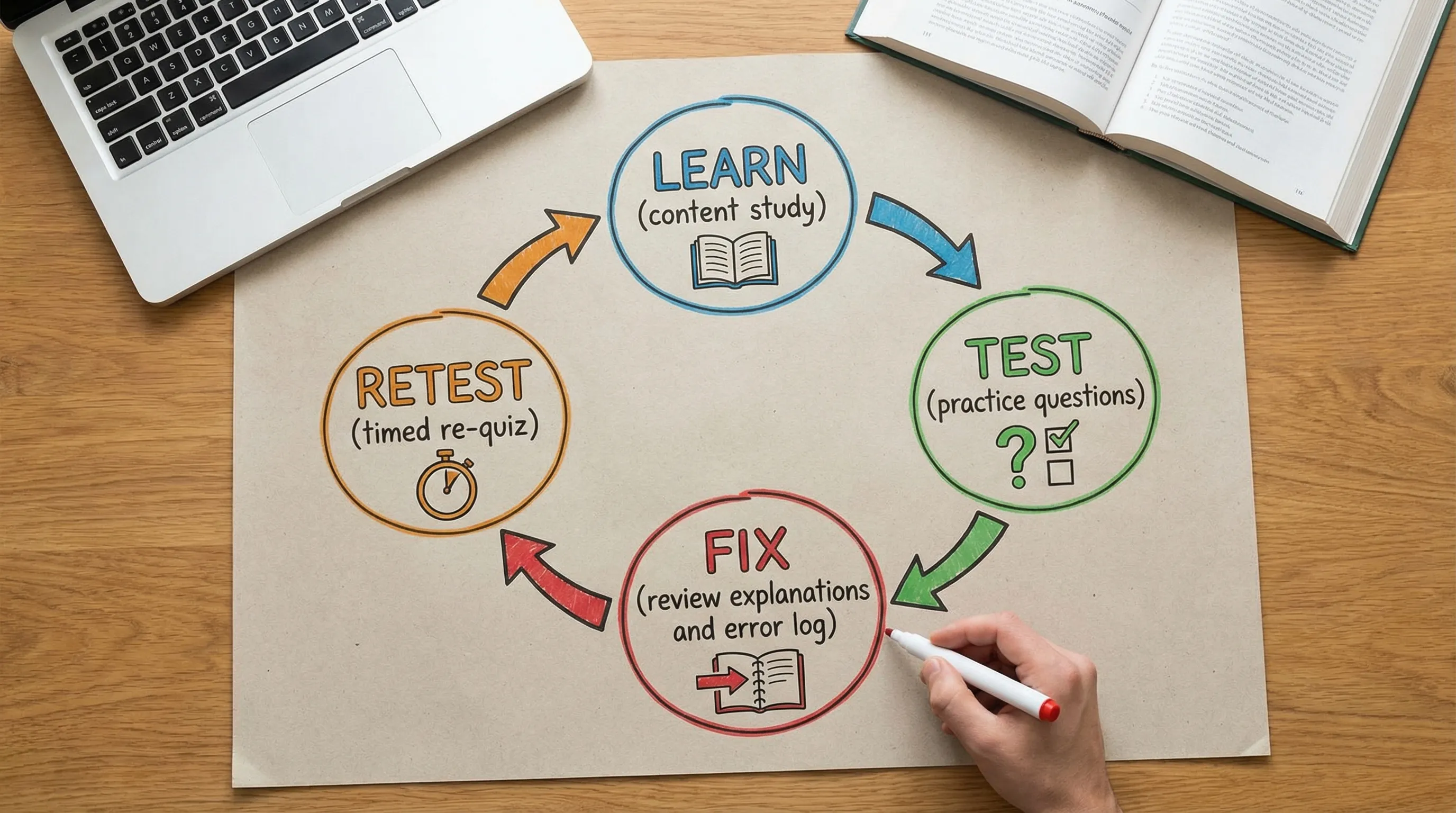
What works best for most candidates: a blended loop (learn, test, fix, retest)
A reliable CSCP prep system has four repeating steps:
Learn: Use the learning system (or equivalent resources) to understand a topic.
Test: Do a short set of questions on that topic, then mixed-topic questions later (mixing is important).
Fix: Review every miss and every guessed-correct. Write a one-sentence rule for what you’ll do next time.
Retest: Re-quiz the same objective 48 to 72 hours later, then again a week later.
This is how you turn “I studied it” into “I can do it under exam conditions.”
How to choose practice tests that actually help (not just inflate confidence)
Not all question banks are equally useful. For CSCP-style prep, prioritize practice tests that offer:
- Explanations that teach, not just label right or wrong
- Realistic exam simulation (timed, full-length feel)
- Coverage depth (enough volume to avoid repeating the same items too quickly)
- Regular updates so you’re not training on stale or low-quality items
A platform like Planet Cert exam questions is built around expert-verified practice tests, explanations, flashcards, and a web-based simulator, which fits the “test, review, retest” workflow without needing extra software.
A practical 6-week plan: learning system plus practice tests
This outline keeps the learning system as your source of truth, while using practice tests to drive efficiency.
Weeks 1 to 2: Build your base and set your benchmarks
Focus: coverage and diagnosis.
- Work through core learning system lessons at a steady pace.
- Take short topic quizzes after each chunk.
- Start an error log (missed concepts, why you missed, the rule you’ll use next time).
Target outcome by end of Week 2: you know your weakest domains, and you have a review system that prevents repeat mistakes.
Weeks 3 to 4: Shift toward mixed practice and application
Focus: integration and decision-making.
- Reduce pure reading time, increase mixed-topic question sets.
- For every practice set, spend as long reviewing as you spent answering.
- Retest your weakest objectives twice each week.
Target outcome by end of Week 4: fewer “I forgot” misses, more “I can explain why” confidence.
Week 5: Full simulations and pacing
Focus: timing, stamina, and consistency.
- Do 2 to 3 timed simulations under realistic conditions.
- Track two metrics: accuracy and time per question.
- Review the exam like a project postmortem, especially guessed-correct answers.
Target outcome by end of Week 5: stable scores with fewer swings across attempts.
Week 6: Final tightening (the highest ROI week)
Focus: eliminate repeat errors, not learning new material.
- Rework your error log rules and redo targeted sets.
- Run one final timed simulation.
- Keep the last 48 hours lighter, focus on sleep and clarity.
If you need a dedicated question engine for this phase, Planet Cert practice exams are designed for realistic simulator runs plus explanation-driven review.
The fastest way to improve: review like an analyst, not a student
Most score gains come from review quality, not question quantity.
A high-ROI review routine looks like this:
- Re-solve missed questions without looking at the answer first
- Identify the failure type: concept gap, misread, poor elimination, or pacing
- Write a “next time” rule in plain language (one sentence)
- Retest the same objective within 72 hours
This is how you stop repeating the same mistakes, which is what usually blocks passing.
Common decision: should you buy the learning system if you already have experience?
If you have 5+ years in supply chain, you might not need the learning system to “learn supply chain.” You might need it to:
- Align your practical knowledge to the exam’s language and frameworks
- Cover areas your role never touches (for example, certain planning or global trade perspectives)
A good compromise many experienced candidates use is: learning system for structure and reference, practice tests for daily training and readiness checks.
For official certification context and requirements, start with the ASCM CSCP certification page.
Frequently Asked Questions
Is the APICS CSCP learning system enough to pass? It can be, especially if you already have strong supply chain fundamentals. Most candidates still benefit from practice tests to build exam timing, application skill, and confidence under realistic conditions.
Can I pass CSCP using only practice tests? Some experienced professionals can, but it’s risky if you have gaps in the body of knowledge. If you go this route, you must do deep review, maintain an error log, and retest weak objectives on a schedule.
When should I start practice tests during CSCP prep? Start early with short diagnostic sets to find weak areas, then increase volume and realism over time. In the final 2 to 3 weeks, prioritize timed simulations and review.
What score should I aim for on practice exams before the real test? Instead of chasing a single number, aim for consistency across multiple timed attempts, stable pacing, and the ability to explain your reasoning on both correct and incorrect answers.
What makes a practice test “high quality” for CSCP? Strong explanations, realistic difficulty and wording, enough question volume, and a simulator that helps you practice timing. Regular updates also matter.
Build CSCP exam readiness with the right mix
If you’re deciding between content and questions, the answer is usually “both,” but in the right order: learn to understand, then practice to perform.
When you’re ready to train with realistic simulations, explanations, and mobile-friendly study tools, use a dedicated question bank like Planet Cert practice tests to run diagnostics, drill weak areas, and rehearse full exam conditions.

Discussion
Question Comments
0 comments·0 participantsSign in to leave a comment and access more free questions.