
AWS Certified Cloud Practitioner 2026 Exam Update: Key Changes
If you had a CLF-C02 study calendar mapped out weeks ago, pull up the current exam guide before you do another practice session. AWS pushed a quiet refresh of the Cloud Practitioner exam in March 2026, and the version now delivering in Pearson VUE centres tests a different blend of knowledge than the one that was live through early 2026. The exam code is still CLF-C02 — no new number appeared — but the emphasis shifted enough that I wouldn’t trust a set of materials compiled before February without a gap check. This isn’t an overhaul that throws out every topic you’ve studied, but it does add net-new content in areas that older question banks tend to skip, and the scoring weights moved more than a casual glance would suggest.
This article runs through the domain rebalance, the new generative AI and sustainability coverage, the services that got pushed into the background, the transition timeline, and what I’d actually do right now if my exam date was within the next month. I’ll separate confirmed details drawn from the AWS documentation that went live alongside the refresh from the patterns that are emerging as more candidates sit the updated test.
Domain Weights Shift: Not a Reshuffle, a Rebalance
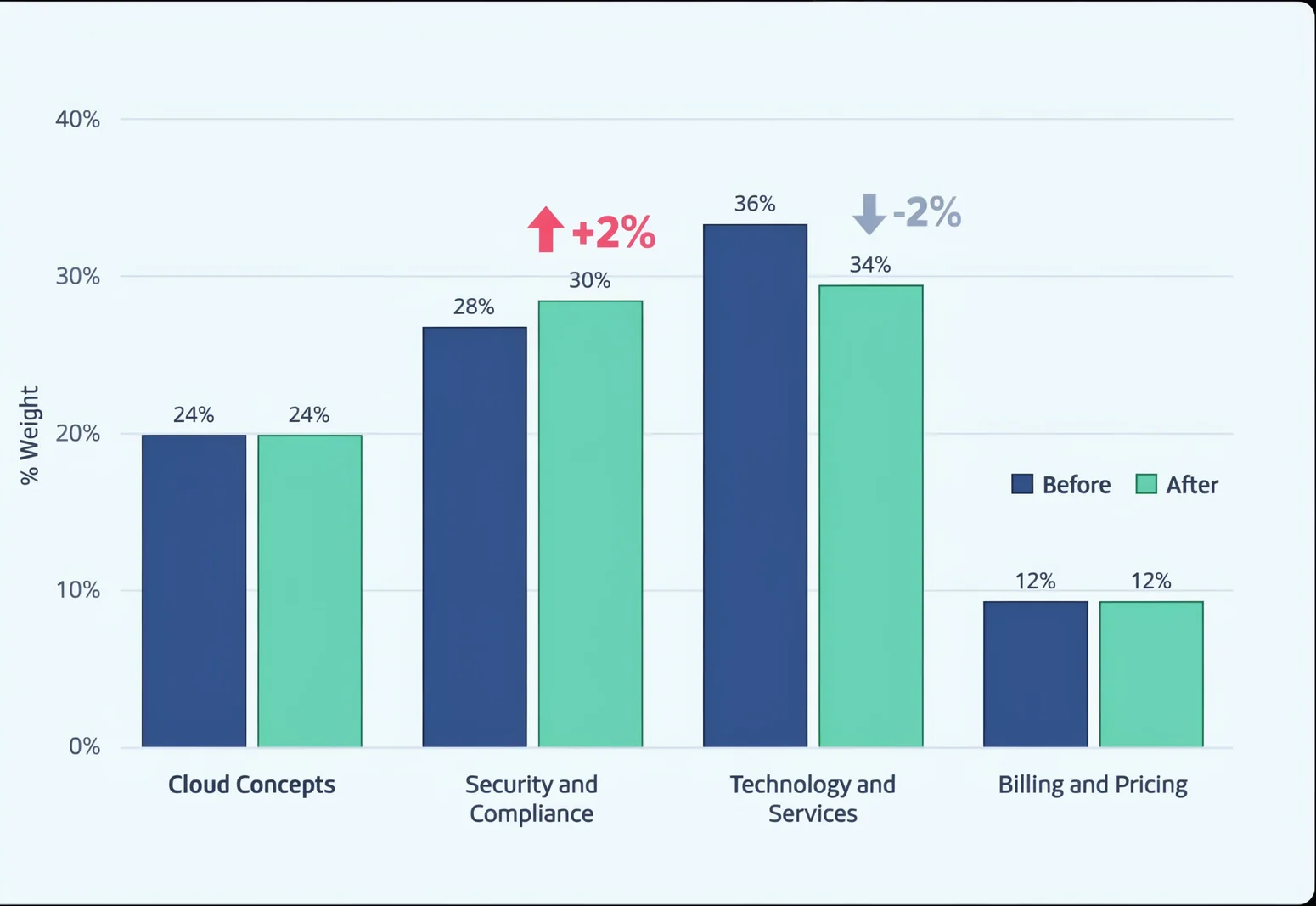
The four CLF-C02 domain names stayed the same, but the percentages shifted and the change is material for anyone with a score that was borderline in the Security pillar. The table below captures the domain weights as they stand after the March 2026 update, pulled from the official AWS exam guide and cross-referenced with training provider outlines that have been refreshed since.
| Domain | Weight (Post-Update) | Direction |
|---|---|---|
| Cloud Concepts | 24% | unchanged |
| Security and Compliance | 30% | increased |
| Cloud Technology and Services | 34% | decreased |
| Billing, Pricing, and Support | 12% | unchanged |
Security and Compliance climbed from 28% to 30%, and Technology and Services dropped from 36% to 34%. The difference represents roughly two to three extra Security items in a 65-question exam — enough to matter if your IAM policy evaluation logic or shared responsibility model recall wobbles under time pressure. The AWS Certified Cloud Practitioner (CLF-C02) reference confirms that the Security domain now covers threat detection services, security best practices, and compliance programmes in more applied scenarios than before, moving away from surface-level definition recognition.
AWS didn’t announce the rebalance as a stand-alone policy change, but the direction fits the broader certification trend across the portfolio: treat security as an embedded architectural concern rather than a checklist you review once the design is done. Every instructor-led course that refreshed alongside this update now spends more time on IAM, AWS Config, and GuardDuty in the foundational track — not because the services got more complex, but because the exam expects you to pair them with plausible business situations. If your practice test reports show a Security domain score hovering around 70%, the extra items in the 2026 exam could push you below the 700-point pass threshold.
Generative AI, Sustainability, and Where the New Focus Lands
The most concrete additions surface in two topic areas that barely registered on earlier CLF-C02 outlines: generative AI services and cloud sustainability practices. The Technologies and Concepts list published by AWS already flagged “Machine learning” as exam territory, but the 2026 version sharpens the expectation to the point where you need to place the right AI service in the right business scenario, not just know that AI exists somewhere in the console.
Prepare to see items that ask you to:
- Recognise Amazon Bedrock as the service that gives access to foundation models from multiple providers through a single API, and match it to a generative AI use case in a short scenario.
- Differentiate foundation models, fine-tuning, and prompt engineering as high-level concepts — not with technical depth, but enough to pick the correct label when a question describes a training process or a model refinement step.
- Identify which service handles conversational AI (Amazon Q), which one performs no-code machine learning (Amazon SageMaker Canvas), and which one builds and runs language models with managed infrastructure (Amazon Bedrock, again, in a slightly different scenario). The questions set up a business need — “a call centre wants to triage voice transcripts automatically” — and ask you to name the service.
- Explain AWS sustainability commitments and the tools AWS provides to support them: the sustainability pillar of the Well-Architected Framework, the Customer Carbon Footprint Tool, and the relationship between AWS Region selection and renewable energy objectives.
Amazon Bedrock gives you access to a choice of high-performing foundation models from leading AI companies and Amazon, all within a single API, so you can build and scale generative AI applications with security, privacy, and responsible AI built in. — AWS documentation on Amazon Bedrock
Sustainability isn’t a memorisation exercise. The exam now presents trade-off questions: a cheaper S3 storage tier might also carry a lower carbon impact, and you need to pick the option that satisfies both the cost and the environmental brief. The shift means you’ll see a few items that feel like multi-step reasoning rather than flat recall. Practising these prompts against a current question bank is what will expose whether you’ve internalised the newer logic or just drilled old flashcards that treat sustainability as a one-line definition.
Cloud economics also broadened in the 2026 update. Pricing model comparisons increasingly include sustainability cost trade-offs — like choosing an S3 storage class that reduces both spend and carbon — and the Billing domain now expects you to reason about AWS Budgets and Cost Explorer reports that include savings plan coverage gaps alongside environmental metrics. These aren’t revolutionary changes, but they move the exam away from pure “Which service is cheapest?” prompts towards “Given these two constraints, which option aligns with both?” That slight increase in reasoning depth can feel sharp if you haven’t worked through the new types of scenarios.
Services That Dropped Off or Got De‑emphasised
AWS rarely publishes a clean deprecation log for exam topics, but the residual signal from the refreshed documentation and from candidates who’ve sat the exam since March gives us a usable picture of what the test no longer expects you to memorise.
First-generation burstable EC2 instance families — the original t1 and m1 lines — and the now-deprecated networking concept EC2-Classic are absent or reduced to brief background mentions if they surface at all. The exam now expects you to reason across the modern compute spectrum: AWS Lambda, AWS Fargate, and EC2 Spot Instances alongside reserved and on-demand pricing. Spending review time memorising historical EC2 instance limits or legacy networking behaviours won’t help you.
The migration conversation inside Domain 1 also changed register. Older CLF-C02 material gave at least equal weight to the “6 Rs” migration framework. The 2026 version shifts more of the Domain 1 emphasis to the AWS Cloud Adoption Framework (AWS CAF) as the primary lens for evaluating migration business cases. The Content Domain 1: Cloud Concepts documentation now ties CAF directly to measurable outcomes — reduced business risk, improved ESG performance, increased operational efficiency — rather than listing technical migration steps. You still need to understand cloud adoption strategies in a general sense, but the CAF perspective gets the bulk of the scenario questions.
Several services that appeared in practice items from 2024 and early 2025 are missing from the current Technologies and Concepts roster. AWS CodeStar, which the company has stopped developing as a standalone service, and Amazon WorkDocs are both absent. The list itself carries a disclaimer that it’s non-exhaustive and subject to change, but the pattern is consistent: services AWS has stopped investing in at the Foundational level have been pruned. Candidates still using pre-2026 flashcards should cross-reference the current concepts page; a service absent from that page is unlikely to show up on your exam.
The cumulative effect is that the exam feels less like a catalogue quiz and more like a test of whether you can place the right service in a realistic business context. That was always the stated brief of CLF-C02, but the 2026 refresh closed the gap between the brief and the question pool.
Transition Timeline: When the New Test Took Over
AWS’s standard exam transition policy gave active candidates a short window. The updated guide went live in March 2026, and any CLF-C02 appointment scheduled on or after that date delivered the refreshed content. Candidates who already held an appointment booked before the cutover could sit the previous version as long as they didn’t reschedule into a later slot. That grace window mirrors the approach AWS used for prior Foundation-level refreshes, and the timeline was flagged ahead of time by Team AWS in January 2026.
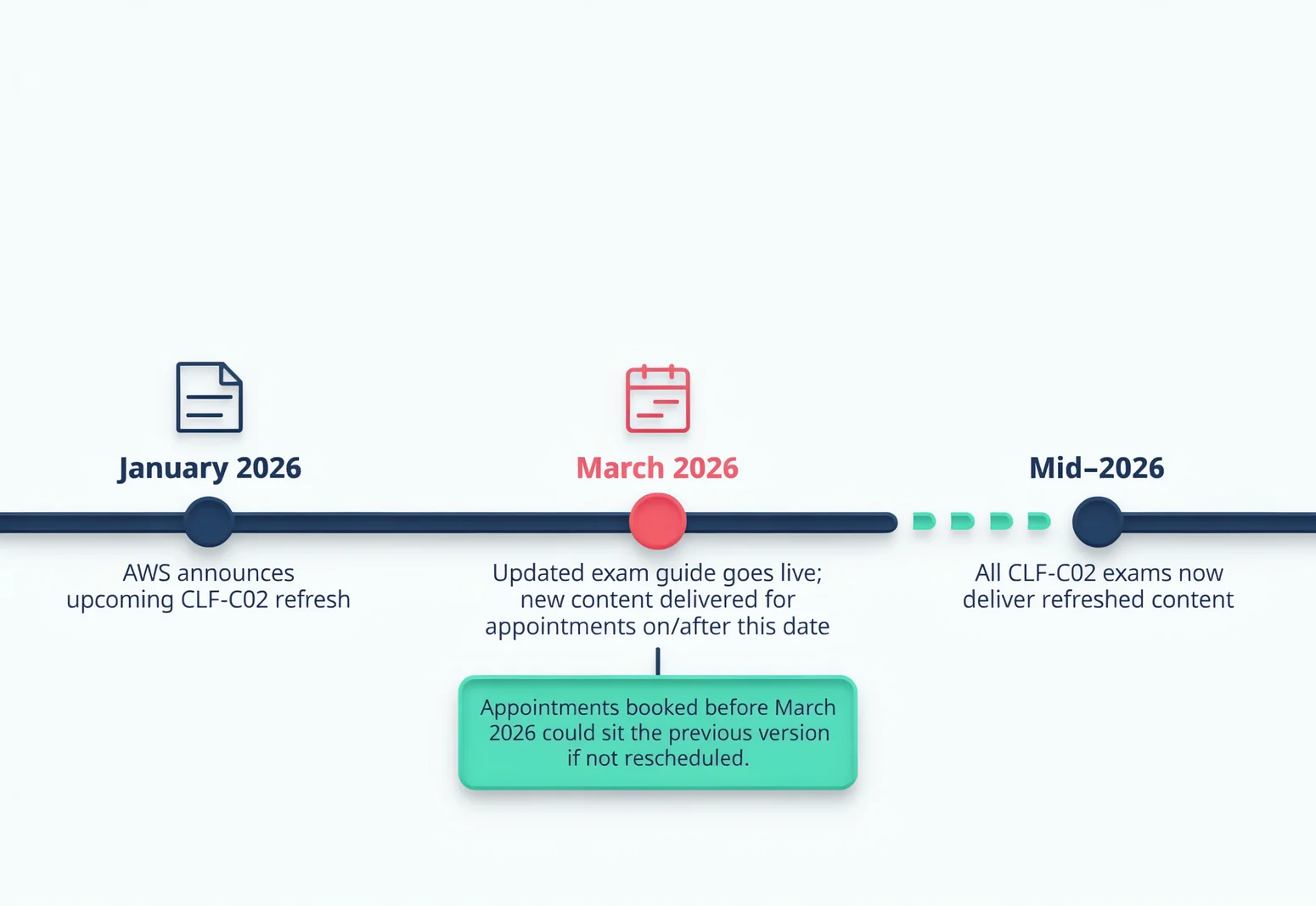
By mid-2026, every CLF-C02 exam delivered through Pearson VUE draws from the rebalanced domains and the updated service catalogue. There’s no version selector at the scheduling screen; the exam code didn’t change, so the refresh is invisible if you’re only looking at the code on your confirmation. I’ve spoken with candidates who walked in assuming their month-old study notes were still fully aligned — and they weren’t, particularly on generative AI and sustainability. That’s not a failing of the candidate; it’s a mismatch caused by the silent nature of the update.
If your study deck was compiled before February 2026, you almost certainly have coverage gaps. The exam code being the same means many course landing pages still list CLF-C02 with outdated outlines. The last-updated date on your materials matters more right now than the exam code printed on the pack.
Adapting Your CLF-C02 Prep for the Updated Exam
You don’t need to rebuild a study plan from scratch, but you do need to supplement the areas that got expanded and swap out any practice sets built against an older domain map. The official source should be your first stop: the AWS Certified Cloud Practitioner (CLF-C02) reference page lists the task statements for every domain. Print it out and work through each statement one at a time — if a statement asks you to “identify AWS services for common use cases” and you can’t name which service builds conversational AI interfaces, you’ve found a hole. Cross-reference those statements with the Technologies and Concepts list to confirm the specific services AWS expects you to relate to those tasks.
Practice tests are where the delta between old and new becomes expensive. Many platforms that host CLF-C02 question pools haven’t cycled in Bedrock, sustainability trade-offs, or the updated CAF scenarios. A candidate can drill a full practice set, score 90%, and still encounter five to seven questions in the live exam that feel unfamiliar — not because the questions are tricky, but because the topic never appeared in their mock exams. That’s not speculation; it follows directly from the domain weight adjustments and the addition of new content areas.
The PlanetCert practice question pool for CLF-C02 was refreshed after the March 2026 exam guide release. The CLF-C02 exam page now includes items that explicitly ask you to match Amazon Bedrock to a generative AI workload, choose a storage option based on both cost and sustainability impact, and reason through CAF-driven migration trade-offs. You can preview a few of those updated CLF-C02 sample questions to gauge how the newer item style reads — it’s a quick way to check whether your current question bank still lines up.
Outside of practice testing, AWS Skill Builder’s free exam prep content was realigned alongside the refresh. The AWS Cloud Practitioner Essentials course — both the digital and classroom versions — now includes dedicated sections on generative AI and sustainability that map to the updated domain weighting. If you earned your badge before the refresh, your certification remains valid for three years from your original pass date, and recertification follows the same renewal path. The update affects candidates preparing for the exam, not the credential status of those who already hold it.
Questions That Keep Coming Up About the Refresh
Is the exam harder now?
Not uniformly harder, but the Security uptick and the generative AI additions make it easier to stumble if those areas were light in your prep. The exam is still foundational — no coding, no architecture design — but the questions push closer to applied reasoning than before. If your strongest domain was Technology and Services and you were weak in Security, the rebalance works against you.
Do I need to memorise every generative AI service?
No. The exam asks you to recognise the purpose of Amazon Bedrock, Amazon Q, and Amazon SageMaker Canvas at a use-case level. It won’t ask you to recall API parameters or judge model accuracy metrics. Knowing what each service broadly does and which business problem it addresses is enough.
My practice tests haven’t been updated since 2025. Can I still use them?
You can use them for domains that didn’t change much — Cloud Concepts and Billing are still close to their earlier shape — but an unchanged question bank on its own will leave you blind to the new Security question patterns, the Bedrock and AI service items, and the sustainability trade-off scenarios. Supplement those older sets with a current pool that covers the new areas, or you risk a point drop of several percentage points that could be the difference between a pass and a retake.
When will the exam code change to CLF-C03?
AWS hasn’t announced a new exam code. The lifecycle pattern for Foundational exams is to keep the same code for years; CLF-C01 ran from 2017 through early 2023. This was a content refresh inside the CLF-C02 framework, not a complete re-versioning, and there’s no signal that a new code is imminent.
Does the exam fee or location change?
The exam still costs $100 and is delivered through Pearson VUE testing centres or online proctoring. Retake policies haven’t changed. The update affected content, not pricing or delivery logistics. For a full look at 2026 fees and retake costs, the PlanetCert 2026 exam fee breakdown covers the financial side in detail.
Keep building your Cloud Practitioner plan
- 2026 exam fee breakdown and retake costs
browse the relevant exam page and purchase a practice test

Discussion
Question Comments
0 comments·0 participantsSign in to leave a comment and access more free questions.