

If you're aiming for the Adobe Analytics Business Practitioner Professional certification, you've probably already searched for AD0-E212 sample questions and found a mixed bag: a few legitimate practice sets, some exam guides of uncertain vintage, and a lot of sites that just list questions without telling you what to do with them. The questions aren't the problem. The missing piece is sequence. This guide gives you a concrete 14-day routine that uses sample questions as the backbone of your prep: a diagnostic set on day one, domain-weighted practice blocks through the middle, explanation review after every session, and timed simulator runs before you book the real thing.
Two weeks is a realistic window if you already work in Analysis Workspace. If you're newer to the tool, stretch the same structure to three weeks and double the review days.
Know what the AD0-E212 actually measures
Before day one, get the exam's shape fixed in your head, because it should drive where your hours go.
The AD0-E212 is Adobe's professional-level credential for people who read data in Analysis Workspace rather than implement the tracking behind it. The paper runs 50 questions in 100 minutes, and you need 31 correct to pass. What makes this exam unusual is where its marks live: the bulk of the paper covers business analysis plus reporting and dashboarding, while general tool knowledge and troubleshooting is a small slice. In plain terms, Adobe cares far less about whether you can recite what an eVar is than whether you can pick the right visualisation for a business question, interpret a fallout report, or explain why a segment changes a metric.
That weighting has a direct planning consequence. If you split your study time evenly across the syllabus, you'll over-prepare the low-value areas and under-prepare the ones that decide pass or fail. Sample questions tell you quickly where the emphasis sits. Work through a set from any reputable source, such as the free Adobe Analytics Business Practitioner sample questions and study guide from Edusum, and you'll notice the same pattern: scenario stems like "given a business need to optimise operational efficiency" or "a stakeholder wants to see monthly sales and customer growth" that force you to choose a reporting approach, not a definition.
Keep one rule in mind while sourcing questions. Plenty of sites publish recycled question lists of unknown accuracy, and some are plain dumps. A dump teaches you to recognise answers, not to answer questions, and it leaves you exposed the moment Adobe rewrites a stem. Stick to practice sets with explanations you can verify against Adobe's own documentation and your own hands-on Workspace work.
Days 1–2: Run a diagnostic and map your gaps
The plan starts with measurement, not study. Your first two days exist to answer one question: where are you actually weak?
- Sit a timed diagnostic. On day one, take 25–40 practice questions in one sitting, timed at roughly two minutes per question (the real exam's pace). Use the AD0-E212 sample questions set or another explanation-backed set. Don't pause to look things up. The point is an honest baseline, and guessing is fine — mark your guesses so they don't inflate your confidence later.
- Tag every miss and every guess. Sort them into four buckets: reporting and visualisation choice, segmentation and data insights, business analysis interpretation, and fundamentals or implementation awareness. Published syllabus breakdowns, like the topic lists on TrainingDump's AD0-E212 page, give you a reasonable category map even if you ignore the marketing around them.
- Score by bucket, not overall. A 70% total score hides the real story. If you got 90% on fundamentals but 40% on fallout and flow interpretation, your plan for the next ten days should lean hard into interpretation. Write the per-bucket percentages at the top of whatever document or spreadsheet you're tracking this in.
- Set a target per bucket. A sensible bar is 85%+ on reporting and business analysis (the heavy domains) and 75%+ on the lighter ones. Anything below that gets scheduled time on days 3–10.
Day two is lighter. Re-do the questions you missed, untimed, with the explanations open. For each one, write a single sentence in your own words stating the rule you now know. "Fallout reports show where visitors drop out of a defined sequence of checkpoints; flow reports show paths without requiring predefined checkpoints" is the kind of sentence you want. If you can't write that sentence, you haven't learned the question yet.
Days 3–7: Domain-weighted practice blocks
Now the real work begins. These five days are built around focused blocks: one domain per day, roughly 60–90 minutes each, weighted toward what the exam weights and what your diagnostic flagged.
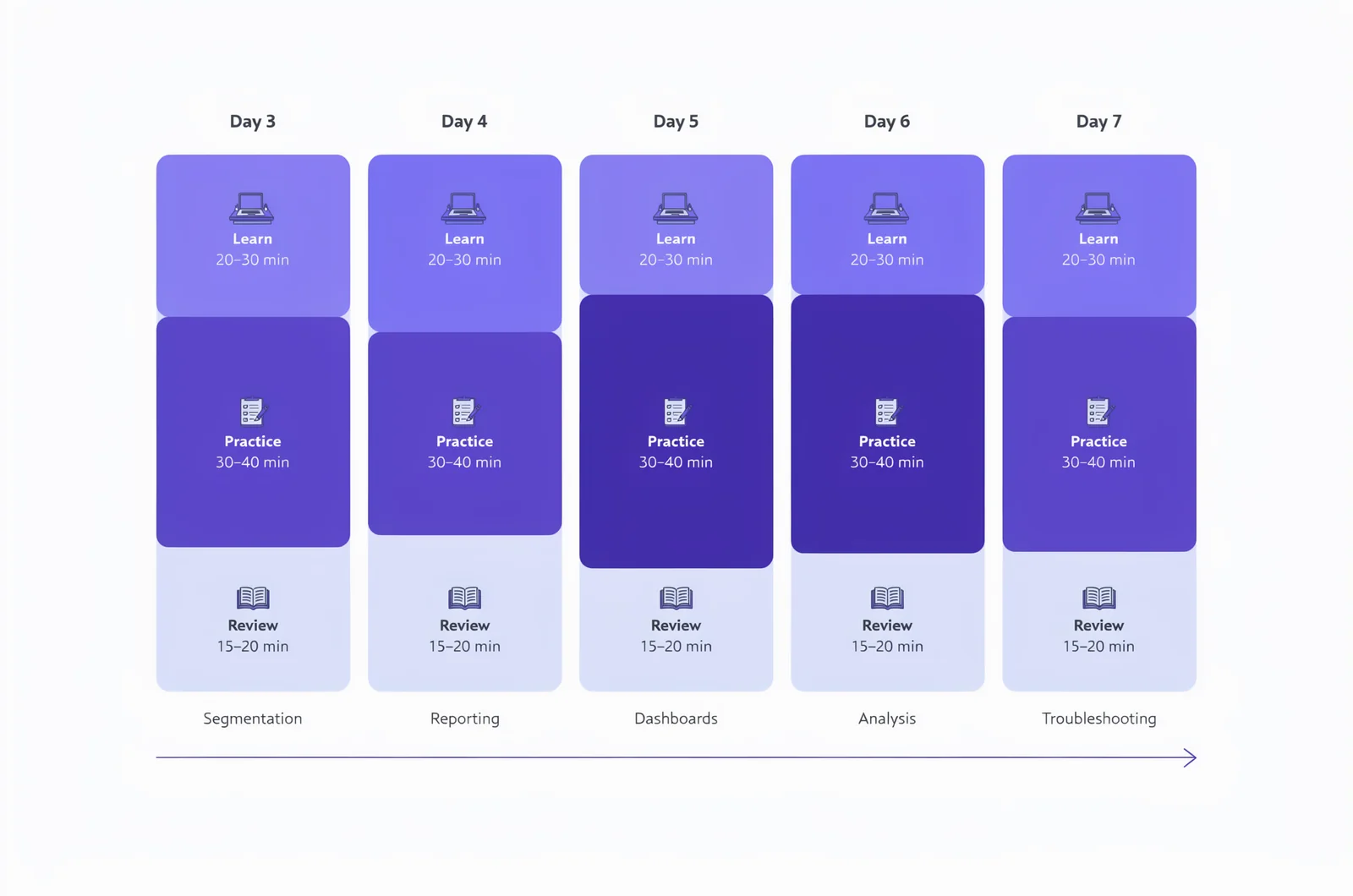
A practical daily block has three parts, and the order matters.
Learn first (20–30 minutes). Open Analysis Workspace and rebuild the thing the domain is about. On a segmentation day, build three segments from scratch: a visit-level segment, a visitor-level segment, and a sequential segment with a THEN condition. On a reporting day, build a fallout visualisation, a flow visualisation, and a cohort table on real or demo data. This exam rewards people who've touched the tool. Reading about contribution analysis without ever clicking it will fail you on scenario stems.
Practise second (30–40 minutes). Work 20–30 sample questions restricted to that day's domain. Untimed is fine here. Speed comes later; accuracy comes now. If your source only offers mixed sets, filter mentally and skip questions outside the domain, saving them for later.
Review third (15–20 minutes). Every wrong answer and every guess gets the same treatment as day two: read the explanation, write your own one-sentence rule, and note whether the miss was knowledge (you didn't know the concept) or reading (you misread the scenario). Reading errors are alarmingly common on this exam, because stems often embed a constraint like "the stakeholder only cares about mobile traffic" that changes the correct answer. Flagging them separately tells you whether you need more study or more careful reading.
A suggested weighting for the five days, assuming a typical gap profile:
- Day 3: Reporting and visualisation choice (when to use fallout vs. flow vs. a simple trended line, which chart fits which business question)
- Day 4: Segmentation and data insights (segment containers, cohort analysis, anomaly detection and contribution analysis)
- Day 5: Business analysis interpretation (reading report data to draw conclusions, data integrity, translating stakeholder needs into reports)
- Day 6: Your weakest bucket from the diagnostic, whatever it is
- Day 7: Fundamentals and implementation awareness (metrics, dimensions, basic data collection concepts) plus a mixed 25-question recap
Adjust freely. The structure is the plan; the specific order should follow your diagnostic numbers. One thing worth checking while you practise: scenario-based questions dominate current AD0-E212 material, and community discussion threads like the ones aggregated on DumpsReview's AD0-E212 page show stems asking why anomalies matter in business reports or which reporting strategy to prioritise for a stated business need. If your practice set is all definitional ("what is an eVar?"), it's out of date relative to how the exam reads now.
Days 8–10: Shift from accuracy to pace
You now know the material or you don't. The second week starts by proving it under time pressure, because 50 questions in 100 minutes is a real constraint. Two minutes per question sounds generous until you hit a four-option scenario question where three options look plausible.
Run one full-length timed session on each of days 8 and 10. Use a simulator mode if your practice source has one — PlanetCert's exam simulator, for instance, mirrors timed conditions and tracks your per-topic score across attempts, which saves you the spreadsheet work. The protocol:
- Simulate honestly. No phone, no notes, 100-minute cap, one sitting. Sit somewhere you won't be interrupted. This is as much stamina training as knowledge testing.
- Apply a triage rule during the run. Answer what you know immediately, flag anything that needs more than 90 seconds of thought, and return to flags at the end. Never leave blanks; there's no penalty for a wrong answer, so a flagged question with 30 seconds of reasoning beats an empty one.
- Debrief for twice as long as the run felt. After each session, review every miss and every flagged question, even the ones you got right. A correct answer you agonised over is a weak point wearing a disguise.
- Track the trend. Session scores of 62%, then 74% tell you the plan is working. Two flat scores in the low 60s tell you to swap day 11–12 activities toward the failing domain instead of more full runs.
Day 9 sits between the two timed runs as a targeted repair day. Take whatever domain sank your day-8 score and repeat the day 3–7 block structure for it, just compressed: 20 minutes hands-on, 25 questions, full explanation review.
Days 11–14: Close gaps and rehearse the exam day
The last four days trade volume for precision. You're not learning new material now; you're sanding off the rough edges and making sure exam day feels familiar.
Day 11: Flashcard and rule-sentence review. By now you should have 40–80 of those one-sentence rules from your review sessions. Run through them all. Any rule you can't recall or state confidently goes back into a small practice set that afternoon. Flashcards work well here if you've been building them along the way; fifteen minutes of spaced recall beats an hour of rereading notes.
Day 12: Final timed run. One more full simulation. This one is your booking decision point. If you're consistently at 75%+ (call it 38 of 50 questions) with room to spare on the clock, book the exam for within the next week while the material is hot. If you're hovering near the 62% pass line, there's no shame in pushing the date out two weeks and repeating days 3–10 on your two weakest domains. A retake costs money and confidence; a delayed booking costs neither.
Day 13: Light touch only. Review your flagged-question list and your rules one final time. Do a short 10-question warm-up set at most. Then stop. Cramming new material the night before reliably makes scenario questions harder, because you're holding half-formed concepts that blur the ones you actually know.
Day 14: Exam day. Arrive or log in early, do a five-question warm-up from a familiar set to get into reading mode, and go. Use the triage rule you practised. Budget your 100 minutes so you're through the first pass by minute 70, leaving 30 minutes for flagged questions and a final sweep for unanswered items.
Mistakes that quietly wreck this plan
A few failure patterns show up over and over with two-week plans. They're worth naming so you can catch yourself.
Studying questions without studying explanations. The single biggest one. A sample question teaches you nothing if you only check whether the letter matched. The explanation is where the transferable rule lives, and the real exam will test the rule with a different scenario.
Practising untimed for the whole two weeks. Candidates who score 85% untimed and 58% timed aren't rare. Pace is a skill and it only develops under the clock. If you take one thing from this article, take the day-8 onward structure.
Overweighting the comfortable domain. Fundamentals questions feel good because you get them right. They're also a small slice of the paper. Every hour spent re-confirming what you know is an hour not spent on the 40%-scoring domain that decides your result.
Trusting stale question lists. Adobe updates objectives, and lists floating around file-sharing sites often reflect older versions of the exam. When a question's answer contradicts current Workspace behaviour, believe the tool, and treat the discrepancy as a sign to change sources.
Skipping the hands-on time. You can pass some certifications on reading alone. This one asks you to choose visualisations and interpret reports, and that judgment comes from having built them. Twenty minutes a day in Workspace is non-negotiable in this plan.
Questions readers ask about AD0-E212 prep
How many sample questions do I need to work through? Quality beats volume, but as a floor, aim for 150–200 unique questions across the two weeks, each with a reviewed explanation. That usually means a full practice bank plus your diagnostic and timed runs. Repeating a question you missed three days ago is worth more than a new question you'll barely remember.
Are free question sets enough? For the diagnostic phase, usually yes. For the full plan, you want a bank large enough that timed runs don't repeat questions you've memorised. That's the point where a paid simulator or practice bundle earns its keep, since memorised answers produce fake scores and fake confidence.
What score should I hit before booking? Consistently 75% or better on timed, full-length runs, with no single domain below about 65%. One good run could be luck; three in that range is readiness.
Can I compress this into seven days? If you already analyse data in Workspace daily, you can merge the diagnostic into day one and run one fewer timed session. If you're new to the tool, compressing is how people end up booking a retake.
Keep your Adobe prep moving


Discussion
Question Comments
0 comments·0 participantsSign in to leave a comment and access more free questions.