

If you're hunting for ADM-211 sample questions, the search results are a minefield. Half the pages promise "actual exam questions" and deliver recycled fragments with no explanations. The other half bury you in 379-question PDFs that don't resemble the real thing.
Here's the problem with that approach: the Salesforce Certified Advanced Administrator exam doesn't test recall. It tests judgment. According to Advanced Administrator exam tips, published June 2026, "ADM-211 questions describe a complex business requirement and ask which combination of Salesforce features satisfies it. Unlike ADM-201, the answer is rarely a single feature — it is often a combination of configurations working together."
That's the format you need to rehearse. Below are the five question types that show up most often, ranked by how much they separate prepared candidates from people who memorised definitions. Each entry covers the format, what it actually tests, and where candidates typically lose marks.
How I Ranked These Question Types
The ranking reflects three things: how frequently each format appears in published ADM-211 practice sets, how much weight the official exam blueprint gives the underlying domain, and how often candidates report getting them wrong.
The exam itself runs 60 multiple-choice questions in 105 minutes with a 65% passing score, per ADM-211 practice exam details. That's roughly 105 seconds per question. Scenario questions eat time fast, so format familiarity matters as much as knowledge.
One note before the list: none of these entries reproduce live exam content. They describe the shape of questions you'll face, built from publicly available practice material and the official exam guide. That's the legitimate way to prepare, and it's more effective than memorising answer keys you won't see again.
1. Multi-Select Security Model Combinations
Format: A scenario describes a business requirement, then asks you to select two or three answers from five or six options. Partial credit doesn't exist.
What it tests: Organisation-Wide Defaults, sharing rules, role hierarchy, profiles, permission sets, and manual sharing working as a system.
A representative example from ADM-211 practice questions asks: "Which two questions should you ask yourself when deciding how to set Organization-Wide Default permissions for an object?"
That's not a definition question. You need to reason about the most restrictive baseline, then layer opening mechanisms on top.
Why candidates miss it: They pick the answer that solves the immediate requirement and forget the second-order effect. A criteria-based sharing rule that grants read/write access overrides a profile's read-only permission — a detail that trips people up in questions like the Suri case scenario published by free Salesforce ADM-211 questions, where a support agent gains edit rights through sharing despite read-only profile access.
Best fit for: Anyone who has configured sharing in a sandbox but never had to justify the design. If you've only worked in a single-role org, this format will expose gaps.
Limitation: These questions are slow. Budget two minutes each and practise recognising when you're overthinking.
2. Automation Logic and Order of Execution
Format: A workflow, flow, or approval process is described in sequence, and you're asked what happens to a specific field or record.
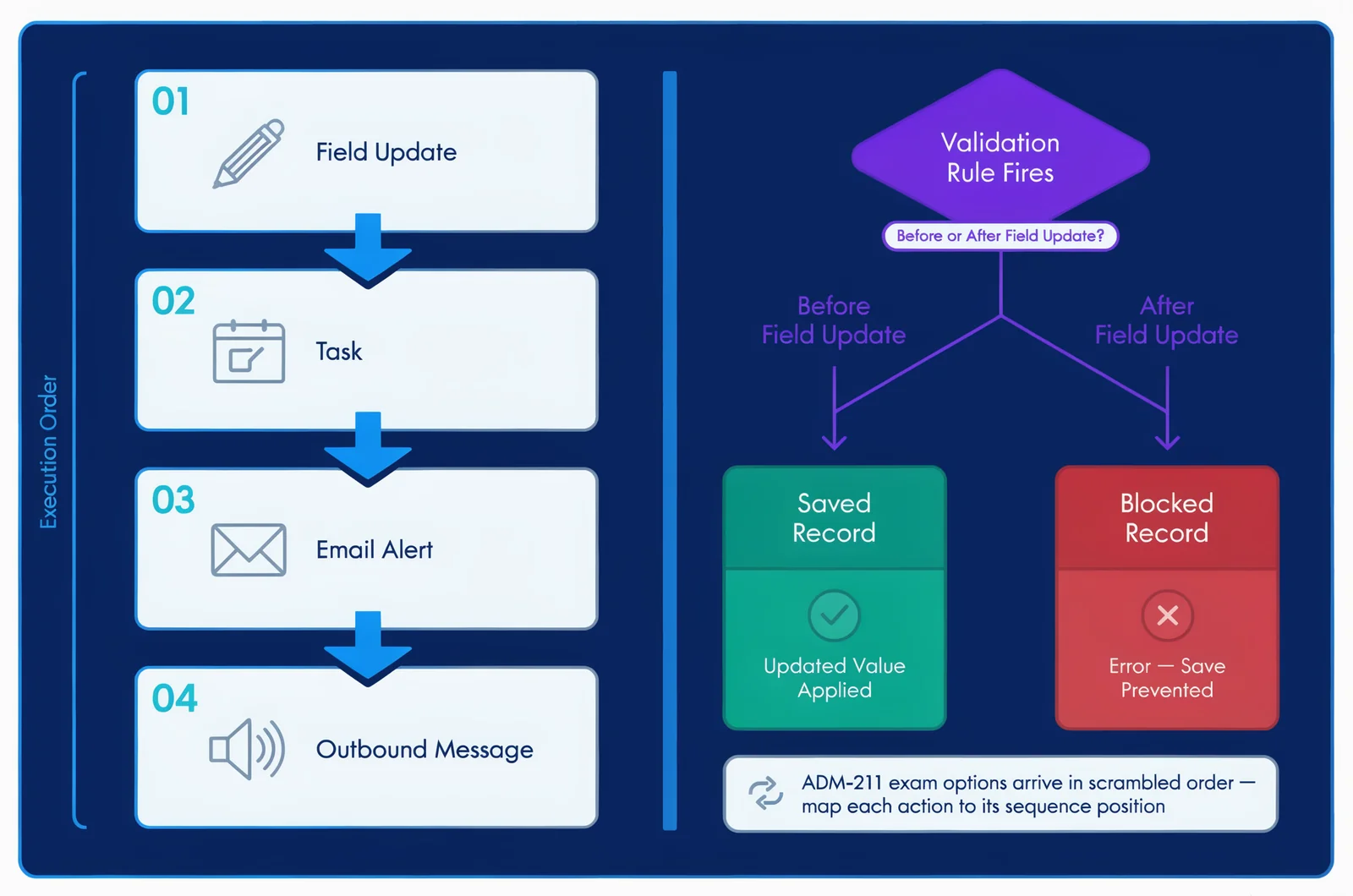
What it tests: The order of execution, field update behaviour, and how automation interacts with validation rules and field-level security.
A common variant asks for the sequence of workflow actions. Practice sets list the correct order as field update, task, email, then outbound message — and questions frequently present those in scrambled order.
Why candidates miss it: The order of execution is long and unforgiving. A field update that fires before a validation rule behaves differently from one that fires after. Candidates who learned automation by clicking through Setup rather than reading the execution order diagram guess here.
Best fit for: Admins who build flows regularly. If you can predict what happens when a record-triggered flow and a workflow rule touch the same field, you're ready.
Limitation: Salesforce has been pushing Flow over Workflow Rules for years, so some older practice material tests features you'll rarely build today. Check that your practice source reflects current platform guidance.
3. Data Management and Duplicate Resolution
Format: A scenario describes symptoms — duplicate records, excessive sharing rules, manual sharing requests — and asks you to diagnose the root cause.
One published example describes an administrator noticing "too many duplicate records, numerous sharing rules, and a large number of manually shared records" and asks what this is a symptom of. The answer relates to org-wide default settings that are too restrictive, forcing users to create records they can see and share individually.
What it tests: Whether you can read a messy org and trace problems back to configuration decisions rather than treating symptoms.
Why candidates miss it: The question presents three symptoms and candidates fixate on the first one. Duplicates suggest a duplicate rule problem. Sharing rules suggest a sharing problem. The actual answer is that both stem from the same root cause.
Best fit for: Admins who have inherited someone else's org. If you've ever audited a Salesforce instance you didn't build, this format plays to your strengths.
Limitation: These questions reward experience. If you've only worked in clean, well-designed orgs, the symptom patterns won't be intuitive yet. Build the pattern recognition through practice sets before exam day.
4. Extending Objects and Cross-Object Formulas
Format: A question describes a relationship between objects and asks which field type or formula reference works.
A typical entry from the practice sets asks what's true about cross-object formula fields, with answer options covering lookup versus master-detail references and how far up a relationship chain you can reach.
What it tests: Relationship types, formula field limits, and the constraints that come with each.
Related questions cover formula field character limits and the maximum number of fields tracked per object in Field History Tracking. These are hard numbers, and you either know them or you don't.
Why candidates miss it: The distinction between lookup and master-detail relationships has cascading consequences — roll-up summaries, cascade delete, ownership — and candidates learn the headline difference without the follow-on effects.
Best fit for: Anyone building custom objects. This is the most "learnable" format on the list because the underlying rules are documented and finite.
Limitation: It's also the most memorisation-heavy, which means it's the format most likely to appear in low-quality question sets. Use it to test yourself, not to define your study plan.
5. Reporting, Analytics, and Cross-Object Filters
Format: A reporting requirement is described, and you choose the report type, filter logic, or dashboard configuration that delivers it.
What it tests: Cross-object filters, report types, bucket fields, and how reporting interacts with the sharing model.
Why candidates miss it: Reporting questions often hinge on what a user can see rather than what the report is configured to show. A perfectly built report returns incomplete data if the running user's sharing access doesn't cover the records.
Best fit for: Admins who own reporting for a sales or service team. If you've debugged a dashboard that showed different numbers to different viewers, you already understand the core concept.
Limitation: Reporting questions are the hardest to practise without a live org. Reading explanations helps, but building the report yourself cements it.
Which Question Types to Drill First
If your exam is two to four weeks out, prioritise by return on effort.
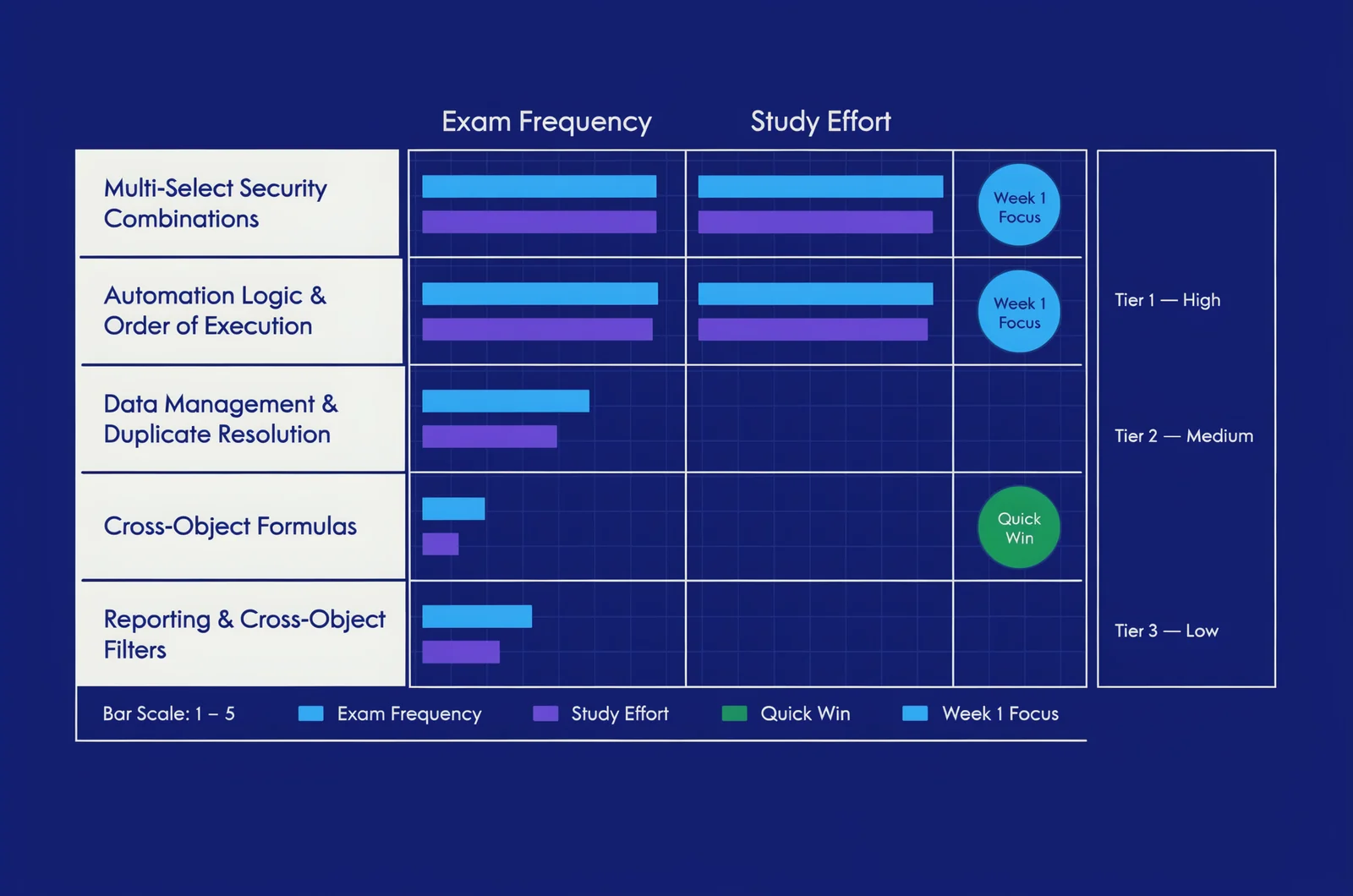
| Question type | Study effort | Exam frequency | Priority |
|---|---|---|---|
| Multi-select security combinations | High | High | Start here |
| Automation logic and order of execution | High | High | Start here |
| Data management diagnosis | Medium | Medium | Week two |
| Cross-object formulas and field limits | Low | Medium | Week one |
| Reporting and cross-object filters | Medium | Medium | Week two |
Security and automation carry the most weight and the steepest learning curve, so they deserve the earliest start. Formula limits are quick wins — an hour of flashcards covers most of them.
A simple tool idea if you want to track this yourself: build a spreadsheet with one row per question type and columns for attempts, accuracy, and average time per question. Update it after every practice session. When accuracy on a type clears 80% and your average time drops under 100 seconds, you can deprioritise it.
Reading Explanations Properly
The explanation is where the learning happens, and most candidates skim it.
When you get a question wrong, don't just read why the correct answer is correct. Read why each distractor is wrong. Multi-select questions in particular are built so that each wrong option represents a specific misconception. If you can name the misconception, you won't fall for it twice.
When you get a question right, check your reasoning. A correct answer reached through faulty logic is a future wrong answer. This is the core idea behind turning ADM-201 practice exam mistakes into a pass plan, and it applies just as directly at the advanced level.
Timed Practice Changes Everything
Untimed practice builds knowledge. Timed practice builds exam readiness. You need both, in that order.
Run your first timed simulator session only after you're consistently scoring above 70% untimed. Then simulate the real conditions: 60 questions, 105 minutes, no pauses, no notes. Review only after the clock stops.
The first timed run usually reveals a pacing problem rather than a knowledge problem. Candidates spend four minutes on a security scenario and then rush the last fifteen questions. Practising the discipline of flagging and moving on is worth more than another fifty practice questions.
If you want a structured set to work through, the advanced administrator sample questions on PlanetCert mirror the scenario format described above, with explanations that walk through the reasoning rather than just stating the answer. Comparing those against ADM-201 sample questions is a useful calibration exercise — the jump in complexity between the two levels tells you a lot about what ADM-211 expects.
Questions Candidates Ask Before Booking
Are ADM-211 sample questions enough on their own?
No. Practice questions test whether you can apply knowledge. They don't build it from scratch. If you're failing scenario questions consistently, go back to the underlying feature documentation before drilling more questions.
How many practice questions should I work through?
Quality beats volume. Working through 150 questions with full explanation review will teach you more than skimming 600. If a source advertises hundreds of questions with no explanations, that's a signal about how it was built.
How current does my practice material need to be?
Check the publication or update date. Salesforce releases three times a year, and older material may reference features that have changed or been superseded. Material updated within the last six months is a reasonable baseline.
What score should I be hitting before I book?
Aim for consistent scores above 80% on timed practice before scheduling. The real exam passes at 65%, but exam-day nerves and unfamiliar question phrasing typically cost you points. The buffer matters.
Does the exam include questions on Apex or Visualforce?
Some published question sets include items on Apex, Visualforce pages, and S-Controls. These appear in older material. Focus your preparation on declarative configuration, which is what the advanced administrator role actually covers day to day.
What to Do This Week
Pick one question type from the list above and work through twenty questions of that format, timed, with full explanation review. Log your accuracy and your average time per question. Then repeat with a second type.
Two weeks of that routine, alternating types and finishing with two full timed simulations, puts you in a far stronger position than reading through a question bank end to end. The format is the exam. Learn the format first, and the content has somewhere to land.


Discussion
Question Comments
0 comments·0 participantsSign in to leave a comment and access more free questions.