
Most people finish a set of ADM-201 sample questions, check the score, feel briefly encouraged or mildly sick, and close the tab. The score is the least useful thing a practice exam gives you. The misses are the valuable part, and they only pay off if you do something structured with them.
This walkthrough is for anyone with a Salesforce Certified Administrator exam date on the calendar, whether that is three weeks out or three days out. It covers a repeatable review routine: log every wrong answer, map it back to the exam objective it came from, find the pattern behind the misses, and convert that pattern into a short pre-test checklist. Done properly, one 60-question mock can generate a week of targeted study that beats re-reading a study guide cover to cover.
What the ADM-201 Exam Actually Tests
Before you can classify a wrong answer, you need to know which bucket it belongs in. The current exam blueprint splits into weighted sections, and those weights tell you where a miss costs you most.
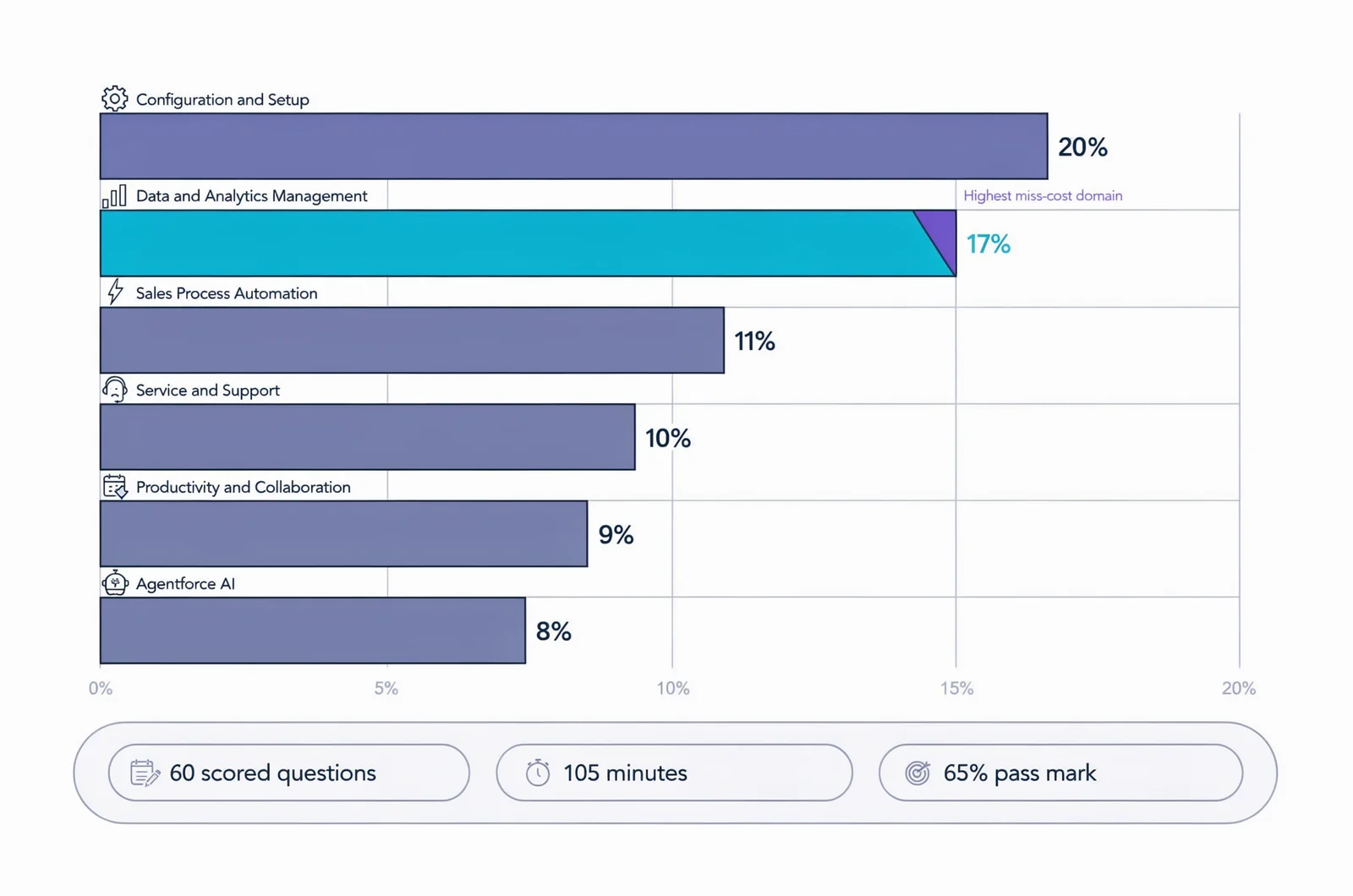
The Salesforce Certified Platform Administrator exam runs 60 scored questions in 105 minutes, with a 65% pass mark, according to CertLand's ADM-201 study guide. The same source notes that Salesforce ships three platform releases a year, so objectives shift with each one. That matters for your review routine: an explanation that was correct two releases ago may now point you at the wrong feature.
Section weightings have moved recently. Reporting on the December 2025 update, a 2026 exam guide puts Data and Analytics Management at 17%, the heaviest single section, with Agentforce AI entering as a new 8% section while traditional configuration topics lost ground. A free practice exam page lists Configuration and Setup at 20% and Data and Analytics at 17%, which shows how much the published breakdowns vary between sources.
Here is the practical takeaway rather than a fight over exact percentages. Roughly two-thirds of the exam sits in configuration, data, automation, and the newer AI and analytics material. If your misses cluster in those areas, you have a real problem to fix. If they scatter across Sales, Service, and Productivity, you may just be reading scenario questions too quickly.
Why scenario questions break otherwise solid candidates
ADM-201 questions rarely ask for a definition. They hand you a business situation, then ask which two steps an administrator should take. The distractor answers are usually features that exist and would technically work, but are not the best fit for the stated requirement.
That is why "I knew that feature" and "I got the question right" are different things. Your review log needs to capture which of the four failure modes caused the miss:
- Knowledge gap. You had never seen the feature or had forgotten it exists.
- Misread requirement. You knew the feature but missed a constraint word like "unable to be deleted" or "more than 2 hours."
- Wrong tool choice. You picked a valid feature when the scenario pointed to a better one, such as Flow over an approval process.
- Careless error. You knew the answer, changed it, or mis-clicked.
Each mode has a different fix. Knowledge gaps need study time. The other three need question-handling drills.
Set Up a Miss Log Before Your Next Mock
Build the log first, because retrofitting one after a 60-question session is miserable. A spreadsheet with six columns is enough.
| Column | What goes in it |
|---|---|
| Question ID | The number from your practice set |
| Exam section | Configuration, Data and Analytics, Automation, and so on |
| Failure mode | Knowledge gap, misread, wrong tool, careless |
| The constraint I missed | The exact phrase from the question stem |
| Correct feature | The tool or setting the explanation names |
| Re-test date | When you will attempt this topic again |
Keep the log open in a second window during the mock. Logging a miss takes about 20 seconds while the question is fresh; reconstructing your reasoning two days later takes far longer and usually fails.
One rule keeps the log honest: write the constraint in the question's own words. If the stem says shoe designs "should be unable to be deleted," copy that phrase. Vague notes like "deletion thing" will not help you spot that the same constraint type keeps catching you out.
Decide whether to review mid-test or after
Do not stop to read explanations during a timed run. The 105-minute limit is part of what you are practising, and pausing breaks the pacing data you need. Log the miss, move on, and review the whole set afterwards.
If you are short on time, split the work. Run the mock timed, then review only the misses and the questions you flagged as guesses. Questions you answered confidently and correctly can wait.
Map Every Miss Back to an Exam Objective
A raw list of wrong answers is noise. A list sorted by objective is a study plan. This is the step most candidates skip, and it is the one that changes your score.
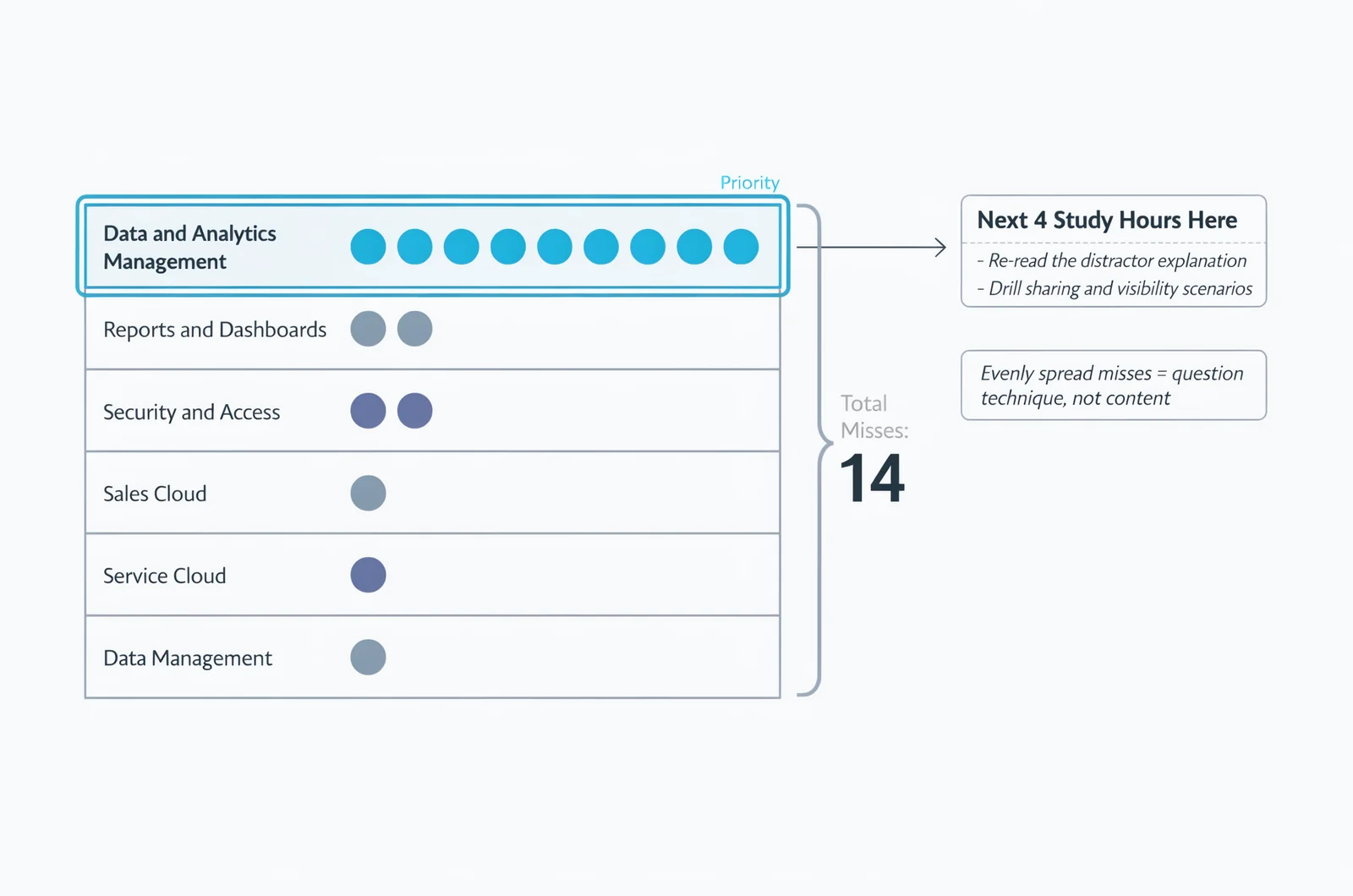
Take your log and tally misses per section. A pattern usually appears fast. Say you miss 14 questions across a 60-question mock. If nine of those sit in Data and Analytics Management, you now know where your next four study hours go. If they spread evenly across six sections, your problem is probably question technique rather than content.
The ADM-201 exam page breaks the objectives down by section, which makes a useful reference when you are deciding which bucket a miss belongs in. Some questions straddle two areas, such as a Flow that updates a field on a custom object. Assign it to the section the question's scenario emphasises, not the one you find more interesting.
Read the explanation for the distractor, not just the answer
Good explanations do two jobs. They confirm the right answer, and they tell you why the tempting wrong one fails. The second half is where the learning sits.
When you review, write one line for each distractor you seriously considered: what it does, and why the scenario ruled it out. After twenty questions you will have a personal list of the traps this exam likes. That list is worth more than another pass through a study guide, because it is calibrated to your own instincts.
If an explanation is thin or you cannot follow the reasoning, treat that question as unresolved rather than memorising it. A question you cannot explain back to yourself is a question you will get wrong in a different form on exam day.
Group misses by feature, not by question number
Question numbers are arbitrary. Features repeat. Sort your log by the feature named in the correct answer and you will often find the same three or four features causing most of the damage.
Common repeat offenders in administrator-level mocks include:
- Sharing and visibility. Org-wide defaults, role hierarchy, sharing rules, and manual sharing each solve a slightly different problem.
- Automation tool selection. Flow, approval processes, and validation rules overlap enough that scenario wording decides the answer.
- Record types and page layouts. Which one controls picklist values, and which controls field visibility, trips people up constantly.
- Data management. Import tools, duplicate rules, and matching rules behave differently depending on the requirement.
If two of those four appear at the top of your list, you have found your revision shortlist.
Turn the Pattern Into a Pre-Test Checklist
The checklist is the output of the whole routine. It should fit on one page and be readable in the ten minutes before you sit down at the test centre or launch the online proctor.
Build it in three passes.
Pass one: the content list. Every feature that caused two or more misses goes on the list with a one-line description of when to use it. Not a definition. A trigger. "Use a validation rule when the requirement is to prevent saving, not to notify someone."
Pass two: the constraint list. Collect the constraint phrases that fooled you. Words like "unable to be deleted," "within 2 hours," "multiple designs for one product," and "without granting extra access" are signals. Each one narrows the answer set, and each one you missed before is worth writing down.
Pass three: the process list. Three or four reminders about how you take the test. Flag and skip long scenario questions on the first pass. Read the requirement sentence twice before looking at the options. Check whether the question says "choose two."
Then test the checklist. Run a fresh set of ADM-201 sample questions and see whether your miss rate in the flagged sections drops. If it does not, your checklist is describing features rather than decisions, and it needs rewriting.
A worked example of the routine
Suppose a mock throws up this scenario: a company wants to track shoe designs by product, designs must not be deletable, and there can be multiple designs per product across various stages.
Your log entry might read: section, Object Manager and Lightning App Builder; failure mode, misread requirement; constraint missed, "unable to be deleted" and "multiple designs for one product"; correct approach, a custom object with a master-detail or lookup relationship to Product plus a validation rule or profile setting that blocks deletion.
Two weeks later, a different question asks about preventing record deletion in a different context. You recognise the constraint phrase, not the scenario, and you get it right. That transfer is the whole point of the routine.
Run Timed Mocks Until the Pattern Stops Repeating
Reviewing misses is the engine, but you still need full-length timed runs to build pacing and stamina. The routine works best on a cycle: mock, log, map, study, re-test.
A workable three-week cycle for someone with a job looks like this.
- Week one. Two untimed section sets to find your weak areas, then one full timed mock. Log everything.
- Week two. Study the two heaviest miss sections. Re-test those sections with fresh questions. Run one full timed mock at the end of the week.
- Week three. One full timed mock early in the week, then targeted review only. Final checklist pass the day before. No new material in the last 48 hours.
Track your section-level accuracy across mocks, not just the total. A rising total with a flat Data and Analytics score means you are improving where you were already strong, which is a comfortable way to fail.
Watch for questions that teach you nothing
Some practice material is not worth your time. If an explanation just restates the correct answer without addressing the distractors, or if the question references a feature that no longer exists in the current release, drop that source and find another.
The same applies to anything promising actual exam content. Beyond being unreliable, it will not teach you to reason through a scenario, which is what the exam rewards. Stick to material that explains why the wrong answers are wrong.
Questions That Come Up During Review
How many practice questions should I do before booking the exam?
Enough to see your section-level accuracy stabilise above the pass mark across two consecutive full mocks. For most people that is three to five full-length sets plus targeted section drills, spread over two to four weeks.
Should I review wrong answers the same day?
Yes, while your reasoning is still recoverable. Same-day review takes about 20 minutes for a 60-question set. Reviewing two days later takes longer and you will have forgotten why the tempting option looked right.
My score is stuck at 60%. What is usually wrong?
Usually one of two things. Either a single heavy section is dragging the average down, which the section tally will show, or you are losing marks to misread requirements rather than missing knowledge. The constraint column in your log separates those two cases quickly.
Do I need to know Agentforce and AI material?
It carries weight on the current blueprint, so yes, at administrator level. You need to know what the tools do and when an administrator would reach for them, not how to build an agent from scratch.
Is a 65% mock score safe?
No. Mock scores and real scores differ, and a 65% mock leaves no margin for a bad section or a run of unfamiliar scenarios. Aim to be consistently above the pass mark before you book.
Where to Go Next With Your Review Routine
The routine only works if you run it on material that explains itself. Start with a set of practice questions, log every miss in the six-column format, and tally by section before you decide what to study next. One honest review session will tell you more about your readiness than three more mock scores.
If you want a structured starting point, the ADM-201 exam page lays out the objectives your log should map against, and a timed simulator run will show you whether your pacing holds up under the 105-minute limit.

Discussion
Question Comments
0 comments·0 participantsSign in to leave a comment and access more free questions.