

CCNA and CCNP Pay in 2026: What the Latest Data Actually Shows
The gap between a CCNA and a CCNP isn't just one exam — it's roughly £15,000 to £35,000 in annual compensation, depending on where you work and how long you've been in the field. If you're deciding whether to stop at the associate level or push through to professional, you need numbers that reflect the market right now, not forum anecdotes from 2022.
This article breaks down current ccna vs ccnp salary data from verified UK and US sources, maps how experience changes the multiplier, and weighs how Cisco's upcoming CCNA v2.0 and AI-focused blueprint changes affect the return on your study hours. Whether you're a first-time cert candidate or a working engineer calculating whether the CCNP Enterprise core is worth the grind, the figures below are drawn from live job-market data as of mid-2026.
What the Numbers Say in 2026
Let's start with the hard data. In the United States, Kaplan's March 2026 salary aggregation places the average CCNP holder at $108,053 annually, or roughly $51.95 per hour. That figure sits within a tight band — the bottom 10% earn around $102,477, while the top 10% reach $105,000. The compression at the upper end suggests that in some US markets, CCNP has become a baseline expectation rather than a premium differentiator.
The UK picture is more nuanced. According to CCNP Job Trends, Salaries & Co-Occurring Skills | IT Jobs Watch, the median CCNP salary for the six months to May 2026 stands at £70,000, up 12% year-on-year from £62,500 in 2025. The 25th percentile sits at £58,750, while the 75th percentile reaches £78,438. Outside London, the median drops to £62,500 — still a healthy figure, but one that underlines how geography skews outcomes.
For CCNA holders, reliable aggregated data is harder to pin down because fewer job postings explicitly require it as a standalone credential. Industry benchmarks and Cisco's own CCNA Certification materials cite entry-level network roles in the $55,000–$75,000 range in the US, with UK equivalents typically falling between £28,000 and £42,000 depending on region and whether the role is internal IT or a managed service provider.
The raw gap, then, is substantial but not automatic. A CCNP doesn't guarantee a £70,000 salary any more than a CCNA locks you into £30,000. What the credential does is shift your ceiling and your access to roles that list it as a hard requirement.
How Experience Reshapes the CCNA vs CCNP Pay Gap
The salary differential widens dramatically with years in role. Here's how the progression typically plays out in UK market data:
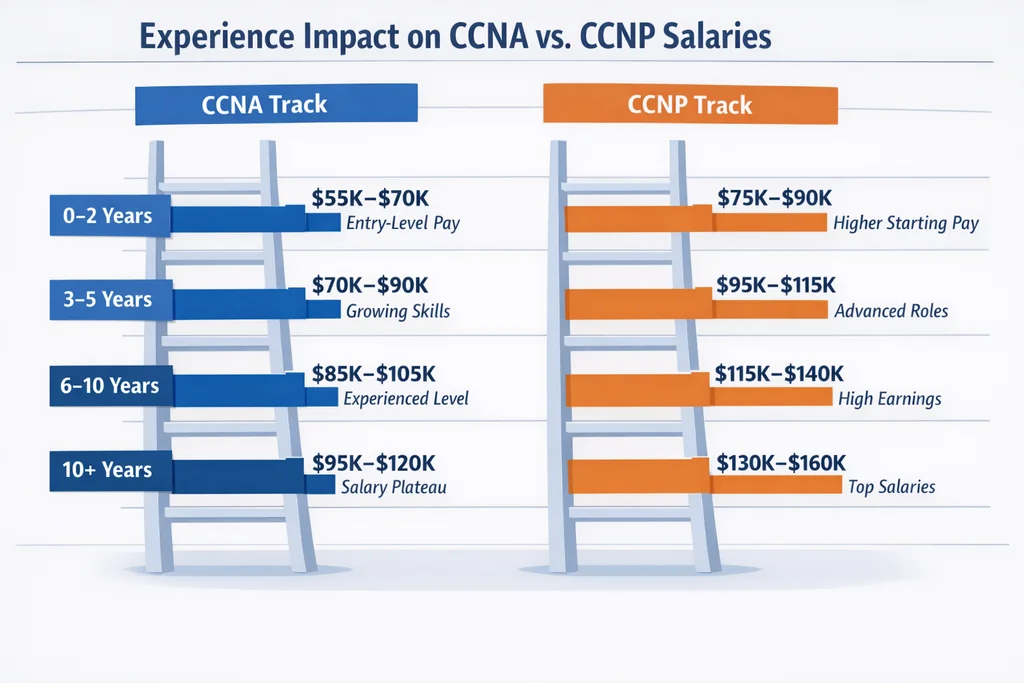
0–2 years: CCNA holders often land NOC technician or junior network engineer roles at £28,000–£35,000. CCNP holders at this experience level are relatively rare — most employers expect some post-CCNA work history before the professional credential carries weight. When they do appear, they might command £38,000–£45,000, but the premium is modest because practical experience hasn't caught up with the cert.
3–5 years: This is where the split becomes visible. A CCNA holder with four years of experience might plateau at £40,000–£48,000 in a senior technician or small-network administrator role. The CCNP holder, by contrast, can move into network engineer or infrastructure analyst positions paying £55,000–£65,000. The cert has opened doors to roles with broader architectural responsibility.
6–10 years: At this stage, CCNP holders frequently cross into senior network engineer, solutions architect, or team lead positions. Median compensation rises to £65,000–£80,000, with London-weighted roles pushing higher. CCNA holders without the professional credential often find themselves constrained to specialist niches — wireless, security operations, or vendor-specific support — where deep expertise can compensate, but the ceiling is lower.
10+ years: Here, the credential matters less than the career path it enabled. A CCIE or specialized cloud-networking profile will outearn a CCNP. But the CCNP was the necessary bridge to reach those opportunities. CCNA holders who never progressed often find their earnings flatten unless they've built substantial adjacent skills in automation, security, or cloud platforms.
The pattern is clear: CCNA gets you in, CCNP moves you up. The salary gap is really a career-progression gap measured in pounds or dollars.
Where You Work Matters More Than You'd Expect
Regional variation can override the cert premium entirely. A CCNP in central London commands the £70,000 median, but that same credential in the Midlands or North of England might translate to £52,000–£58,000. The cost-of-living differential eats some of that gap, though not all of it.
In the US, the geographic spread is even wider. ZipRecruiter's May 2026 data shows CCNA/CCNP combined roles averaging $108,375 nationally, with Texas and California representing opposite poles of the distribution. Remote work has flattened some of this variation since 2023, but employers still anchor offers to local market rates.
Sector matters too. Financial services and consulting firms typically pay 15–25% above median for the same cert level. Public sector and education roles often sit 10–20% below. A CCNP at a London investment bank can expect £85,000–£95,000 base, while the same credential in local government might top out at £55,000.
The practical implication: when you evaluate ccna vs ccnp salary data, anchor your expectations to your specific market, not national averages.
Cisco's 2026 Exam Changes and Your ROI Calculation
Here's where the decision gets interesting. Cisco announced Built for What's Next: Major Updates to CCNA, CCIE, and More on 20 May 2026, and the changes are significant enough to affect your study timeline and expected return.
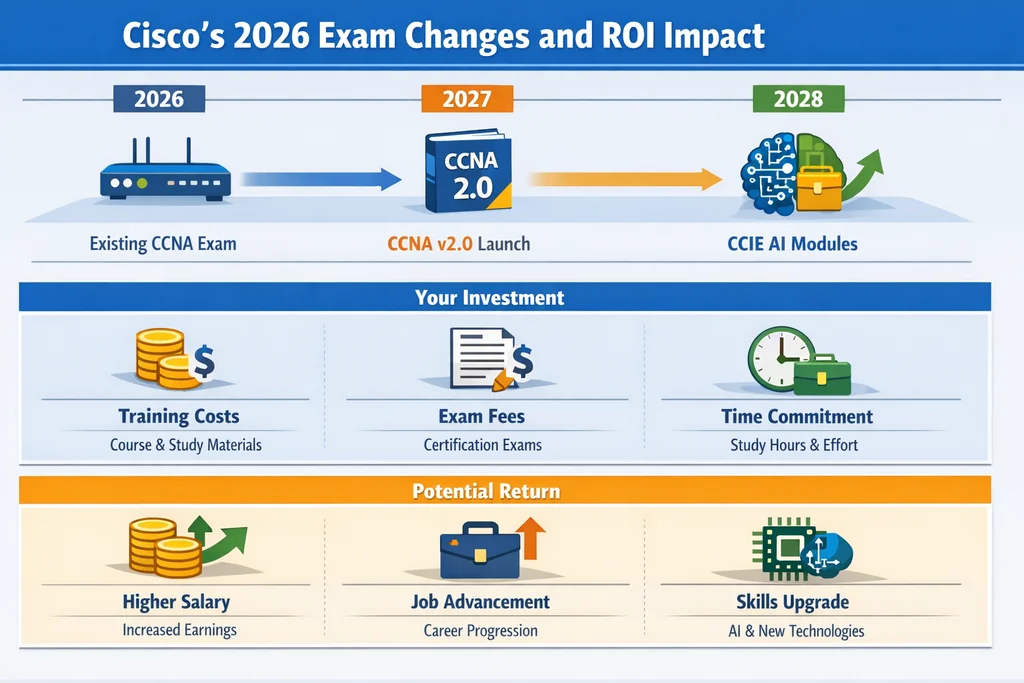
CCNA 200-301 v2.0 arrives in February 2027, with a blueprint built around four pillars: network infrastructure, troubleshooting and problem-solving, security-first mindset, and — critically — the role of AI in network management and operations. This is the first major CCNA revision since 2019. For candidates currently studying, Cisco has committed to a long transition runway; you can still sit the current version through mid-2027.
The CCNP tracks are also shifting. Enterprise, Security, Data Center, and Collaboration concentrations are gaining automation and AI operations modules. The CCIE practical exam now includes an AI-focused module. These aren't cosmetic updates — they reflect how network engineering roles are being redefined as AI-driven infrastructure becomes standard.
What does this mean for salary ROI? Three things:
First, the CCNA v2.0 AI content will likely create a temporary skills gap. Early holders of the updated credential may command a modest premium — perhaps 5–10% above current CCNA baselines — as employers seek engineers who can operate AI-assisted network platforms. This window typically lasts 12–18 months post-launch.
Second, the CCNP's automation and AI modules will become baseline expectations faster than previous technology shifts. If you're studying for CCNP now, prioritize concentrations with strong automation components — Enterprise and Security lead this list — because those skills will be priced at a premium in 2027–2028 hiring.
Third, the total cost of certification is rising. Exam fees for CCNP core plus concentration sit around $900–$1,000, plus study materials and potential retakes. With CCNA v2.0 requiring updated resources, the fully loaded cost of CCNA → CCNP could reach £2,500–£3,500 when you factor in practice tests, lab equipment or simulator access, and time off work for study.
Against a £15,000–£35,000 annual salary differential, that investment pays back within months if you land the right role. But the payoff assumes you actually use the credential to change jobs or secure promotion, not just add a line to your CV.
The Real Decision: Stop at CCNA or Push to CCNP?
The comparison isn't really about two certifications — it's about two career trajectories.
Choose CCNA alone if: You're entering networking from another IT discipline, you're in a role where the credential satisfies a compliance or baseline requirement, or you're pairing it with a strong adjacent skill (cloud, security, automation) that carries its own market value. Some engineers build perfectly viable careers on CCNA plus AWS or Azure networking specializations, particularly in cloud-first organizations where traditional Cisco-centric infrastructure is diminishing.
Push to CCNP if: You want to work on large-scale enterprise networks, you're targeting senior engineer or architect roles, or you're in a market — like UK financial services or US federal contracting — where CCNP is frequently a hard requirement. The credential also matters if you plan to specialize; the CCNP Security or Data Center concentrations open doors that CCNA simply doesn't.
Consider the timing carefully. With CCNA v2.0 launching in February 2027, starting from zero today means a compressed study window for the current exam or a wait for updated materials. If you're already CCNA-certified, the CCNP core (350-401 ENCOR) is stable through 2026, so there's no immediate exam-version risk. But if you're planning to sit CCNA in late 2026, check whether your study materials cover v2.0 content — the AI and automation sections will be new, and outdated resources could leave you exposed.
One concrete scenario: a network technician in Manchester earning £38,000 with CCNA studies for CCNP Enterprise over four months, passes in autumn 2026, and moves to a senior engineer role at £58,000 by early 2027. The £20,000 uplift recovers the certification investment in under two months. But that same technician, staying in a flat organizational structure with no senior roles available, might see only a £4,000 internal raise — still positive ROI, but measured in years, not months.
Provider Profiles
Kaplan IT Training
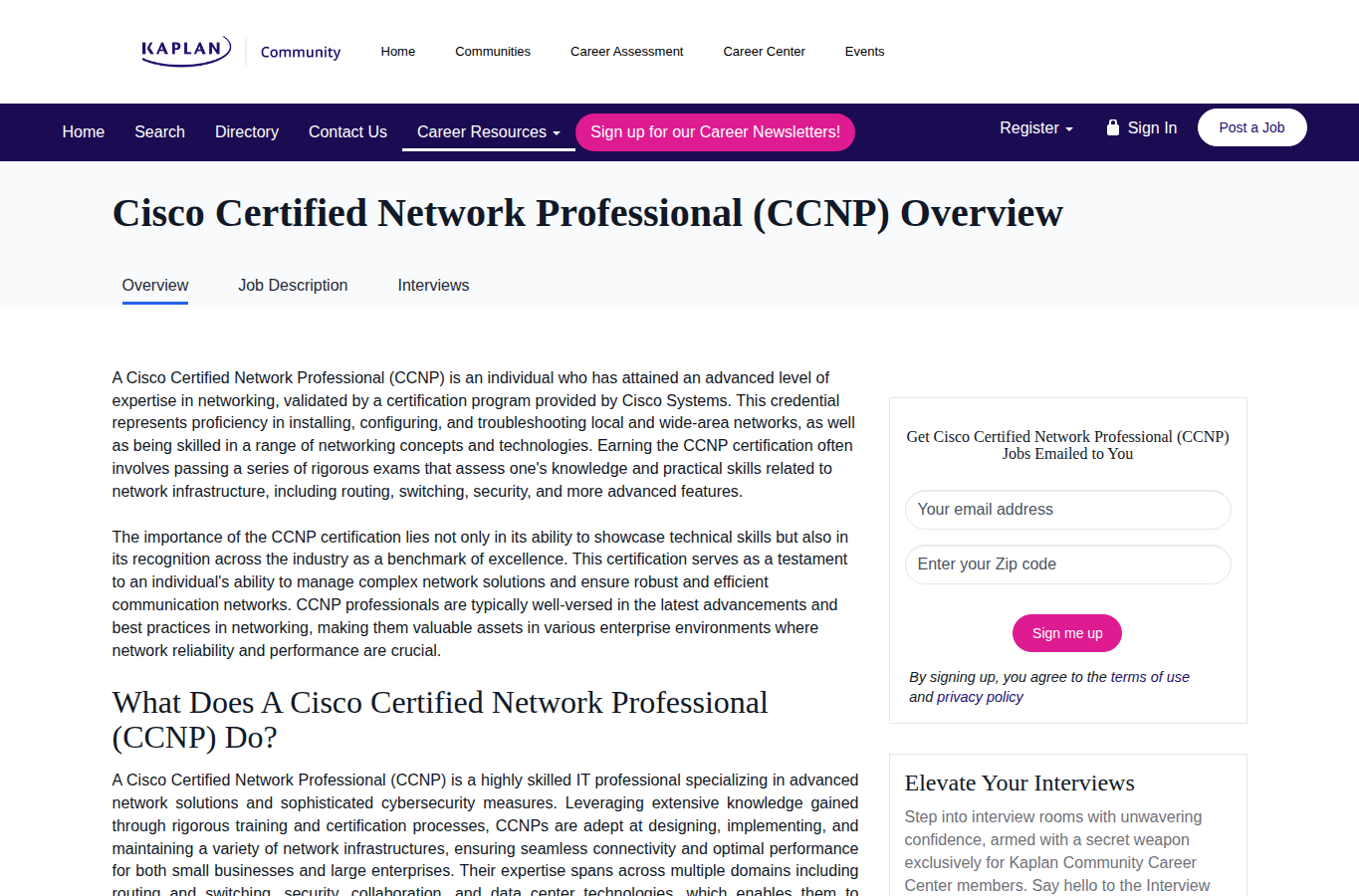
Kaplan operates a salary aggregation and job-market data service through its community jobs portal. The Kaplan CCNP salary data cited in this article reflects US-based figures as of March 2026, drawn from employer postings and self-reported compensation. Kaplan does not produce Cisco training materials directly, but its salary benchmarks are widely referenced in certification ROI discussions.
PayScale
PayScale maintains a UK-specific certification salary database with self-reported data from 163 CCNP holders as of October 2025. The PayScale CCNP UK figures show an average base of £50,000, though the platform notes limited sample sizes for granular role breakdowns. PayScale's broader methodology emphasizes real-time market matching rather than posted job ranges, which can produce different figures than employer-driven sources like IT Jobs Watch.

FAQ
Does CCNP automatically double my CCNA salary?
No. The typical uplift is 30–60% in UK markets, with higher percentages at junior levels and more modest gains for experienced engineers. The cert opens access to higher-paying roles; it doesn't inflate your current salary by fiat.
Should I wait for CCNA v2.0 or take 200-301 now?
If you're exam-ready by late 2026, sit the current version. Cisco has confirmed a transition period through mid-2027, and v2.0 study materials won't be fully mature until early 2027. If you're starting from scratch today, factor the new blueprint into your timeline.
Which CCNP concentration pays best?
Enterprise and Security consistently show the strongest salary outcomes, partly because they map to the most common job postings. Data Center can exceed these in specialist roles, but the total opportunity pool is smaller. Automation and AI skills within any concentration are increasingly priced at a premium.
Is the CCNP core exam harder than CCNA?
Significantly. The 350-401 ENCOR covers enterprise networking at depth, including advanced routing, SD-WAN, automation, and network design. Most candidates need 200–300 study hours beyond their CCNA foundation. The concentration exam adds another 100–150 hours.
Do employers still value CCNA if I have CCNP?
Yes, but implicitly. CCNP supersedes CCNA in hiring requirements; you won't see both listed as separate must-haves. However, the CCNA knowledge base remains foundational — gaps there will show in technical interviews regardless of your professional-level credential.
Further Reading

Discussion
Question Comments
0 comments·0 participantsSign in to leave a comment and access more free questions.