

Real Exam Questions: Boosting Certification Success
Most American IT students are surprised to learn that nearly 60 percent of certification candidates struggle to pass on their first attempt. This challenge is not unique to American professionals but affects early-career tech hopefuls worldwide who need reliable methods to prove their knowledge. Understanding what defines real exam questions can make the difference between uncertainty and real confidence, giving candidates the tools to measure their readiness with accuracy and integrity.
Table of Contents
- Defining Real Exam Questions In IT Certifications
- Types Of Real Exam Questions And Their Features
- How Real Questions Improve Exam Performance
- Finding Reliable And Updated Practice Questions
- Common Risks: Exam Dumps And Legal Pitfalls
Key Takeaways
| Point | Details |
|---|---|
| Real Exam Questions Are Critical | Authentic exam questions measure technical knowledge, problem-solving skills, and professional competency effectively. |
| Diverse Question Types Enhance Assessment | Employing multiple formats—like multiple-choice, scenario-based, and interactive simulations—ensures comprehensive evaluation of candidates’ abilities. |
| Practice with Genuine Materials is Essential | Engaging with authentic exam questions significantly improves learning outcomes and test performance. |
| Avoid Exam Dumps for Long-Term Success | Using unauthorized materials poses serious legal and ethical risks and undermines genuine learning. |
Defining Real Exam Questions in IT Certifications
Real exam questions are specialized assessment tools designed to evaluate a candidate’s technical knowledge, problem-solving skills, and professional competency within specific technology domains. These are not random inquiries but carefully constructed scenarios that mirror actual professional challenges IT professionals encounter in their work environments. In the certification world, these questions serve as precise measurement instruments for gauging an individual’s readiness and expertise.
The ISC2 SSCP Certification Exam Outline reveals that authentic exam questions are strategically developed to test not just memorization, but practical application of technical concepts. They typically fall into several distinct categories: multiple-choice, scenario-based, drag-and-drop, and interactive simulation questions. Each type targets different cognitive skills essential for professional competence - from theoretical understanding to hands-on troubleshooting capabilities.
Understanding the anatomy of real exam questions requires recognizing their core characteristics. Legitimate exam questions are meticulously crafted by subject matter experts who deeply understand industry standards and current technological landscapes. They often incorporate complex scenarios that require candidates to demonstrate critical thinking, apply theoretical knowledge to practical situations, and show nuanced understanding of technical frameworks. These questions are not designed to trick candidates but to validate their comprehensive comprehension of technical domains.
Pro tip: Practice with authentic certification practice tests that closely mimic actual exam formats to develop strategic test-taking skills and build genuine technical confidence.
Types of Real Exam Questions and Their Features
IT certification exams utilize multiple sophisticated question formats designed to comprehensively assess a candidate’s technical knowledge and problem-solving capabilities. These diverse question types are strategically engineered to evaluate different cognitive skills and ensure candidates possess both theoretical understanding and practical expertise in their specific technological domain.
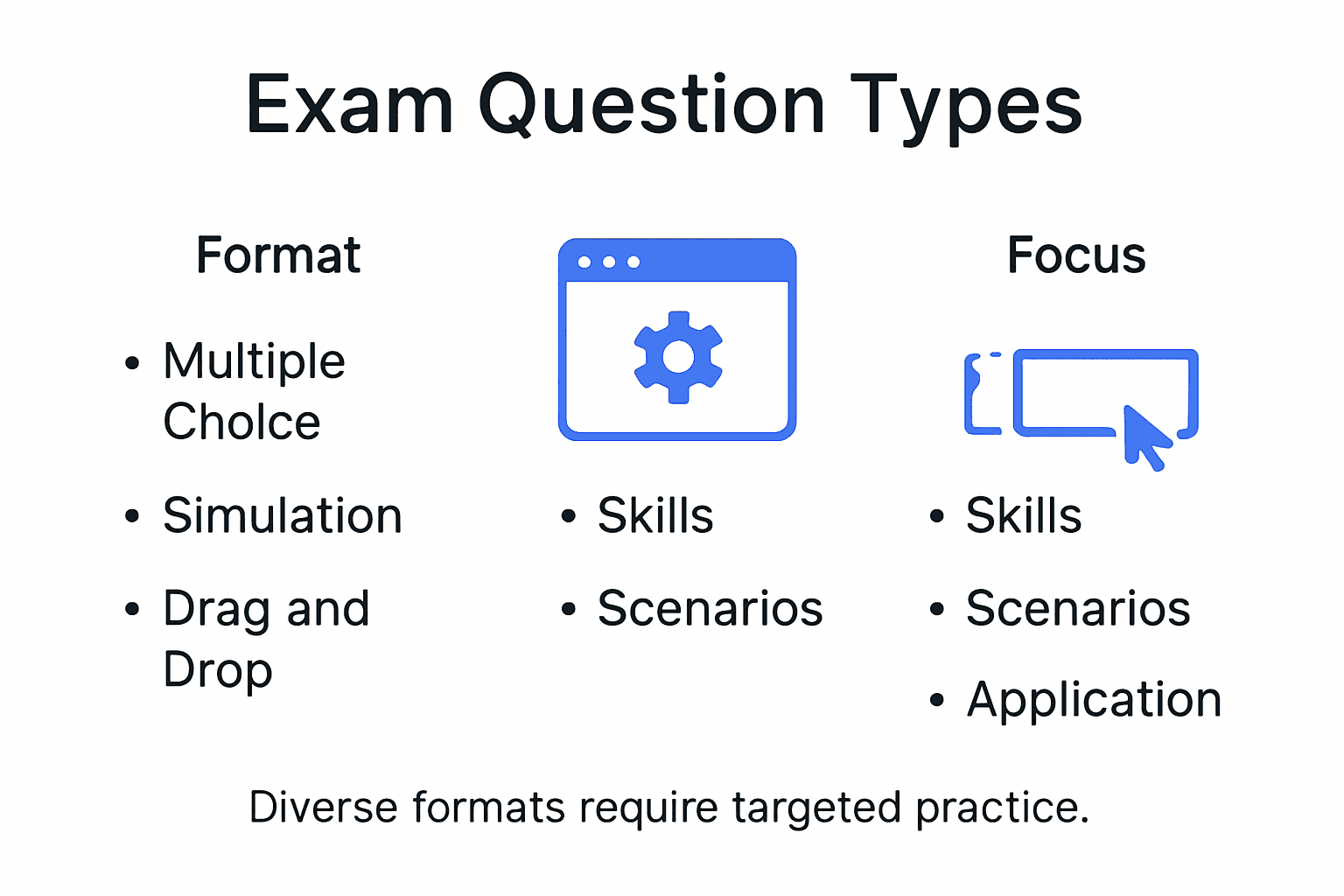
According to the comprehensive exam strategies guide, certification exam questions typically fall into three primary categories: factual recall, analytical reasoning, and application-based challenges. Multiple-choice questions remain the most prevalent format, allowing precise measurement of technical knowledge through carefully constructed answer sets. Scenario-based questions represent a more advanced approach, presenting complex real-world technical situations that require candidates to demonstrate critical thinking and practical problem-solving skills.
Specialized question formats in IT certifications include interactive simulations, drag-and-drop challenges, and performance-based assessments. These advanced question types go beyond traditional testing methods by requiring candidates to demonstrate actual technical skills. Interactive simulations might ask test-takers to configure network settings, troubleshoot system errors, or implement security protocols in a simulated environment. Drag-and-drop questions challenge candidates to correctly sequence processes, match technical components, or organize system configurations, testing both conceptual understanding and practical application.
Pro tip: Develop a systematic approach to different question types by practicing with diverse exam simulators and focusing on understanding the underlying concepts rather than memorizing isolated facts.
Here’s a clear comparison of common IT certification exam question types and what they assess:
| Question Type | Skills Tested | Typical Use | Preparation Focus |
|---|---|---|---|
| Multiple-Choice | Technical knowledge | Broad concept review | Understanding core principles |
| Scenario-Based | Analytical reasoning | Complex problem-solving | Applying theories to real cases |
| Drag-and-Drop | System organization | Sequencing & matching | Practicing workflows and logic |
| Interactive Simulation | Hands-on ability | Real-time troubleshooting | Performing technical tasks securely |
How Real Questions Improve Exam Performance
Engaging with authentic exam questions represents a critical strategy for transforming test preparation from passive learning to active skill development. These carefully constructed practice scenarios do more than simply familiarize candidates with exam formats; they create powerful cognitive pathways that enhance overall test performance and professional competency.

Research from the University of Connecticut demonstrates how targeted practice with genuine exam materials dramatically improves candidates’ learning outcomes. By systematically working through real-world problem scenarios, IT professionals develop critical cognitive skills such as pattern recognition, rapid decision-making, and technical problem-solving. This approach goes beyond rote memorization, enabling test-takers to build muscle memory for complex technical challenges they will encounter both in examinations and professional environments.
The psychological benefits of practicing with real exam questions are equally significant. Candidates who regularly engage with authentic test materials experience reduced test anxiety, increased confidence, and improved self-regulation strategies. By simulating actual exam conditions, test-takers learn to manage time effectively, understand question nuances, and develop strategic approaches to solving complex technical problems. This mental preparation transforms the examination from an intimidating challenge into a structured opportunity to demonstrate professional expertise.
Pro tip: Create a structured study routine that mimics actual exam conditions, including timed practice sessions and detailed performance analysis after each mock test.
Finding Reliable and Updated Practice Questions
Navigating the landscape of practice exam resources requires a strategic approach to ensure candidates access high-quality, current materials that genuinely reflect modern certification standards. The proliferation of online platforms and study materials makes discerning reliable sources increasingly complex for IT professionals seeking authentic preparation resources.
Official certification bodies provide the most trustworthy practice materials. ISTQB sample exam collections represent an excellent example of authoritative practice question sources, offering meticulously curated questions that precisely match current syllabus requirements. Candidates should prioritize resources directly associated with certification organizations, as these materials undergo rigorous review processes and reflect the most recent technological and professional standards. Verification criteria for reliable practice questions include alignment with current exam blueprints, comprehensive coverage of examination domains, and consistent updating to reflect emerging industry technologies.
Beyond official sources, candidates can leverage multiple strategies to identify reliable practice questions. Professional networking platforms, specialized IT forums, and peer study groups often share verified practice resources. Critical evaluation involves checking question sources, verifying author credentials, and cross-referencing materials with multiple reputable platforms. Experienced certification candidates recommend maintaining a diverse portfolio of practice materials, including official sample exams, professionally developed practice tests, and community-validated question banks.
Pro tip: Create a systematic approach to collecting practice questions by maintaining a curated collection from multiple verified sources, and regularly update your materials to ensure alignment with the most recent certification standards.
The table below highlights sources of reliable practice questions for IT certification and their main advantages:
| Source Type | Advantages | Key Consideration |
|---|---|---|
| Official Exam Providers | Highly accurate & current | Directly aligned with exam standards |
| Professional Forums | Peer-reviewed insights | Must verify source credibility |
| Study Groups | Community validation | Quality may vary by group |
| Commercial Platforms | Wide selection offered | Ensure regular content updates |
Common Risks: Exam Dumps and Legal Pitfalls
Exam dumps represent a dangerous shortcut that can potentially derail an entire professional certification journey, exposing candidates to significant legal and ethical risks. These unauthorized materials, which typically contain verbatim exam questions, might seem tempting to struggling test-takers seeking a quick path to certification, but they carry profound consequences that extend far beyond immediate academic penalties.
Academic institutions have established clear guidelines regarding unauthorized exam materials. Comprehensive academic misconduct research reveals that using exam dumps can result in severe repercussions, including permanent credential revocation, institutional disciplinary actions, and potential professional blacklisting. Certification bodies universally consider exam dumps a direct violation of professional ethics, viewing them as a form of intellectual property theft that undermines the integrity of professional credentialing systems.
The risks associated with exam dumps extend beyond immediate academic consequences. Professional certification organizations maintain sophisticated detection mechanisms that can identify candidates who have used unauthorized materials. These detection systems compare answer patterns, track question origins, and cross-reference suspicious examination performances. Candidates caught using exam dumps risk not just current certification attempts but potentially permanent disqualification from future examination opportunities in their professional domain. The long-term career damage can be substantially more significant than any short-term perceived advantage gained through these unethical materials.
Pro tip: Invest your preparation time in legitimate study materials and practice tests, recognizing that genuine learning builds lasting professional competence far more effectively than risky shortcuts.
Accelerate Your Certification Success with Real Exam Questions
The challenge of mastering complex certification topics and navigating diverse question formats can feel overwhelming. This article highlights how real exam questions sharpen your technical knowledge, improve problem-solving skills, and reduce exam anxiety by simulating authentic testing scenarios. Many candidates struggle with memorization without true understanding. You need a proven way to move beyond theory and build real-world competence.
PlanetCert.com offers an extensive library of verified real exam questions and tailored practice tests designed to mirror your target certification exams. With regularly updated materials for certifications like Cisco CCNA, CompTIA Security+, AWS, PMP, and more, you get comprehensive preparation that addresses multiple question types including multiple-choice, scenario-based, and interactive simulations. Our platform transforms your study sessions into hands-on learning experiences that boost confidence and sharpen critical thinking – so you can excel on your first attempt.
Don’t leave your certification success to chance. Start practicing with authentic questions today on PlanetCert.com and experience the difference that real exam simulations make. Explore our collection of practice tests and discover how properly structured study methods align perfectly with industry standards. Take control of your exam journey with resources trusted by professionals and accelerate your career progress now.
Frequently Asked Questions
What are real exam questions in IT certifications?
Real exam questions are specifically designed assessment tools that evaluate a candidate’s technical knowledge and problem-solving skills, mirroring actual challenges faced by IT professionals.
How do real exam questions differ from practice questions?
Real exam questions are constructed by subject matter experts to reflect current professional standards and scenarios, while practice questions may vary in quality and relevance depending on their sources.
Why should I focus on practicing with authentic exam questions?
Practicing with authentic exam questions helps build critical cognitive skills and boosts confidence, reducing test anxiety and improving overall test performance by simulating real exam conditions.
What types of questions can I expect on IT certification exams?
IT certification exams typically include multiple-choice, scenario-based, drag-and-drop, and interactive simulation questions, each designed to assess different cognitive skills and practical technical abilities.
Recommended

Discussion
Question Comments
0 comments·0 participantsSign in to leave a comment and access more free questions.