
Choosing the Right AWS Certification Exam for Your Role
Map your current job function to the AWS certification that actually validates what you do daily, so you study the right material and avoid a costly retake.
The Real Problem With Choosing an AWS Exam
Most candidates start with the wrong question. They ask "which AWS certification is easiest?" or "which one pays the most?" and end up with a credential that doesn't match their actual work. The result is a $150-$300 exam fee spent on a test that validates skills they don't use, while the skills they do use go unproven.
The better question is role-first: what do you actually build, fix, or secure on AWS each week? AWS designs its exams around job functions, not abstract knowledge. The AWS Certification Exam Guides explicitly tie each credential to specific responsibilities like designing resilient architectures, deploying applications, or implementing security controls. When your certification aligns with your daily tasks, preparation feels like professional development instead of forced memorization.
This matters more in 2026 than before. AWS has retired several associate-level exams, introduced new specialty credentials, and shifted how professional-level prerequisites work. The landscape is leaner but requires more precise targeting. A generic "get certified" strategy wastes time on outdated assumptions.
Consider Derek, a support engineer who spent four months studying for Solutions Architect Associate because his mentor recommended it. He passed, but discovered his new job focused on CI/CD pipeline maintenance and CloudWatch monitoring—skills the SysOps Administrator exam would have validated more directly. His credential impressed hiring managers, yet he still needed on-the-job training for tasks he faced daily. The mismatch cost him confidence and delayed his productivity ramp.
Foundational Level: Starting With Cloud Practitioner
The AWS Certified Cloud Practitioner (CLF-C02) serves two distinct audiences. First, professionals in non-technical roles—sales, marketing, finance, project management—who need credible cloud literacy to collaborate with engineering teams. Second, technical newcomers who want a low-risk entry point before committing to a three-month associate-level study plan.
The exam covers four domains: cloud concepts (24%), security and compliance (30%), cloud technology and services (34%), and billing, pricing, and support (12%). Notice the emphasis: this is about understanding what AWS offers and how accounts work, not about building anything. Per the AWS Certification Paths PDF, AWS positions this as an optional first step that "validates foundational knowledge of AWS Cloud and terminology."
For a technical professional already handling tickets, writing code, or managing infrastructure, Cloud Practitioner offers limited career value. The credential won't differentiate you in job searches requiring hands-on AWS skills. However, if you're switching careers and have zero cloud exposure, the Cloud Practitioner practice test builds vocabulary and confidence without the steep learning curve of associate exams.
Consider Maria, a former network administrator who spent eight years on Cisco gear before her company migrated to AWS. She took Cloud Practitioner first, not because she needed it on her resume, but because she needed to learn how AWS names and organizes services before tackling the Solutions Architect Associate. The foundational exam saved her from confusion during associate-level prep.
Another valid use case: managers who approve cloud budgets but don't configure resources. Understanding AWS pricing models, support plans, and basic security responsibilities helps them ask better questions of technical teams and avoid costly procurement mistakes.
Associate Level: Where Most Technical Careers Start
AWS currently offers three associate-level exams, each mapping to a distinct technical function. This is where the aws certification exam comparison becomes concrete—choose based on what you actually do, not what sounds impressive.
Solutions Architect Associate (SAA-C03)
This exam validates your ability to design distributed systems on AWS. The domains emphasize resilient architectures, high-performing solutions, secure applications and platforms, and cost-optimized designs. If your job involves drawing architecture diagrams, selecting services for new projects, or reviewing infrastructure for reliability, this is your exam.
The SAA-C03 assumes you understand how VPCs, subnets, load balancers, and auto-scaling groups interact. Questions present scenarios: a three-tier application needs 99.99% availability, or a data pipeline must handle 10x traffic spikes. You select and justify the architecture. This is not about memorizing service names—it's about tradeoff analysis.
For candidates debating Solutions Architect versus Developer, the distinction is architectural scope versus implementation depth. Solutions Architect questions span multiple services and require understanding how they connect. Developer questions drill deeper into specific service configurations and code integration.
The exam also tests cost optimization explicitly. You might need to choose between Reserved Instances, Savings Plans, and Spot Instances for a given workload pattern, or between S3 storage tiers based on access frequency. These decisions mirror real architectural reviews where budget constraints matter as much as technical requirements.
Developer Associate (DVA-C02)
The DVA-C02 targets professionals who build and maintain applications on AWS. Domains cover development with AWS services (32%), security (26%), deployment (24%), and troubleshooting and optimization (18%). The emphasis is on writing code that interacts with AWS APIs, configuring CI/CD pipelines, and debugging application issues.
If your day involves Lambda functions, API Gateway configurations, DynamoDB table design, or ECS deployments, this exam validates those skills directly. The Developer Associate practice test focuses heavily on SDK usage, deployment strategies, and monitoring application health.
James, a backend engineer at a fintech startup, initially considered Solutions Architect because it "sounded more senior." His manager pointed out that James spent 70% of his time building serverless APIs and optimizing Lambda cold starts. The Developer Associate matched his actual responsibilities, and he passed with three weeks of focused study instead of struggling through architecture scenarios he rarely encountered.
A common misconception: Developer Associate is only for software engineers writing application code. In practice, infrastructure engineers who work extensively with CloudFormation, SAM, or CDK also benefit, since the exam covers deployment automation and infrastructure-as-code patterns extensively.
SysOps Administrator Associate (SOA-C02)
This exam validates operational skills: monitoring, troubleshooting, deployment automation, and security compliance. The domains split into monitoring and reporting (20%), high availability (16%), deployment and provisioning (14%), storage and data management (12%), security and compliance (18%), networking (14%), and automation and optimization (6%).
SysOps Administrator suits infrastructure engineers, site reliability engineers, and anyone responsible for keeping AWS environments running. The exam emphasizes CloudWatch, CloudTrail, Config, and Systems Manager—tools you use to observe, audit, and remediate environments.
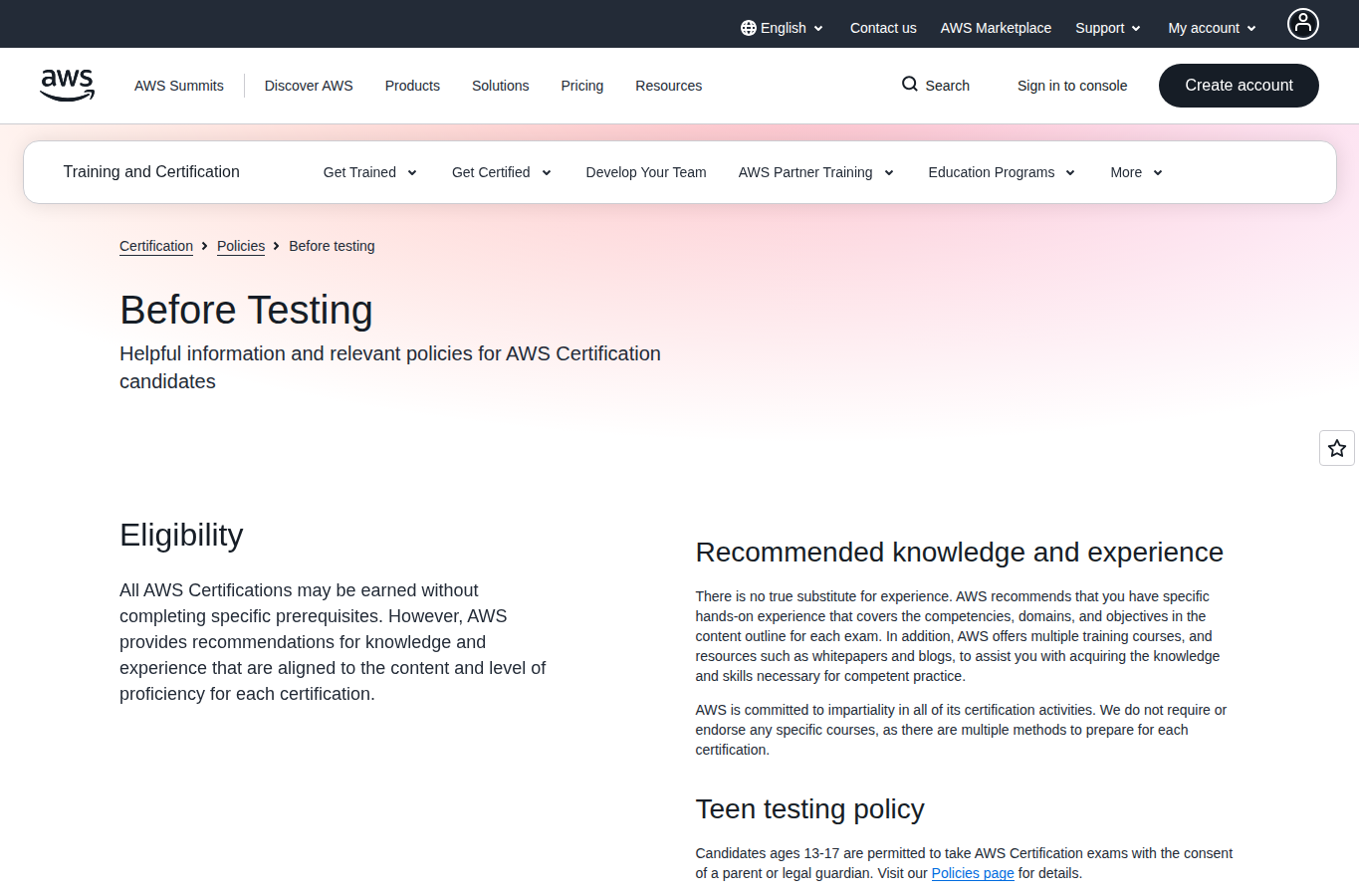
A critical detail from the Before Testing policy: AWS recommends "specific hands-on experience that covers the competencies, domains, and objectives in the content outline for each exam." For SysOps, this means you've actually configured monitoring alarms, troubleshot failed deployments, and automated patching—not just read about them.
The automation domain, though smallest by percentage, often trips up candidates. AWS expects you to use Systems Manager Automation documents, Lambda functions triggered by events, and CloudWatch Events/EventBridge rules to respond to operational issues without manual intervention.
Professional Level: Advanced Validation for Experienced Practitioners
Professional-level exams require deeper expertise and broader scenario analysis. AWS recommends two or more years of hands-on experience, and the questions reflect that complexity.
Solutions Architect Professional (SAP-C01)
The Solutions Architect Professional practice test covers designing solutions across complex hybrid environments, migrating multi-tier applications, and optimizing for cost, security, and operational excellence. The exam assumes you've architected systems spanning multiple AWS accounts, regions, or even cloud providers.
This credential matters for senior architects making organization-wide decisions. Questions present weeks-long migration projects or multi-account governance challenges. The professional level tests judgment under constraint: limited budget, legacy dependencies, compliance requirements, and team skill gaps.
One key difference from the associate level: SAP-C01 explicitly covers hybrid and multi-cloud scenarios. You might need to integrate on-premises Active Directory with AWS SSO, or design a disaster recovery strategy that fails over between AWS and another cloud provider. These scenarios require understanding networking at depth, including Direct Connect, VPN configurations, and routing protocols.
The exam also emphasizes cost optimization at organizational scale. Instead of choosing between EC2 instance types, you might design a purchasing strategy across multiple accounts using Reserved Instances, Savings Plans, and Spot Fleet with automatic diversification.
DevOps Engineer Professional (DOP-C01)
This exam bridges development and operations at scale. Domains cover continuous delivery, automation of security controls, monitoring and logging, and incident response. The professional DevOps exam assumes you've designed pipelines for multiple teams, implemented infrastructure as code across environments, and handled production incidents with automated rollback procedures.
The DevOps Professional has shifted in 2026. AWS restructured prerequisites, making the associate-level Developer or SysOps Administrator more explicitly recommended before attempting this exam. The content now assumes you've already validated foundational skills in one of those tracks.
A typical scenario: a microservices deployment with canary releases, automatic rollback on error rate thresholds, and security scanning integrated into the pipeline. You need to know not just how to configure these pieces, but how they interact under failure conditions—what happens when the canary fails but the rollback also fails, or when a security scan blocks a critical hotfix.
Specialty Exams: Deep Validation for Specific Functions
Specialty certifications demonstrate expertise in narrow domains. These suit professionals whose roles focus intensely on one area rather than general cloud architecture.
Security Specialty (SCS-C02)
The Security Specialty practice test covers incident response, logging and monitoring, infrastructure security, identity and access management, and data protection. AWS updated this exam in early 2026 with expanded coverage of generative AI security, zero-trust architectures, and automated remediation.
This credential suits security engineers, compliance officers, and architects designing regulated environments. The exam assumes deep familiarity with IAM policies, KMS encryption, GuardDuty, and Security Hub—not just awareness that these services exist.
The 2026 updates matter practically. Candidates now need to understand how to secure generative AI workloads on AWS, including Bedrock model access controls, prompt injection mitigation, and data privacy for training datasets. These topics didn't appear on earlier exam versions.
Machine Learning Specialty (MLS-C01)
The Machine Learning Specialty practice exam validates ability to build, train, and deploy ML models on AWS. Domains cover data engineering, exploratory data analysis, modeling, and implementation and operations. The exam assumes you've used SageMaker, feature stores, and model monitoring in production.
This is not an entry-level credential. AWS expects you to understand algorithm selection, hyperparameter tuning, and model deployment patterns. For data scientists already building on AWS, it validates specialized skills that generalist certifications cannot demonstrate.
The exam tests operational ML heavily: model drift detection, A/B testing for model versions, and automatic retraining pipelines. These reflect real production challenges where model accuracy degrades over time and requires systematic monitoring.
Other Specialty Options
AWS also offers specialty exams for Advanced Networking, Database, Data Analytics, and SAP on AWS. Each follows the same pattern: deep, narrow validation for professionals whose roles center on that domain. The 2026 landscape added a Generative AI specialty, reflecting market demand for AI-specific credentials.
The Data Analytics Specialty (DAS-C01) suits data engineers building ETL pipelines, data warehouses, and streaming analytics systems. The Database Specialty (DBS-C01) targets professionals managing complex database migrations, performance tuning, and high-availability configurations across multiple database engines.
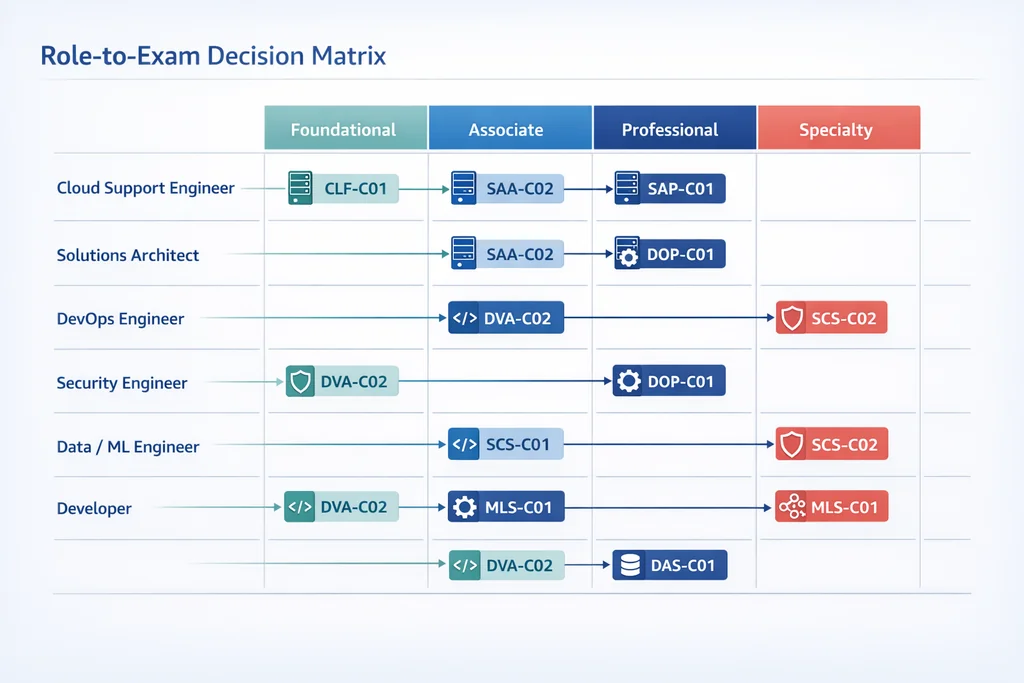
Role-to-Exam Decision Matrix
Use this mapping to shortcut your selection based on current responsibilities:
| Your Primary Responsibilities | Recommended Starting Exam | Next Credential to Consider |
|---|---|---|
| Technical sales, project management, finance reviewing cloud costs | Cloud Practitioner (CLF-C02) | Solutions Architect Associate |
| Designing architectures, selecting services, reviewing infrastructure designs | Solutions Architect Associate (SAA-C03) | Solutions Architect Professional |
| Writing application code, building APIs, configuring CI/CD | Developer Associate (DVA-C02) | DevOps Engineer Professional |
| Monitoring systems, troubleshooting incidents, automating operations | SysOps Administrator Associate (SOA-C02) | DevOps Engineer Professional |
| Securing environments, compliance audits, incident response | Security Specialty (SCS-C02) | Solutions Architect Professional |
| Building ML models, feature engineering, model deployment | Machine Learning Specialty (MLS-C01) | Data Analytics or Database Specialty |
| Data pipeline engineering, ETL, warehouse design | Data Engineer Associate (DEA-C01) | Data Analytics Specialty |
This matrix reflects the AWS Certification Paths PDF guidance, adapted for professionals who already know their role and need to identify the matching credential.
Common Selection Mistakes to Avoid
Several patterns lead candidates to choose poorly. Recognize them before committing study time.
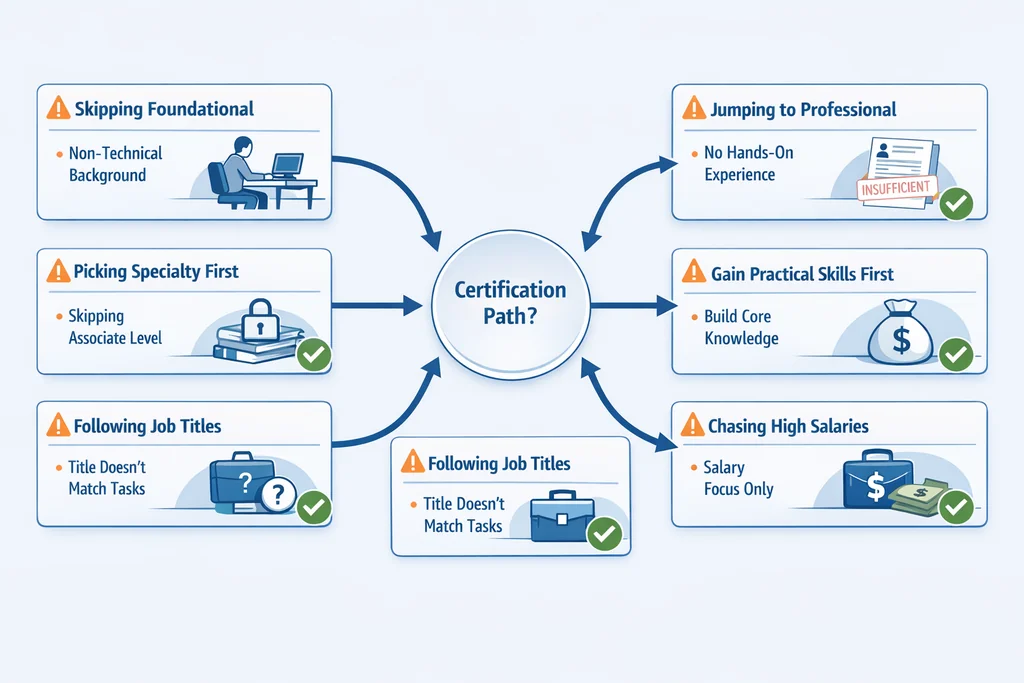
Chasing salary data without role alignment. Reports show Solutions Architect Professional commands high salaries, but if you spend your days writing Python scripts for data pipelines, that credential won't validate your actual skills. Employers hire for demonstrated competence, not credential prestige.
Skipping associate-level exams. AWS removed formal prerequisites for professional exams, leading some candidates to attempt SAP-C01 or DOP-C01 directly. The Before Testing policy notes that while "all AWS Certifications may be earned without completing specific prerequisites," the exams are constructed for candidates with recommended experience. The professional-level scenarios assume associate-level knowledge as baseline.
Ignoring 2026 exam changes. AWS refreshed several exam guides in early 2026. The CLF-C02 now includes generative AI coverage. The SCS-C02 expanded zero-trust content. Studying outdated materials means missing new domains that appear on your actual exam. Verify you're using current guides, not blog posts from 2024.
Selecting based on job title alone. A "DevOps Engineer" at one company might write infrastructure code all day; at another, they might primarily handle incident response. Examine your actual tasks, not your business card.
Overlooking specialty exams for deep specialists. A security engineer with five years of AWS experience sometimes pursues Solutions Architect Professional when Security Specialty would validate their expertise more precisely and require less study time. The specialty credential often carries more weight in security-focused hiring decisions.
Building Your Study Plan After Selection
Once you've chosen your exam, structure preparation around your role's existing strengths and gaps. A Solutions Architect candidate with networking background needs less VPC study but more serverless architecture practice. A Developer candidate strong in Lambda might need focused work on IAM and security controls.
AWS provides exam guides with explicit domain weightings. Use these to allocate study time proportionally. If a domain represents 30% of the exam, it deserves roughly 30% of your preparation hours, adjusted for your existing knowledge.
For hands-on practice, build small projects in your AWS account that mirror exam scenarios. The AWS Certification Exam Guides list in-scope services for each credential. Focus labs on those services, not the full AWS catalog.
Timed practice exams build stamina and reveal weak domains. Most candidates underestimate the mental fatigue of 65-75 scenario-based questions in 130-180 minutes. Schedule full-length practice sessions in your final two weeks to build pacing awareness.
Consider forming a study group with colleagues preparing for the same exam. Explaining concepts to others reveals gaps in your own understanding, and peer accountability maintains momentum through difficult domains. Many successful candidates report that teaching a topic—like VPC peering or IAM policy evaluation—cemented their knowledge more than solo review.
FAQ
Can I take professional-level exams without associate-level certifications?
Yes. AWS removed formal prerequisites. However, the exams assume associate-level knowledge, and candidates without that foundation often struggle with scenario complexity. The Before Testing guidance recommends specific experience for each level.
How long should I study for each exam level?
Cloud Practitioner typically requires 2-4 weeks. Associate exams need 6-10 weeks for candidates with relevant work experience. Professional and specialty exams often require 10-16 weeks of dedicated study. Adjust based on your daily AWS usage—hands-on practitioners need less time than those learning concepts from scratch.
Do AWS certifications expire?
AWS certifications are valid for three years. You can recertify by passing the current version of the same exam or by earning a higher-level certification in the same track. Plan recertification into your professional development calendar to avoid last-minute cramming.
Which exam has the highest pass rate?
AWS does not publish official pass rates. Anecdotal community data suggests Cloud Practitioner has the highest first-attempt pass rate, while professional and specialty exams have lower rates due to scenario complexity. Your personal pass probability depends heavily on role alignment and hands-on experience.
Should I get multiple associate certifications?
For early-career professionals, one associate certification aligned with your role provides more value than two misaligned credentials. Senior professionals sometimes earn multiple associates to demonstrate breadth before pursuing professional-level exams. Consider whether the study time advances your specific career goals.
How do I verify I'm studying current exam content?
Check the official AWS Certification Exam Guides for your specific exam code. AWS updates these guides when exam objectives change. Avoid study materials that don't reference the current exam version—CLF-C02, not CLF-C01; SAA-C03, not SAA-C02.
Further Reading

Discussion
Question Comments
0 comments·0 participantsSign in to leave a comment and access more free questions.