

Passing Security+ in two weeks is realistic if you study like you are training for a performance, not just “reading to feel productive.” The biggest lever is deliberate practice with high-quality questions, plus a tight feedback loop: attempt, review, fix gaps, retest.
This 14-day plan is built around the current Security+ structure (many candidates take SY0-701) and assumes you can commit 90 to 120 minutes on weekdays and 2 to 3 hours on weekend days. If you have less time, keep the same sequence, just reduce the breadth each day and protect the practice test + review block. For topic order, pair it with our Security+ study-first priority map.
Before you start (30 minutes today)
1) Set your target score and rules
Pick a clear goal: for example, 80%+ on mixed timed sets by Day 12, with no single domain below 75%.
Also set two rules that keep you honest:
- No passive rereads unless you can explain the topic from memory first.
- Every missed question produces an artifact, either a flashcard or a note in your error log.
2) Gather your materials
You do not need ten resources. You need one primary study guide, a way to do hands-on reps (home lab or guided exercises), and a reliable bank of questions with explanations.
If your biggest bottleneck is exam-readiness (timing, wording traps, and coverage), prioritize realistic practice exams with detailed rationales. A simulator-style experience helps you build stamina and pacing.
3) Create an error log (this is your secret weapon)
Use a simple table like this and update it daily.
| Date | Topic | What I answered | Correct concept | Why I missed it | Fix (flashcard/lab/notes) |
|---|---|---|---|---|---|
| Day 1 | Example: access control | Picked DAC | RBAC fit scenario | Misread “roles” clue | 10 flashcards + reattempt set |
How to use practice tests (so they actually raise your score)
Most people “do questions.” High scorers train with questions.
Use a 3-pass cycle
- Pass 1 (diagnostic): Mixed set, timed, no notes. Goal is to locate weak domains.
- Pass 2 (targeted): Short quizzes by topic (for example, cryptography, incident response). Goal is rapid feedback and gap closure.
- Pass 3 (exam simulation): Full-length, timed, realistic conditions. Goal is pacing, endurance, and decision-making.
Review like an engineer, not a student
For every missed or guessed question, write:
- What clue in the prompt mattered.
- Why the wrong choice was attractive.
- The rule of thumb you will use next time.
This turns explanations into reusable intuition.
The 14-day Security+ study plan (daily schedule)
The table below gives you a concrete, day-by-day path. Adjust the exact domain order to match your baseline results.
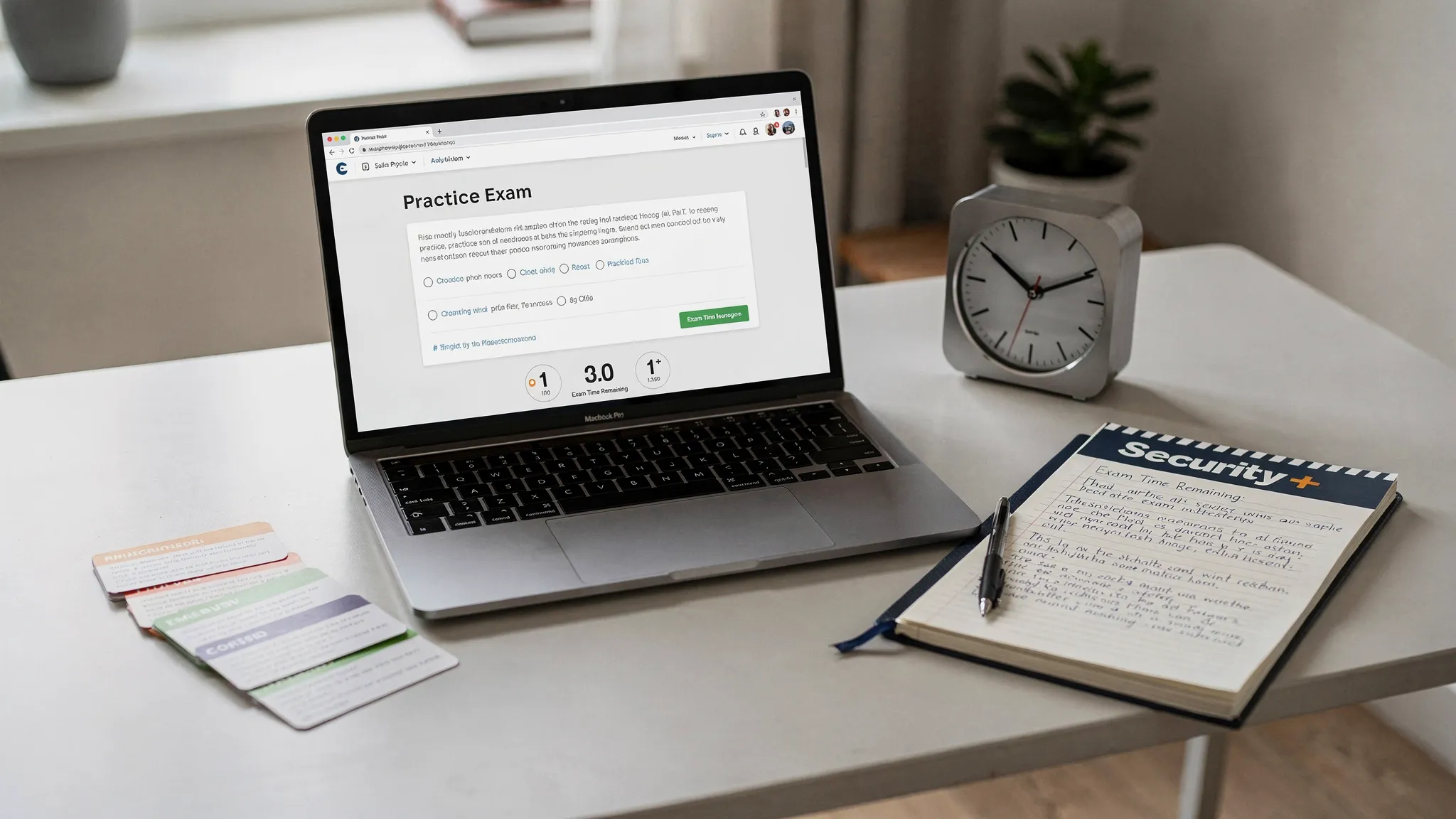
| Day | Primary focus | Practice test work | Output you must produce |
|---|---|---|---|
| 1 | Baseline + exam map (domains, objectives) | 30–45 question mixed diagnostic, timed | Error log started + top 5 weak topics list |
| 2 | Attacks, threats, vulnerabilities | 2 topic quizzes (short sets) | 15–25 flashcards from misses |
| 3 | Architecture & design (secure design, segmentation, cloud basics) | 45–60 question mixed set | 1-page “design patterns” cheat sheet |
| 4 | Implementation (identity, auth, secure protocols) | Targeted quizzes on weakest subtopics | Updated error log + retest missed questions |
| 5 | Operations (monitoring, hardening, logging concepts) | Timed mixed set, review every miss | “If you see X, think Y” list (10 items) |
| 6 | Incident response (triage, containment, evidence basics) | Scenario-heavy set, slower review | A simple IR flow you can recite |
| 7 | Governance, risk, compliance (policies, risk, third-party) | Half exam simulation (timed) | Domain score snapshot + plan fixes |
| 8 | Patch weak domains (Round 1) | Topic quizzes only | Close 2 major gaps, documented |
| 9 | Patch weak domains (Round 2) | Mixed set, timed | Reduce “guess” rate (track it) |
| 10 | Performance day (stamina + pacing) | Full exam simulation, timed | Post-mortem: 5 causes of misses |
| 11 | Deep review of simulation results | Targeted retest on misses | New flashcards + 1 lab-style rep |
| 12 | Second full simulation (prove improvement) | Full exam simulation, timed | Confirm readiness thresholds |
| 13 | Light polish (only high-yield errors) | 30–45 mixed questions, untimed | Final condensed notes (2 pages max) |
| 14 | Exam day routine (no cramming) | 10–15 warm-up questions only | Calm pacing plan + logistics check |
What to study each week (high-yield emphasis)
Week 1 goal: Build coverage and accuracy
During Days 1 to 7, you are building the “map” in your head and removing the most common misunderstandings.
Focus on:
- Reading questions precisely (scope words like best, first, most likely).
- Core definitions you can recall without prompts (authentication vs authorization, encryption vs hashing, segmentation vs isolation).
- Scenario habits (identify assets, threat, vulnerability, control).
Week 2 goal: Convert knowledge into performance
During Days 8 to 14, your goal is not “learn new things.” Your goal is to:
- Raise your weak domains above threshold.
- Stabilize timing.
- Eliminate repeat misses.
This is where exam simulation and ruthless review pays off.
Daily template (use this every study day)
Keep a consistent rhythm so you do not waste mental energy deciding what to do.
Block A (20 to 30 min): Active recall
Close your notes. Write what you remember about today’s topic, then check what you missed.
Block B (40 to 60 min): Learn and connect
Use your primary guide to fill gaps. Keep notes short, aim for decision rules and distinctions.
Block C (30 to 45 min): Practice test + review
Do a timed set, then review immediately. Update your error log and create flashcards.
Hands-on reps (simple, fast, and effective)
Security+ rewards practical thinking. Even light “lab” reps help you answer scenario questions faster.
Examples you can do without overbuilding a complex lab:
- Configure and explain MFA factors and when each fails.
- Compare secure protocols (what they protect, what port expectations are typical, and what misconfigurations look like).
- Walk through an incident response mini-scenario (what is evidence, what changes state, who gets notified).
Keep it minimal. One hands-on rep per day in Week 2 is enough.
Where PlanetCert fits in this plan (and how to use it efficiently)
If you are following a 14-day timeline, you need practice questions that are realistic, explain the “why,” and let you simulate exam conditions.
A platform approach can reduce friction because you can do topic quizzes, mixed sets, and full simulations in one place. PlanetCert’s offering is positioned for that style of training, with expert-verified materials and a web-based simulator.
When you are ready to start your diagnostic and simulations, use Planet Cert practice tests for Security+ exam questions as your question engine for Days 1, 7, 10, and 12, then use targeted sets for Days 2 to 6 and Days 8 to 11.
Make your environment work for you (small change, big consistency)
Two-week plans fail more from friction than from difficulty. Set up a dedicated spot with:
- A visible timer.
- One notebook.
- Headphones if you need them.
- A clean, comfortable space you do not dread sitting down in.
If you want your study corner to feel like a place you actually want to return to daily, a simple visual refresh can help. Some candidates even add a print or poster to make the space feel “finished,” you can browse ready-to-hang options at dreamprint.art.
Readiness checks (use these on Days 10 to 13)
You are ready when your results show consistency, not when you “feel” ready.
Use these criteria:
- Two timed mixed sets (or simulations) with stable scores.
- Fewer repeat misses in the same concept area.
- A clear pacing strategy (you know when to move on and when to mark and return).
If you are not there by Day 12, do not panic. Narrow scope:
- Retest only your bottom two domains.
- Stop chasing edge cases.
- Focus on prompt-reading discipline and common confusions.
Day 14 exam routine (no cramming)
On the final day, protect your confidence and clarity.
- Do a short warm-up set (10 to 15 questions) to get into “prompt-reading mode.”
- Review only your condensed notes and the top items in your error log.
- Use a pacing plan: if a question is going nowhere after a reasonable effort, mark it and move.
The win condition is not “knowing everything.” It is making fewer mistakes than you made in practice, under realistic timing.

Discussion
Question Comments
0 comments·0 participantsSign in to leave a comment and access more free questions.