

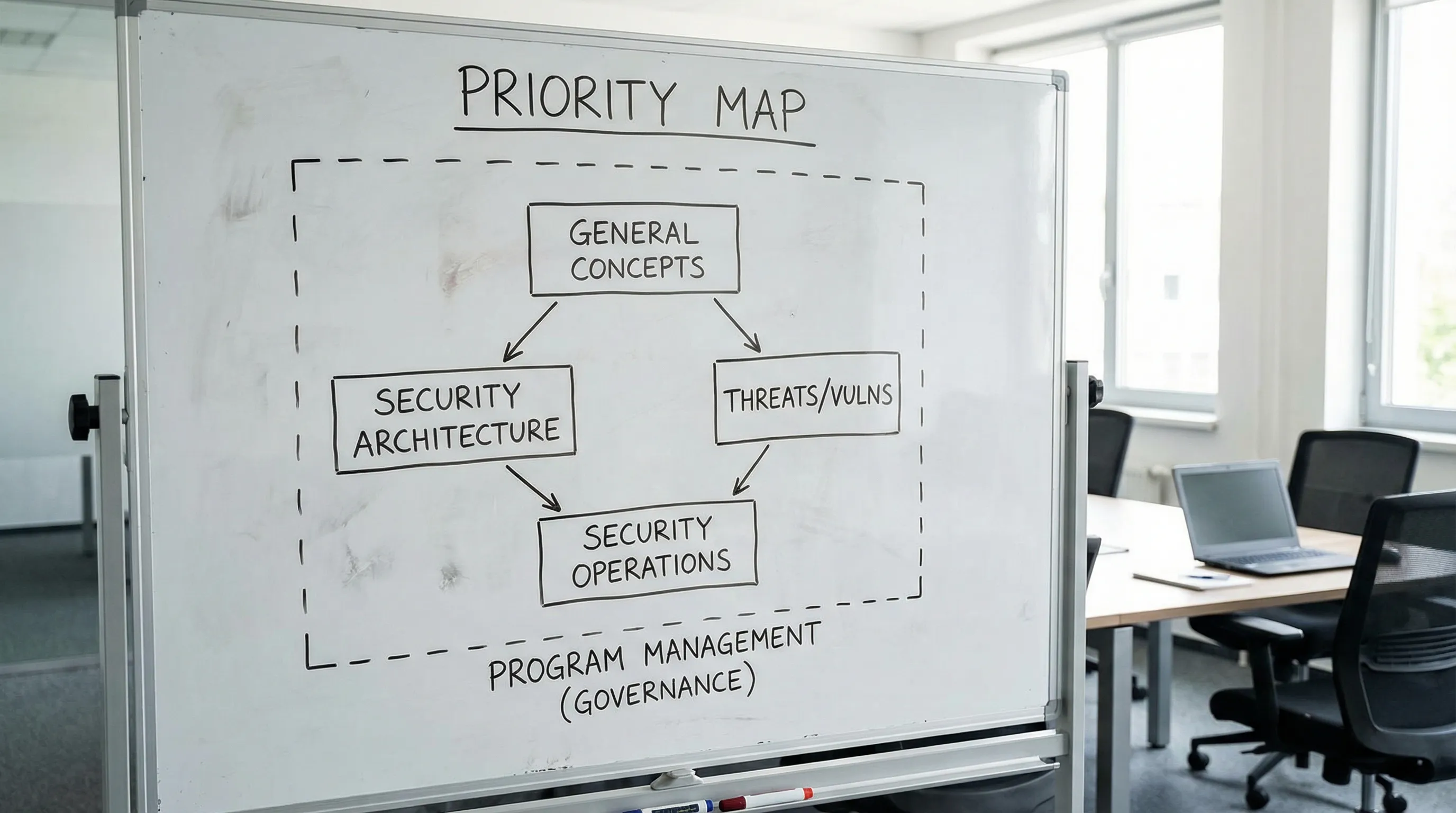
Security+ (SY0-701) covers a lot of ground, and most candidates lose time because they study in the order a book is written, not the order the exam rewards. A better approach is to use the official objectives as your map, then study the topics with the highest test density first, while building “prerequisite” concepts early so later domains feel easier.
Below is a study-first priority map you can use to plan what to learn first, what to drill hardest with practice questions, and what to leave for the final pass.
Start with the exam blueprint (then reinterpret it as priorities)
CompTIA publishes the Security+ SY0-701 exam objectives and domain weightings. Use them as the source of truth for coverage, but not necessarily the best study order. You can find the objectives on CompTIA’s official exam objectives page.
Security+ (SY0-701) is typically organized into five domains with these weightings:
| Domain | What it’s really testing | Weight (SY0-701) | Why it matters for your study order |
|---|---|---|---|
| 1. General Security Concepts | Baseline language of security, controls, and “what good looks like” | 12% | Prerequisite vocabulary for everything else |
| 2. Threats, Vulnerabilities, and Mitigations | Identifying threats and selecting the right countermeasure | 22% | High question volume and heavy scenario framing |
| 3. Security Architecture | Designing secure systems (on-prem, cloud, identity, segmentation) | 18% | Architecture concepts show up inside Ops and Threat questions |
| 4. Security Operations | Detect, respond, harden, log, monitor, handle incidents | 28% | Largest domain, also the most “applied” |
| 5. Security Program Management and Oversight | Risk, governance, policies, third-party, training | 20% | Lots of “best answer” judgment calls |
Key takeaway: The exam is not five separate mini-exams. Most questions blend domains (for example, an incident response scenario that also tests logging, IAM, and policy). That’s why your study sequence should front-load foundational concepts and then move quickly into applied operations and scenario-based practice.
The study-first priority map (what to learn first, not just “what’s on the exam”)
Use this as your default order unless a diagnostic test shows a glaring weakness.
Priority 1: Operations + core concepts (highest score impact)
If you only optimize one thing, optimize how quickly you can reason through operational scenarios.
Focus areas that tend to pay off the fastest:
- Security controls and control types (preventive vs detective vs corrective, technical vs administrative vs physical) and how they map to scenarios.
- Identity and access fundamentals (authentication factors, authorization concepts, least privilege, account lifecycle).
- Logging and monitoring basics (what logs prove, what you would check first, and how alert fatigue happens).
- Incident response flow (triage, containment, eradication, recovery, lessons learned) and what actions are appropriate at each stage.
- Vulnerability management cadence (scan, validate, prioritize, remediate, verify) and common failure modes.
This is where a high-quality question bank matters because the exam’s difficulty is often in the phrasing and trade-offs, not the definition. If you’re using planet cert practice tests, start with mixed sets early so you learn to switch mental gears the way the real exam requires.
Priority 2: Threats, vulnerabilities, and mitigations (scenario matching)
Most candidates can memorize malware types, but miss points because they cannot match a mitigation to a specific constraint (business need, tech limitation, or risk tolerance).
Study this domain as “if you see X, do Y, because Z”:
- Malware and attack types: not just names, but what evidence you would see (symptoms, indicators) and what containment looks like.
- Social engineering patterns: cues in the prompt, urgency, authority, and what control stops it (training, MFA, filtering, policy).
- Vulnerability categories: misconfiguration, unpatched systems, weak identity controls, exposed services.
- Mitigations: hardening, segmentation, patching, compensating controls, backups, allowlisting.
Practical way to study: after every missed question, write one sentence that begins with “The giveaway was…” and one sentence that begins with “The best mitigation is…”. This forces pattern recognition.
Priority 3: Security architecture (the “why” behind many best answers)
Architecture is the domain that silently boosts your score across domains because it explains why certain controls are preferred.
High-yield architecture concepts to study early:
- Zero Trust principles (verify explicitly, least privilege, assume breach) and what it changes in network and identity design.
- Segmentation (VLANs, micro-segmentation concepts, separating workloads, limiting lateral movement).
- Secure network design basics (DMZ intent, east-west vs north-south traffic, where to place sensors).
- Identity architecture (federation concepts, SSO basics, where MFA fits, service accounts).
- Resilience (redundancy vs backups, RTO/RPO meaning, why “restore testing” matters).
Architecture questions often look like operations questions (for example, “where should you place a control?”). If you can sketch the system in your head, your answer quality jumps.
Priority 4: Program management and oversight (best-answer judgment)
This domain is 20% for SY0-701, and it’s where “two answers seem right” happens.
Study it as decision-making rules, not definitions:
- Risk basics: risk appetite, risk acceptance, risk transfer, compensating controls.
- Policy vs standard vs guideline vs procedure (what changes behavior vs what provides recommendations).
- Third-party and supply chain risk: due diligence, SLAs, vendor access controls, audit considerations.
- Security awareness: what training is appropriate and how to measure effectiveness.
When practicing, ask: “What is the most defensible action in a real organization?” The exam often rewards governance that reduces recurring risk, not one-off heroics.
A “topic triage” view inside each domain (what’s worth perfecting)
Not all objectives behave equally on the exam. Some produce many questions, some produce fewer but tricky questions.
Use this triage table as a practical guide to what to master first.
| Topic cluster | Why it shows up a lot | What to be able to do under time pressure |
|---|---|---|
| Incident response + logging | Core job skill, easy to scenario-test | Pick the next action, identify best evidence, choose containment vs eradication |
| IAM fundamentals | Touches every system and many controls | Differentiate authn vs authz, apply least privilege, know MFA trade-offs |
| Vulnerability management | Common operational workflow | Prioritize remediation, distinguish scanning vs validation, understand false positives |
| Network segmentation + secure design | Drives “best answer” choices | Decide where to place controls, reduce blast radius, explain why segmentation matters |
| Risk and policy | Common leadership framing | Choose the most defensible governance action, not just a technical fix |
How to apply the priority map with practice questions (without wasting hours)
A priority map only works if you pair it with a practice loop that turns mistakes into retests.
Step 1: Run a diagnostic that is mixed-domain
Do not start with a single-domain quiz unless you are brand new. Mixed-domain diagnostic results show you whether the problem is knowledge, interpretation, or time pressure.
A good diagnostic outcome looks like this:
- You can explain why correct answers are correct.
- Your misses fall into repeatable buckets (for example, “I misread the constraint,” or “I confuse containment with eradication”).
If you want a structured schedule for this approach, PlanetCert already has a dedicated guide: CompTIA Practice Test Security Plus: A 14-Day Study Plan.
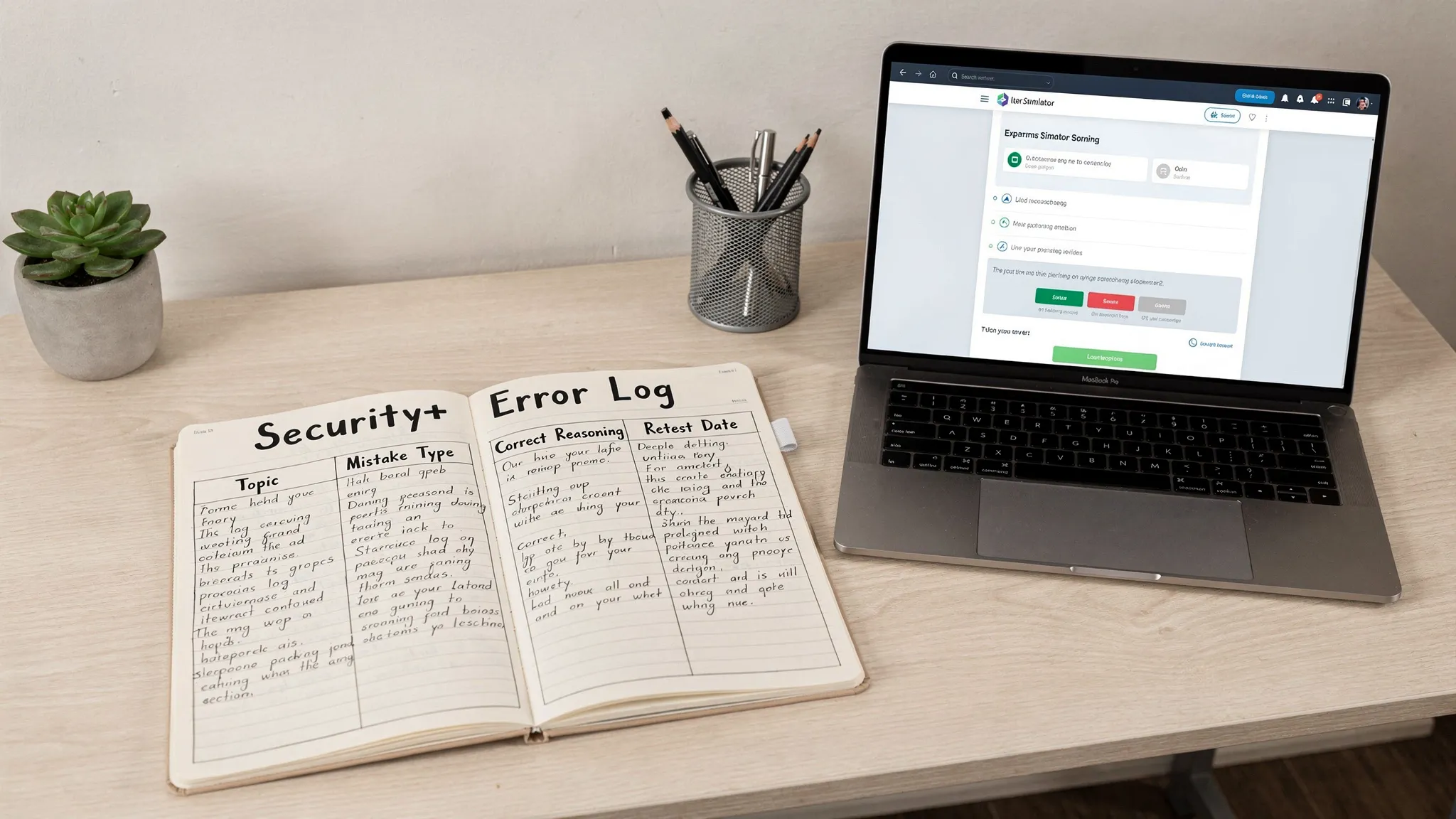
Step 2: Build a short “error log” that forces root cause
Your log should capture why you missed it, not just what you missed.
A simple format:
- Objective/topic
- Why you chose your answer
- Why the correct answer is better
- The “trigger” you will look for next time
- Retest date (48 to 72 hours)
Step 3: Use targeted drills, then return to mixed sets quickly
Targeted drills are for fixing a weakness, but mixed sets are what make the score stick.
A simple rhythm that works well:
- Targeted drills to repair one weakness
- Short mixed sets to confirm the repair transfers
- Timed blocks to build pacing
When you are ready to transition from topic quizzes to full simulations, use the readiness signals in CompTIA Security Plus Practice Test: When to Switch to Full Exams.
PBQs: treat them like “mini-labs,” not trick questions
Performance-based questions (PBQs) reward operational thinking: identify what’s wrong, apply the correct control, and validate.
To prepare efficiently:
- Practice reading the prompt first, then scanning the interface for what is being asked.
- Train yourself to look for constraints (time, business impact, access limitations).
- When reviewing, write the minimal steps needed to solve it again.
PBQs become much easier when your Priority 1 topics are strong (operations, logging, IR, IAM).
A realistic way to allocate study time by priority
If you have limited time, you can still cover the full blueprint while emphasizing what moves your score.
| Priority band | What it includes | Suggested share of study time |
|---|---|---|
| Band A (Score drivers) | Security Operations, incident response, logging, IAM, vulnerability management | 45 to 55% |
| Band B (Scenario multipliers) | Threats and mitigations, security architecture fundamentals | 30 to 40% |
| Band C (Best-answer governance) | Risk, policy hierarchy, third-party oversight, awareness | 15 to 25% |
This is not about ignoring any domain. It’s about spending your “fresh brain” hours on the areas that produce the most exam points.
Putting it all together
If you want a one-sentence strategy: learn the language of security fast, then spend most of your time doing applied practice on operational scenarios, and use architecture and governance to choose the best answer under constraints.
When you’re ready to turn this map into daily execution, pair it with a question engine that supports both topic drills and realistic timed simulations. You can do that with planet cert practice exams, then use the review loops in the linked study-plan resources to convert each missed question into a predictable score gain.

Discussion
Question Comments
0 comments·0 participantsSign in to leave a comment and access more free questions.