

AWS Data Engineer Associate: Step-by-Step Prep Path
A structured preparation framework for the DEA-C01 exam that prioritizes data pipeline design, monitoring, and optimization over rote service memorization. Most candidates approaching the AWS Data Engineer Associate certification treat it like a vocabulary test. They flashcard their way through service names and hope pattern recognition carries them through exam day. The DEA-C01 doesn't work that way. According to the AWS Certified Data Engineer exam guide, this test validates your ability to implement data pipelines, monitor and troubleshoot them, and optimize for cost and performance within live AWS environments. This guide maps a preparation path that aligns with what the exam actually measures: applied data engineering judgment, not recitation.
Table of Contents
- Topic Map
- What Is the AWS Data Engineer Associate Certification?
- Core Concepts
- How It Works
- Main Layer 1: Data Ingestion and Storage Architecture
- Main Layer 2: Data Transformation and Pipeline Orchestration
- Main Layer 3: Monitoring, Troubleshooting, and Optimization
- Maturity Path
- Real-World Scenarios
- Common Mistakes to Avoid
- How PlanetCert Helps
- What to Read Next
Topic Map
The DEA-C01 exam organizes around four domains: data ingestion and transformation, data store management, data operations and monitoring, and data security and governance. These aren't isolated knowledge areas. They form a continuous workflow that mirrors how data engineers actually build systems on AWS. Your preparation needs to follow the same arc. First, understand how data enters AWS and where it lands. Then, learn how to transform and move it reliably. Next, build operational awareness: how do you know your pipeline failed before your stakeholders do? Finally, wrap everything in appropriate security and compliance controls. This guide moves through each layer with specific service coverage, hands-on priorities, and study phase recommendations. The goal is exam readiness that also transfers to real job performance.
What Is the AWS Data Engineer Associate Certification?
The AWS Certified Data Engineer - Associate (DEA-C01) is a 130-minute, 65-question exam that tests implementation-level skills across the data engineering lifecycle on AWS. Launched as part of AWS's expanded data and analytics certification track, it sits between the foundational AWS Cloud Practitioner and the professional-level solutions architect and DevOps tracks. The certification targets candidates with at least one year of hands-on experience building data pipelines, working with data lakes, and operating analytics workloads in AWS. The [PDF] AWS Certified Data Engineer exam guide specifies that candidates should understand how to choose optimal data stores, design and maintain pipelines, ensure data quality, and implement security controls. This isn't a theoretical assessment. Questions present scenarios with specific requirements and ask you to select the most appropriate architecture or identify the root cause of a pipeline failure. The certification matters now because data engineering roles increasingly expect cloud-native fluency. Organizations migrating from on-premises data warehouses need engineers who can design idempotent pipelines, handle schema evolution, and optimize query costs—not just run ETL scripts. The DEA-C01 validates that baseline competency.
Core Concepts
Before diving into service specifics, you need fluency in four foundational ideas that recur throughout the exam. Data pipeline idempotency. In distributed systems, the same input should produce the same output regardless of how many times a job runs. AWS services like AWS Glue and Amazon EMR support this through job bookmarks and transaction controls, but you need to understand when and why to enable them. Schema evolution and data contracts. Data formats change. The exam tests whether you know how to handle additions, deletions, and type modifications without breaking downstream consumers. Formats like Apache Iceberg, Delta Lake, and Avro with schema registries appear in scenario questions. Cost-performance tradeoffs. Every storage and compute choice on AWS involves this tension. S3 Standard vs. Intelligent-Tiering. Provisioned vs. serverless Spark. On-demand vs. reserved capacity. The exam expects you to select options that match specific access patterns and budget constraints. Observability over monitoring. Monitoring tells you something broke. Observability helps you understand why. The DEA-C01 emphasizes distributed tracing, structured logging, and metric correlation across pipeline stages—skills you implement with Amazon CloudWatch, AWS X-Ray, and CloudWatch Logs Insights.
How It Works
The exam presents two question formats: multiple choice and multiple response. Multiple choice questions have one correct answer from four options. Multiple response questions require selecting two or more correct answers from five or more options, with no partial credit. Questions distribute across four domains with the following approximate weightings: - Domain 1: Data Ingestion and Transformation (34%) - Domain 2: Data Store Management (26%) - Domain 3: Data Operations and Monitoring (22%) - Domain 4: Data Security and Governance (18%) The AWS Certified Data Engineer documentation notes that exam content updates periodically, with revisions published at least one month before changes appear on your test. This means your study materials need to stay current, especially as AWS releases new data services or modifies existing ones. Scoring follows a scaled model against a minimum standard set by AWS certification professionals. You receive a pass or fail designation, with score reports showing performance at the domain level. This diagnostic feedback helps identify weak areas if you need to retake. The question construction follows a consistent pattern that rewards systems thinking over memorization. A typical scenario describes a company with specific data volume, velocity, and variety requirements, then asks you to select the architecture that meets constraints around cost, latency, durability, or compliance. Distractor answers often include services that could technically work but violate a stated requirement—such as proposing Kinesis Data Streams for a batch workload that only processes daily, or suggesting S3 Standard for archive data that gets accessed once per quarter. Time management matters significantly. With 130 minutes for 65 questions, you have roughly two minutes per question. Scenario-based questions with lengthy descriptions can consume four to five minutes, leaving less time for straightforward knowledge checks. The exam interface allows flagging questions for review, and you should use this liberally rather than rushing through complex scenarios.
Main Layer 1: Data Ingestion and Storage Architecture
This domain carries the highest exam weight and demands the deepest service knowledge. You need to understand not just what services do, but how they interact in complete architectures.
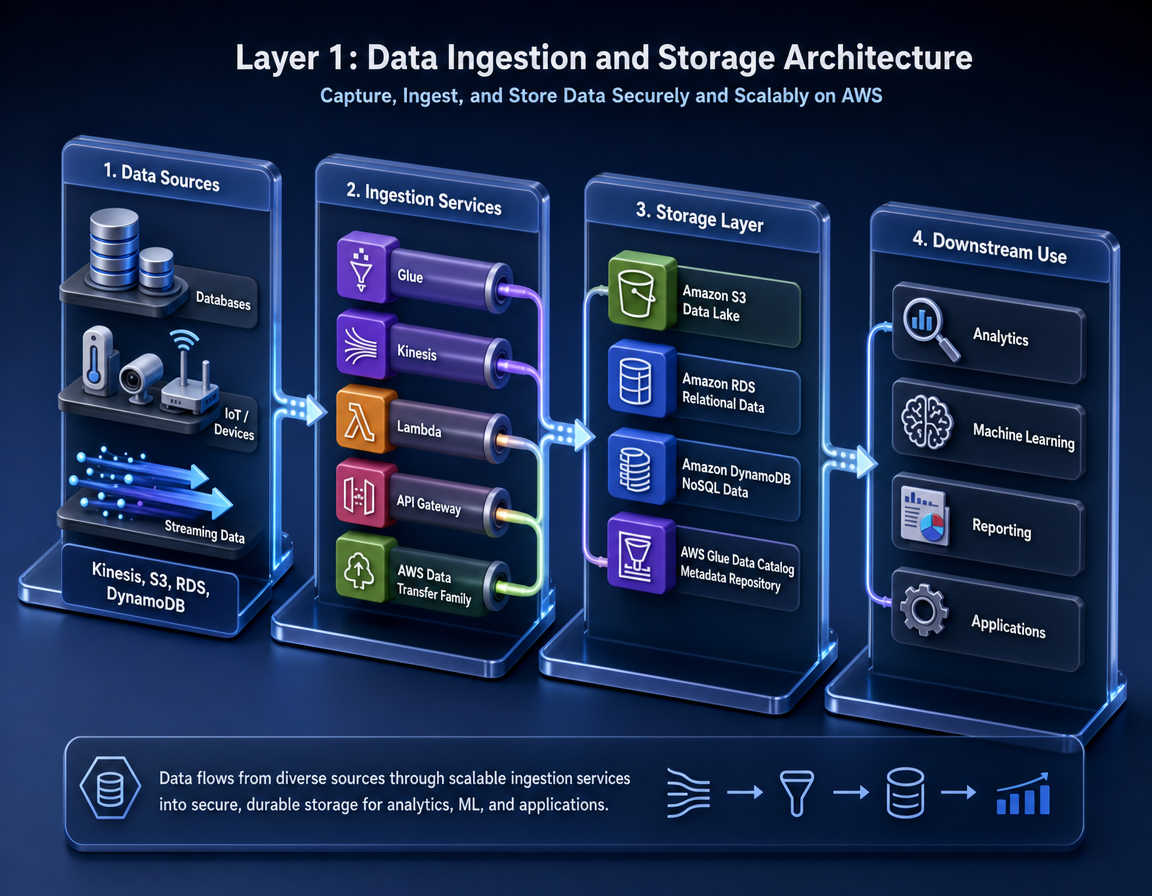 Ingestion patterns and service selection. The exam tests three primary ingestion paths: batch, streaming, and change data capture. For batch, know when AWS Glue, Amazon EMR, or custom containerized jobs on Amazon ECS or EKS fit best. For streaming, master Amazon Kinesis Data Streams and Amazon MSK (Managed Streaming for Apache Kafka), including partition strategies, consumer group behavior, and exactly-once processing semantics. For change data capture, understand AWS Database Migration Service (DMS) and how to stream CDC events through Kinesis or Amazon EventBridge. Storage tiering and format optimization. S3 isn't just one storage class. The exam tests Intelligent-Tiering, Glacier Instant Retrieval, and lifecycle policies with specific access pattern scenarios. You also need to know columnar formats: Parquet and ORC for analytics, Avro for streaming, and when JSON or CSV still make sense despite their inefficiency. Data lake architecture. The DEA-C01 expects familiarity with the S3 data lake pattern: raw zone, curated zone, and consumption zone. Understand how AWS Glue Data Catalog and AWS Lake Formation enforce access controls across these layers. Know the difference between resource-based policies, IAM policies, and Lake Formation permissions—and when each applies. Lakehouse concepts. Apache Iceberg and Delta Lake on S3 appear in newer exam content. Understand how these table formats enable time travel, partition evolution, and concurrent writes without locking entire datasets. The exam may test when to choose Iceberg over native Hive tables, particularly for workloads with frequent updates or schema changes. Edge case: small file problems. Ingestion architectures often create many small files, especially with streaming or high-frequency batch loads. The exam tests your awareness of compaction strategies: S3DistCp for EMR, Glue job bookmarks with coalesce operations, and Athena VACUUM for Iceberg tables. Small files degrade query performance and increase costs through excess LIST operations.
Main Layer 2: Data Transformation and Pipeline Orchestration
Once data lands, it needs to become useful. This layer covers the compute and orchestration services that transform raw data into analytics-ready datasets. AWS Glue deep dive. Glue serves multiple roles: ETL engine, data catalog, and crawler. For the exam, understand Glue DynamicFrames vs. Spark DataFrames, when to use each, and how Glue job bookmarks handle incremental loads. Know the difference between Glue Studio visual jobs, Glue notebooks, and programmatic job authoring. Cost optimization appears in scenarios: when does a Python shell job beat a Spark job, and how do worker types affect performance? Amazon EMR and Spark optimization. The exam tests Spark tuning on EMR: executor memory and core allocation, dynamic allocation vs. fixed clusters, and when to use EMR Serverless vs. provisioned clusters. Understand EMRFS consistency, S3Guard deprecation, and how to handle small file problems in long-running streaming jobs. The shift from S3Guard to DynamoDB-based consistency checking represents an important recent change that older study materials may misrepresent. Orchestration with Amazon MWAA and Step Functions. Modern data pipelines need reliable orchestration. The DEA-C01 tests Amazon Managed Workflows for Apache Airflow (MWAA) for complex DAGs with dependencies, retries, and backfills. For simpler workflows, AWS Step Functions integrate directly with Glue, EMR, and Lambda. Know when to choose each: MWAA for Python-native teams with existing Airflow experience, Step Functions for event-driven, state-machine logic with minimal infrastructure. Data quality and validation. AWS Glue Data Quality and Deequ-based validation appear in exam scenarios. Understand how to define rules, handle anomalies, and route quality failures to notification channels without halting entire pipelines. The exam tests whether you can implement circuit-breaker patterns: failing fast on critical quality checks while logging and continuing on minor issues. Edge case: cross-region pipelines. Multi-region architectures introduce latency, compliance, and cost complexity. The exam may test when to replicate data vs. when to process centrally, how to handle GDPR data residency requirements, and the cost implications of cross-region data transfer. Understand S3 Cross-Region Replication triggers and how they interact with event-driven processing.
Main Layer 3: Monitoring, Troubleshooting, and Optimization
Operational excellence separates functioning pipelines from production-grade systems. This domain tests your ability to detect, diagnose, and resolve issues under time pressure. CloudWatch for data pipelines. Beyond basic metrics, understand CloudWatch Logs Insights for querying structured logs, metric filters for creating custom alarms from log patterns, and CloudWatch Synthetics for endpoint monitoring. The exam presents scenarios where pipeline latency spikes or error rates increase, and you must identify the most likely root cause from CloudWatch data. Distributed tracing with X-Ray. For complex pipelines spanning multiple services, X-Ray traces help identify where latency accumulates. Know how to instrument Glue jobs, Lambda functions, and API Gateway endpoints, and how to interpret service maps and trace segments. The exam tests whether you recognize when X-Ray adds value vs. when CloudWatch Logs Insights suffices. Cost optimization strategies. The exam tests practical cost control: S3 Intelligent-Tiering configuration, EMR Spot Instance usage with fallback to On-Demand, Glue job auto-scaling, and Reserved Instance planning for steady-state workloads. Understand the tradeoffs: Spot Instances reduce cost but may terminate, requiring checkpointing and idempotent design. Performance tuning. Query optimization appears through Amazon Athena and Redshift Spectrum scenarios. Know when to partition, when to sort, and how columnar format selection affects scan efficiency. For streaming, understand Kinesis shard splitting and merging in response to throughput changes. The exam tests whether you can calculate required shard count from records per second and payload size. Edge case: disaster recovery. The DEA-C01 includes questions on pipeline resilience. Understand S3 versioning for data protection, multi-AZ vs. multi-region strategies, and how to design recovery point objectives (RPO) and recovery time objectives (RTO) into your architecture. Know when AWS Backup applies to data engineering resources and when native service replication is preferred.
Maturity Path
Your preparation should evolve through three distinct phases, each with different activities and success criteria.
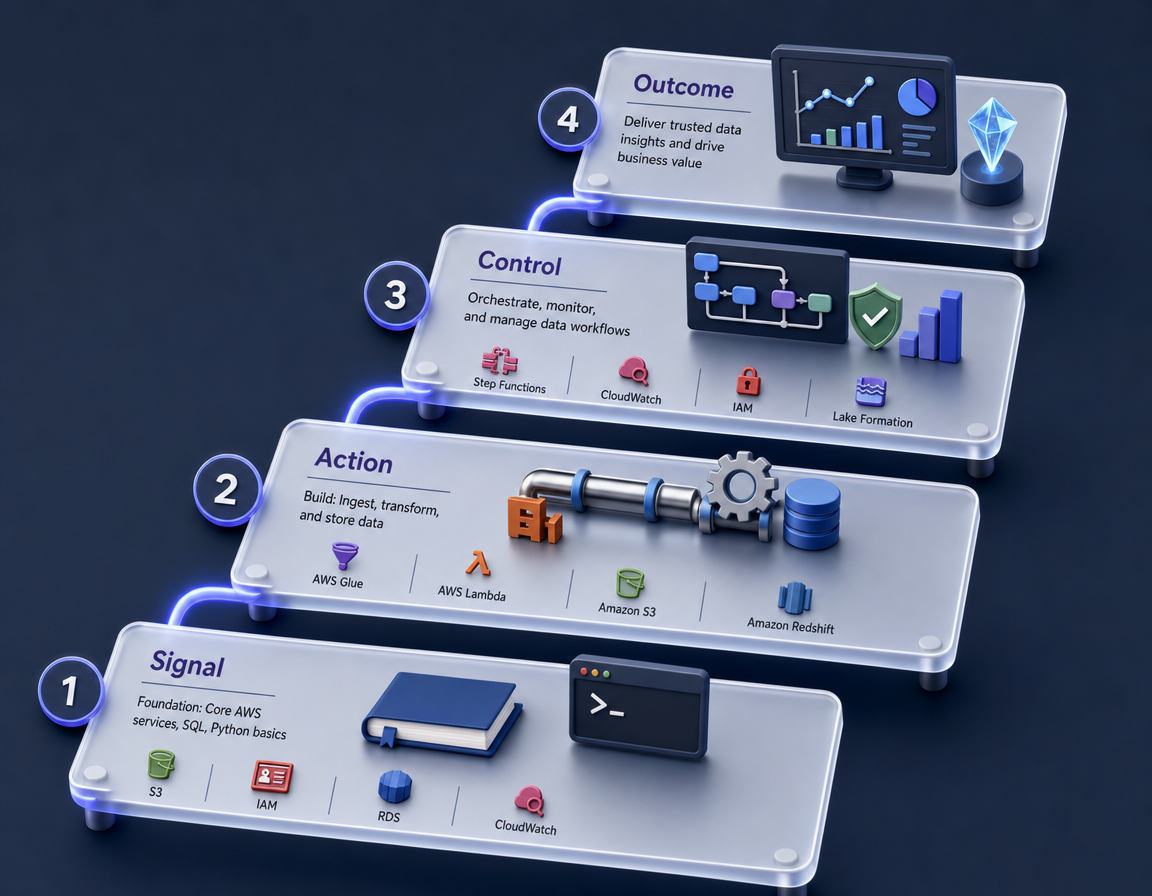 Beginner: Foundation building (weeks 1-2). At this stage, you're mapping services to functions. Build small, complete pipelines: ingest a CSV to S3, transform with Glue, query with Athena. Focus on making things work, not optimizing. Success criteria: you can explain why you chose each service in your pipeline and what alternative you rejected. Study activities should include: completing the AWS Skill Builder Data Engineer learning path, building 3-5 hands-on labs with different ingestion patterns, and creating flashcards for service limits and default configurations. Avoid premature optimization. If your Glue job takes 20 minutes for a 10 MB dataset, note the inefficiency but move on—you'll return to tuning in the intermediate phase. Intermediate: Scenario complexity (weeks 3-4). Now introduce failure modes, schema changes, and cost constraints. Run your pipelines with Spot Instances. Introduce a deliberate schema change and handle it without breaking downstream queries. Add CloudWatch alarms and practice responding to simulated failures. Success criteria: you can debug a failed Glue job from CloudWatch logs and identify the fix without external help. This phase demands deliberate practice with exam-style scenarios. Use the AWS practice test comparison to find resources with scenario-based questions. For each incorrect answer, write a paragraph explaining why your choice was wrong and what architectural principle you missed. This metacognitive practice builds the reasoning patterns the exam rewards. Advanced: Exam simulation and gap closure (weeks 5-6). Take full-length practice exams under timed conditions. Review every incorrect answer to identify whether the error was knowledge, interpretation, or time pressure. Focus remaining study on weak domains. Success criteria: consistent scores above 80% on practice tests with clear understanding of why each wrong answer was wrong. The final week should reduce new content intake and emphasize review. Revisit your error log from practice exams. Re-run your most complex lab pipeline and time yourself. Sleep and stress management matter—cognitive performance degrades measurably with poor rest, and the exam's scenario density requires sustained focus.
Real-World Scenarios
Scenario 1: The streaming pipeline that wasn't. Maria's team built a Kinesis Data Streams pipeline for real-time clickstream analysis. Three weeks after launch, they noticed duplicate events in their analytics dashboard. The root cause: their consumer application didn't implement idempotent writes to DynamoDB. The fix was adding a composite primary key of event ID and timestamp, but the data quality issues took days to clean up. The DEA-C01 tests exactly this pattern: recognizing where exactly-once semantics break down and how to design for failure. Scenario 2: The cost surprise. James migrated a nightly batch ETL from an on-premises Hadoop cluster to EMR. His first month bill was 40% higher than projected. Investigation showed his Spark jobs allocated default executor sizes, leaving most cores idle during shuffle operations. Right-sizing to fewer, larger executors and enabling dynamic allocation cut costs by 60% without increasing runtime. The exam presents similar scenarios where the "obvious" AWS choice isn't the optimal one. Scenario 3: The compliance audit. A healthcare client's data lake needed to demonstrate HIPAA-compliant access controls for an upcoming audit. Priya used Lake Formation to implement column-level permissions and CloudTrail to log all data access. She discovered that several IAM policies granted overly broad S3 access that bypassed Lake Formation controls. The exam tests this intersection of security architecture and governance: knowing when native service controls suffice and when you need additional layers. Scenario 4: The schema evolution crisis. A product team added a new field to their application events, causing downstream Athena queries to fail with "HIVE_BAD_DATA" errors. The data engineering team had used OpenCSVSerde without schema enforcement. The fix involved migrating to Parquet with Glue Data Catalog schema evolution enabled, then backfilling historical data. The DEA-C01 tests format selection consequences: when flexible schemas help and when they create invisible technical debt.
Common Mistakes to Avoid
Mistake 1: Studying services in isolation. The DEA-C01 rarely asks "what does service X do?" It asks "which combination of services solves this problem?" Build study habits around architecture patterns, not feature lists. Draw pipeline diagrams and justify each component choice. Mistake 2: Ignoring the exam guide's task statements. The official exam guide lists specific tasks like "choose an optimal data store based on access patterns" and "implement appropriate authentication and authorization." These aren't suggestions—they're question blueprints. Map your hands-on practice directly to these statements. Mistake 3: Neglecting data security and governance. At 18% of the exam, this domain seems small. But security questions often appear as scenario complications in other domains. A pipeline design question may hinge on whether encryption in transit is required, or whether Lake Formation permissions can replace IAM policies. You can't treat security as a separate study topic. Mistake 4: Over-relying on console experience. The exam tests conceptual understanding, not click-through memorization. If you've only built pipelines through the AWS Console, practice with AWS CLI and CloudFormation or Terraform. Understanding how resources relate in infrastructure-as-code deepens your architectural reasoning. Mistake 5: Skipping practice exams until the final week. Diagnostic testing should start early to guide your study priorities. A practice exam in week two reveals domain weaknesses while you still have time to address them. Final-week practice exams should confirm readiness, not discover gaps. Mistake 6: Underestimating time pressure. Two minutes per question sounds generous until you encounter a multi-paragraph scenario with five answer options, each describing different three-service architectures. Practice under timed conditions from your first full-length exam. Build the habit of identifying the constraint that eliminates most options quickly.
How PlanetCert Helps
Preparing for the DEA-C01 requires more than reading documentation. You need to recognize how AWS presents scenarios, how distractor answers are constructed, and how to manage the 130-minute time constraint under pressure. PlanetCert's AWS practice test comparison includes exam-style questions that mirror the DEA-C01's scenario-based format, with detailed explanations for both correct and incorrect answers. The mobile-friendly simulator lets you build timing discipline during commutes or breaks, and the flashcard system helps reinforce service-specific knowledge gaps identified during full-exam review. For candidates structuring their preparation, the study planning guide for tech certification exams offers frameworks for building sustainable study schedules around work commitments. The exam topics explained resource breaks down how to translate official exam guides into actionable weekly priorities.
What to Read Next
The DEA-C01 sits within a broader AWS certification ecosystem. Your next steps depend on your career direction. If you're building toward the AWS Solutions Architect Professional, deepen your multi-service integration knowledge with the AZ-104 practice test materials—the Azure parallel helps reinforce cloud-agnostic architectural patterns that strengthen AWS reasoning. For security-focused data engineering roles, the Security+ SY0-701 zero-trust and cloud coverage provides complementary governance knowledge that appears increasingly in data platform interviews. If you're comparing certification paths across cloud providers, the best certification exam platforms comparison helps evaluate where to invest your study time based on current market demand and your existing experience.
Related Blog Posts
- AWS practice test comparison — Evaluate exam prep resources for AWS certifications with feature and format analysis
- Study planning guide for tech certification exams — Build sustainable study schedules that account for work constraints and knowledge gaps
- Exam topics explained: how to study what matters — Translate official exam guides into actionable weekly study priorities
- Real Exam Questions Certification Success
- Securityplus Sy0 701 Zero Trust Cloud
browse the relevant exam page and purchase a practice test
Get started
Discussion
Question Comments
0 comments·0 participantsSign in to leave a comment and access more free questions.