

5 TEAS Exam Mistakes That Kill Your Science Score
Most nursing candidates lose points in the Science section before they ever open an anatomy textbook — here is what to fix first.
The ATI TEAS Science section eliminates more nursing candidates than any other subtest, yet most examinees sabotage themselves long before they sit down at the testing center. This checklist is built for candidates who have an exam date within the next 30 days and need a structured correction plan they can execute in under two weeks. Work through each phase sequentially, checking items off as you complete them, and expect to spend roughly eight to ten focused hours resolving all five mistakes.
The Science section accounts for 53 questions across human anatomy and physiology, life and physical sciences, and scientific reasoning. According to ATI's own TEAS exam content areas and breakdown, human anatomy and physiology alone represents 32 scored items — the single largest cluster on the entire TEAS. Candidates who treat all science topics with equal weight, memorize without application, or skip timed simulation are the ones who fall short. These TEAS exam practice mistakes compound quietly, and by test day the gaps feel insurmountable.
Key Takeaways
- Anatomy and physiology deserves twice the study time of any other Science subtopic because it carries the highest question density on the TEAS.
- Passive re-reading of notes is the least effective study method; active recall through practice questions produces measurably better retention.
- Skipping timed practice under realistic conditions creates false confidence that collapses under exam-day pressure.
- Scientific reasoning questions test process literacy — hypothesis evaluation, variable identification, data interpretation — not memorized facts.
- Reviewing answer explanations after every practice set is the single highest-leverage habit most candidates neglect.
Before You Start
Before working through the five mistake-correction phases below, confirm these prerequisites are in place. Missing any of them will reduce the effectiveness of the checklist.
- Confirm your TEAS version. ATI updated the TEAS to Version 7 in June 2022. Verify that every resource you are using — textbooks, flashcards, practice tests — aligns with TEAS 7 content areas. Outdated Version 6 material omits updated anatomy topics and scientific reasoning item formats.
- Secure a reliable question bank. Free quiz websites rarely map questions to the official ATI content plan. Use a platform that tags questions by subtopic and provides detailed explanations, such as the study planning guide for tech certification exams approach of structured, syllabus-aligned preparation.
- Block dedicated study sessions. Each phase in this checklist requires 90 to 120 minutes of uninterrupted focus. Schedule these sessions on your calendar now. Fragmented 15-minute bursts do not produce the deep encoding the Science section demands.
- Gather your baseline score. Take one full-length, timed Science practice test before starting. Record your percentage correct in each subtopic: anatomy and physiology, life sciences, physical sciences, and scientific reasoning. You will reference this baseline in Phase 3.
Phase 1: Stop Treating All Science Subtopics Equally
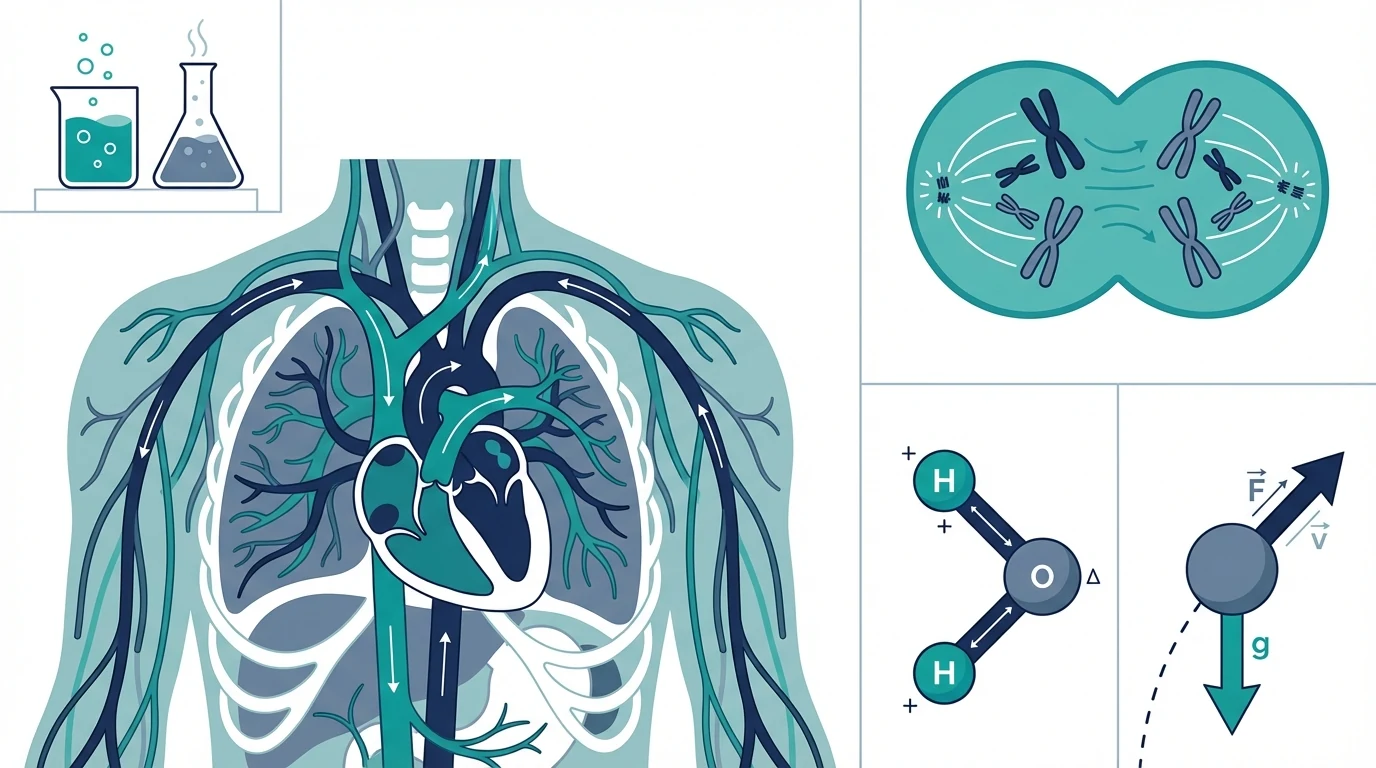
The most pervasive of all TEAS exam practice mistakes is distributing study time evenly across the four Science subtopics. Candidates assume that because the section is labeled "Science," each area must carry similar weight. That assumption is wrong, and it costs points.
Map the official question distribution. Human anatomy and physiology accounts for approximately 32 of the 53 Science questions. Life and physical sciences contribute roughly 8 questions each, and scientific reasoning adds about 5. Write these numbers on a sticky note and attach it to your study area as a constant visual reminder.
Audit your current study plan for time allocation. Open your study schedule and calculate what percentage of Science study time you have assigned to anatomy and physiology. If the answer is below 50 percent, restructure immediately. A candidate spending equal time on four subtopics is giving anatomy only 25 percent of their attention while it represents over 60 percent of their score.
Prioritize the 11 body systems by exam frequency. ATI's content outline specifies cardiovascular, respiratory, nervous, musculoskeletal, digestive, urinary, endocrine, reproductive, integumentary, lymphatic, and immune systems. Historical test analysis suggests cardiovascular, respiratory, and nervous systems appear most frequently. Rank your confidence in each system from 1 to 5 and attack the lowest-scoring systems first.
Create a weighted practice rotation. For every five practice questions you complete, allocate three to anatomy and physiology, one to life or physical sciences, and one to scientific reasoning. This ratio mirrors the actual exam weighting and prevents the common mistake of over-studying low-yield topics at the expense of high-yield ones.
Eliminate "comfort studying." Candidates gravitate toward topics they already understand because correct answers feel rewarding. Identify the two body systems where you score lowest and commit to spending the first 30 minutes of every study session exclusively on those systems. Comfort studying is one of the most insidious TEAS exam practice mistakes because it feels productive while accomplishing nothing.
Phase 2: Replace Passive Review with active recall practice
Reading highlighted notes or watching video lectures without self-testing is the second critical mistake. Cognitive science research consistently demonstrates that retrieval practice — forcing your brain to pull information from memory — produces stronger long-term retention than passive review. A landmark study published in Science magazine on retrieval practice and learning found that students who practiced retrieval retained 50 percent more material one week later compared to students who re-studied the same content.
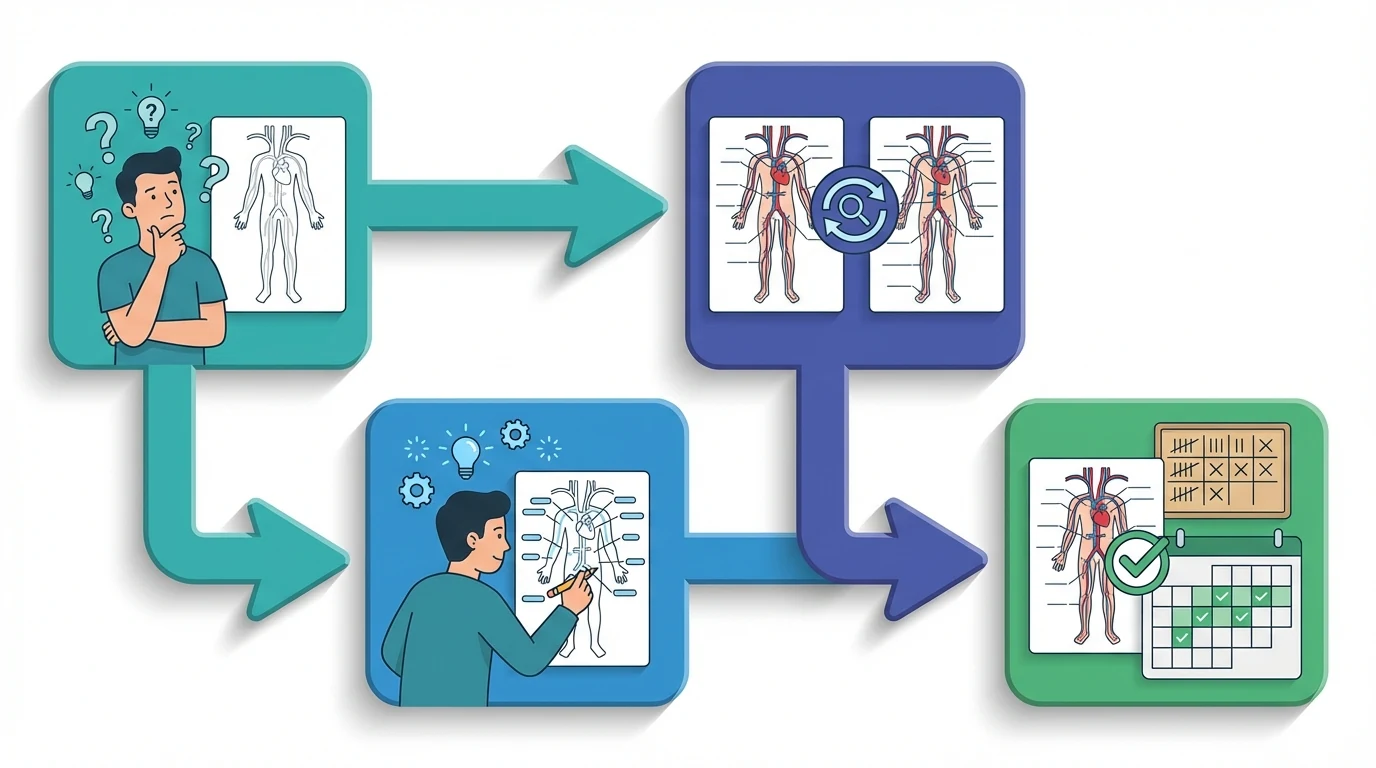
Convert every study session into a question-first format. Before reading any notes on a body system, attempt 10 practice questions on that system cold. Record which questions you miss. Then study only the concepts those missed questions tested. This inverts the traditional "read then quiz" sequence and forces your brain into active retrieval from the first minute.
Build a personal "miss list" spreadsheet. Create three columns: Question Topic, Why I Got It Wrong, and Corrected Understanding. After every practice set, log each missed question. Within two weeks this spreadsheet becomes your single most valuable study resource because it maps your actual knowledge gaps rather than assumed ones. Candidates who use the role of real exam questions in certification preparation understand this principle — authentic questions expose blind spots that passive study cannot.
Use spaced repetition for anatomy terminology. Flashcard apps that implement spaced repetition algorithms (Anki is the most widely validated) present cards at increasing intervals based on your accuracy. Create cards for the anatomical terms, organ functions, and physiological processes you have missed in practice. Review these cards daily for 15 minutes, and the algorithm will automatically prioritize your weakest material.
Teach each body system aloud. After completing a practice set on a specific system, close your materials and explain the system to an empty room as if lecturing a classmate. If you cannot articulate the pathway — for example, tracing blood flow from the right atrium through the pulmonary circuit and back to the left ventricle — you have identified a gap that passive reading would have concealed.
Eliminate the "I knew that" rationalization. When reviewing answers, candidates frequently mark a missed question as understood by saying "I knew that, I just read it wrong." Track these separately. If more than 20 percent of your misses fall into this category, the issue is not careless reading — it is incomplete understanding masked by familiarity with the terminology.
Phase 3: Simulate realistic timing conditions
The third mistake is practicing without a clock. The TEAS Science section allots approximately 63 minutes for 53 questions, which translates to roughly 71 seconds per question. Candidates who practice untimed consistently overestimate their readiness because they unconsciously spend two to three minutes on difficult items without noticing.
Calculate your current pace. Take your baseline practice test results from the prerequisite step. Divide the total time you spent by the number of questions attempted. If your average exceeds 80 seconds per question, you have a pacing problem that will cost you unanswered questions on exam day.
Run timed mini-sets of 15 questions. Set a timer for 18 minutes and attempt 15 Science questions. This replicates the per-question pace of the real exam in a manageable block. After three consecutive sessions where you finish with at least 90 seconds to spare, increase to 25-question sets with 30-minute timers.
Practice strategic skipping. On the real TEAS, spending three minutes on a single anatomy question means stealing time from two other questions you might answer correctly. During timed practice, flag any question that does not yield an answer within 90 seconds and move forward. Return to flagged questions only after completing the remaining items. This triage skill must be rehearsed — it does not emerge naturally under pressure.
Simulate full-section conditions at least twice. Before your exam date, complete two full 53-question Science practice sessions under strict timing. Close all other browser tabs. Silence your phone. Use the restroom beforehand. These sessions should feel uncomfortable — that discomfort is the signal that you are building genuine test-day resilience rather than practicing in an artificially comfortable environment.
Log your timing data by subtopic. After each timed session, note which subtopics consumed disproportionate time. If anatomy questions average 60 seconds but scientific reasoning questions average 100 seconds, you have identified where to focus your efficiency training. Platforms like IT Certification Practice Tests & Simulator provide best certification exam platform comparison data that highlights how timed simulation features differ across study tools — seek platforms that offer per-question timing analytics.
Phase 4: Master Scientific Reasoning as a Skill, Not a Content Area
The fourth TEAS exam practice mistakes pattern involves treating scientific reasoning questions as if they test memorized facts. They do not. Scientific reasoning items assess your ability to interpret experimental designs, identify independent and dependent variables, evaluate hypotheses, and draw conclusions from data tables or graphs. These are process skills, and they require a fundamentally different preparation approach.
Learn the six-step scientific method cold. Observation, question, hypothesis, experiment, analysis, conclusion. Every scientific reasoning question on the TEAS maps to one or more of these steps. When you encounter a reasoning question, immediately identify which step the question is testing. This mental framework converts ambiguous questions into structured problems.
Practice variable identification with real experiments. Find five published experiment summaries (introductory biology or chemistry textbooks work well) and for each one, identify the independent variable, dependent variable, and at least two controlled variables. Repeat this exercise until identification becomes automatic. The TEAS frequently presents a brief experiment description and asks which variable the researcher manipulated — candidates who have not drilled this skill waste critical seconds re-reading the passage.
Build graph-reading fluency. Obtain 10 practice questions that include bar charts, line graphs, or data tables. For each one, answer these four questions before reading the answer choices: What is the x-axis measuring? What is the y-axis measuring? What is the overall trend? Are there any outliers? This four-question pre-read prevents the common mistake of jumping to answer choices before fully understanding the data presentation.
Distinguish correlation from causation in practice items. ATI frequently includes answer choices that conflate correlation with causation. Train yourself to flag any answer choice containing words like "causes," "results in," or "leads to" and verify that the experimental design described actually supports a causal claim. If the study is observational rather than controlled, causation language is almost always the wrong answer.
Complete at least 20 standalone scientific reasoning questions. Isolate these from your anatomy and physiology practice. Many candidates never practice reasoning questions in isolation, which means they never develop the specific reading and analysis strategies these items require. Think of this as a distinct skill — similar to how candidates preparing for other standardized assessments use real exam questions to build certification success by practicing question types individually before combining them.
Phase 5: review every answer explanation, Not Just the Missed Ones
The fifth and final mistake is the most universally neglected. Candidates review explanations for questions they answered incorrectly and skip explanations for questions they answered correctly. This creates a dangerous blind spot: questions answered correctly through elimination, guessing, or partial understanding receive no reinforcement, and those fragile correct answers collapse under slightly different phrasing on the real exam.
Commit to the 100-percent review rule. After every practice set, read the explanation for every single question — correct and incorrect alike. This typically doubles the time spent in review, but the learning value per hour increases substantially. A correct answer you cannot fully explain is not a correct answer; it is a lucky guess that will not replicate.
Categorize your correct answers. For each question you answered correctly, assign one of three labels: Confident (I knew exactly why this was right), Uncertain (I eliminated two choices and guessed between the remaining two), or Lucky (I had no idea and guessed). Track the distribution across practice sets. If Uncertain and Lucky together exceed 30 percent of your correct answers, your true mastery level is significantly lower than your score suggests.
Extract principles, not just facts. When reading an explanation, do not simply note "the answer was B." Instead, identify the underlying principle the question tested. For example, a question about oxygen transport is testing the principle of hemoglobin binding affinity and the oxyhemoglobin dissociation curve. Recording principles rather than isolated facts allows you to answer novel questions that test the same concept from a different angle.
Cross-reference explanations with your miss list. Check whether the principle tested by a correctly answered question overlaps with a principle you previously missed. If it does, that topic area is unstable in your knowledge and deserves additional practice. The importance of real exam questions in certification preparation lies precisely in this kind of cross-referencing — authentic questions reveal interconnected knowledge gaps that single-topic review cannot surface.
Schedule a cumulative review session. Two days before your exam, review your miss list spreadsheet and your categorized correct answers. Focus exclusively on Uncertain and Lucky items. This session should be review only — no new content. Your brain needs 48 hours to consolidate the corrected understanding before exam day.
After You Finish
Once you have completed all five phases, take these closing actions to lock in your preparation and enter the testing center with justified confidence.
Take one final full-length timed Science practice test. Compare your score and pacing data against your baseline from the prerequisite step. You should see measurable improvement in both accuracy and time management. If your score has not improved by at least 10 percentage points, revisit Phase 2 and Phase 5 — active recall and explanation review are typically where the remaining gains hide.
Review your miss list one final time. Read through every entry. For any item where you cannot immediately recall the corrected understanding, spend five minutes re-studying that specific concept. Do not open a textbook and read broadly — target only the documented gaps.
Confirm logistics. Verify your testing center location, appointment time, required identification documents, and permitted calculator policy. Logistical anxiety on exam morning compounds test anxiety and degrades performance on the Science section specifically because it demands the highest cognitive load.
Sleep. Cognitive consolidation occurs during sleep. Studying until 2 AM the night before your TEAS destroys the memory consolidation process that converts short-term practice gains into retrievable knowledge. Set an alarm that gives you eight hours of sleep and stop studying 12 hours before your appointment.
Complete Checklist (Printable Summary)
Phase 1 — Weight Your Study Time
- Map the official question distribution
- Audit current study plan for time allocation
- Prioritize the 11 body systems by exam frequency
- Create a weighted practice rotation
- Eliminate comfort studying
Phase 2 — Active Recall Over Passive Review
- Convert every session to question-first format
- Build a personal miss list spreadsheet
- Use spaced repetition for anatomy terminology
- Teach each body system aloud
- Eliminate the "I knew that" rationalization
Phase 3 — Simulate Realistic Timing
- Calculate current pace
- Run timed 15-question mini-sets
- Practice strategic skipping
- Simulate full-section conditions twice
- Log timing data by subtopic
Phase 4 — Scientific Reasoning as a Skill
- Learn the six-step scientific method
- Practice variable identification with real experiments
- Build graph-reading fluency
- Distinguish correlation from causation
- Complete 20 standalone reasoning questions
Phase 5 — Review Every Explanation
- Commit to the 100-percent review rule
- Categorize correct answers (Confident / Uncertain / Lucky)
- Extract principles, not just facts
- Cross-reference explanations with miss list
- Schedule a cumulative review session
After You Finish
- Take one final full-length timed test
- Review miss list one final time
- Confirm logistics
- Sleep eight hours
How to Prepare with IT Certification practice tests & Simulator
Correcting these five TEAS exam practice mistakes requires more than awareness — it requires a practice platform that supports the specific study behaviors this checklist prescribes. PlanetCert's exam simulator is built for exactly this kind of structured, syllabus-aligned preparation.
The timed simulation mode replicates real testing conditions, allowing you to execute Phase 3 with per-question pacing analytics that reveal where your time leaks occur. Review mode provides detailed explanations for every question — correct and incorrect — which directly supports the Phase 5 requirement of reviewing 100 percent of explanations rather than only missed items. Questions are mapped to specific content areas, so you can isolate scientific reasoning practice (Phase 4) or weight your sessions toward anatomy and physiology (Phase 1) without manually sorting through an untagged question bank.
PlanetCert's question banks are built from official syllabus objectives, not recycled braindumps. This distinction matters because the CCSP practice test comparison analysis demonstrates how syllabus-aligned questions produce fundamentally different preparation outcomes than generic question sets. The same principle applies to TEAS preparation: questions that mirror ATI's content plan expose the same cognitive demands you will face on exam day.
Browse the full catalog of available exams at PlanetCert's exam library to find practice tests matched to your certification goals. Whether you are preparing for the TEAS or expanding into IT certifications after nursing school, the simulator's pass-or-refund guarantee means your investment is protected.
Frequently Asked Questions
What are the most common TEAS exam practice mistakes in the Science section?
The five most damaging TEAS exam practice mistakes are distributing study time equally across subtopics instead of weighting anatomy and physiology, relying on passive review instead of active recall, practicing without timed conditions, treating scientific reasoning as a content area rather than a process skill, and reviewing explanations only for missed questions. Each mistake independently reduces scores, and most candidates commit at least three of the five simultaneously.
How many questions are on the TEAS Science section?
The TEAS 7 Science section contains 53 questions. Of those, approximately 32 cover human anatomy and physiology, 8 address life sciences, 8 cover physical sciences, and 5 assess scientific reasoning. The section time limit is 63 minutes, giving candidates roughly 71 seconds per question. Understanding this distribution is essential for allocating study time effectively.
How long should I study for the TEAS Science section?
Most candidates benefit from 40 to 60 hours of focused Science section preparation spread across three to four weeks. However, total hours matter less than study quality. A candidate who spends 30 hours using active recall, timed simulation, and thorough explanation review will outperform a candidate who spends 80 hours passively re-reading highlighted notes. Use the checklist phases above to structure your time for maximum retention.
Is the TEAS Science section harder than the other sections?
The Science section is statistically the lowest-scoring subtest for most TEAS candidates. ATI does not publish official pass rates by section, but aggregated data from nursing program admissions consistently shows Science as the section where candidates score furthest below their target. The difficulty stems not from the content itself but from the breadth of material — 11 body systems plus life sciences, physical sciences, and scientific reasoning — combined with strict time pressure.
Can I use a calculator on the TEAS Science section?
ATI provides an on-screen calculator for the TEAS, but its utility on the Science section is limited. The vast majority of Science questions test conceptual understanding, anatomical knowledge, and reasoning skills rather than numerical computation. Candidates who spend practice time mastering the calculator at the expense of content mastery are misallocating their preparation effort. Focus calculator practice on the Math section instead, where computational speed directly impacts scores.
Related Blog Posts
- Study Planning Guide for Tech Certification Exams — structured preparation frameworks that apply to any standardized test
- The Role of Real Exam Questions in Certification Preparation — why authentic practice questions outperform generic study material
- Real Exam Questions and Certification Success — data on how question quality affects pass rates
- Why Real Exam Questions Matter for Certification — the science behind retrieval practice and exam simulation
- Best Certification Exam Platforms Comparison — evaluating practice test platforms by features that matter
- CCSP Practice Test Comparison — how syllabus alignment affects preparation outcomes
- CompTIA Network+ SD-WAN and Careers — expanding into IT certifications after clinical credentials

Discussion
Question Comments
0 comments·0 participantsSign in to leave a comment and access more free questions.