
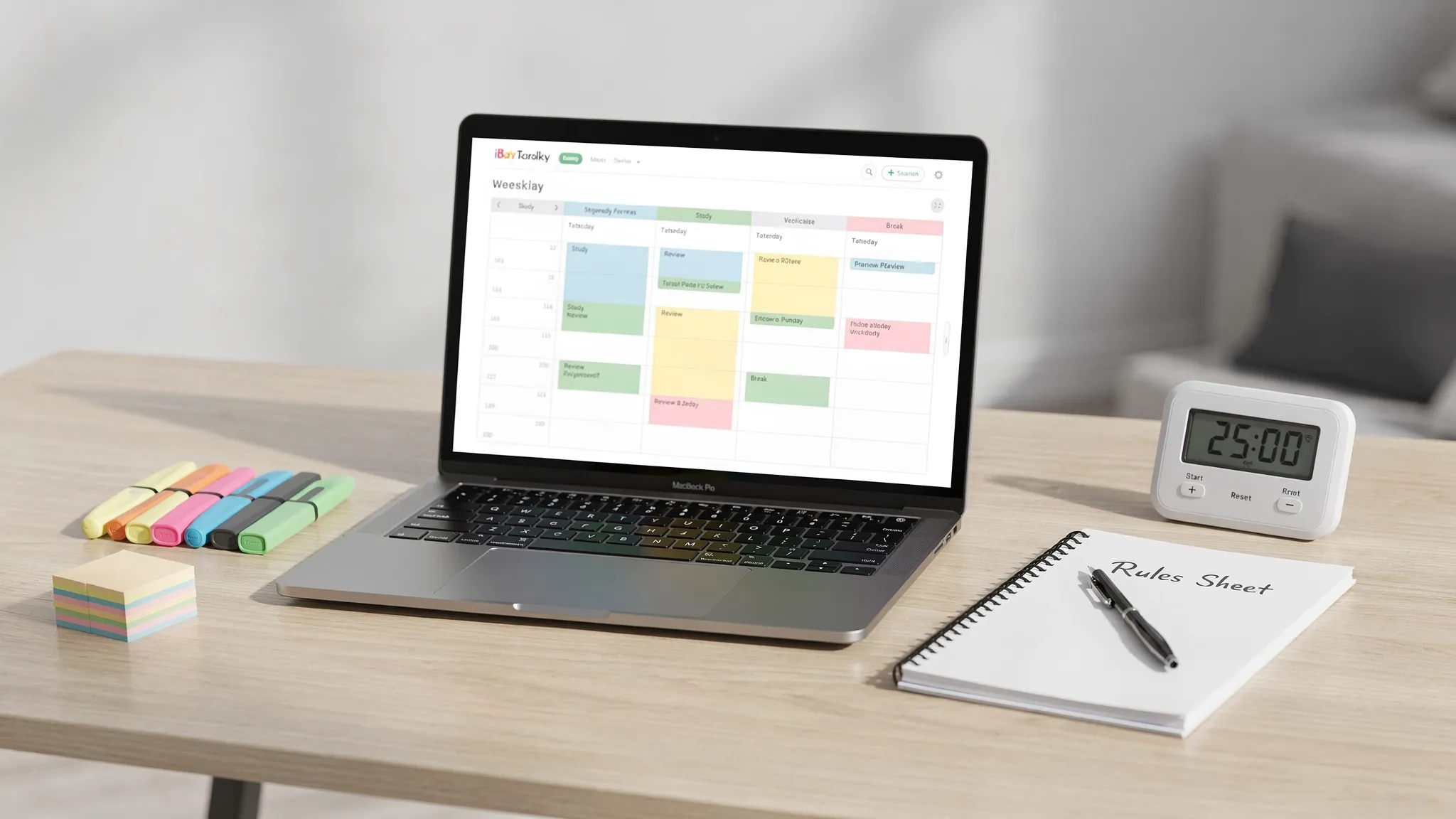
Cramming feels productive because it creates urgency. The problem is that urgency is not the same as retention. Most certifications and professional exams reward durable recall, pattern recognition, and decision-making under time pressure, which are built through repetition over time.
A weekly plan solves that by doing two things cramming cannot:
- It spaces your exposure to the same concepts across multiple days (so memory strengthens instead of fading).
- It forces you to practice retrieval and exam-style decisions, not just “read and highlight.”
Below is a practical weekly system you can reuse for almost any exam, whether you have 30 minutes a day or a full hour.
The “no-cram” rule: what you do every week
A weekly plan that sticks needs a repeatable structure. The simplest one is:
- Build (learn): add new material in small chunks.
- Retrieve (recall): pull it from memory without notes.
- Test (apply): answer exam-style questions under realistic constraints.
- Repair (review): convert mistakes into a short list of rules, then retest.
If you only “build,” you feel busy but you do not get faster or more accurate on test questions. If you only “test,” you may plateau because you are repeating the same mistakes.
Step 1: Choose a weekly time budget you can actually keep
Most people fail study plans because the plan assumes an ideal week. Instead, pick one of these two budgets and commit for 4 weeks.
Option A (recommended): 5 days x 45 minutes + 1 longer session
- Mon to Fri: 45 minutes
- Sat or Sun: 90 minutes
- One rest day: no studying
Option B (busy weeks): 3 days x 60 minutes + 1 longer session
- 3 weekdays: 60 minutes
- Sat or Sun: 90 minutes
- Other days: 10-minute “maintenance” only
The goal is not to maximize minutes. The goal is to make studying automatic.
Step 2: Use a weekly template (copy, paste, repeat)
This template assumes you have a blueprint or domain list (most certification exams publish one). If not, use your course sections or study guide chapters.
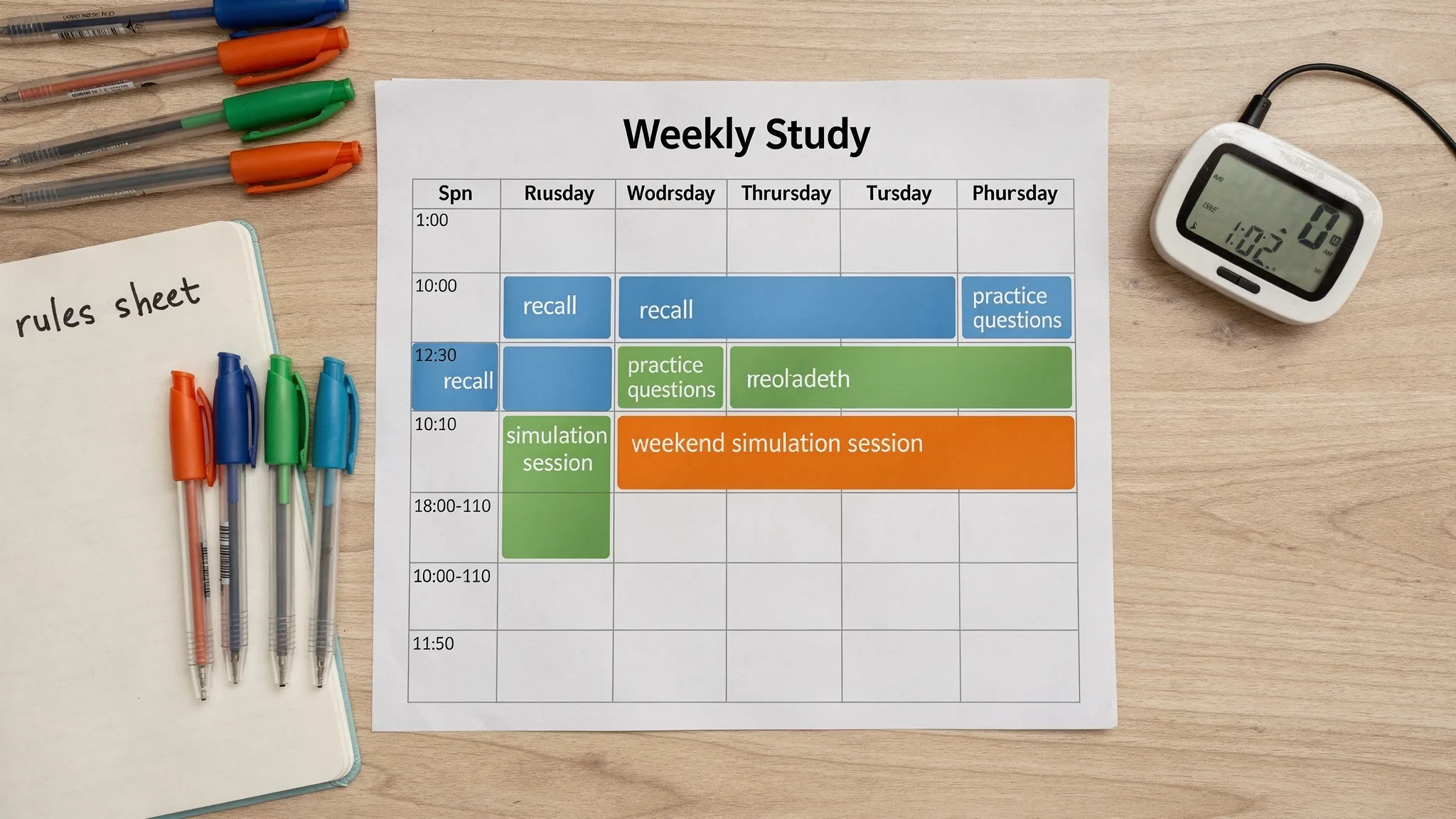
| Day | Primary goal | What you do (minimum effective dose) | Output you keep |
|---|---|---|---|
| Monday | Baseline + plan | 15-question diagnostic set + identify 2 weak domains | A short “this week focus” list (2 domains) |
| Tuesday | Learn + recall | 25 min learn, 10 min closed-book recall, 10 min flashcards | 10 recall prompts (questions you can self-test) |
| Wednesday | Targeted practice | 20 to 30 timed questions from weak domains | Error notes for missed/guessed items |
| Thursday | Repair day | Review misses, rewrite them into “if/then” rules, retest 10 items | A 1-page “rules sheet” |
| Friday | Mixed set | 25 to 40 mixed questions (all domains), timed | Trend note: what’s improving, what’s not |
| Weekend | Simulation + deep review | One longer timed set, then structured review | Updated rules sheet + next week focus |
If you are studying for an exam with performance-based tasks, labs, or simulations, swap Wednesday or Thursday’s block for hands-on work. The weekly rhythm stays the same.
Step 3: Make recall non-negotiable (this is the anti-cram lever)
Reading is not rehearsal. Recall is rehearsal.
A simple recall block looks like this:
- Close your notes.
- Write 8 to 12 prompts that your exam could ask.
- Answer from memory in short bullets.
- Reopen your notes and correct only what is wrong or missing.
Good recall prompts are specific and decision-focused:
- “When would I choose X over Y?”
- “What is the first step when I see symptom Z?”
- “Which option violates the requirement and why?”
Over time, these prompts become your personal “exam brain” training set.
Step 4: Turn every mistake into a rule (instead of a regret)
Most people review incorrectly. They reread the explanation, nod, and move on. That creates familiarity, not skill.
Use this lightweight review loop after every question set:
The C.L.E.A.R. review loop
- Capture: Was it wrong, guessed, or slow? Mark it.
- Locate: Was it a knowledge gap, a misunderstanding, or a process error (misread, rushed, eliminated wrong)?
- Explain: Write a one-sentence explanation in your own words.
- Add a rule: Create an “if/then” trigger you will use next time.
- Retest: Re-answer the same question (or a close variant) within 48 to 72 hours.
Examples of rules that actually help on exam day:
- “If two answers are both true, choose the one that best satisfies the constraint in the question.”
- “If the scenario mentions latency sensitivity, favor the option that reduces round trips.”
- “If I cannot justify an answer in one sentence, I do not know it well enough yet.”
This is how you study for exams without cramming, because you are building a growing playbook of decisions.
Step 5: Add realistic timing before you feel “ready”
Cramming often happens because timing surprises you late. Train timing early, in small doses:
- Start with mini-timed sets (10 to 15 questions) twice a week.
- Add one longer timed set on the weekend.
- Keep a simple “time leak” note: what types of questions steal your minutes?
If your exam is long, stamina matters as much as knowledge. The weekend session is where you practice staying accurate while slightly tired.
Step 6: Use practice questions strategically (not as endless scrolling)
High-quality questions do two jobs:
- They reveal what you do not know (diagnostic value).
- They train the decision patterns your exam rewards (performance value).
To keep it structured, assign each question set a purpose:
- Tuesday: topic-linked questions (right after learning)
- Wednesday: weak-domain drills
- Friday: mixed-domain accuracy check
- Weekend: exam-style simulation
If you want one place to run this system with realistic pacing, explanations, and a simulator, use a dedicated practice platform. For example, Planet Cert practice tests include expert-verified practice exams, exam questions, and a web-based simulator you can use on desktop or mobile, which fits well with timed weekday sets and a longer weekend simulation.
Step 7: Track only the metrics that predict passing
You do not need elaborate dashboards. You need signals that tell you when your study is working.
Use this simple tracker once per week (Friday or weekend):
| Metric | What to record | What “good” looks like |
|---|---|---|
| Mixed-set accuracy | % correct on a mixed set | Trending up week over week |
| “Explainability” | % you can justify in 1 sentence | Above 80% before exam week |
| Timing | Avg seconds per question | Stable under your target pace |
| Repeat misses | Topics you miss twice | Shrinking list each week |
The most important metric is repeat misses. If the same idea keeps showing up, it deserves a dedicated drill session, not more reading.
Two weekly schedules you can follow exactly
The 45-minute weekday schedule
Use the same three-part structure each day so it becomes automatic:
- 5 minutes: warm-up recall (from yesterday’s prompts)
- 30 minutes: the day’s main work (learn, drill, or mixed questions)
- 10 minutes: review (C.L.E.A.R. notes + 1 to 2 new rules)
The 90-minute weekend schedule
- 45 to 60 minutes: timed simulation set
- 30 to 45 minutes: deep review (C.L.E.A.R. + rules sheet update)
This is where your score improves the most, because review is where learning is “locked in.”
How to avoid the 3 most common weekly-plan failures
Failure 1: You over-pack Monday and fall behind by Wednesday
Fix: Monday is for diagnosis and planning, not hero study sessions. Keep it short, define the two domains you will focus on, and move on.
Failure 2: You keep doing “more questions” but your score stalls
Fix: increase your review intensity, not your question volume. Your rules sheet should grow, and repeat misses should shrink.
Failure 3: Life happens and you miss two days, then you cram
Fix: use a recovery rule: “Never try to make up missed hours. Make up missed reps.”
That means you do one mixed set + one repair session, then return to the normal schedule.
Tie the plan to a career outcome (it makes consistency easier)
If the exam supports a role change or promotion, connect your weekly plan to what employers reward. For example, candidates aiming for leadership-track roles often benefit from knowing which certifications and skills are being hired for in their market. Browsing an international recruitment agency like Optima Search Europe can help you see how companies describe high-impact responsibilities in sales, marketing, digital, IT, and executive roles, which can clarify why you are putting in the weekly reps.
Motivation gets you started. A clear outcome keeps you consistent.
A 4-week arc you can repeat for almost any exam
Once the weekly template is stable, here is how to aim it over a month:
- Week 1: diagnostics + fundamentals, build your first rules sheet
- Week 2: weak-domain focus, increase mixed sets, retest rules
- Week 3: more timed work, reduce time leaks, stabilize accuracy
- Week 4: full simulations, tighten review, keep sleep and routines steady
You can extend this to 6 to 8 weeks by repeating Weeks 2 and 3.
The simplest way to start (today)
If you want to study for exams without cramming, do this in the next 60 minutes:
- Take a 15-question diagnostic set.
- Identify two weak domains.
- Schedule three sessions this week (two short, one longer).
- Create your first rules sheet with at least five “if/then” triggers.
Then repeat the weekly template. Consistency beats intensity, and a plan that sticks is the one you can run even on your busiest week.

Discussion
Question Comments
0 comments·0 participantsSign in to leave a comment and access more free questions.