
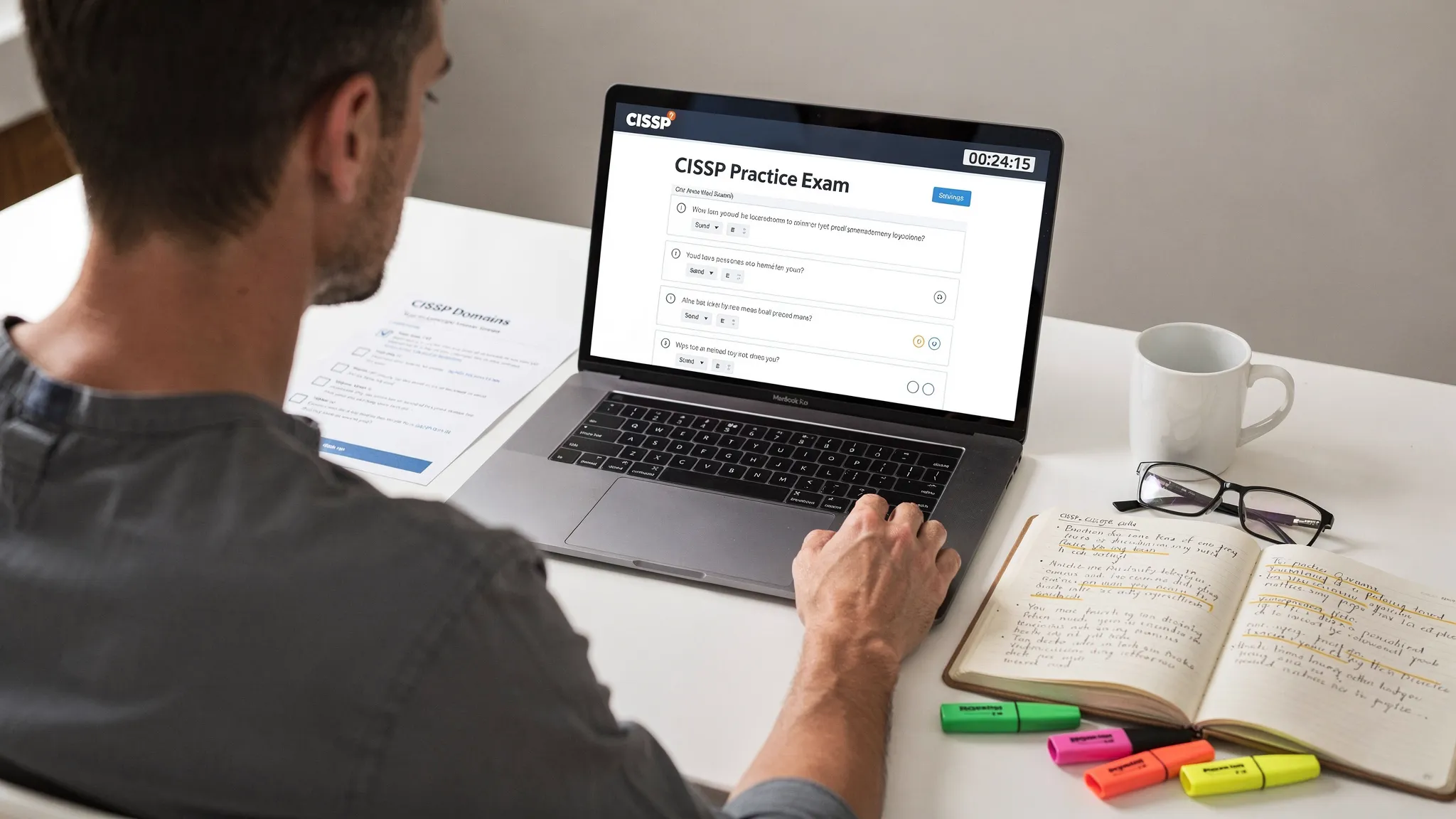
If you are searching for an online CISSP practice exam, you are likely past the “what is CISSP” stage and into execution: building the timing, decision-making, and endurance you need to pass on exam day.
Last verified: March 10, 2026. ISC2 lists the CISSP exam as Computerized Adaptive Testing (CAT) for all exams, with 100 to 150 items in 3 hours and a passing standard of 700 out of 1000 points.[1][2]
| CISSP exam fact | Current official detail |
|---|---|
| Format | Computerized Adaptive Testing (CAT) for all exams |
| Length | 3 hours |
| Number of items | 100 to 150 |
| Passing standard | 700 out of 1000 points |
| Current outline | Effective April 15, 2024 |
That is exactly how you should use practice exams for CISSP. Not as a one-off score check, but as a repeatable system for:
- Learning to answer at CAT pace without second-guessing
- Understanding what “passing” means when the real exam is adaptive
- Converting missed questions into durable fixes (not temporary memorization)
Below is a practical guide to timing, scoring, and prep tactics that make online practice exams translate into a real pass.
What your online CISSP practice exam must replicate (or it will mislead you)
Before you obsess over your percentage correct, make sure your practice environment resembles the real constraints.
The real CISSP exam is CAT
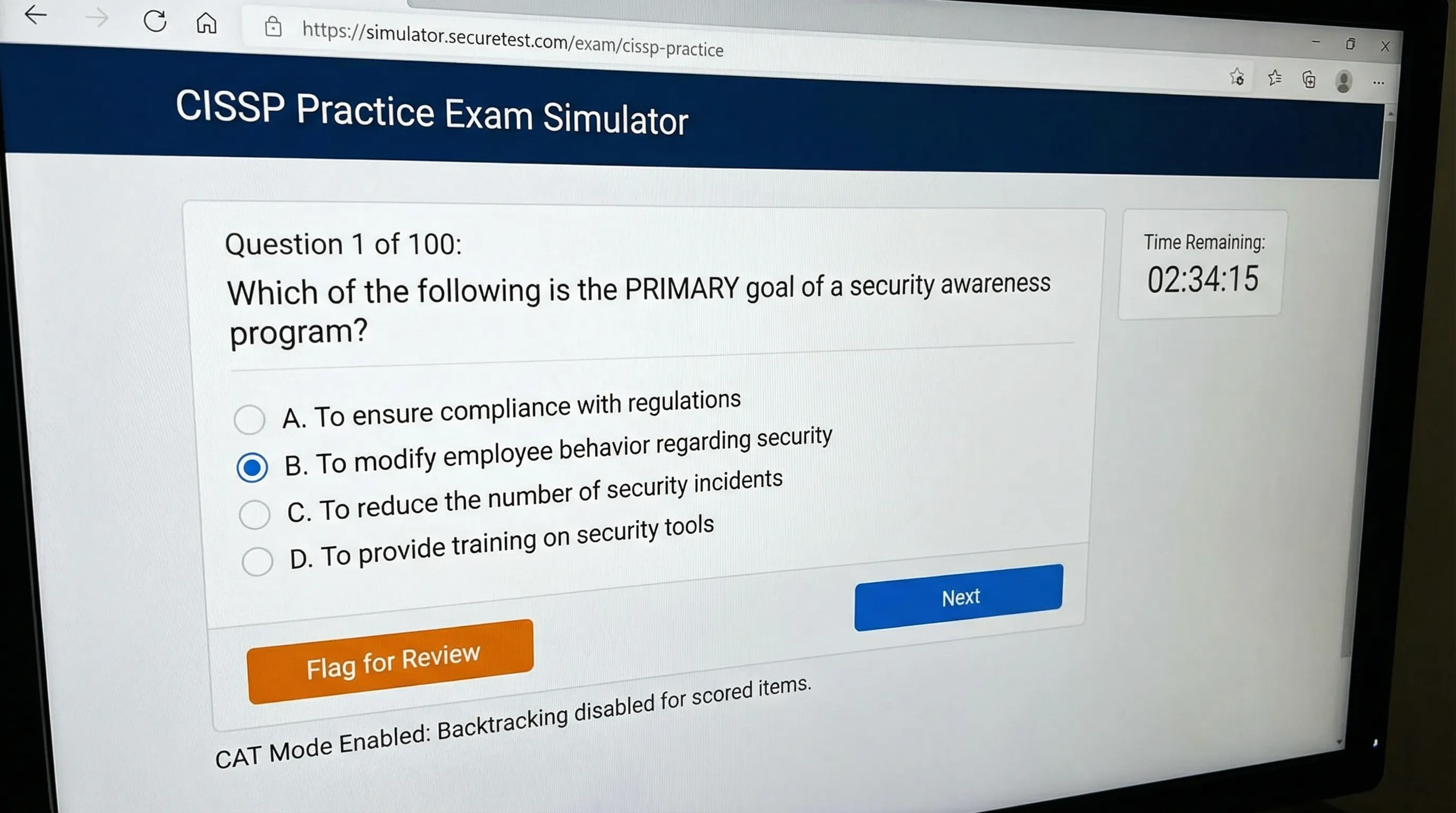
ISC2 states that the CISSP exam uses Computerized Adaptive Testing (CAT) for all exams. The test adapts question difficulty based on your performance, and you cannot go back to change answers. The current published parameters in ISC2's certification and outline materials are:[1][2]
- Length: 100 to 150 items
- Time: 3 hours
- Passing standard: 700 out of 1000 points
Verify the latest format directly on the official ISC2 pages because exam parameters can change over time: ISC2 CISSP certification exam outline and the ISC2 CISSP certification page.
Why this matters for practice
Many candidates train in a way that is structurally different from CAT:
- They do “review mode” quizzes with unlimited time.
- They rely on backtracking to correct earlier mistakes.
- They pause often, breaking the mental stamina requirement.
A good online CISSP practice exam experience should let you run timed, uninterrupted simulations and then review afterward with explanations.
CISSP timing: a pace that works in CAT
The biggest timing mistake is trying to “finish fast.” The goal is to maintain a steady, defensible decision process for up to three hours.
Build your pace around the worst-case question count
Because the current CISSP CAT can go up to 150 items in 3 hours, plan around that ceiling.
- 3 hours = 180 minutes
- 180 minutes / 150 items = ~1 minute 12 seconds per item
That does not mean you must answer every question in 82 seconds. It means your overall rhythm must average out close to that when the exam extends.
A practical timing model you can rehearse
Use this model during every full online CISSP practice exam:
- First pass decision window: Aim to decide within ~60 to 90 seconds.
- Hard-stop rule: If you are still torn after ~2 minutes, choose the best defensible answer and move on.
- Micro-reset: Every 20 to 25 questions, take 5 to 10 seconds to unclench your jaw, reset posture, and breathe.
This keeps you from spending 4 minutes on a single item early, then rushing the last third of the exam.
CAT-specific timing reality: you cannot “make it up later”
In linear exams, you can sometimes recover by revisiting flagged items. In CISSP CAT, you typically cannot return to previous questions. So your practice needs to include:
- Committing to an answer the first time
- Avoiding perfectionism
- Reducing rereads by improving your question-parsing routine
A simple parsing routine to train:
- Read the last line first (what is the question really asking?)
- Identify the domain and role (manager vs engineer, risk vs fix)
- Eliminate two answers fast, then choose between the remaining two
If you repeatedly miss “best,” “most appropriate,” or “first” style prompts, review these common certification exam question types before your next timed set.
CISSP scoring: what “700 out of 1000” really means
Candidates often try to map practice percentages directly to the real exam. That is not how CISSP works.
What ISC2 publicly states about passing
ISC2 reports CISSP results as pass/fail, and the passing standard is commonly described as 700 out of 1000 on their scale. Under the hood, CISSP scoring uses psychometric methods and CAT behavior that are not equivalent to a raw percentage.
Your practice platform cannot perfectly reproduce ISC2’s scoring model, but it can still measure what matters: your readiness under time pressure and your consistency across domains.
How to interpret practice exam scores without fooling yourself
Use your online CISSP practice exam results to answer three questions:
- Is my performance stable under time? (Not just one lucky high score)
- Do I miss questions for the same reasons repeatedly? (Patterns beat percentages)
- Can I explain why the right answer is right? (CISSP tests judgment)
Here is a practical way to translate practice performance into next steps.
| Practice signal (timed, full-length) | What it often means | What to do next |
|---|---|---|
| Score swings widely between attempts | Gaps are broad, review is not targeted | Tighten your error log and drill weak domains for 3 to 5 days |
| Solid accuracy but you run out of time | Decision process is too slow | Train 60 to 90 second decisions, do mixed timed sets |
| Good timing but misses are “avoidable” | Misreads, assumptions, rushing | Add a question-parsing checklist, slow down on keywords |
| Consistent performance across domains | Readiness is rising | Shift from topic drills to more full simulations |
Treat the table as a diagnostic tool. A stable “good-enough” score under realistic conditions is more valuable than a single high score with pauses, notes, or backtracking.
The review loop that makes practice exams actually improve your score
Most candidates waste the value of a practice exam during review. They read the explanation, nod, and move on. Two days later they miss the same concept again.
Instead, use a structured loop that turns each miss into a permanent upgrade.
Step 1: Keep an error log that captures cause, not just topic
For every missed (or guessed) question, record:
- Domain and subtopic
- Why your chosen answer felt right
- Why the correct answer is better (in CISSP framing)
- The root cause category
Root cause categories that work well for CISSP:
- Concept gap (did not know)
- Misread (missed “best/most/first”)
- Role confusion (engineer fix vs manager risk decision)
- Overthinking (added facts not in the question)
- Weak elimination (did not remove distractors fast)
Step 2: Do a “cold re-solve” the next day
The next day, re-attempt the same question (or a similar one) without looking at notes first. If you still miss it, the issue is not memory, it is understanding.
Step 3: Convert mistakes into micro-drills
For each root cause pattern, create a small drill:
- If you misread, do 20 questions where your only goal is underlining (mentally) the exact ask.
- If you confuse roles, practice writing one sentence: “As a CISSP, my priority here is…” before choosing.
- If it is a concept gap, write a 5-line summary and then do 10 targeted questions immediately.
This is how practice exams create compounding returns.
Timing + review: how many full online practice exams should you run?
There is no universal number, but you want enough repetitions to remove randomness.
A strong pattern for many candidates:
- Early phase: shorter timed sets (20 to 40 questions) to build speed and parsing
- Middle phase: 2 to 4 full simulations to pressure-test pacing and stamina
- Final phase: additional full simulations until your performance is consistent and your error log stops revealing new root causes
The key is consistency. If you take 6 full exams but never fix the underlying patterns, you simply practice being wrong faster. If you need a broader workflow for turning practice scores into a review system, use this practice test strategy guide.
High-impact CISSP prep tips that pair well with online practice exams
CISSP is not a pure trivia exam. Many questions are scenario-based and reward sound security governance judgment.
Train “CISSP thinking,” not just memorization
When reviewing explanations, ask:
- What is the risk-management principle at work?
- What is the best next step in a process (not the coolest tool)?
- What would reduce risk broadly, not just patch a single symptom?
This is why many correct answers look “boring” compared to flashy technical options.
Use a lightweight lab mindset for certain domains
You do not need a full enterprise lab, but hands-on familiarity helps your intuition in areas like:
- IAM flows (authentication vs authorization, federation basics)
- Network segmentation concepts
- Logging and detection fundamentals
The goal is not to become a tool expert. It is to reduce cognitive load when a scenario references common real-world patterns.
Protect your study schedule with a realistic budget
CISSP prep often involves exam fees, retake planning, books, and practice platforms. If budgeting stress is competing with your study focus, build a simple plan for your prep spend and timeline. The FIYR personal finance blog is a useful resource for practical budgeting and long-term planning ideas that can help you keep exam prep financially predictable.
A simple 21-day plan built around online CISSP practice exams
This is a practical, exam-driven plan you can adapt based on your timeline.
Week 1: Diagnose and build your timing foundation
- Take one timed baseline exam (or a long mixed set) to identify weak domains
- Start your error log immediately
- Do 4 to 5 days of targeted drills on your two weakest domains
- Add 2 timed mixed sets (30 to 50 questions) focusing on pacing
Week 2: Shift to mixed practice and decision consistency
- Alternate targeted drills with mixed timed sets
- Run one full simulation mid-week under strict conditions (no pausing)
- Review using the cold re-solve method the next day
Week 3: Full simulations and readiness confirmation
- Run 2 full simulations spaced out (example: Day 2 and Day 5)
- Between simulations, drill only what your error log proves is still failing
- Two days before your exam, stop chasing new material and focus on:
- Common misread traps
- Role and process questions
- A steady pacing rhythm
Choosing a platform for online CISSP practice exams
When selecting where to practice, prioritize fidelity and learning efficiency.
Look for:
- Timed simulator experience (mobile-friendly is a plus)
- High-quality explanations (not just answer keys)
- A large question pool so you can avoid repeating the same items too soon
- Updated content that reflects the current eight-domain outline and current CAT exam window
If you want one place to run realistic simulations and targeted drills, start with the CISSP exam page for the current exam details and use the CISSP practice test route for timed practice. If you are comparing cloud-security study paths alongside CISSP, this CCSP practice test comparison is the closest related guide on the site.

Sources Used in This Refresh
The bottom line
A strong online CISSP practice exam strategy is not about chasing a magic percentage. It is about rehearsing the real constraints (CAT timing and no backtracking), then using a disciplined review loop to eliminate repeatable mistake patterns.
Do that, and your practice results become predictive, your timing becomes automatic, and exam day feels like another simulation instead of a gamble.

Discussion
Question Comments
0 comments·0 participantsSign in to leave a comment and access more free questions.