

Certification Exam Question Types: Raising Success Rates
Facing the next CompTIA Security+ or AWS Certified Solutions Architect exam, many IT professionals and students discover that mastering question types is as vital as knowing technical content. Certification bodies worldwide use a mix of multiple-choice, scenario-based, and performance tasks to verify true expertise, rather than just memorization. By understanding how each format tests different skills, candidates can build focused strategies that increase confidence and exam success.
Key Takeaways
| Point | Details |
|---|---|
| Varied Question Types Enhance Assessment | Certification exams use multiple question formats to accurately evaluate both knowledge and practical skills. |
| Focus on Practical Application | Exam strategies prioritize real-world scenarios and problem-solving over rote memorization. |
| Importance of Understanding Exam Formats | Familiarity with diverse question formats helps candidates reduce test anxiety and adapt their strategies effectively. |
| Avoid Common Pitfalls | Candidates should be aware of common missteps and develop systematic approaches for each question type to improve performance. |
Defining Certification Exam Question Types
Certification exams employ strategic question types designed to comprehensively assess a professional’s technical knowledge, practical skills, and domain expertise. Computer-based testing platforms have revolutionized how these assessments are structured, introducing multiple sophisticated evaluation methods beyond traditional multiple-choice questions.
These exam question types typically fall into several core categories:
- Multiple Choice Questions (MCQs): Single correct answer from 3-5 options
- Multiple Response Questions: Several correct answers from multiple options
- Drag and Drop: Demonstrating knowledge by organizing information
- Point and Click: Interactive scenario-based assessments
- Fill-in-the-Blank: Direct knowledge verification
- Simulation-Based: Practical skill demonstration
Each question type serves a unique purpose in validating professional competencies. Multiple-choice questions allow rapid knowledge assessment, while interactive formats like drag-and-drop evaluate deeper understanding and practical application.
Certification bodies strategically design these question types to minimize guesswork and ensure candidates demonstrate genuine comprehension. By incorporating varied assessment methods, exams can more accurately measure a professional’s true capabilities across different cognitive levels and skill domains.
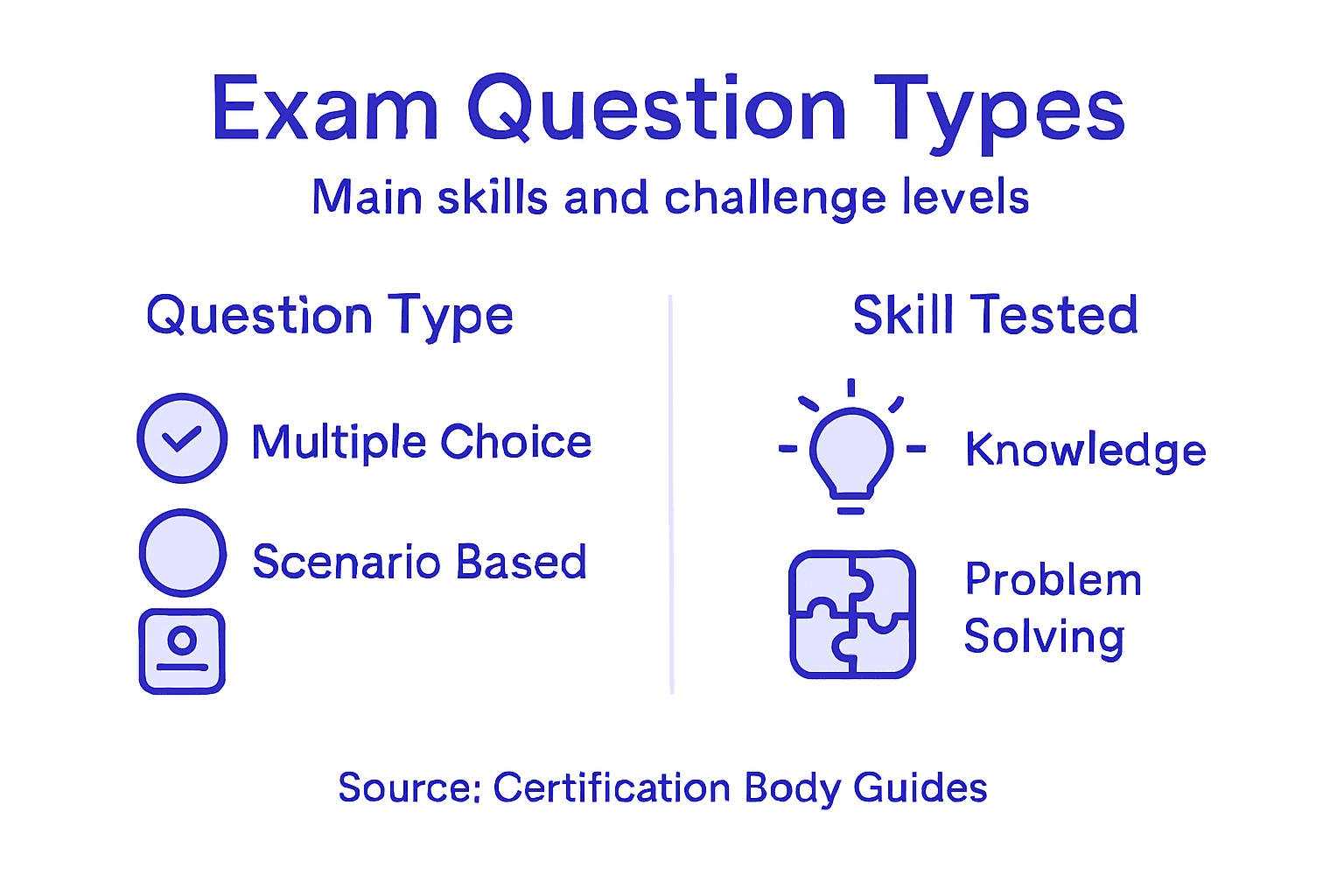
Here’s a summary comparing certification exam question types and the cognitive skills they primarily evaluate:
| Question Type | Main Skill Evaluated | Typical Challenge Level |
|---|---|---|
| Multiple Choice (MCQ) | Knowledge recall | Basic to moderate |
| Drag and Drop | Information organization | Moderate |
| Simulation-Based | Real-world application | Advanced |
| Hotspot/Point & Click | Visual problem-solving | Moderate |
| Case Study Scenarios | Analytical reasoning | Advanced |
| Performance-Based | Practical demonstration | Advanced |
Pro tip: Always review the specific exam blueprint to understand exactly which question types you’ll encounter and practice accordingly.
Common Formats in Tech Certification Exams
Tech certification exams have evolved significantly, moving beyond traditional testing methods to incorporate sophisticated assessment techniques that more accurately measure professional competency. Technical certification formats now include multiple question types designed to evaluate candidates’ practical knowledge and critical thinking skills.
The most common formats in tech certification exams include:
- Multiple Choice Questions (MCQs): Assessing foundational knowledge
- Check-All-That-Apply (CATA): Testing comprehensive understanding
- Hotspot Questions: Evaluating visual problem-solving skills
- Case Study Scenarios: Measuring real-world application abilities
- Performance-Based Testing: Simulating actual work environment challenges
- Adaptive Questions: Dynamically adjusting difficulty based on candidate responses
Each question format serves a strategic purpose in comprehensively evaluating a professional’s technical expertise. Multiple-choice questions provide rapid knowledge assessment, while case studies and performance-based questions demand deeper analytical and practical skills.

Certification bodies carefully design these varied question formats to create a holistic evaluation that goes beyond simple memorization. By incorporating different assessment methods, exams can more effectively gauge a candidate’s true professional capabilities, ensuring that certification represents genuine competence in the field.
Pro tip: Practice with diverse question formats to build flexibility and reduce test anxiety during your certification examination.
Unique Features of CompTIA and AWS Questions
CompTIA and AWS certification exams distinguish themselves through sophisticated questioning strategies that go beyond traditional knowledge testing. Sample certification questions reveal unique approaches designed to evaluate comprehensive technical understanding and practical application skills.
Key distinctive features of these certification exam questions include:
- Scenario-Based Complexity: Presenting real-world technical challenges
- Multi-Layered Problem Solving: Requiring integrated knowledge across domains
- Dynamic Difficulty Scaling: Adapting question complexity based on candidate responses
- Practical Application Focus: Emphasizing skills over rote memorization
- Interdisciplinary Knowledge Testing: Connecting multiple technical concepts
- Contextual Decision-Making Scenarios: Evaluating critical thinking and system-level understanding
CompTIA Security+ and AWS Solutions Architect exams, in particular, incorporate advanced questioning techniques that simulate actual professional environments. Their questions often require candidates to analyze complex scenarios, demonstrating not just technical knowledge, but the ability to make strategic decisions under realistic constraints.
These certification bodies have intentionally designed their question formats to mirror the complexity of modern technological challenges. By creating questions that demand critical analysis and practical application, they ensure that certified professionals possess genuine, actionable expertise rather than superficial understanding.
This table highlights unique question features found in CompTIA and AWS certification exams compared to typical industry certifications:
| Feature | CompTIA/AWS Exams | Typical Industry Exams |
|---|---|---|
| Scenario Complexity | Multi-layered, realistic | Single-layer, direct |
| Adaptive Difficulty | Frequently present | Rare or absent |
| Interdisciplinary Focus | Broad technical coverage | Niche subject focus |
| Practical Skill Emphasis | Highly emphasized | Moderately emphasized |
Pro tip: Practice decoding complex scenario-based questions by breaking them down into fundamental technical components and analyzing each element systematically.
Tackling Multiple-Choice, Scenario, and Performance Tasks
Certification exams demand strategic approaches to different question types, each requiring unique problem-solving skills. Multiple-choice question strategies reveal critical techniques for successfully navigating these challenging assessments.
Key strategies for different exam question types include:
-
Multiple-Choice Questions:
- Eliminate obviously incorrect answers first
- Read the entire question before selecting an option
- Look for subtle contextual clues
- Avoid changing initial answers without strong evidence
-
Scenario-Based Tasks:
- Carefully analyze the entire scenario
- Break down complex problems into smaller components
- Consider the broader system-level implications
- Use logical reasoning to connect theoretical knowledge
-
Performance-Based Tasks:
- Simulate real-world working conditions
- Practice time management
- Demonstrate step-by-step problem-solving
- Show comprehensive technical understanding
The most successful candidates develop a systematic approach that transcends individual question types. They understand that certification exams are not just about knowing facts, but about demonstrating the ability to apply knowledge in complex, interconnected technological environments.
Professional certification bodies intentionally design these varied question formats to ensure that certified individuals possess not just theoretical knowledge, but practical, actionable expertise that translates directly to real-world technical challenges.
Pro tip: Develop a flexible mental strategy that allows you to quickly adapt between different question formats during your certification exam.
Avoiding Missteps With Each Question Type
Successful certification exam performance requires strategic navigation of different question formats, understanding potential pitfalls, and developing targeted approaches. Computer-based testing strategies reveal critical insights into minimizing common examination errors across various question types.
Common missteps to avoid in different question formats include:
-
Multiple-Choice Questions:
- Rushing without reading entire question
- Changing answers without solid reasoning
- Overlooking subtle contextual clues
- Falling for deliberately placed distractors
-
Scenario-Based Tasks:
- Making assumptions not supported by provided information
- Ignoring specific scenario constraints
- Overcomplicating problem-solving approaches
- Failing to consider holistic system implications
-
Performance-Based Tasks:
- Neglecting step-by-step documentation
- Misunderstanding precise task requirements
- Panicking under time pressure
- Skipping initial problem analysis
Professional certifications intentionally design complex question formats to evaluate not just technical knowledge, but also critical thinking, analytical skills, and the ability to perform under pressure. Candidates who develop a methodical, calm approach to different question types significantly improve their chances of success.
Understanding the nuanced strategies for each question type transforms exam preparation from memorization to genuine skill demonstration. By recognizing and avoiding common missteps, test-takers can approach their certification exams with confidence and strategic precision.
Pro tip: Practice mock exams using timed, diverse question formats to build mental flexibility and reduce performance anxiety.
Master Every Certification Exam Question Type With PlanetCert
Facing varied and complex certification exam question types like scenario-based tasks or performance-based testing can be overwhelming. This article highlights common challenges such as decoding multi-layered problems and avoiding common pitfalls across multiple-choice, drag-and-drop, and simulation questions. If you want to conquer these challenges and raise your success rates for exams like CompTIA Security+, AWS Solutions Architect, Cisco CCNA, or PMP, it is crucial to prepare with realistic practice materials tailored to these exact question formats.
Take control of your exam journey now by exploring PlanetCert.com, your trusted platform offering updated real exam questions, in-depth study guides, and interactive online simulators. With verified content across hot certifications including cybersecurity, cloud computing, networking, and project management you can train with confidence. Embrace diverse question types and build the critical thinking skills needed for 2025 and beyond. Start practicing today to boost your first-attempt pass rate and turn exam anxiety into exam achievement.
Frequently Asked Questions
What are the different types of questions found in certification exams?
Certification exams typically include multiple choice questions (MCQs), multiple response questions, drag and drop tasks, point and click assessments, fill-in-the-blank questions, and simulation-based questions.
How do certification exams assess practical skills?
Certification exams assess practical skills primarily through simulation-based questions and performance-based tasks, where candidates demonstrate their ability to apply knowledge in real-world scenarios.
What strategies can I use to succeed in multiple-choice questions?
To succeed in multiple-choice questions, eliminate obviously incorrect answers, read the entire question carefully, look for contextual clues, and avoid changing your answer without strong reasons.
Why are scenario-based questions important in certification exams?
Scenario-based questions are important because they evaluate a candidate’s analytical reasoning and practical application skills, requiring a comprehensive understanding of concepts and the ability to make decisions in realistic situations.
Recommended

Discussion
Question Comments
0 comments·0 participantsSign in to leave a comment and access more free questions.