

Exam topics are not filler. They are the closest thing you have to a scope document for what a certification exam is designed to measure. That matters because research on learning techniques consistently shows that passive rereading is weaker than practice testing and distributed practice, and retrieval practice improves durable learning better than many study habits candidates default to.[1][2]
That is where exam topics come in. When you understand what the phrase really means and how to turn it into a focused study system, you stop guessing, you stop collecting random resources, and you start building coverage of the skills the exam is designed to test.
Last verified: March 10, 2026. This article was refreshed against current learning-science references on practice testing and retrieval practice, plus current Microsoft, CompTIA, and Cisco exam-topic / skills-measured examples.[1][2][3][4][5]
| Exam-topics quick facts | What to do with them |
|---|---|
| Primary source | Use the official vendor blueprint, objectives, or “skills measured” page before anything else.[3][4][5] |
| Best study translation | Turn each objective into a coverage map, a mastery statement, and a review status. |
| Best learning loop | Learn enough to attempt questions, retrieve from memory, then patch weak areas with targeted review.[1][2] |
| High-risk mistake | Treating exam topics like a reading list instead of a performance checklist tied to realistic questions. |
What “exam topics” actually means (and what it does not)
In certification prep, people use “exam topics” to describe a few different things. You will study better if you separate them clearly.
1) Official exam topics (the only “source of truth”)
Vendors often publish an exam blueprint that lists domains, skills, and task statements, often with weighting. Examples include:
- Microsoft study guide pages include a “skills measured” section on Microsoft Learn.[3]
- CompTIA provides exam objectives and current certification information through its certification pages.[4]
- Cisco publishes concrete exam-topic outlines, such as the CCNA 200-301 exam topics document.[5]
These are the exam topics that matter most because they define what the exam writers aim to measure.[3][4][5]
2) Community “exam topics” (useful, but not authoritative)
Forums, study groups, and course creators often share “what showed up on my exam” notes. These can help you:
- Spot commonly tested sub-skills.
- Find tricky areas where candidates misread the objective.
- Learn how objectives are phrased as questions.
But community lists are incomplete, biased toward memorable questions, and can drift over time.
3) Brain dumps (not exam topics)
If a site or PDF looks like leaked questions, it is not “exam topics,” it is likely a dump. Aside from ethical and policy issues, dumps also train the wrong habit, memorization instead of competence. Even if you pass, you often pay for it later on the job. If you need a clearer boundary, read how exam dumps work in IT cert prep.
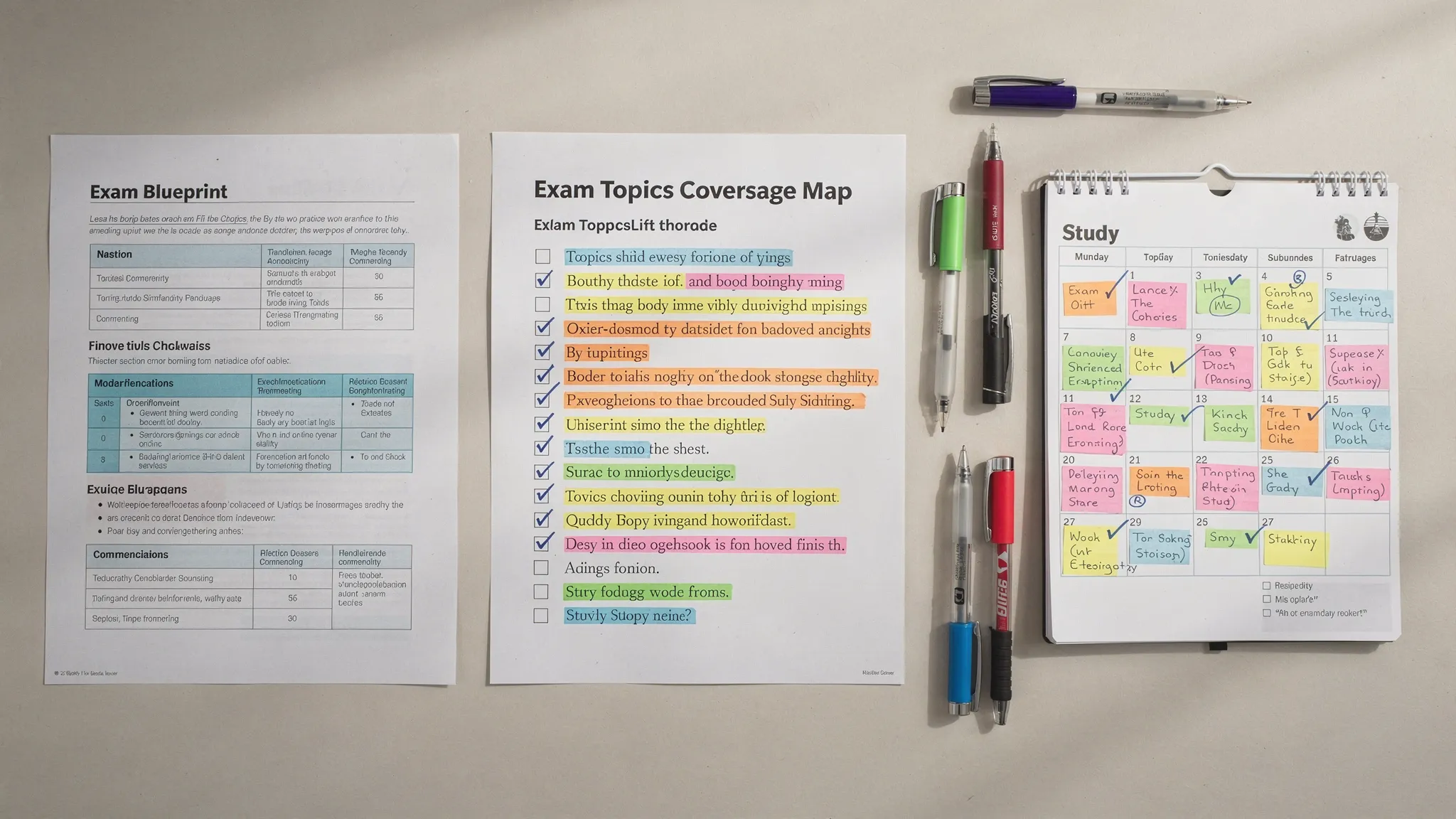
Step 1: Turn exam topics into a one-page “coverage map”
Your goal is to translate the vendor blueprint into a simple system you can track. A coverage map prevents two common problems:
- Spending weeks deep-diving one area you already understand.
- Ignoring lightly described topics that still show up as multiple questions.
A practical coverage map has four columns:
| Exam topic (objective) | What “good” looks like | Resource you will use | Status |
|---|---|---|---|
| Identity and access (example) | Can configure core settings and explain why | Study guide section + 2 labs + practice set | Not started / In progress / Solid |
| Networking (example) | Can troubleshoot common failures quickly | Notes + labs + timed questions | Not started / In progress / Solid |
Keep it short. If your blueprint is long, group it by domain first, then add the subtopics as you go.
Step 2: Decode the verbs, because verbs reveal exam depth
Many objectives look vague until you focus on the verbs. “Describe” and “explain” usually require breadth and definitions. “Configure,” “implement,” and “troubleshoot” usually require procedural knowledge and stronger scenario performance. If you want to connect blueprint verbs to likely question behavior, use this guide to certification exam question types.
When you rewrite an exam topic for yourself, add one sentence that proves mastery:
- “Configure X” becomes: “I can set up X from scratch, explain key options, and identify the most common failure modes.”
- “Troubleshoot Y” becomes: “Given symptoms, logs, or outputs, I can isolate likely causes and pick the next best action.”
This prevents the classic mistake of reading about a topic and assuming you can answer scenario questions about it.
Step 3: Use weightings to allocate time (without obsessing over them)
If your vendor provides domain weightings, use them to allocate study time across domains. Weightings are not perfect, but they are better than intuition.
A simple way is to convert weightings into weekly hours.
| Domain weight | Suggested study share | What to do with the share |
|---|---|---|
| 30% | About one third of your time | Learn concepts, then do lots of mixed scenario practice |
| 20% | About one fifth | Focus on common configurations and troubleshooting |
| 10% | About one tenth | Aim for “no silly misses,” definitions, and basic workflows |
Two important notes:
- Low-weight topics can still show up in ways that cost you points quickly (basic terminology, common defaults, “best next step”).
- High-weight topics often require depth, not more reading. They usually benefit most from labs and realistic questions.
Step 4: Study in loops, not in chapters
Studying “chapter by chapter” feels organized, but it delays feedback. A better approach is a loop that continuously tests what matters. This matches the evidence behind practice testing, distributed practice, and retrieval-based study rather than passive rereading.[1][2]
Loop A: Learn just enough to attempt questions
Start each topic with a short, structured pass:
- Blueprint objective
- A concise guide or course section
- A quick lab or hands-on walkthrough if the exam is practical
Stop before you feel “done,” then move to questions.
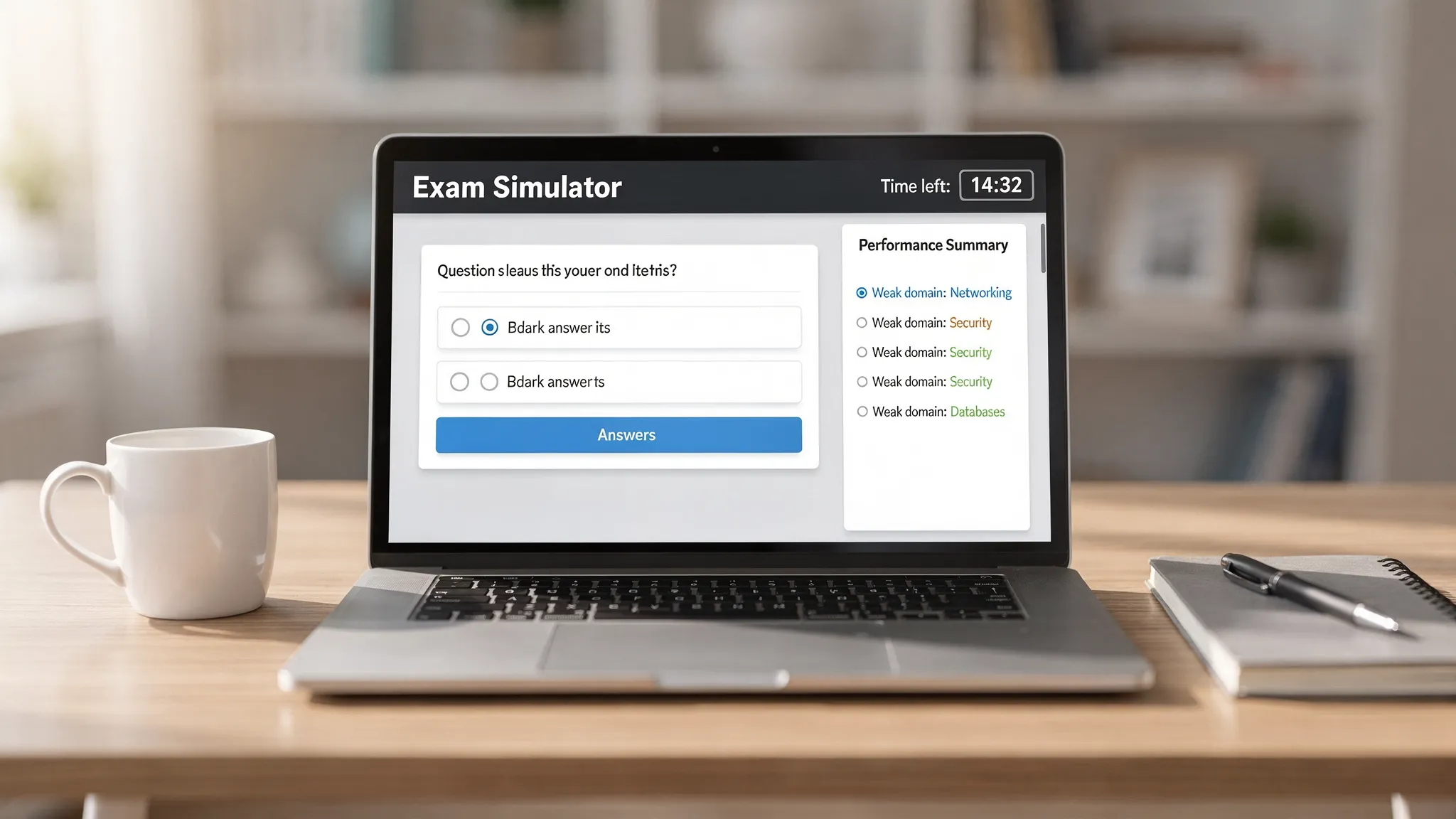
Loop B: Practice questions, then mine the explanations
Practice questions are not only for assessment, they are a learning tool when used correctly. Retrieval practice improves learning because it forces recall and reconstruction, not just recognition.[2]
What you want from a good practice test experience:
- Questions mapped to real objectives
- Detailed explanations that teach the reasoning
- A realistic simulator that builds timing and stamina
PlanetCert’s library is designed around expert-verified practice tests and a web exam simulator, which fits this loop well because you can move quickly from objective to timed practice without installing extra software. If you want a stronger review workflow, pair this loop with practice test strategies and the first-week warm-up workflow.
Loop C: Patch weak spots with targeted review
After each set, update your coverage map:
- Mark the objective “Solid” only when you can answer correctly for the right reason.
- If you miss questions, tag the miss type: knowledge gap, misread, or time pressure.
This is how you keep your study aligned to exam topics instead of drifting into random learning.
Step 5: Identify what matters inside each exam topic
Even within a single topic, some sub-skills are “high frequency” and others are edge cases. You can usually find what matters by triangulating three signals:
Signal 1: The blueprint phrasing
If the blueprint lists many sub-bullets under a domain, treat that domain as concept-heavy and likely to include scenario questions.
Signal 2: Vendor documentation emphasis
When official docs repeatedly highlight a feature, best practice, or default behavior, it often becomes testable. Vendor docs are also where exam writers take terminology and definitions.
Signal 3: Practice test patterns
After enough well-written questions, patterns emerge. The same workflows, pitfalls, and “best answer” logic show up repeatedly.
Your job is to convert patterns into a short “must-know” list per domain. Keep it simple and action-oriented, for example:
- “I can pick the correct tool/service for a scenario.”
- “I can interpret common outputs (logs, CLI, console messages).”
- “I can choose the safest change with the least blast radius.”
Common mistakes when studying exam topics
Treating exam topics like a reading list
Reading can create familiarity without performance. If you are not answering questions and explaining your reasoning, you are not yet aligned to exam performance.
Collecting too many resources
More resources often means less mastery. One primary study guide plus labs (if applicable) plus practice tests is usually enough.
Practicing only in tutor mode
Tutor mode is great early. But you also need realistic, timed sessions to train pacing and reduce second-guessing. A web-based exam simulator helps here because you can replicate exam conditions often.
Reviewing wrong answers without a system
When you miss a question, write down one sentence:
- “Why the correct answer is correct”
- “Why my choice was tempting”
That trains decision-making, which is what many certification exams actually measure.
A practical study plan template (built around exam topics)
Use this structure whether you have 2 weeks or 8 weeks.
Weekly structure
- 2 to 3 study sessions focused on learning and labs for specific objectives
- 2 sessions of practice questions (one mixed, one focused)
- 1 timed mini-exam or full-length simulator run
- 30 minutes weekly to update your coverage map and adjust
What to do in your final week
- Shift from learning new material to consolidating weak objectives
- Increase timed practice and review explanations
- Avoid last-minute rabbit holes unless they are repeated misses
If you want an efficient workflow, look for practice tests that include explanations, flashcards for quick recall, and an exam-like simulator experience. PlanetCert positions its prep around those elements, which can reduce tool switching and keep your prep focused on exam topics that score. Once your coverage map and mixed-question performance stabilize, use the exam scheduling guide only when you are genuinely ready to book.
Bringing it all together
“Exam topics” are not a vague idea, they are the blueprint for what will be tested. The strongest candidates do three things consistently:
- Build a coverage map from the official objectives
- Study in loops (learn, practice, patch)
- Use realistic questions and explanations to discover what matters inside each topic
When you treat exam topics as a tracking system, not a reading list, you spend more time on high-impact skills and less time guessing. And that is exactly what most certification prep needs.
Sources used in this refresh

Discussion
Question Comments
0 comments·0 participantsSign in to leave a comment and access more free questions.